

Quick Answer
DIY skincare for combination skin is about zone-based treatment, since combination skin is oily through the T-zone but normal to dry on the cheeks.
The smartest approach is one balanced, lightweight base routine, usually built around niacinamide, which regulates oil in the T-zone while supporting the barrier on the cheeks, plus targeted extras applied only where needed.
That means oil-control ingredients like salicylic acid on the T-zone, richer hydration like hyaluronic acid and ceramides on the cheeks, and techniques like multi-masking to serve both zones at once.
Introduction
Combination skin is the most common skin type, yet it is the worst served by skincare marketing, which tries to sell separate oily and dry ranges. The reality is that combination skin needs neither; it needs a balanced base and a little targeting.
The defining feature is a face with two personalities. An oily T-zone across the forehead, nose, and chin sits alongside cheeks that are normal or dry, so treating the whole face the same way always leaves some part unhappy.
I formulate for combination skin often, and the trick is never a single miracle product. It is a gentle, balanced routine plus the simple habit of treating different zones according to their needs.
This guide covers what combination skin is, the zone-based approach that solves it, the ingredients that work across both areas, a full routine, simple formulas, and the mistakes to avoid.
Understanding Combination Skin
Combination skin shows characteristics of both oily and dry skin on different parts of the face. The T-zone, meaning the forehead, nose, and chin, tends to be oily, while the cheeks are normal to dry.
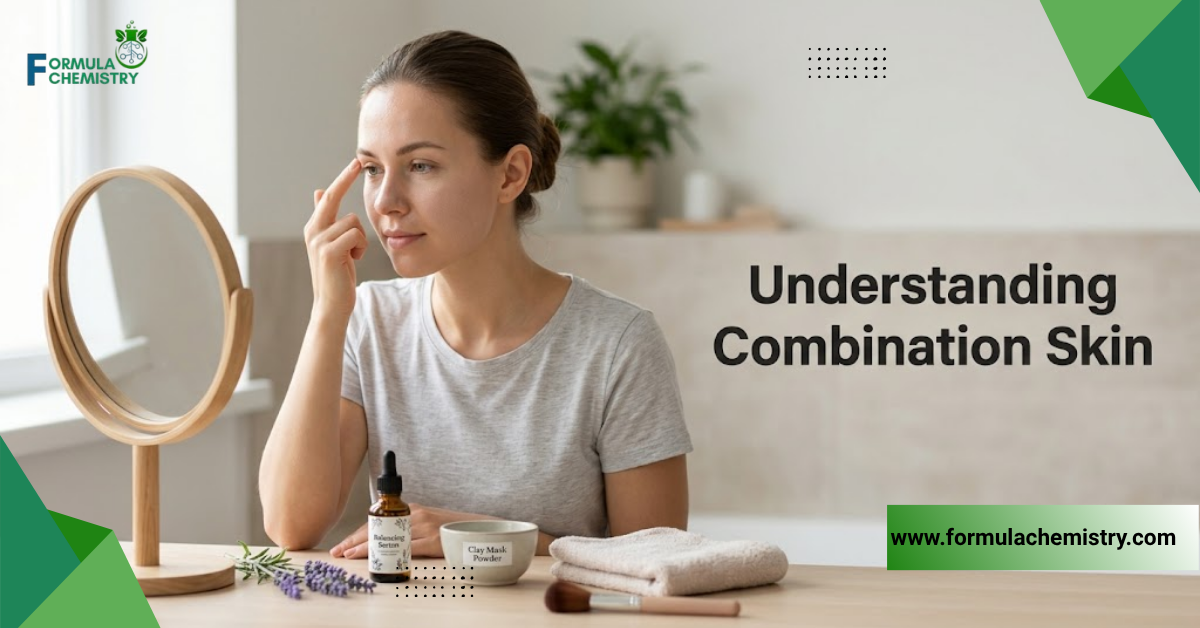
This happens because oil glands are not evenly distributed across the face. The T-zone naturally has more active sebaceous glands, so it produces more oil, while the cheeks have fewer and can run dry.
The result is a genuine balancing act. A product rich enough for dry cheeks can overwhelm an oily T-zone, and one mattifying enough for the T-zone can leave cheeks tight, which is why a one-size approach fails.
Combination skin also shifts over time and with the seasons. It often runs oilier in summer and drier in winter, and it can change with age and hormones, so the routine benefits from staying flexible.
| Ingredient | Function | Weight % | Amount (g) |
|---|
All amounts are by weight. Weigh every ingredient, including liquids, on a scale accurate to 0.01 g.
The Zone-Based Approach
The key concept in DIY skincare for combination skin is zoning, which means treating different areas of the face according to their needs rather than applying everything everywhere. This single idea solves most combination-skin frustration.
One Balanced Base, Not Two Routines
You do not need two complete routines or an entire oily range and an entire dry range. The efficient approach is one gentle, lightweight, balanced base routine used all over, with targeted extras added only where needed.
A lightweight gel-cream base suits both zones reasonably well. From there, you layer a little more oil control on the T-zone or a little more hydration on the cheeks, rather than duplicating everything.
Targeting Each Zone
The targeting is where combination skin is genuinely different. On the oily T-zone, focus on oil-regulating and pore-refining ingredients, while on the drier cheeks, focus on hydration and barrier support.
This can be as simple as applying one serum to the T-zone and another to the cheeks, a technique sometimes called multi-serum application. It sounds fussy but takes seconds, and it is what lets both zones get exactly what they need.
Ingredients That Work Across Both Zones
Some ingredients suit the whole face, while others are best reserved for a specific zone. Knowing which is which makes building a routine straightforward.
Niacinamide, the Combination Skin Hero
Niacinamide is the single most useful ingredient for combination skin, because it works across both zones at once. It helps regulate oil in the T-zone while strengthening the barrier that keeps the cheeks hydrated, used at around 5 to 10%.
This dual action is why niacinamide anchors so many combination routines. A single niacinamide serum used all over balances the whole face, often pairing well with zinc for extra oil regulation.
For the Oily T-Zone
The T-zone benefits from the same ingredients that suit oily skin. Salicylic acid, a BHA, keeps pores clear, while clay in a targeted mask absorbs excess oil, and lightweight textures stop the area feeling greasy.
These are best applied only where the oil is. Using a BHA or a clay mask on the T-zone alone avoids drying out cheeks that do not need it.
For the Dry Cheeks
The cheeks benefit from the ingredients that suit dry skin. Hyaluronic acid and glycerin draw in water, ceramides rebuild the barrier, and a slightly richer cream or a few drops of a gentle oil like squalane add the extra nourishment the cheeks want.
Reserve the richness for the cheeks. Applying a heavier cream only where it is needed keeps the T-zone from becoming greasy while the cheeks stay comfortable.
The Full Combination Skin Routine
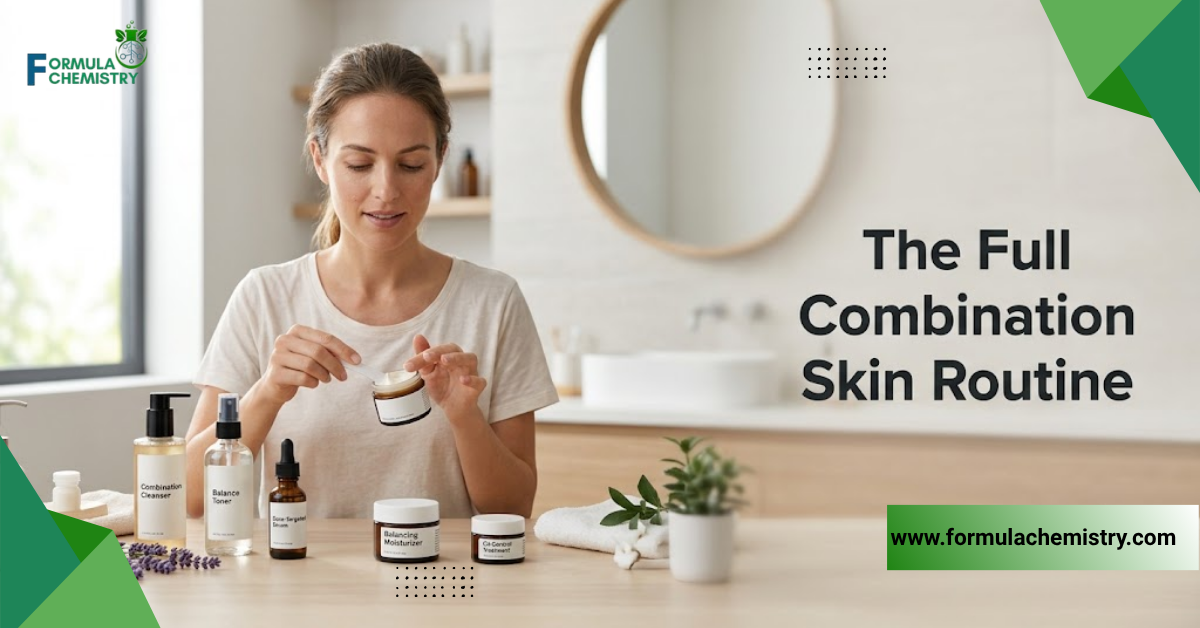
A complete DIY skincare routine for combination skin is a balanced base with zone-specific extras. It stays gentle and lightweight overall, with targeting where each zone needs it.
Morning Routine
- Gentle gel cleanser: a mild, sulfate-free cleanser that refreshes the T-zone without stripping the cheeks
- Niacinamide serum: applied all over to balance oil and support the barrier
- Lightweight gel-cream moisturiser: all over, with a little extra on the cheeks if they feel dry
- Broad-spectrum SPF 30 or higher: a lightweight, non-greasy or gel sunscreen
Evening Routine
- Gentle cleanse: the same balanced cleanser, or an oil cleanser first if wearing sunscreen or makeup
- Targeted treatment: a BHA on the T-zone a few nights a week, a gentle AHA or extra hydration on the cheeks
- Niacinamide serum: the same balancing serum all over
- Moisturiser: the gel-cream all over, with a richer layer or a few drops of oil on the cheeks only
Weekly Additions
- Multi-masking: a clay mask on the T-zone and a hydrating mask on the cheeks at the same time
- Gentle exfoliation: focused more on the T-zone, gentler on the cheeks
The routine’s logic is always the same. A balanced base keeps the whole face healthy, while small targeted steps handle the difference between the zones.
Simple DIY Formulas for Combination Skin
A few DIY skincare formulas for combination skin cover the essentials, built to suit both zones or to target one. Treat these as frameworks to adapt.
A Balancing Niacinamide Serum
An all-over serum can be built around niacinamide at 5 to 10%, optionally with zinc PCA, in a light water base with glycerin and a suitable preservative. This is the balancing product that works across the whole face.
Keep it light and fast-absorbing so it suits both zones. This single serum does much of the work in a combination routine, regulating the T-zone while supporting the cheeks.
A Lightweight Gel-Cream Moisturiser
A gel-cream can be built on a light emulsion base with hyaluronic acid, glycerin, and niacinamide, with just enough emollient to comfort the cheeks without greasing the T-zone. It is the ideal all-over base for combination skin.
This texture is the sweet spot. Light enough for the T-zone yet hydrating enough for the cheeks, a good gel-cream often removes the need for two separate moisturisers, which is a balance we aim for at Formula Chemistry when formulating for combination skin.
A Targeted Clay Mask and Hydrating Mask
For multi-masking, a simple kaolin clay mask with glycerin suits the T-zone, while a hydrating mask rich in humectants and a little emollient suits the cheeks. Applied at the same time, they treat both zones in one session.
This is combination skincare at its most efficient. One weekly ritual absorbs excess oil where it gathers and floods hydration where it is needed.
Identifying Your Zones and Adjusting Over Time
Combination skin is not identical for everyone, and mapping your own face is the first step to DIY skincare for combination skin that fits. A little observation saves a lot of trial and error.
Mapping Your Own Combination Pattern
Notice where your skin gets shiny through the day and where it feels tight. For most people, the shine gathers on the forehead, nose, and chin while tightness shows on the cheeks, but the exact pattern varies.
Some people have a very oily T-zone and only slightly dry cheeks, while others have mild oiliness and quite dry cheeks. Matching the intensity of your targeting to your actual pattern is what makes zoning work, rather than assuming a textbook combination face.
Adjusting for Season and Hormones
Combination skin shifts, so the routine should too. It often runs oilier in summer and humid weather, when the T-zone needs more oil control, and drier in winter, when the cheeks need more hydration.
Hormones and age also change the balance, and many people find their T-zone calms with age while their cheeks grow drier. Revisiting the routine as the seasons and years change keeps it matched to the skin you actually have.
Textures Matter as Much as Ingredients
For combination skin, the format of a product is nearly as important as what is in it. The right texture is what lets one product suit two different zones.
Gel and gel-cream textures are the combination-skin sweet spot we reach for at Formula Chemistry, light enough for the T-zone yet hydrating enough for the cheeks. They spread easily and absorb cleanly without leaving grease where it is not wanted.
Heavier balms and rich creams are best kept as spot treatments for the cheeks rather than all-over products. Matching texture to zone, light everywhere and rich only where needed, is a quiet skill that makes combination routines feel effortless.
The Mistakes to Avoid
A few common errors in DIY skincare for combination skin make it harder to manage. Each comes from treating the face as uniform rather than zoned.

Treating the whole face as oily is the first mistake. Stripping the cheeks along with the T-zone leaves them tight and dry, so oil control belongs on the T-zone, not everywhere.
Treating the whole face as dry is the opposite error. Applying rich creams all over leaves the T-zone greasy and congested, so richness belongs on the cheeks, not the whole face.
Skipping moisturiser is a third mistake, often made because of the oily T-zone. This dehydrates the cheeks and pushes the T-zone to produce even more oil, so a lightweight moisturiser all over is essential.
The last mistake is using harsh, high-alcohol products to control shine. These over-dry the cheeks while triggering more oil in the T-zone, giving the worst of both, so gentle and balanced always wins.
Building Your Combination Skin Routine
Think in zones rather than in a single skin type. Build one gentle, lightweight, balanced base around niacinamide, then add oil control to the T-zone and richer hydration to the cheeks only where each is needed.
Keep the whole routine light and non-greasy, reserving richness for the cheeks and oil control for the T-zone. Lean on efficient techniques like multi-masking and multi-serum application, which serve both zones without doubling your whole routine.
Above all, resist the urge to fight the whole face at once. DIY skincare for combination skin succeeds through balance and targeting, not through separate oily and dry regimens, so build a smart base, target each zone gently, patch test new formulas, and combination skin becomes far easier to keep comfortable and balanced.
Frequently Asked Questions
What is combination skin?
Combination skin shows both oily and dry characteristics on different areas of the face, typically an oily T-zone across the forehead, nose, and chin, with normal to dry cheeks. It is caused by uneven distribution of oil glands. It is the most common skin type.
How do I care for combination skin?
Use one gentle, balanced, lightweight base routine, ideally built around niacinamide, then target each zone. Apply oil-control ingredients like salicylic acid to the T-zone and hydrating ingredients like hyaluronic acid and ceramides to the cheeks. Techniques like multi-masking help serve both zones.
What is the best ingredient for combination skin?
Niacinamide is the standout because it works across both zones, regulating oil in the T-zone while strengthening the barrier on the cheeks. Used at around 5 to 10%, it balances the whole face with one product. It pairs well with zinc.
Do I need two different moisturisers for combination skin?
Not usually. A single lightweight gel-cream moisturiser works across both zones for most people. If your cheeks are much drier, layer a richer cream or a few drops of oil on them only, rather than buying two full products.
What is multi-masking?
Multi-masking means applying different masks to different areas of the face at the same time. For combination skin, a clay mask on the oily T-zone absorbs excess oil while a hydrating mask on the cheeks adds moisture. It treats both zones in one session.
Should combination skin use different serums on different areas?
You can, and it works well. Apply an oil-regulating serum like niacinamide or salicylic acid to the T-zone and a hydrating serum with hyaluronic acid to the cheeks. This is called multi-serum application, and it gives each zone what it needs.
Why does my T-zone get oily but my cheeks stay dry?
This is the definition of combination skin, caused by more active oil glands in the T-zone and fewer on the cheeks. The forehead, nose, and chin produce more sebum, while the cheeks produce less. Zone-based care addresses both at once.
Can I use facial oil on combination skin?
Yes, but reserve it for the drier cheeks rather than the T-zone. Light oils like squalane or jojoba can balance and hydrate dry areas without heaviness. Keep heavier oils off the oily T-zone to avoid congestion.
Key Takeaways
DIY skincare for combination skin works through zone-based treatment, since combination skin is oily in the T-zone and normal to dry on the cheeks. Rather than two separate routines, use one gentle, lightweight, balanced base plus targeted extras where each zone needs them.
Niacinamide is the hero ingredient because it works across both zones, regulating T-zone oil while supporting the cheek barrier. Reserve salicylic acid and clay for the oily T-zone, and hyaluronic acid, ceramides, and light oils for the dry cheeks, using techniques like multi-masking to treat both at once.
Avoid treating the whole face as either oily or dry, never skip a lightweight moisturiser, and steer clear of harsh high-alcohol products that unbalance the skin further. Build a smart base, target gently by zone, patch test new formulas, and combination skin becomes easy to keep balanced and comfortable.