

Introduction
Evaluating the efficacy of a skincare routine regimen needs a blend of patience and scientific observation. As a cosmetic formulator, I look for specific biological signals that indicate whether a product is integrating with the skin barrier or causing cellular distress.
Most consumers expect immediate results, but bodily changes, such as collagen synthesis or pigment inhibition, operate on a 28-day skin cell turnover cycle.
Formula Chemistry provides practical formulation education and safety-forward guidance to help you cross these biological timelines.
If you aren’t seeing the results you desire, it is rarely due to a “bad” product and more commonly due to ingredient incompatibility, improper pH levels, or barrier disruption. Knowing these details is the initial step toward a functional routine.
Quick Answer: Signs Your Skincare Isn’t Working
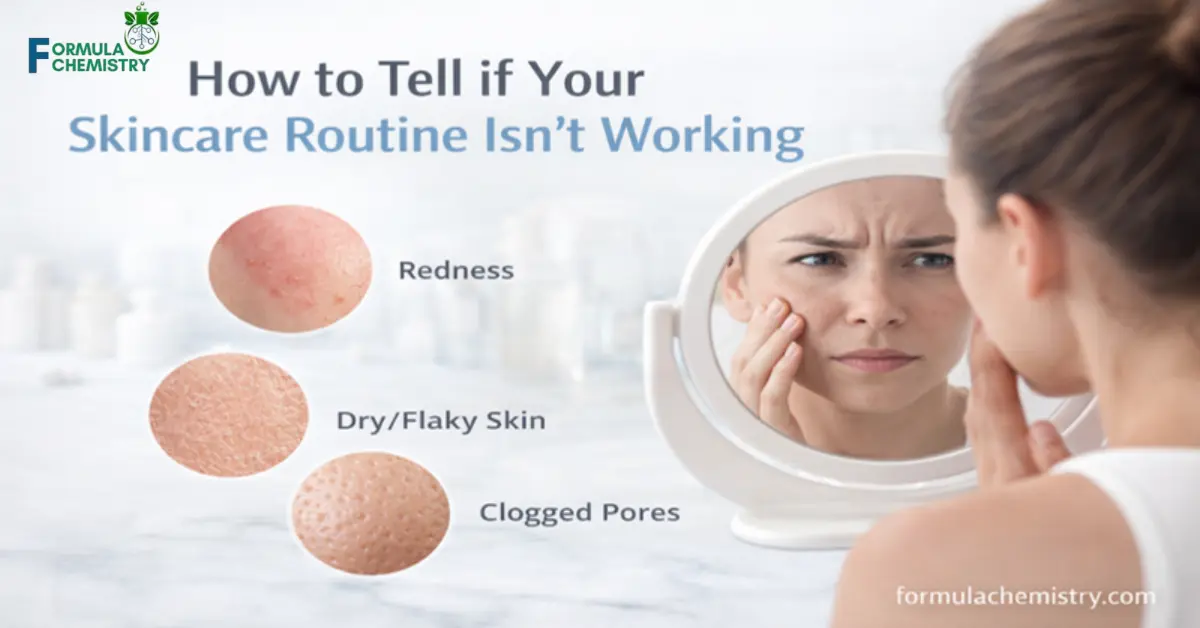
- Persistent Irritation: Redness, stinging, or itching that lasts more than 60 seconds after application.
- New Breakouts: Distinguishing between “purging” (expected with retinoids/acids) and “clogging” (reaction to comedogenic oils).
- Product Pilling: Formulas balling up on the skin, indicating poor absorption or incompatible polymers.
- Increased Oiliness: A “tight” but greasy feel frequently indicates a compromised moisture barrier.
- No Change After 12 Weeks: Lack of progress in hyperpigmentation or fine lines after three full turnover cycles.
- Texture Changes: Roughness or “orange peel” texture despite regular exfoliation.
- Sensitivity to Water: When your usual cleanser or even plain water begins to sting.

Find out the reasons behind flaking in Why Is My Skin Peeling After Using Skincare Products?
What Are the Key Indicators of an Ineffective Routine?
The primary keyword for any functional routine is equilibrium. When a routine fails, the skin usually reveals signs of “stress signaling.”
This often occurs when effective substances like L-Ascorbic Acid or Retinol are used at the wrong pH or concentration, bringing about inflammation rather than repair.
Chronic Inflammation and the “Squeaky Clean” Myth
Many users mistake a tight, “squeaky clean” feeling for purity. In cosmetic chemistry, this is a sign of lipid depletion.
High-pH surfactants (like Sodium Lauryl Sulfate) can strip the acid mantle, which should naturally sit at a pH of 4.5–5.5. If your skin feels taut after washing, your cleanser is too alkaline, which disrupts enzyme activity necessary for desquamation.
Product Pilling and Formula Incompatibility
Pilling when products roll into tiny flakes is a mechanical sign of failure. This usually happens when a water-based serum is applied over a heavy, silicone-based occlusive, or when Cross-polymers and Carbomers react poorly to high salt content in other serums.
If a product cannot penetrate the Stratum Corneum, it cannot deliver its active payload, rendering the step useless.
Common Problems and Formulation Fixes
Identifying a failure is only half the battle; the second half is adjusting the formulation or application method.
Often, the “failure” is a result of incorrect layering or using actives that cancel each other out through chelation or pH destabilization.
Managing the Purging vs. Breaking Out Dilemma
When introducing Alpha Hydroxy Acids (AHAs) or Salicylic Acid (BHA) at usage rates of 2–10%, the skin may “purge.”
This is the rapid shedding of microcomedones. However, if you see deep, cystic acne in areas where you don’t usually break out, the product is likely comedogenic for your skin type or contains irritating fragrances.
Optimizing Active Ingredient Stability
Vitamin C (L-Ascorbic Acid) is notorious for instability. If your serum has turned dark orange or brown, it has oxidized. Applying oxidized Vitamin C can actually increase oxidative stress on the skin.
Always check that your antioxidants are stored in opaque, airtight packaging and remain within the pH range of 2.5–3.5 for maximum penetration.
Common Formulation Fixes Table
| Problem | Likely Cause | Recommended Fix |
| Stinging/Burning | Compromised barrier or low pH | Pause AHAs/Retinoids; use Ceramides. |
| Excessive Oiliness | Dehydration-induced seborrhea | Switch to a humectant-rich gel cream. |
| Dullness/Grey Tint | Lack of exfoliation or oxidation | Incorporate 2% BHA or fresh Antioxidants. |
| Dry Flakes | Over-exfoliation | Reduce acid frequency to 2x per week. |
| Whiteheads | Heavy occlusives (Petrolatum) | Swap for Squalane or Caprylic Triglycerides. |
Why Your Active Ingredients Might Be Failing
Even the most expensive activities fail if the delivery system is flawed. Formulation chemistry relies on molecular weight and solubility.
If an active ingredient cannot bypass the skin’s hydrophobic barrier, it remains on the surface and provides no long-term benefit.
The Impact of pH on Ingredient Efficacy
Many consumers mix products without realizing they are neutralizing the chemistry.
For example, applying a low-pH AHA (pH 3.5) immediately followed by Niacinamide (optimal pH 6.0) can cause a “Niacin flush” (redness) and diminish the efficacy of both.
Warning: Always allow 15–20 minutes between applying products with significantly different pH levels to allow the skin’s buffering capacity to reset.
Dosage, Frequency, and the Plateau Effect
Using a 0.1% Retinol may work initially, but the skin eventually undergoes retinization and builds tolerance.
If your anti-aging results have stalled, it may be time to increase the concentration or move to a more potent retinoid like Retinaldehyde or Adapalene. However, who should avoid high concentrations? Those with Rosacea or Eczema should stick to lower, buffered dosages to avoid chronic inflammation.
Troubleshooting Your Daily Skincare Regimen
A successful routine requires consistent monitoring. If you are DIY-ing your formulations or mixing “clean” beauty products, remember that preservation is mandatory.
Any product containing water (aqua) without a broad-spectrum preservative system (like Phenoxyethanol or Ethylhexylglycerin) can contain mold and bacteria within weeks, leading to “mystery” breakouts.
When to Perform a Patch Test
Whenever you introduce a high-potency active, a patch test is essential. Apply a small amount to the inner forearm or behind the ear for 48 hours.
If no reaction occurs, proceed with facial application. This is particularly vital for products containing Essential Oils or High-strength Acids.
Knowing When to Simplify
Sometimes, the best way to make a routine “work” is to remove items. “Skincare Minimalism” or “Skin Fasting” allows the barrier to recover.
If your skin is persistently reactive, strip back to a basic cleanser, moisturizer, and SPF 50+. Once the barrier is intact (no more stinging or redness), reintroduce actives one by one, every two weeks.
FAQs about How to Tell if Your Skincare Routine Isn’t Working
How long should I wait to see results from a new product?
For hydration, results are instant. For acne, allow 4–6 weeks. For hyperpigmentation and fine lines, expect to wait 12 weeks (three skin cycles) to see measurable improvement.
Can I use Vitamin C and Retinol together?
It is generally advised to use Vitamin C in the morning (for antioxidant protection) and Retinol at night (as it is photosensitive). Using them together can increase the chance of irritation due to the acidic nature of Vitamin C.
My skin is peeling from Retinol; should I stop?
Mild peeling is common during the first 2–4 weeks. This is called “retinization.” You can minimize this by using the “sandwich method” (moisturizer-retinol-moisturizer) or decreasing frequency to every third night.
Why does my moisturizer sting even though it has no acids?
If a basic moisturizer stings, your skin barrier is likely compromised. This means the “bricks and mortar” of your skin have gaps, allowing ingredients to reach nerve endings. Focus on Ceramides and Panthenol to repair it.
Is a “tingling” sensation a sign that the product is working?
Not necessarily. While a mild tingle is common with Lactic or Glycolic acid, it is often just a sensory response. Prolonged burning or heat is a sign of an adverse reaction, and you should rinse the product off immediately.
Can I mix my SPF with my foundation?
No. Mixing SPF with other products dilutes the preservative system and the UV filters, creating “holes” in your sun protection. Always apply SPF as a dedicated, final layer.
How do I know if I’m over-exfoliating?
Signs include a shiny but dry forehead, increased sensitivity to products that used to be fine, and a raw, “waxy” appearance to the skin.
What is the best way to store my skincare?
Keep products in a cool, dark place. Bathrooms are often too humid and warm, which can compromise the preservative system and accelerate the oxidation of delicate actives like Resveratrol or Vitamin C.