
Introduction
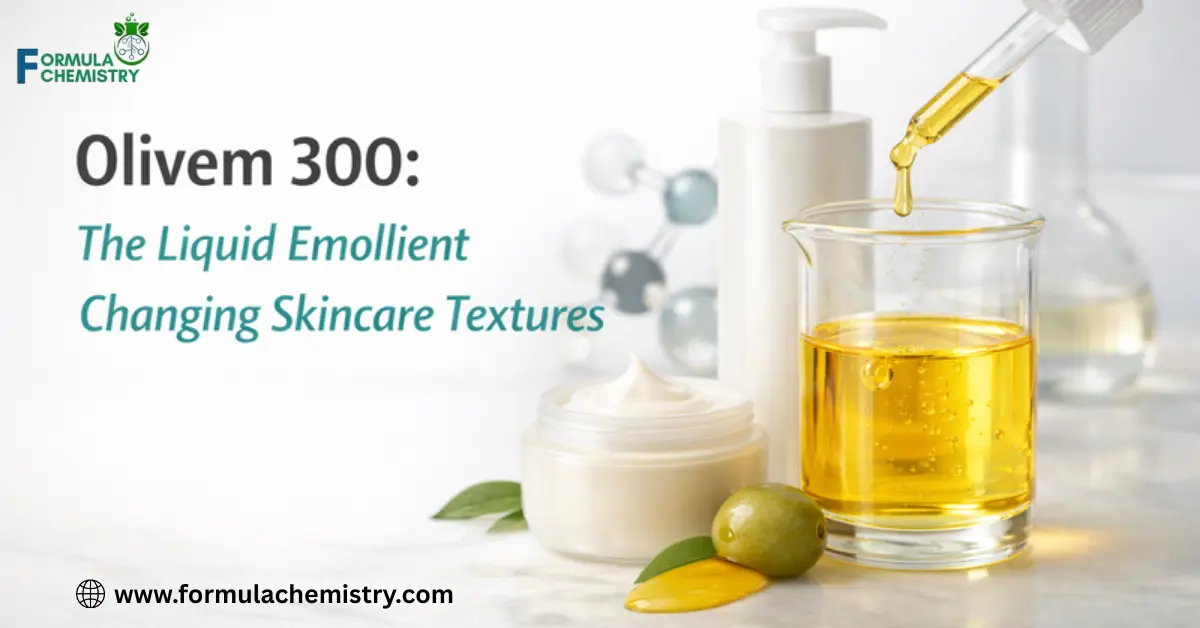
Olivem 300 is a sophisticated, water-soluble functional lipid derived from high-purity olive oil. In contrast to traditional oils that require heavy emulsification, this non-ionic surfactant and emollient provides a unique bridge between oil-rich nourishment and water-based clarity.
Formulators favor it for its ability to provide long-term moisturization and “fatting” effects without damaging the foam density or clarity of a product.
At Formula Chemistry, we provide practical formulation education and safety-forward guidance to help creators deal with complex ingredient interactions.
Understanding the chemical structure of Olivem 300 specifically its Olive Oil PEG-7 Esters composition is essential for crafting professional-grade skincare that achieves sensory elegance alongside dermatological efficacy.
Quick Answer
- Chemical Name: Olive Oil PEG-7 Esters.
- Function: Water-soluble emollient, co-emulsifier, and superfatting agent.
- Appearance: Clear, slightly yellow liquid with a mild characteristic odor.
- Usage Rate: Typically 1% to 10%, depending on the application.
- Solubility: Fully soluble in water, alcohol, and most surfactants.
- Skin Feel: Silky, non-greasy, and highly absorbent.
- Primary Benefit: Reduces irritation from harsh surfactants as it adds “slip.”
- HLB Value: Approximately 11 to 12.
- Best For: Micellar waters, transparent shampoos, and luxury body washes.
Enhance your skin’s hydration with Olivem 900: Boost Moisture and Softness Naturally.
What are the Core Benefits of Olivem 300 in Formulations?
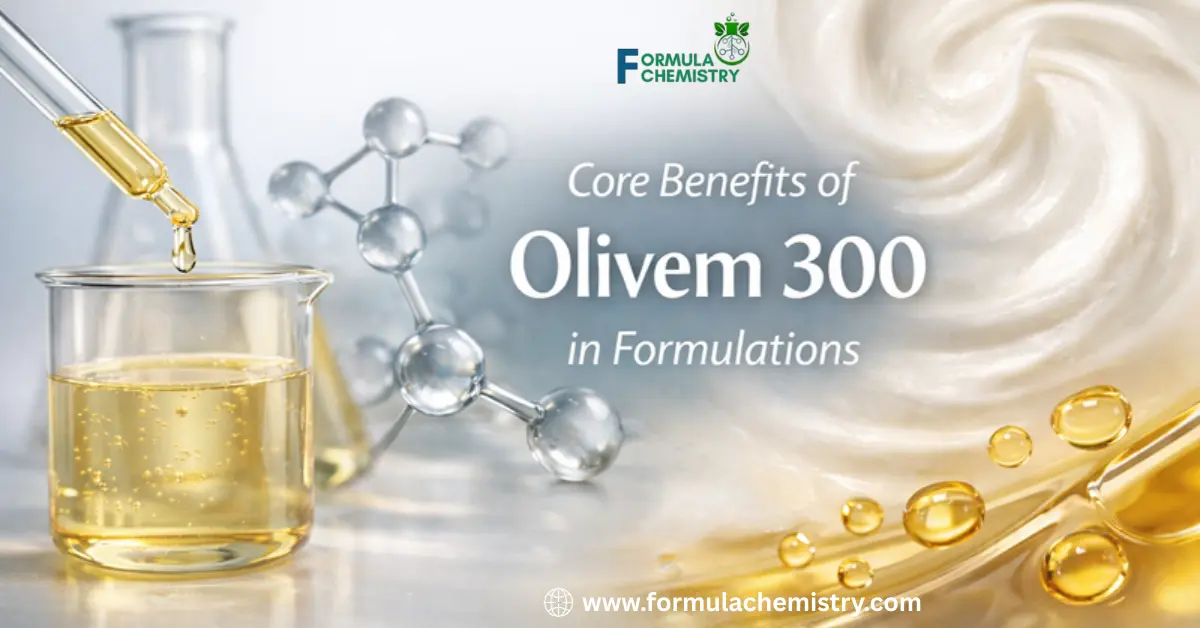
Olivem 300 stands out because it retains the fatty acid profile of olive oil while being transformed into a water-dispersible format.
This allows formulators to incorporate the skin-softening benefits of olives into aqueous systems without the need for high-shear mixing or heat. It functions as a powerful sebum-regulating agent, mimicking the skin’s natural lipid barrier to prevent Trans-Epidermal Water Loss (TEWL).
Beyond simple moisturization, it acts as a solubilizer for essential oils and fragrances. If you are struggling with a “cloudy” toner after adding fragrance, Olivem 300 can often close that gap while simultaneously improving the “after-feel” of the product on the skin.
Enhancing Surfactant Performance
In cleansing products, the addition of Olivem 300 at 2% to 5% considerably changes the profile of the foam. While many oils collapse foam, this ester assists in maintaining a creamy, dense lather.
It acts as a superfatting agent, depositing a thin, protective layer of lipids back onto the skin during the wash cycle. This is notably helpful for sensitive skin formulations where preventing the “tight” feeling after washing is a priority.
Versatility in Leave-On and Rinse-Off Products
Because it is non-comedogenic and has a low irritation profile, it is used extensively in both rinse-off products like face washes and leave-on products like soothing serums. Its high refractive index adds to a “glossy” appearance in clear gels.
In leave-on applications, it provides an immediate softening effect (emolliency) that fills the microscopic gaps between skin cells, leading to a smoother texture.
Technical Specifications and Compatibility Guidelines
Success with Olivem 300 requires knowledge of its physical and chemical constraints. It is a strong ingredient, functioning well within a broad pH range of 3 to 12, making it compatible with everything from acidic AHA exfoliants to alkaline soap bases.
It is predominantly non-ionic, meaning it can be used alongside cationic, anionic, and amphoteric surfactants without causing instability or “crashing” the emulsion.
Recommended Usage Rates and Ratios
The concentration of Olivem 300 dictates its function within the formula. At low levels, it is a texture enhancer; at higher levels, it becomes a primary emollient.
| Application Type | Recommended Usage | Key Benefit |
| Micellar Water | 0.5% – 2.0% | Gentle makeup removal & lipid replenishment |
| Shampoos/Body Wash | 3.0% – 5.0% | Reduces surfactant harshness; adds shine |
| Toners/Serums | 1.0% – 3.0% | Improves skin feel; solubilizes fragrances |
| Wet Wipes | 1.0% – 2.0% | Softens cloth feel; non-irritating to eyes |
| Bath Oils (Dispersible) | 10% – 20% | Creates “milky” bath water |
Storage and Shelf Life
To protect the integrity of Olivem 300, it should be stored in a cool, dry location away from direct sunlight. The shelf life is typically 24 months when sealed.
Because it contains no water itself, it does not require a preservative in its neat form; however, once added to a water-based formula, a broad-spectrum preservative is mandatory to prevent microbial growth.
Formulating with Olivem 300: Common Problems and Fixes
While Olivem 300 is user-friendly, beginners often face problems when combining it with high-electrolyte environments or specific thickeners. It is important to remember that while it is “water-soluble,” it is still a lipid derivative.
If your formula becomes cloudy or separates, it usually indicates an imbalance in the solubilization ratio or an interference with your primary gelling agent.
Solving Solubility and Transparency Problems
One common problem is the “blue tint” or slight haziness in micellar water. This usually happens if the fragrance load is too high for the amount of Olivem 300 used.
- The Fix: Pre-mix your fragrance or essential oil with Olivem 300 (at a 1:3 ratio) before adding it to the water phase.
- The Fix: If using carbomer-based thickeners, ensure you neutralize the carbomer after adding the Olivem to prevent clumping.
Addressing Viscosity Drops
In surfactant systems (like body wash), adding Olivem 300 may sometimes cause a “thinning” effect or a drop in viscosity.
- The Fix: Compensate by slightly increasing your salt (Sodium Chloride) intake if using an anionic system (SLeS), or add a secondary thickener like Crothix or HEC.
- Safety Note: Always perform a patch test on the final formulation, as high concentrations of any surfactant or ester can cause localized reactions in individuals with ultra-sensitive skin.
Mastering Advanced Textures and Safety Procedures
The true power of Olivem 300 resides in its capacity to transform the sensory profile of a product from “basic” to “luxury.” It provides a “cushion” during application, reducing the friction that can lead to irritation. In facial oils that are designed to be rinsed off, it facilitates the transition from an oil to a milk upon contact with water, assuring no heavy residue is left behind.
Synergistic Ingredient Pairings
Olivem 300 works exceptionally well when paired with Propanediol 1,3 or Glycerin, as these humectants draw moisture into the skin while the Olivem seals it in.
For hair care, pairing it with Pro-Vitamin B5 (Panthenol) results in a formula that improves combability and shine without the buildup associated with silicones. It is an excellent “clean beauty” alternative to synthetic emollients.
Safety and Who Should Avoid It
While generally regarded as safe (GRAS), individuals with a known allergy to olives should exercise caution.
- Who should avoid: Those with fungal acne (Malassezia Folliculitis) may find that the fatty acid chain lengths in olive derivatives can potentially trigger flare-ups.
- Irritation Cautions: While it reduces the irritation of other surfactants, using it at concentrations above 15% in leave-on products may feel heavy or tacky on certain skin types.
- Preservation Reminder: Always include a preservative like Phenoxyethanol or Ethylhexylglycerin in any aqueous solution containing this ingredient.
FAQ about Olivem 300: The Liquid Emollient Changing Skincare Textures
Is Olivem 300 a natural ingredient?
It is naturally derived from olive oil but undergoes a synthetic process (ethoxylation) to become water-soluble. It is often accepted in “naturally inspired” branding, but may not meet strict “100% organic” certifications depending on the standard used.
Can I use Olivem 300 as a primary emulsifier?
No, Olivem 300 is a co-emulsifier or emollient. It cannot hold together a traditional oil-in-water cream on its own; you would need a primary emulsifier like Olivem 1000 or Glyceryl Stearate.
Does Olivem 300 clog pores?
It is considered non-comedogenic. Its water-soluble nature permits it to be easily washed away or absorbed without leaving a thick, occlusive film that typical oils might.
What is the difference between Olivem 300 and Olivem 1000?
Olivem 300 is a liquid, water-soluble emollient used for clearness and feel. Olivem 1000 is a waxy solid used as a primary emulsifier to create thick lotions and creams.
Can I use it in anhydrous (waterless) balms?
Yes, it can be added to anhydrous balms to improve the “rinse-off” capability, turning the balm into a milk when the user washes their face with water.
Is it safe for use around the eyes?
Yes, Olivem 300 is known for its low ocular irritation, which is why it is a staple ingredient in high-end eye makeup removers and micellar waters.
Will it affect the pH of my final product?
Olivem 300 is relatively pH-neutral. It will not significantly shift the pH of your formula, but you should always check and adjust your final product to the skin-friendly range of pH 4.5–5.5.
Can I replace Polysorbate 20 with Olivem 300?
In many cases, yes. If you are using Polysorbate 20 to solubilize a small amount of oil or fragrance, Olivem 300 can often perform the same task while providing a much better skin feel.