
Introduction
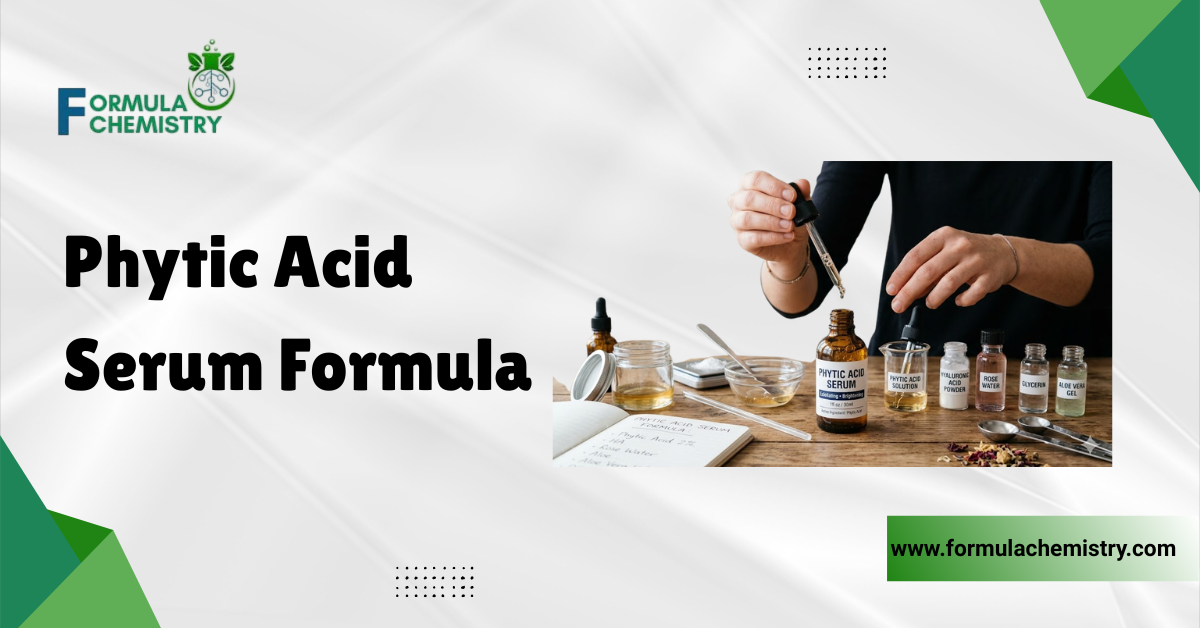
Most brightening formulas fail not because of the wrong ingredient but because of the wrong architecture. A phytic acid serum formula punishes sloppy phase order, incorrect pH, and poor thickener selection faster than almost any other serum type.
Get those three things right and you have a stable, effective brightening serum. This guide gives you everything to do exactly that, from the complete formula table to a bench-ready method with nothing left out.
What Is Phytic Acid?
Phytic acid (INCI: Phytic Acid, CAS 83-86-3) is a naturally occurring polyol phosphate derived most commonly from rice bran or corn. It is not an AHA or a BHA by chemical classification. It belongs to the polyol phosphate family, sometimes grouped loosely with polyhydroxy acids due to its mild keratolytic behaviour.
Its six phosphate groups give it strong chelating activity against divalent and trivalent metal ions, particularly iron and copper. That chelation is the foundation of its brightening function in skin care.
Bottom Line for phytic acid
A phytic acid serum formula is a water-based leave-on treatment that works through three mechanisms: chelation of copper ions that activate tyrosinase, mild exfoliation at low pH, and suppression of new melanin formation over time.
The formula in this guide delivers 2% active phytic acid at pH 3.5 to 4.0, paired with niacinamide and skin-conditioning support ingredients. It is suitable for intermediate formulators and can be completed in a single bench session.
Why This Phytic Acid Serum Formula Works
The Brightening Science Behind the Formula
By binding copper ions, phytic acid can inhibit tyrosinase at the point where it converts tyrosine into melanin precursors. This may help support a more even skin tone with consistent use by reducing the rate at which new pigmentation forms.
At pH 3.5 to 4.0, phytic acid also exerts a mild keratolytic effect on the skin surface. This contributes to improved surface texture alongside the tone-evening activity.
Why Niacinamide Belongs in This Formula
Niacinamide at 4% targets a completely different step in the pigmentation process. It inhibits melanosome transfer from melanocytes to keratinocytes, which is the step where pigment moves into the skin’s visible surface cells.
These two actives work on different biological pathways. That is a formulation decision grounded in chemistry, not ingredient stacking for marketing purposes.
Ingredient Breakdown of phytic acid by Phase
Phase A: Water Phase Ingredients
Aqua (Distilled Water) forms the continuous phase. It carries all water-soluble actives and accounts for the largest portion of the formula by weight, which is standard in water-based serums.
Glycerin functions as a primary humectant at 5%. It draws moisture to the skin surface and contributes to a non-tacky, comfortable skin feel in the finished serum.
Niacinamide is vitamin B3 in its amide form. At 4%, it sits within the studied range for melanosome transfer inhibition and dissolves fully in heated water without any compatibility issues at this phase.
Sodium PCA is the sodium salt of pyrrolidone carboxylic acid, a component of the skin’s own natural moisturising factor (NMF). At 2%, it reinforces the hydration profile and contributes to a lightweight skin feel.
Panthenol (Pro-Vitamin B5) converts to pantothenic acid on skin contact. At 1%, it supports barrier function and improves the slip and spreadability of the finished serum.
Hydroxyethylcellulose (HEC) is the rheology modifier. It builds a clean, non-greasy gel texture and remains fully stable at the low pH this formula requires.
Carbomers and acrylate-based thickeners lose viscosity dramatically below pH 5.0, which makes HEC the only correct choice here. At 0.5%, it delivers a lightweight gel body without any stringiness on application.
Phase B: Cool Down Phase Ingredients
Phytic Acid (50% aqueous solution) is added at cool down to avoid heat degradation. Using 4% of the 50% solution delivers 2% active phytic acid in the finished formula. Always confirm your supplier’s concentration specification before calculating your inclusion rate.
Allantoin at 0.2% is a skin-conditioning agent with a well-established safety record. In an acid formula, it contributes to barrier tolerance and helps the skin adjust to the low-pH environment without discomfort.
Butylene Glycol (1,3-Butylene Glycol) at 3% adds secondary humectancy and improves the solubility of other cool-down phase components. It also contributes mild antimicrobial support to the preservation system.
Sodium Gluconate at 0.5% acts as a chelating preservative booster. It binds trace metal ions that would otherwise compromise the preservative system or drive oxidative instability in the formula.
Phenoxyethanol (and) Ethylhexylglycerin at 1% is the primary preservation system. It provides broad-spectrum antimicrobial coverage against bacteria, yeast, and mould and is fully stable at the pH range of this formula.
Sodium Hydroxide (10% aqueous solution) is used only for pH adjustment. Phytic acid drops the formula pH sharply on addition. The 10% NaOH solution allows precise, controlled correction to target pH without overshooting.
Complete Phytic Acid Serum Formula Table
Batch size note: Multiply each percentage directly by your batch weight in grams. For a 100g batch, 78.30% equals 78.30g.
| Phase | INCI Name | Common Name | % Weight |
| A | Aqua | Distilled Water | 78.30% |
| A | Glycerin | Glycerin | 5.00% |
| A | Niacinamide | Vitamin B3 | 4.00% |
| A | Sodium PCA | Sodium PCA | 2.00% |
| A | Panthenol | Pro-Vitamin B5 | 1.00% |
| A | Hydroxyethylcellulose | HEC (Natrosol 250 HHR) | 0.50% |
| B | Phytic Acid (50% aq. sol.) | Phytic Acid Solution | 4.00% |
| B | Allantoin | Allantoin | 0.20% |
| B | Butylene Glycol | 1,3-Butylene Glycol | 3.00% |
| B | Sodium Gluconate | Sodium Gluconate | 0.50% |
| B | Phenoxyethanol (and) Ethylhexylglycerin | Preservative Blend | 1.00% |
| B | Sodium Hydroxide (10% aq. sol.) | NaOH Solution | 0.50% |
| Total | 100.00% |
Step-by-Step Method for phytic acid formula
Step 1: Sanitise and Set Up
Wipe all equipment, beakers, and stirring tools with 70% isopropyl alcohol and allow to air dry. Weigh distilled water into a clean, heat-resistant glass beaker. Place on a magnetic stirring hotplate and set stirring to medium (300 to 400 rpm) before adding anything.
Step 2: Disperse the HEC into Cold Water
With stirring active at room temperature (20°C to 22°C), add hydroxyethylcellulose in a thin, steady stream onto the surface of the water. Add it slowly over 2 to 3 minutes. Allow 5 more minutes of stirring before applying heat.
Dumping HEC in all at once causes clumping that high-shear mixing cannot always fully reverse.
Step 3: Heat Phase A and Add Humectants
Begin heating Phase A to 75°C with continuous stirring. While temperature rises, add glycerin, sodium PCA, and panthenol directly to the beaker. All three are water-soluble and fully stable at this temperature.
Step 4: Dissolve Niacinamide
Once Phase A reaches 70°C to 75°C, add niacinamide powder. Stir for 3 to 5 minutes until fully dissolved and the solution is clear. Hold the entire Phase A at 75°C for 10 minutes minimum to ensure the HEC gel network hydrates completely.
Step 5: Cool Phase A Under Continuous Stirring
Remove the beaker from heat. Keep stirring at medium speed throughout cool down. Monitor temperature with a calibrated thermometer.
Do not use an ice bath, as rapid cooling can disrupt the HEC gel structure and create uneven viscosity in the finished serum.
Step 6: Add Phytic Acid at 40°C or Below
When the batch temperature reads 40°C or below, add the phytic acid 50% solution slowly with stirring. The formula acidifies noticeably at this point, which is expected. Stir continuously for 2 full minutes after the complete addition before moving to the next step.
Step 7: Add Remaining Cool Down Ingredients One at a Time
Add allantoin, butylene glycol, and sodium gluconate one at a time in that order. After each addition, stir for 1 to 2 minutes before adding the next. Do not add them together in a single pour.
Step 8: Add the Preservative
Add phenoxyethanol and ethylhexylglycerin to the batch. Stir at medium speed for 3 full minutes. The preservative needs to distribute evenly through the entire gel matrix before pH adjustment begins.
Step 9: Adjust pH to Target Range
Take a pH reading with a calibrated pH meter. The formula will typically read between pH 2.8 and 3.2 at this point. Add your 10% sodium hydroxide solution in small increments of 0.1 to 0.2g at a time.
Stir for 30 seconds after each addition, then recheck pH before adding more. Target range is pH 3.5 to 4.0. Do not overshoot.
Step 10: Rest, Recheck, and Package
Allow the formula to rest for 15 minutes undisturbed, then take a final pH reading. Phytic acid formulas can drift slightly after initial adjustment, and this rest period catches that drift. Make any final pH corrections needed, then transfer to clean, sanitised packaging and label with batch date and pH.
Technical Formulation Notes for phytic acid
pH of the Finished Phytic Acid Serum Formula
The target pH range is 3.5 to 4.0 for daily leave-on use. Below pH 3.5, this formula from formula chemistry moves toward peel territory and can cause barrier disruption with repeated use.
Above pH 4.5, phytic acid’s chelating and mild exfoliant activity begins to reduce meaningfully. The pH range is where the formula works, not a preference.
Preservation System Rationale
This formula uses three layers working together: the inherent antimicrobial challenge of low pH, the phenoxyethanol and ethylhexylglycerin blend at 1%, and sodium gluconate as a chelation-based preservative booster.
Low pH alone is not sufficient preservation for a water-rich cosmetic. All three layers are needed and none replaces the others.
Stability Considerations
Niacinamide is stable at pH 3.5 to 4.0 for a standard 12-month product lifespan when stored below 30°C and away from direct light. If pH drifts above pH 5.0 in storage, niacinamide can convert to nicotinic acid, which may cause flushing on application.
Seal packaging well and conduct a 3-month accelerated stability study at 40°C and 75% relative humidity before any commercial release.
Substitutions and Alternatives
HEC can be replaced with xanthan gum at 0.3 to 0.5%, though xanthan produces a more stringy texture that many users find unpleasant in a leave-on serum. Carbomers are not suitable substitutes without restructuring the formula entirely due to their pH sensitivity.
Sodium gluconate can be replaced with sodium phytate at the same usage level, which also reinforces the chelating character of the formula.
Scale-Up Notes
This formula scales linearly with no additional corrections needed for ingredient ratios. At pilot scale of 5kg and above, use a propeller or planetary mixer instead of a magnetic stirrer.
High-shear homogenisation is not required and can break the HEC gel if applied aggressively. Add sodium hydroxide solution more slowly at larger batch sizes, as greater thermal mass slows pH re-equilibration between additions.
Common Mistakes with Phytic Acid Serum Formulas
- Adding phytic acid above 40°C. The acid degrades at elevated temperatures and can disrupt the HEC gel structure. Always confirm temperature on your thermometer before beginning Phase B additions.
- Dumping HEC into hot water without pre-dispersion in cold. This creates dry clumps that are nearly impossible to resolve without high-shear equipment. Always disperse HEC into cold, stirring water first.
- Allowing pH to fall below 3.5 in the finished product. This turns a daily leave-on serum into a peel-strength product. Always bring pH to target range before packaging and recheck after the resting period.
- Miscalculating active phytic acid percentage. Using 4% of a 50% solution gives 2% active. Using the same percentage of a 70% solution gives 2.8% active. Always read your raw material specification sheet before calculating.
- Adding niacinamide in the cool-down phase. Niacinamide dissolves best in heated water. Added to a thickened gel base at cool down, it may not dissolve fully and can leave visible particles in the finished serum.
- Using a preservative system not validated at low pH. Some preservatives lose efficacy below pH 5.0. Always confirm your chosen system’s effective pH range with the supplier before committing to it in an acid formula.
Variations and Customisation
- Thicker serum texture: Increase HEC to 0.8% and reduce water by 0.3% to maintain 100% total. Do not exceed 1% HEC in this formula type as the texture becomes unpleasantly stringy on application.
- Alpha-arbutin addition: Add alpha-arbutin at 1 to 2% to Phase A for a third pigmentation pathway. It is water-soluble, stable at this pH, and works through a different mechanism than both phytic acid and niacinamide. Reduce water by the same percentage added.
- Vitamin C addition: L-ascorbic acid can be added to Phase B at cool down at 5 to 10%. It is stable at pH 3.5 to 4.0 and is compatible with phytic acid in this range. Adding vitamin C significantly increases oxidative instability risk and reduces expected shelf life to 3 to 4 months without antioxidant support such as tocopherol or ferulic acid.
- Fragrance or essential oils: Use a solubiliser such as Polysorbate 20 at a 3:1 to 4:1 ratio relative to the essential oil. Add to Phase B at cool down. Keep total fragrance below 0.5% in any leave-on acid formula to avoid sensitisation risk.
- Sensitive skin modification: Reduce phytic acid to 2% of the 50% solution (1% active) and increase allantoin to 0.5%. This produces a gentler daily-use version appropriate for reactive or redness-prone skin types.
Suitability Guide for phytic acid
Who This Formula Is Best Suited For
This phytic acid serum formula performs best on oily, combination, and normal skin types managing uneven tone, post-inflammatory hyperpigmentation, or dull surface texture. It is also appropriate for use on melanin-rich skin, with a cautious introduction period.
Who Should Proceed Carefully
Dry skin and compromised barrier skin types can find the acid pH uncomfortable with daily use. Begin with every-other-day application on these skin types and assess tolerance over two weeks before moving to daily use.
This formula is suited to intermediate or advanced formulators who are confident with pH measurement, hot process technique, and basic preservation testing.
Beginners making their first leave-on acid product should build those skills before working at this pH range. Always conduct a 48-hour patch test with any new formula before wider use.
| Ingredient | Function | Weight % | Amount (ml/g) |
|---|
Frequently Asked Questions about phytic acid
What Does Phytic Acid Do for Skin in a Serum?
Phytic acid for skin works through chelation, mild exfoliation, and tyrosinase inhibition. In a serum format, the leave-on contact time is long enough for all three mechanisms to operate. It may help support more even-looking skin tone and smoother surface texture with consistent use over several weeks.
Is Phytic Acid an AHA or BHA?
Phytic acid is neither. By chemical structure, it is a polyol phosphate, not a hydroxy acid of any kind. It is sometimes informally grouped with polyhydroxy acids due to its mild keratolytic behaviour at low pH, but that is a functional comparison, not a chemical classification.
Why Is Phytic Acid Considered Potentially Irritating?
Phytic acid is considered an irritation risk primarily when used at pH values below 3.0 or at concentrations above 3% active in leave-on products.
At pH 3.5 to 4.0 and 2% active, as formulated here, the risk profile is comparable to other mild acid actives used daily. The irritation question is more about formulation decisions than the ingredient itself.
Can Phytic Acid and Vitamin C Be Used Together?
Yes. Phytic acid and L-ascorbic acid are chemically compatible at pH 3.0 to 4.0, which happens to be the stability range both actives require.
The combination is technically sound but increases sensitivity to oxidation and light exposure. Any formula combining the two should include antioxidant support and carry a shorter expected shelf life.
Does Phytic Acid Cause Acne?
Phytic acid is not comedogenic and does not directly cause acne. Its chelating and mild exfoliant properties may contribute to clearer-looking skin over time by reducing surface congestion.
A temporary skin response is possible with any new active ingredient introduced to a sensitised or compromised barrier, which is why patch testing before full-face application is always the right first step
Formulator’s Summary about phytic acid
- Phytic acid works through three distinct mechanisms: metal ion chelation, tyrosinase inhibition, and mild keratolytic activity at low pH. Knowing all three is what allows you to choose the right co-actives and set the right expectations for what the formula delivers.
- pH 3.5 to 4.0 is the working range for every reason simultaneously: phytic acid activity, niacinamide stability, and preservative efficacy all align here.
- HEC is not a default choice in this formula. It is the correct choice because it is the only common rheology modifier that remains stable below pH 5.0 without complex neutralisation workarounds.
- Niacinamide and phytic acid address pigmentation through different biological pathways. That makes this formula more effective than one built around either active alone.
- Preservation in this formula uses three overlapping layers. Removing any one of them creates a gap, not a simplification.
- Make your first batch at 100g, confirm pH, texture, and visual stability at 40°C for four weeks, then scale with confidence. Every modification you make from a stable base is a decision, not a guess.