

By Dr. SamiUllah, PhD Lead Formulator, Formula Chemistry
Quick Answer
A deodorant with coconut oil holds its shape when 42.5% Cocos Nucifera (Coconut) Oil is structured with 11% candelilla wax and 14% shea butter, because coconut oil alone melts at 24 to 26°C.
Odor control comes from 8% Magnesium Hydroxide (CAS 1309-42-8) and 2% zinc ricinoleate, which avoid the pH 8.3 alkalinity of sodium bicarbonate. Add the powders at 65°C, the fragrance at 50°C, and pour at 45 to 50°C.
Why Do Homemade Coconut Oil Deodorants Melt, Sweat, or Sting?
Most homemade recipes start with coconut oil, and most complaints trace back to it. Sticks slump in warm rooms, leave oil on shirts, or sting after the first week.
A deodorant with coconut oil performs well when the oil is structured with wax and paired with a low-alkalinity odor neutralizer. Those two decisions separate a reliable stick from a rash.
I treat coconut oil as a carrier with a narrow melting window, not as an active. Its job is glide and delivery, while the wax, powders, and odor neutralizers do the work.
This guide gives you a complete 100 g stick formula, a temperature-controlled method, and adjustments for heat and sensitive skin. Formula Chemistry covers the broader process in its guide to do it yourself deodorant, and this page focuses on the coconut oil base.
Everything here is anhydrous, meaning it contains no water. That removes the need for a preservative and keeps the stick stable on the shelf.
What Does Coconut Oil Actually Do in a Deodorant Stick?
Coconut oil supplies glide, skin feel, and a fatty carrier that keeps the powders suspended. It is a triglyceride blend, and its fatty acid profile explains both its strengths and its weaknesses.
What Is the Composition and Melting Behavior of Coconut Oil?
Cocos Nucifera (Coconut) Oil (CAS 8001-31-8) is roughly 45 to 52% lauric acid and 16 to 21% myristic acid. Those short, saturated chains give it a low iodine value of 6 to 11 and a sharp melting range of 24 to 26°C.
Underarm skin sits around 33 to 35°C, so the oil turns fully liquid on contact. That is why it glides so easily, and why an unstructured coconut oil paste never stays solid in summer.
| Property | Value |
| INCI name | Cocos Nucifera (Coconut) Oil |
| CAS number | 8001-31-8 |
| Chemical class | Triglyceride (medium and long chain saturated) |
| Main fatty acids | Lauric 45 to 52%, myristic 16 to 21% |
| Average molecular weight | About 660 g/mol |
| Melting range | 24 to 26°C |
| Iodine value | 6 to 11 |
| Solubility | Insoluble in water, soluble in nonpolar oils |
| Typical use level in sticks | 30 to 50% |
| Formulator difficulty | Beginner |
Does Lauric Acid Help With Odor?
In laboratory studies, lauric acid shows activity against some Gram-positive bacteria, which is one reason coconut oil is so popular in deodorant recipes. Whether that effect carries over to the underarm in a finished stick has not been established.
I treat it as a possible bonus and not as the odor control system. The magnesium hydroxide and zinc ricinoleate handle odor in this formula, while the coconut oil may help support smooth, low-drag application.
| Ingredient | Function | Weight % | Amount (g) |
|---|
All amounts are by weight. Weigh every ingredient on a scale accurate to 0.01 g. This anhydrous deodorant stick helps manage odor but does not prevent sweating. Keep water out of the product, use dry equipment, and patch test before use. Discontinue if irritation develops.
Which Type of Coconut Oil Should You Use?
Refined coconut oil is my default for sticks because it has no scent to compete with the essential oil. Virgin coconut oil works if you accept a coconut aroma and slightly more color.
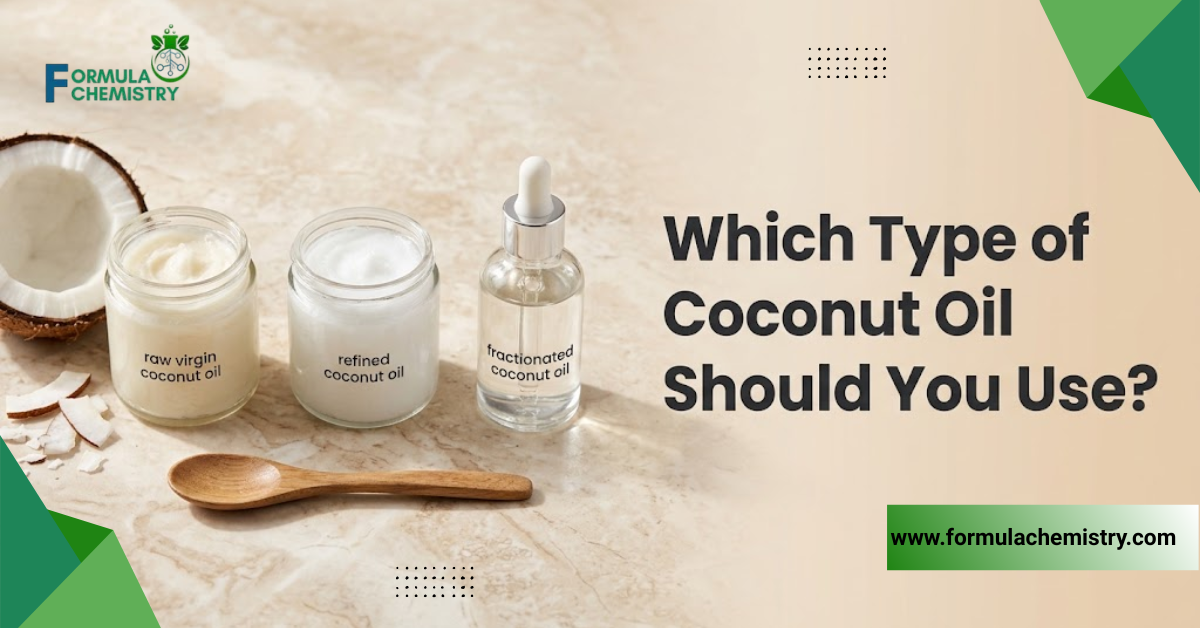
| Type | INCI Name | Scent | State at 20°C | Best Use |
| Refined coconut oil | Cocos Nucifera (Coconut) Oil | Neutral | Solid | Base of the stick |
| Virgin coconut oil | Cocos Nucifera (Coconut) Oil | Distinct coconut | Solid | Scented sticks and balms |
| Fractionated coconut oil | Caprylic/Capric Triglyceride | Neutral | Liquid | Dry-feel emollient |
Caprylic/Capric Triglyceride (CAS 65381-09-1) stays liquid because the long chain lauric fraction has been removed. The dry, light feel of fractionated coconut oil softens the waxy drag of a stick, and I use it at 5% here.
Is a Coconut Oil Deodorant the Same as an Antiperspirant?
No. A deodorant manages odor and absorbs some moisture, but it does not reduce sweat flow. Aluminum salts do that job in antiperspirants, which are regulated as over-the-counter drugs in the United States. Our guide to homemade antiperspirant explains that separate route.
Which Other Ingredients Does the Stick Need?
Beyond coconut oil, the stick needs a wax for structure, a butter for body, a powder for absorption, and an odor neutralizer. Each group solves one physical problem, and removing any of them shows up quickly in the finished product.
Wax and Butter: The Structure
Euphorbia Cerifera (Candelilla) Wax (CAS 8006-44-8) melts between 68 and 73°C and provides the hardness. At 11% it holds a coconut-heavy stick together under normal room conditions.
Butyrospermum Parkii (Shea) Butter (CAS 91080-23-8) melts between 32 and 45°C and adds body without stiffness. Readers who want the full profile can read about shea butter, which I use here because it raises the melting range of the whole base.
Powders: Absorber and Odor Binder
Maranta Arundinacea Root Powder (arrowroot) absorbs moisture and gives a dry, silky finish at 10 to 20%. It is safe here only because the base is anhydrous, since starch supports microbial growth once water is present.
Zinc Ricinoleate (CAS 13040-19-2, MW 660.3 g/mol) binds sulfur and nitrogen containing odor molecules at 1 to 3%. It complements magnesium hydroxide, which works mainly on acidic odor molecules.
Antioxidant and Fragrance
Tocopherol (CAS 59-02-9) at 0.2 to 0.5% slows oxidation in the shea butter and essential oil. Coconut oil resists rancidity well on its own, but the other lipid components do not.
Lavandula Angustifolia (Lavender) Oil (CAS 8000-28-0) gives a clean scent at 0.5 to 1.0%. Linalool in the oil must be declared on EU labels above 0.001% in leave-on products, and sourcing lavender essential oil from a supplier with batch data keeps the scent consistent.
Which Odor Neutralizer Suits a Deodorant with Coconut Oil?
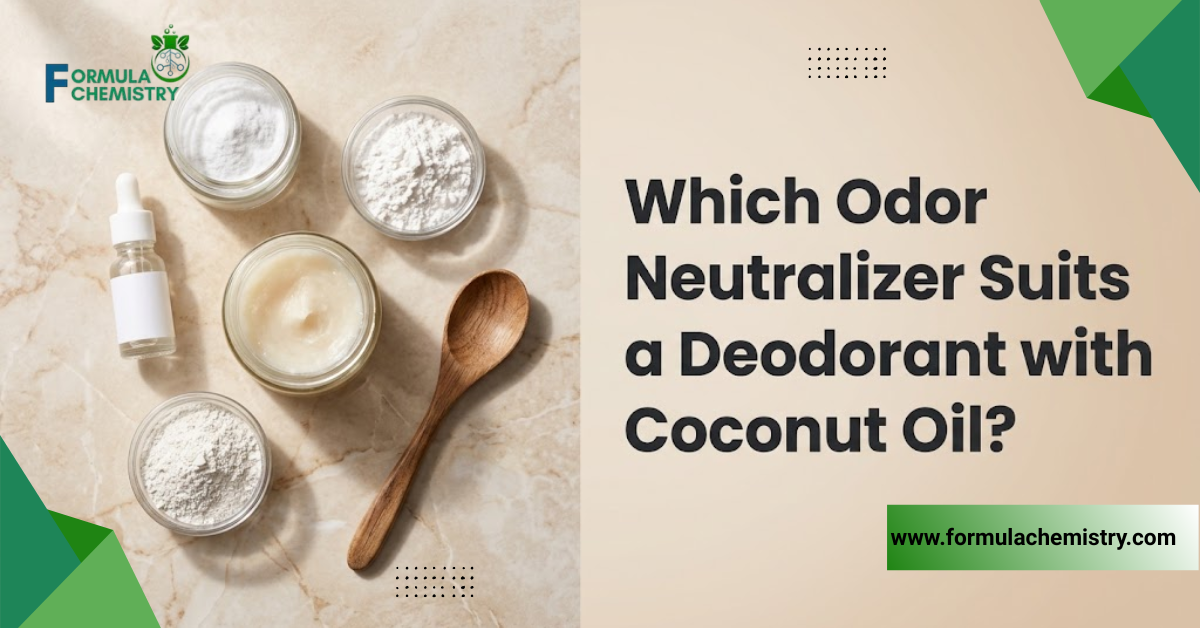
Magnesium hydroxide at 8%, paired with 2% zinc ricinoleate, is the neutralizer system I recommend for a coconut oil stick. Together they cover acidic and sulfur odor molecules with little free alkalinity.
Why Does Magnesium Hydroxide Work Here?
Magnesium Hydroxide (CAS 1309-42-8, MW 58.32 g/mol) dissolves only to about 10 mg per liter, so it acts as a fine, low-abrasion solid at the skin surface. It neutralizes acidic odor molecules without the free alkalinity that irritates freshly shaved skin.
Coconut oil suits it well, since the fat carries fine powders evenly and glides them over skin. Add the powder at 65°C with the other solids, because it has no heat sensitivity.
Where Does Baking Soda Fit?
Sodium bicarbonate reads about pH 8.3, against skin at pH 4.7 to 5.5, and it works faster than magnesium hydroxide. It also irritates more often, and it needs its own particle size and temperature rules.
Our coconut-free baking soda stick covers strengths, sifting, and swaps in full. Formula Chemistry keeps that detail on one page so this one can stay focused on the coconut base.
The Complete Formula: A 100 g Coconut Oil Deodorant Stick
This stick totals exactly 100.00% and contains no water and no baking soda. Prepare phases A, B, and C as separate weighings.
| Phase | INCI Name | Common Name | Percentage |
| A | Cocos Nucifera (Coconut) Oil | Refined coconut oil | 42.50% |
| A | Butyrospermum Parkii (Shea) Butter | Shea butter | 14.00% |
| A | Euphorbia Cerifera (Candelilla) Wax | Candelilla wax | 11.00% |
| A | Caprylic/Capric Triglyceride | Fractionated coconut oil | 5.00% |
| B | Maranta Arundinacea Root Powder | Arrowroot powder | 16.00% |
| B | Magnesium Hydroxide | Magnesium hydroxide powder | 8.00% |
| B | Zinc Ricinoleate | Zinc ricinoleate | 2.00% |
| C | Tocopherol | Vitamin E | 0.50% |
| C | Lavandula Angustifolia (Lavender) Oil | Lavender essential oil | 1.00% |
| Total | 100.00% |
To scale the batch, multiply each percentage by the batch weight in grams and divide by 100. A 250 g batch means multiplying every figure by 2.5, so coconut oil becomes 106.25 g. A 100 g batch fills about two 50 g tubes. Weigh on a scale accurate to 0.01 g, because the small percentages carry the odor control.
You will need:
- A heat-safe glass beaker and a water bath
- A digital scale accurate to 0.01 g and a thermometer
- A fine mesh sieve and a small whisk or spatula
- Empty deodorant tubes and 70% isopropyl alcohol for sanitizing
How Do You Make the Stick Step by Step?
Follow the temperatures rather than the clock. Temperature control decides whether the powders stay suspended and whether the shea stays smooth.
- Sanitize the tubes, beaker, and tools with 70% isopropyl alcohol and let them air dry.
- Weigh phase A into the beaker: coconut oil, shea butter, candelilla wax, and caprylic/capric triglyceride.
- Heat the beaker in a water bath to 75°C and stir until no wax flecks remain.
- Sift the arrowroot, magnesium hydroxide, and zinc ricinoleate together through a fine mesh sieve.
- Remove the beaker from the heat, let it cool to 65°C, and whisk in all the powders for two minutes until smooth.
- At 50°C, stir in the tocopherol and lavender oil for 30 seconds.
- Pour at 45 to 50°C, stirring the beaker between tubes so the powders stay suspended.
- Chill the filled tubes in the refrigerator for 30 minutes, then cap them.
- Cure the sticks at room temperature for 24 hours before first use.
Adding every powder at 65°C keeps the wax fluid long enough to wet each particle. Fast chilling prevents the shea butter from forming coarse, grainy crystals.
Essential oil goes in last because its terpenes evaporate quickly at higher temperatures. If the mass stiffens before you finish pouring, rewarm the beaker gently to 55°C and continue.
How Do You Adjust the Formula for Heat, Skin, and Texture?
Change one variable per batch and keep a written log. Two simultaneous changes make it impossible to know which one solved the problem.
| Problem | Likely Cause | Adjustment |
| Stick softens in summer | Coconut oil melts near 25°C | Raise candelilla to 13.00% and lower coconut oil to 40.50% |
| Stick drags on skin | Wax level too high | Lower candelilla to 9.00% and raise caprylic/capric triglyceride to 7.00% |
| Grainy texture | Shea cooled slowly | Reheat to 75°C and chill quickly |
| Oil beads on the surface | Liquid oil too high | Lower caprylic/capric triglyceride to 2.00% and raise arrowroot to 19.00% |
| Fragrance or skin sensitivity | Lavender oil reacts with your skin | Remove the lavender oil and add 1.00% to the coconut oil, bringing it to 43.50% |
| White marks on clothing | Excess powder load | Lower arrowroot to 13.00% and raise coconut oil to 45.50% |
| Powder settles at the tube bottom | Poured too hot | Pour at 45 to 50°C and stir between tubes |
What Is the Best Version for Sensitive Skin?
The formula as written is already the gentle option, since it contains no bicarbonate. Remove the lavender oil and raise the coconut oil to 43.50% for a fragrance-free version.
Apply a small amount on the first day and avoid freshly shaved skin. Wait a few hours after shaving before use.
Can You Make a Soft Balm Instead of a Stick?
Yes. Lower candelilla to 5.00% and raise coconut oil to 48.50%, and apply the balm with clean fingertips or a dry spatula.
How Do You Test Stability at Home?
Place a finished stick at 35 to 40°C for 72 hours and look for oil beads, slumping, or a rancid smell. Then move a second stick to the refrigerator for 24 hours and check for cracks.
A stick that passes both checks will handle normal household conditions. Passing them matters most for any deodorant with coconut oil, since that fat is the first to soften.
Does a Coconut Oil Deodorant Need a Preservative?
No, provided no water enters the formula or the tube. Microbes need available water to multiply, and an anhydrous base sits well below the water activity of about 0.6 that supports growth.
For that reason the formula uses no hydrosol, aloe juice, or witch hazel water. Any of them creates a water phase and changes the safety requirements completely.
Expect a shelf life of 6 to 12 months when stored below 25°C. A sharp, crayon-like smell signals that the shea butter or essential oil has oxidized.
Seven Coconut Oil Deodorant Mistakes and How to Fix Them
Using Coconut Oil With No Wax
A deodorant with coconut oil and no structuring wax turns into a runny paste at skin temperature. It also slumps in any room warmer than 25°C. Keep candelilla at 10 to 13% and lower the coconut oil to compensate in warm climates.
Using Unsifted Magnesium Hydroxide
Fine powders form small clumps that whisking alone will not break. Those clumps feel gritty and clog the glide surface. Sift every powder through a fine mesh before it meets the melted fat.
Skipping Zinc Ricinoleate
Magnesium hydroxide handles acidic odor molecules and misses sulfur ones. The stick then smells fine at 9 am and fails by afternoon. Keep zinc ricinoleate at 1 to 3%.
Stacking Too Much Powder
Total powders above about 28% make the stick drag and leave white marks on dark fabric. Adding more neutralizer does not fix that. Hold total powders near 26%, and raise the coconut oil if the stick feels dry.
Pouring the Mixture Too Hot
Powders sink in thin, hot oil and leave a hard, dry layer at the bottom of the tube. The top of the stick then goes greasy. Pour at 45 to 50°C, and stir the beaker between every tube.
Adding Water-Based Ingredients
Hydrosols, aloe, and floral waters feel natural, and they also invite mold in an unpreserved product. Mold in a stick is easy to miss until it has spread. Keep the base anhydrous, or build a full emulsion with a broad-spectrum preservative if you want a water phase.
Letting the Stick Set Slowly
Slow cooling gives shea butter time to form large, uneven crystals. The result is a grainy, sandy stick that feels rough on skin. Chill the filled tubes in the refrigerator right after pouring, and reheat any grainy batch to 75°C before recasting.
Who Should Use This Stick and Who Should Look Elsewhere
This stick suits adults who want an aluminum-free deodorant with a short ingredient list and are comfortable with an oil-based product. It also suits small makers who want a dependable base formula to test before scaling.
Use caution if you have eczema in the underarm area, fragrance sensitivities, or skin that has just been shaved. Start with the fragrance-free version and apply a small amount.
Anyone with a known coconut sensitivity should skip this formula. Shea butter comes from a tree nut, and although it is low in allergenic proteins, people with tree nut allergies should confirm with a physician first. Heavy sweating that disrupts daily life deserves a medical conversation, because a cosmetic stick is not designed to address it.
Always conduct a 48-hour patch test with any new formula before wider use.
Questions Readers Ask About Coconut Oil Deodorant
Does coconut oil deodorant stain clothes?
It can, particularly on silk and dark cotton, where oil marks show quickly. Let each application settle for a minute before dressing. Wash stained fabric with a dish detergent that cuts grease.
Can I use coconut oil deodorant right after shaving?
Wait a few hours after shaving, since freshly shaved skin has a thinner barrier and reacts more to any new ingredient. The fragrance-free version is the better choice on shaving days.
Can I skip shea butter in this recipe?
Yes. Replace the 14.00% of shea with 13.00% coconut oil and 1.00% extra candelilla wax. The stick will feel slightly less cushioned, but it will hold its shape.
Can I use cornstarch instead of arrowroot?
Yes, at a 1 to 1 ratio, using Zea Mays (Corn) Starch. It feels slightly less silky, and it is a practical option when arrowroot is hard to source.
How much coconut oil deodorant should I apply?
Two swipes per underarm on clean, dry skin is enough. Heavier layers build residue without improving odor control.
Does coconut oil deodorant clog pores?
Coconut oil is often rated 4 out of 5 on comedogenic scales, though these ratings are not standardized across laboratories. Underarm skin has fewer sebaceous glands than facial skin, but anyone who notices underarm bumps should watch how their skin responds.
Is coconut oil deodorant vegan?
Yes, when it is made with candelilla wax and plant-derived shea butter, as in this formula. Versions that use beeswax are not vegan.
Where should I store a coconut oil deodorant stick?
Keep it in a cool drawer or cabinet, away from shower steam and sunny windowsills. Steam adds moisture and heat, and both shorten the life of the stick.
our First Batch, Then One Change at a Time
A dependable deodorant with coconut oil depends on structure first and odor control second. Candelilla wax and shea butter hold the stick together, while magnesium hydroxide and zinc ricinoleate handle odor with little alkalinity.
Keep the formula water-free, sift every powder, and chill the tubes quickly. Those three habits prevent most of the failures described above. Weigh out the 100 g formula this weekend, wear the finished stick for a full week, and change only one percentage in your next batch.