

By Dr. SamiUllah, PhD Lead Formulator, Formula Chemistry
Quick Answer
A baking soda deodorant recipe without coconut oil uses 38% shea butter, 9.5% cocoa butter, and 12% jojoba oil, structured by 10% candelilla wax and neutralized by 7% Sodium Bicarbonate (CAS 144-55-8, MW 84.01 g/mol).
Shea and cocoa butter soften at 32 to 45°C and 34 to 38°C, well above the 24 to 26°C melting range of coconut oil, so the stick holds its shape in warm rooms. Sift the bicarbonate twice, add it at 55°C or below, and pour at 45 to 50°C.
Why Do Coconut-Based Baking Soda Deodorants Fail So Many People?
A baking soda deodorant recipe without coconut oil solves two problems at once. Coconut-based sticks slump in a warm room, and coconut is off the table for anyone sensitive to it.
This guide replaces the coconut fraction with shea butter, cocoa butter, and jojoba oil. You get exact percentages, a temperature-controlled method, and a strength chart for sensitive skin.
If you prefer a coconut carrier, our coconut oil deodorant recipe covers that route in full. This page covers the melt-resistant alternative.
Formula Chemistry treats a deodorant stick as four jobs: carry the actives, hold its shape, glide without drag, and neutralize odor without stressing skin. Coconut oil handles the first and third well and the second poorly, because it melts at 24 to 26°C.
On my bench, coconut-free sticks fail for two reasons. They carry too little wax, or they use a neutral-looking liquid oil that is quietly coconut derived.
Everything here is anhydrous, meaning it contains no water, which removes the need for a preservative. The broader method is in our guide to do it yourself deodorant.
How Does Baking Soda Neutralize Odor, and Why Does pH Matter?
Sodium bicarbonate neutralizes odor by converting the volatile fatty acids produced by skin bacteria into nonvolatile salts. It works well on acidic odor molecules and poorly on sulfur ones.
Bacteria convert apocrine sweat precursors into branched fatty acids such as 3-methyl-2-hexenoic acid. Sulfur thiols such as 3-methyl-3-sulfanylhexan-1-ol are weaker acids, which is why I pair bicarbonate with zinc ricinoleate.
Why Is pH the Real Limit on Bicarbonate?
Bicarbonate reads about pH 8.3 in solution, while healthy underarm skin sits near pH 4.7 to 5.5. Each swipe pushes the surface toward alkaline conditions, and freshly shaved skin has less barrier to absorb that shift.
Coarse crystals add friction on top of the pH effect. Fine grinding, a modest percentage, and a base that does not trap the powder against skin reduce both problems.
Does Heat Change Sodium Bicarbonate?
Yes, slowly. Bicarbonate loses carbon dioxide and water as heat and moisture rise, forming sodium carbonate, and a 1% sodium carbonate solution sits above pH 11.
Dry powder in a fat melt converts slowly, so the risk is modest. I still add it at 55°C or below to keep heat exposure short.
| Property | Sodium Bicarbonate |
| INCI name | Sodium Bicarbonate |
| CAS number | 144-55-8 |
| Chemical class | Inorganic carbonate salt |
| Molecular weight | 84.01 g/mol |
| pKa values (carbonic acid) | 6.35 and 10.33 |
| pH in solution | About 8.3 |
| Water solubility | About 96 g/L at 20°C |
| Behavior on heating | Forms sodium carbonate, faster with moisture |
| Typical use level in sticks | 5 to 10% |
| Formulator difficulty | Beginner to intermediate |
What Should Replace Coconut Oil in a Baking Soda Deodorant?
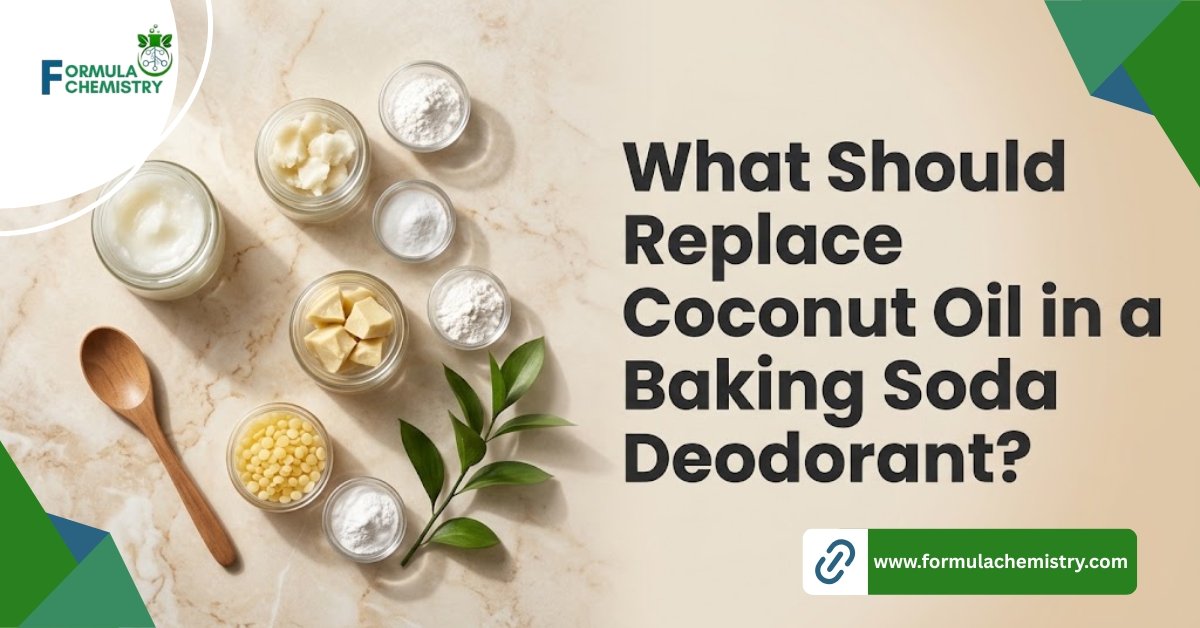
A coconut-free base needs three fat components: a butter for body, a wax for hardness, and a stable liquid oil for gliding. Together they should stay solid at room temperature and melt on contact with skin.
Which Fats Hold Up Best in Warm Rooms?
Shea and cocoa butter stay solid well above the point where coconut oil turns liquid. Candelilla wax then sets the final hardness of the stick.
| Ingredient | INCI Name | CAS Number | Melting Range | Role in the Stick |
| Coconut oil (for comparison) | Cocos Nucifera (Coconut) Oil | 8001-31-8 | 24 to 26°C | Glide, but softens early |
| Shea butter | Butyrospermum Parkii (Shea) Butter | 91080-23-8 | 32 to 45°C | Body and slip |
| Cocoa butter | Theobroma Cacao (Cocoa) Seed Butter | 8002-31-1 | 34 to 38°C | Firmness and snap |
| Candelilla wax | Euphorbia Cerifera (Candelilla) Wax | 8006-44-8 | 68 to 73°C | Hardness |
| Jojoba oil | Simmondsia Chinensis (Jojoba) Seed Oil | 61789-91-1 | Liquid above about 10°C | Glide and oxidative stability |
Which Neutral Oils Secretly Contain Coconut?
Caprylic/Capric Triglyceride (CAS 65381-09-1) is commonly derived from coconut oil, and sometimes from palm kernel oil. It does not belong in a coconut-free stick unless the supplier documents the source.
The same caution applies to fractionated coconut oil and to any INCI name beginning with Coco, Cocos, or Caprylic/Capric. Read the ingredient declaration, not the front label.
Jojoba is a liquid wax ester and not a triglyceride, which is why it resists oxidation so well. That stability matters here, because shea and cocoa butter contain far more unsaturated fatty acids than coconut oil.
Which Other Ingredients Does the Stick Need?
Beyond the fats, the stick needs absorbing powders, an odor binder, an antioxidant, and a small dose of fragrance. Each solves one physical problem, and removing any of them shows up quickly in the finished product.
Butters: The Structure
Butyrospermum Parkii (Shea) Butter carries most of the structure at 38%. The profile of shea butter explains its melting range and why it needs fast cooling to stay smooth.
Theobroma Cacao (Cocoa) Seed Butter adds firmness and a clean snap at 9.5%. Choose a deodorized grade if you dislike a chocolate note.
Powders and Odor Binder
Maranta Arundinacea Root Powder (arrowroot) absorbs moisture and gives a silky finish at 10 to 20%. It is safe here only because the base is anhydrous, since starch supports microbial growth once water is present.
Kaolin (CAS 1332-58-7, MW 258.16 g/mol) is a fine clay that adds slip and absorbs oil at 5 to 10%. It helps the stick glide over the bicarbonate particles.
Zinc Ricinoleate (CAS 13040-19-2, MW 660.3 g/mol) binds sulfur and nitrogen containing odor molecules at 1 to 3%. It covers the thiols that bicarbonate handles poorly.
Antioxidant and Fragrance
Tocopherol (CAS 59-02-9) at 0.2 to 0.5% slows oxidation of the butters and jojoba. It is an antioxidant, not a preservative.
Lavandula Angustifolia (Lavender) Oil (CAS 8000-28-0) gives a clean scent at 0.5 to 1.0%. Sourcing lavender essential oil with batch data keeps scent and sensitization risk predictable.
How Much Sodium Bicarbonate Belongs in the Stick?
Between 5 and 10% covers the useful range, and 7% is the level I recommend for a first batch. Below 5% the odor effect is weak, and above 10% skin reactions rise faster than the benefit.
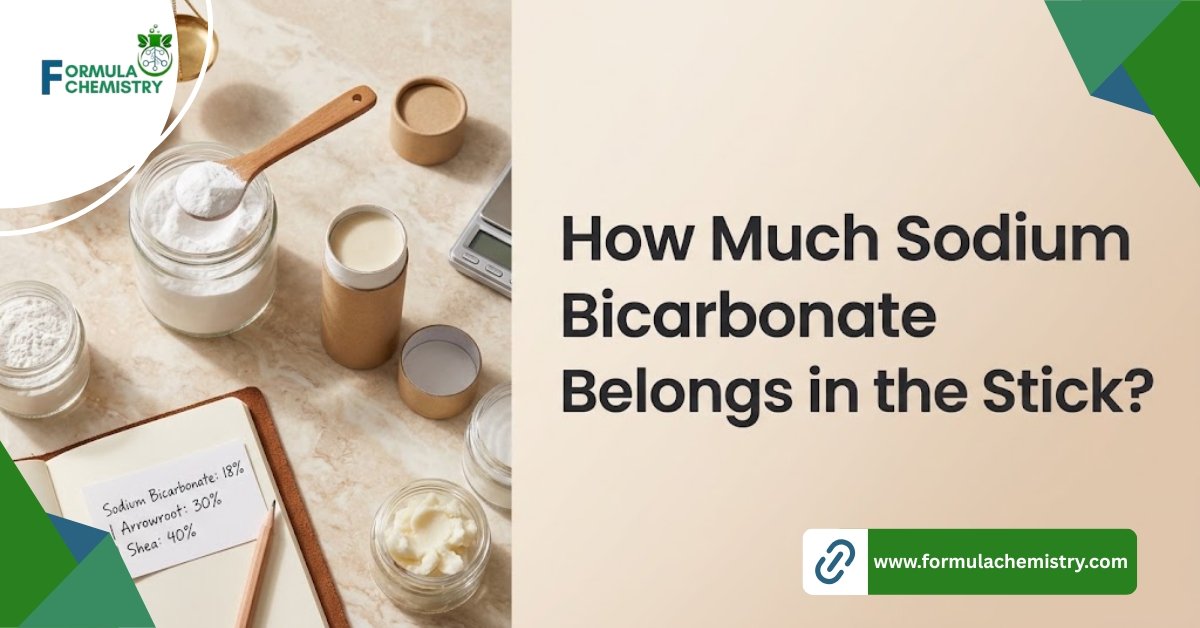
Most online recipes use 20 to 30%, and I consider those levels a formulation error. Magnesium Hydroxide (CAS 1309-42-8, MW 58.32 g/mol) softens the gentle version, since it neutralizes acidic odor molecules with far less free alkalinity.
| Strength | Sodium Bicarbonate | Magnesium Hydroxide | Best For |
| Gentle | 4.00% | 3.00% | Sensitive or newly shaved skin |
| Standard | 7.00% | 0.00% | Normal skin, first batch |
| Firm | 10.00% | 0.00% | Skin that has tolerated Standard for several weeks |
The Gentle and Standard rows keep the formula at exactly 100.00% with no other change. For the Firm level, lower the shea butter to 35.00%.
The Baking Soda Deodorant Recipe Without Coconut Oil: A 100 g Stick
This formula totals exactly 100.00% and contains no water and no coconut ingredient. Prepare phases A, B, and C as separate weighings.
| Phase | INCI Name | Common Name | Percentage |
| A | Butyrospermum Parkii (Shea) Butter | Shea butter | 38.00% |
| A | Theobroma Cacao (Cocoa) Seed Butter | Cocoa butter | 9.50% |
| A | Euphorbia Cerifera (Candelilla) Wax | Candelilla wax | 10.00% |
| A | Simmondsia Chinensis (Jojoba) Seed Oil | Jojoba oil | 12.00% |
| B | Maranta Arundinacea Root Powder | Arrowroot powder | 12.00% |
| B | Sodium Bicarbonate | Baking soda, finely ground | 7.00% |
| B | Kaolin | White kaolin clay | 8.00% |
| B | Zinc Ricinoleate | Zinc ricinoleate | 2.00% |
| C | Tocopherol | Vitamin E | 0.50% |
| C | Lavandula Angustifolia (Lavender) Oil | Lavender essential oil | 1.00% |
| Total | 100.00% |
To scale the batch, multiply each percentage by the batch weight in grams and divide by 100. A 400 g batch means multiplying every figure by four, so the shea butter becomes 152 g and the bicarbonate 28 g.
A 100 g batch fills roughly two 50 g tubes. Weigh on a scale accurate to 0.01 g, because the small percentages control both odor and irritation.
You will need:
- A heat-safe glass beaker and a water bath
- A digital scale accurate to 0.01 g and a thermometer
- A fine mesh sieve and a small whisk or spatula
- Empty deodorant tubes and 70% isopropyl alcohol for sanitizing
How Do You Make the Stick, Step by Step?
Follow the temperatures rather than the clock. Temperature decides whether the shea stays smooth and how long the bicarbonate spends in heat.
- Sanitize the tubes, beaker, and tools with 70% isopropyl alcohol and let them air dry.
- Weigh phase A into the beaker: shea butter, cocoa butter, candelilla wax, and jojoba oil.
- Heat the beaker in a water bath to 75°C and stir until no wax flecks remain.
- Sift the arrowroot, kaolin, and zinc ricinoleate together, then sift the bicarbonate twice into its own bowl.
- Remove the beaker from the heat, let it cool to 65°C, and whisk in the arrowroot, kaolin, and zinc ricinoleate until smooth.
- Allow the mixture to fall to 55°C, then whisk in the sodium bicarbonate for one minute.
- At 50°C, stir in the tocopherol and lavender oil for 30 seconds.
- Pour into the tubes at 45 to 50°C, stirring the beaker between pours so the powders stay suspended.
- Chill the filled tubes in the refrigerator for 30 minutes, then cap them.
- Cure the sticks at room temperature for 24 hours before first use.
A butter-heavy mass thickens faster than a coconut-based one. If it stiffens before you finish pouring, rewarm the beaker gently to 55°C and continue.
Sifting the bicarbonate twice breaks the small aggregates that whisking leaves behind. Those aggregates feel like grit on shaved skin, so this step matters more than any percentage change.
Fast chilling keeps the shea from forming coarse, grainy crystals. Essential oil goes in last because its terpenes evaporate quickly at higher temperatures.
How Do You Adjust the Stick for Heat, Skin, and Texture?
Change one variable per batch and keep a written log. Two simultaneous changes make it impossible to know which one solved the problem.
| Problem | Likely Cause | Adjustment |
| Stick softens in summer | Wax level too low for your climate | Raise candelilla to 12.00% and lower jojoba to 10.00% |
| Stick drags on skin | Wax and powder load too high | Lower candelilla to 8.00% and raise jojoba to 14.00% |
| Grainy texture | Shea cooled slowly | Reheat to 75°C and chill quickly |
| Oil beads on the surface | Liquid oil too high | Lower jojoba to 9.00% and raise arrowroot to 15.00% |
| Brittle stick that cracks | Cocoa butter too high | Lower cocoa butter to 6.00% and raise shea to 41.50% |
| Redness or stinging | Bicarbonate too high for your skin | Move to the Gentle strength |
| Powder settles at tube bottom | Poured too hot | Pour at 45 to 50°C and stir between tubes |
What Is the Best Version for Sensitive Skin?
Use 4.00% sodium bicarbonate and 3.00% magnesium hydroxide, and leave every other percentage unchanged. Add the magnesium hydroxide with the arrowroot at 65°C.
For a fragrance-free version, remove the lavender oil and add 1.00% to the shea butter, which brings it to 39.00%. Anyone prone to fragrance reactions should start there.
How Do You Test Stability at Home?
Place a finished stick at 30 to 35°C for 72 hours and look for oil beads, slumping, or a rancid smell. Then move a second stick to the refrigerator for 24 hours and check for cracks.
This stick controls odor and absorbs some moisture, but it does not reduce sweat flow. Sweat reduction requires an aluminum salt, which is regulated as an over-the-counter drug in the United States, as our guide to homemade antiperspirant explains.
Does a Coconut-Free Baking Soda Deodorant Need a Preservative?
No, provided no water enters the formula or the tube. Microbes need available water to multiply, and an anhydrous base sits well below the water activity of about 0.6 that supports growth.
Water also causes a chemical problem, because it dissolves bicarbonate inside the tube and starts the slow conversion to carbonate. Expect a shelf life of 6 to 12 months when stored below 25°C, and discard any stick with a sharp, crayon-like smell.
Seven Mistakes That Ruin a Coconut-Free Baking Soda Stick
Using a Coconut-Derived Oil in a Coconut-Free Stick
Caprylic/capric triglyceride and fractionated coconut oil come from coconut, and they defeat the purpose for anyone avoiding it. Makers often assume a neutral liquid oil is plant-neutral.
Use jojoba, or check the supplier’s source documentation before using any triglyceride.
Under-Waxing a Butter Base
Shea and cocoa butter are firmer than coconut oil, but they still soften above 32°C. A stick with too little wax slumps in a pocket or gym bag. Keep candelilla at 10 to 12%, and raise it in hot climates.
Cooling the Shea Slowly
Slow cooling lets high-melting fractions crystallize into coarse grains. The stick then feels sandy on skin.
Chill the tubes in the refrigerator right after pouring, and reheat any grainy batch to 75°C before recasting.
Using 20 to 30% Bicarbonate
Recipes copy this range because it neutralizes odor loudly. Skin pays for that strength with pH stress and friction. Hold sodium bicarbonate at 5 to 10%, or replace part of it with magnesium hydroxide.
Skipping the Double Sift
Bicarbonate clumps as it absorbs moisture from the air. Whisking will not break those clumps, and they feel like sand on shaved skin. Sift twice through a fine mesh, and store the powder in a sealed container.
Adding Bicarbonate to a Hot Melt
Heat and residual moisture speed the conversion toward sodium carbonate, which is far more alkaline. The stick then irritates even though the recipe looks identical on paper.
Add the bicarbonate at 55°C or below, and never into the 75°C melt.
Adding Water or Acids
Hydrosols, aloe, vinegar, and citric acid either react with bicarbonate or invite mold. The reaction releases carbon dioxide and consumes the very ingredient you added for odor control.
Keep the base anhydrous and leave acidic ingredients out.
Who Should Try This Stick and Who Should Choose a Gentler Route
This stick suits adults who want an aluminum-free, coconut-free deodorant with a short ingredient list and are comfortable with an oil-based product. It also suits small makers who want a heat-stable base to test at several strengths.
Use the Gentle strength if you have eczema in the underarm area, fragrance sensitivities, or skin that reacts easily. Formula Chemistry recommends leaving out the lavender oil entirely for fragrance-sensitive users.
Shea butter comes from a tree nut, and although it is low in allergenic proteins, anyone with a tree nut allergy should confirm with a physician first. If you react to cocoa butter, replace the 9.50% with 8.50% extra shea butter and 1.00% extra candelilla wax.
Heavy sweating that disrupts daily life deserves a medical conversation, because a cosmetic stick is not designed to address it.
Always conduct a 48-hour patch test with any new formula before wider use.
Questions Readers Ask About Coconut-Free Baking Soda Deodorant
Can I make baking soda deodorant without coconut oil?
Yes. Shea butter, cocoa butter, and jojoba oil replace it fully, and the formula above uses no coconut ingredient of any kind.
What oil replaces coconut oil in deodorant?
Jojoba oil is my first choice because it is a liquid wax ester that resists oxidation. High-oleic sunflower oil (Helianthus Annuus (Sunflower) Seed Oil, CAS 8001-21-6) works at the same level as a cheaper option, though it needs the tocopherol.
Is caprylic/capric triglyceride coconut free?
Usually not. It is most often derived from coconut oil, sometimes from palm kernel oil, so ask your supplier for the source before using it in a coconut-free product.
Why does my shea deodorant feel grainy?
Shea contains triglyceride fractions that crystallize at different rates, and slow cooling lets the high-melting ones form coarse grains. Reheating the batch to 75°C and chilling the tubes quickly resets the crystal structure.
Does coconut oil make baking soda work better?
No. Odor control comes from the bicarbonate and zinc ricinoleate, and coconut oil mainly supplies glide. Laboratory studies show lauric acid has activity against some bacteria, but that effect has not been established in a finished stick.
How much baking soda goes in a 50 g stick?
At 7%, a 50 g stick holds 3.5 g of sodium bicarbonate. The Gentle strength uses 2 g of bicarbonate plus 1.5 g of magnesium hydroxide, and the Firm strength uses 5 g of bicarbonate.
Why does baking soda deodorant burn my armpits?
Burning usually signals a pH or friction problem, and it is not something to push through. Stop using it, let the skin recover, and restart with the Gentle strength or a magnesium hydroxide version.
Can I use baking powder instead of baking soda?
No. Baking powder is bicarbonate premixed with acid salts and starch, so its neutralizing capacity is much lower. Use pure sodium bicarbonate and check the label before weighing.
Build It, Wear It for a Week, Then Change One Thing
A dependable baking soda deodorant recipe without coconut oil depends on three decisions: how much bicarbonate, how fine it is, and when it enters the melt. Without coconut oil, a fourth decision joins them, which is enough candelilla wax to keep a butter-based stick firm.
Read every INCI name for hidden coconut derivatives, and chill the tubes quickly to keep the shea smooth. Magnesium hydroxide gives you a reliable fallback when skin says no.
Weigh out the Standard 100 g stick this weekend, wear it for a full week, and change only one percentage in your next batch