
Introduction
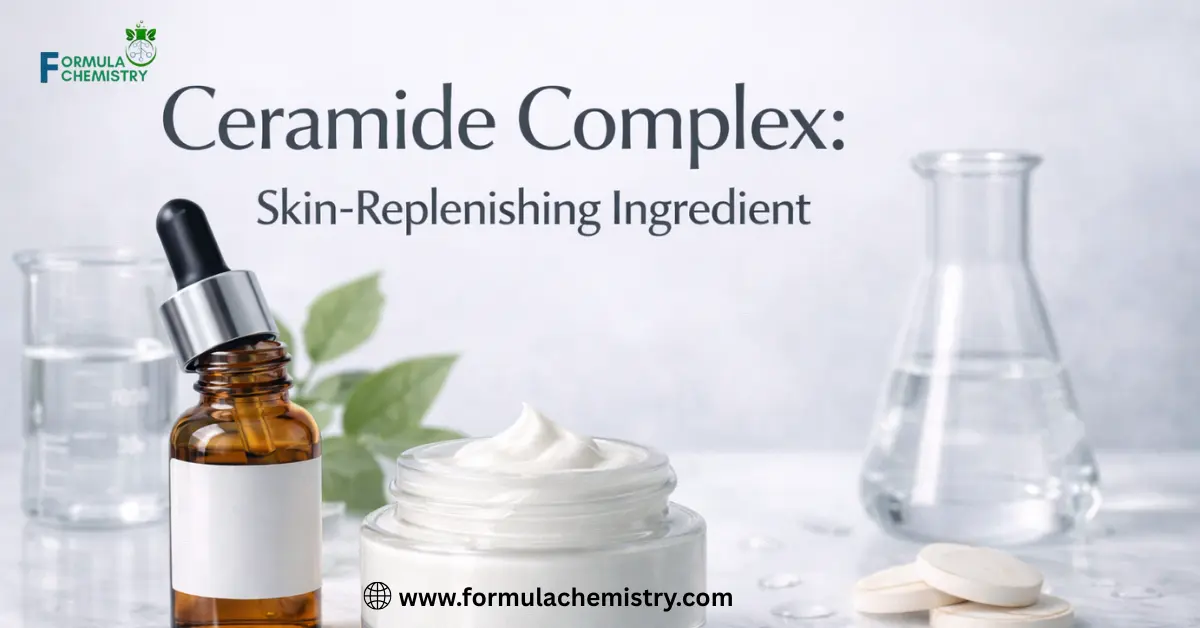
Ceramide complex are lipid molecules found in high concentrations in the uppermost layers of the skin. They make up approximately 50% of the skin’s composition, playing a vital role in determining how your skin looks and how it responds to environmental threats.
As a keystone of the FormulaChemistry educational approach, understanding the “complex” aspect of this ingredient is necessary for formulating effective barrier-repair formulations.
A ceramide complex generally refers to a synergistic mixture of different ceramide types (such as NP, AP, and EOP) combined with cholesterol and free fatty acids.
This mixture mimics the natural lipid bilayer of the human skin, providing a “mortar” that holds skin cells (the “bricks”) together. When this barrier is intact, moisture is sealed in, and irritants are kept out.
Quick Facts
- What it is: A concentrated mixture of skin-identical lipids including ceramides, cholesterol, and fatty acids.
- Who it’s for: Ideal for dry, dehydrated, aging, or compromised skin barriers.
- How to use: Incorporate into the oil phase of emulsions or add to the cool-down phase, depending on the specific supplier’s heat sensitivity.
- Typical usage range: Usually formulated at 1% to 15% for liquid complexes, or 0.05% to 1% for pure powdered forms.
- pH/Solubility: Most complexes are oil-soluble or dispersible in emulsions; stable within a pH range of 5.0 to 7.0.
- Compatibility: Highly compatible with niacinamide, hyaluronic acid, and glycerin; use caution when pairing with high-percentage exfoliating acids.
- Common mistake: Using a single ceramide type rather than a complex, which is less effective at mimicking the skin’s natural architecture.
- Safety note: Always perform a patch test when adding new lipid complexes to sensitive skin types.
Protect and nourish your skin with Ectoin Skincare: The Essential Ingredient Your Skin Needs.
What is a Ceramide Complex in Cosmetic Formulation?
In the world of cosmetic chemistry, a ceramide complex is far more than a single raw material. It is a deliberate delivery system intended to restore the skin’s protective layer.
While individual ceramides are available, they are notoriously difficult to formulate with because of their high melting points and tendency to recrystallize in a finished product.
A complex solves this issue by pre-dispersing the lipids in a liquid phase, often utilizing vegetable-derived surfactants or phospholipids to ensure stability. FormulaChemistry focuses on the use of these complexes because they provide the precise 1:1:1 ratio of ceramides, cholesterol, and fatty acids that scientific research suggests is optimal for skin barrier recovery.
Chemical Makeup and Structure
Ceramides are composed of a sphingoid base linked to a fatty acid. In a commercial complex, you will frequently see Ceramide NP (Ceramide 3), Ceramide AP (Ceramide 6 II), and Ceramide EOP (Ceramide 1). These are often paired with Phytosphingosine, a precursor to ceramides that also possesses antimicrobial properties.
The physical structure of these lipids allows them to form lamellar liquid crystals within a cream or lotion.
This structure is what allows the ingredient to incorporate smoothly into the intercellular spaces of the stratum corneum. Because these are skin-identical, the biocompatibility is exceptionally high, making them a mainstay in “clean clinical” formulations.
Formulation Guidelines and Stability
When working with a ceramide complex, the formulator must pay close attention to the processing temperature. Many liquid complexes are heat-sensitive and should be added during the cool-down phase (below 40°C) to sustain the integrity of the lipid structure.
| Feature | Specification for Ceramide Complex |
| Physical Form | Viscous liquid or liposomal dispersion |
| Usage Rate | 1% – 10% (standard liquid complex) |
| Optimal pH | 5.5 – 6.5 |
| Solubility | Oil-dispersible / Emulsion compatible |
| Storage | Cool, dark place; avoid freezing |
Failure to respect the pH notes or temperature restrictions can result in the complex “crashing” out of the emulsion, leading to graininess or phase separation. FormulaChemistry provides practical formulation education and safety-forward guidance to help avoid these common manufacturing pitfalls.
Hydrate and comfort your skin daily with Skin Soothing Hydrating Lotion Moisturizer.
Benefits of Replenishing Skin Lipids
The main function of a ceramide complex is the restoration of the skin’s permeability barrier. As we age or through the use of harsh surfactants and environmental stressors, the natural ceramide levels in our skin decline.
This leads to what is known as Trans-Epidermal Water Loss (TEWL). By topically applying a complex, we provide the skin with the raw materials it needs to plug those gaps.
This replenishment does more than just hydrate; it actively calms the skin. When the barrier is weak, the skin is in a constant state of low-grade inflammation. Restoring the lipid signals to the skin so that it is protected, reducing redness and sensitivity.
This makes ceramide complexes an essential element in products designed for post-treatment care or retinoid-adjacent routines.
Improving Skin Elasticity and Texture
Although often marketed for “dry skin,” ceramide complexes are equally important for anti-aging. A well-hydrated stratum corneum appears plumper and smoother.
When the lipid matrix is full, fine lines caused by dehydration are minimized. The skin takes on a “bouncy” texture that cannot be achieved by humectants like hyaluronic acid alone.
Furthermore, ceramides influence the rate of skin cell shedding (desquamation). A lack of lipids can cause skin cells to stick together unnaturally, leading to a dull, flaky complexion. By normalizing the environment, a ceramide complex encourages a smoother, more radiant surface.
Common Problems and Fixes in Ceramide Formulations
- Problem: Product seems too heavy or greasy.
- Fix: Reduce the percentage of the complex or balance the oil phase with “dry” esters like Isopropyl Myristate.
- Problem: The emulsion separates after two weeks.
- Fix: Ensure the complex was added at the correct temperature and check if the emulsifier system is compatible with high lipid loads.
- Problem: Pilling when layered with other products.
- Fix: This is often caused by high molecular weight polymers in the complex; try reducing the usage rate or adjusting the film-formers in your base.
- Problem: Cloudy appearance in a clear serum.
- Fix: Ceramides are lipids and will naturally cloud aqueous solutions; use a solubilizer or accept an opaque “milky” serum aesthetic.
Proper Integration in Skincare Programs
To maximize the efficacy of a ceramide complex, it should be used in leave-on products rather than rinse-off cleansers.
While “ceramide cleansers” are popular, the contact time is often too short for the lipids to integrate into the skin barrier significantly. Instead, focus on serums, moisturizers, and night creams.
FormulaChemistry suggests applying ceramide-rich products to slightly damp skin. This traps the existing moisture underneath the lipid barrier, boosting the hydrating effect. Because ceramides are non-reactive, they can be used both morning and night, providing 24-hour barrier support.
Synergistic Pairings
Ceramides work best when they aren’t working alone. Pairing a ceramide complex with cholesterol and fatty acids is the industry standard, but adding other barrier-supporting ingredients is able to enhance the results:
- Niacinamide: Known to stimulate the skin’s natural production of ceramides.
- Panthenol (Pro-Vitamin B5): Enhances skin repair and soothes.
- Glycerin: Provides the necessary hydration that the ceramides then “lock in.”
Who should avoid: While ceramides are generally safe for all, those with extremely oily or acne-prone skin should look for “non-comedogenic” labeled complexes, as certain fatty acid carriers (like stearic acid) might be too occlusive for some.
Key warnings include avoiding use on broken or infected skin without medical supervision.
Safety and Handling Requirements
When formulating with these lipids, a preservation reminder is important. Even though the complex itself may be oil-based, any finished product containing water must be robustly preserved to prevent microbial growth.
- Patch testing advice: Always test the finished formulation on a small patch of skin for 24–48 hours to ensure no sensitivity to the specific lipid blend or emulsifiers.
- Irritation cautions: While ceramides themselves are soothing, they can increase the penetration of other actives. If your formula contains Retinol or AHA, the ceramide complex might make those ingredients more “potent,” possibly increasing irritation if not balanced correctly.
- Who should avoid: Individuals with a known allergy to the source material (e.g., certain plant-derived lipids) should exercise caution.
| Ingredient | Function | Weight % | Amount (ml/g) |
|---|
⚠ Professional Lab Verification Required
- Water Percentage (q.s.): Distilled water is listed as a starting estimate. In a real laboratory batch, water is added q.s. (quantity sufficient) after all other ingredients are accurately weighed to bring the total to exactly 100%.
- pH Adjustment: Sodium hydroxide and citric acid percentages are formulation starting points only. Every real batch must be verified and corrected using a calibrated pH meter to hit the target pH range precisely.
- Ceramide Incorporation: Ceramides are lipophilic and require careful dispersion. Pre-disperse ceramides in a small amount of warm emollient oil before incorporating into the oil phase. Temperature must not exceed 75°C during processing to preserve ceramide integrity and biological activity.
- Preservation Efficacy: Preservative performance must be validated through Challenge Testing (PET) as per ISO 11930 before any commercial or consumer use of this formulation.
- Stability Testing: This formula requires accelerated stability testing at 4°C, 25°C, and 40°C over a minimum of 12 weeks to confirm physical, chemical, and microbiological stability before market release.
Essential FAQs for Ceramide Complexes
What is the difference between a single ceramide and a complex?
A single ceramide is one specific molecule (like Ceramide 3), whereas a complex is a professional mixture of multiple ceramides, cholesterol, and fatty acids designed to mimic the skin’s natural lipid proportions.
Are ceramide complexes vegan?
Most modern ceramide complexes used by FormulaChemistry and other reliable suppliers are synthetic or plant-derived (often from yeast or soy), making them vegan-friendly. Always check the manufacturer’s TDS to verify.
Can I use ceramides with Vitamin C?
Yes. Ceramides are non-acidic and highly stable, considering them an excellent companion to Vitamin C. They help soothe the skin if the Vitamin C (L-Ascorbic Acid) causes slight tingling or dryness.
How long does it take to see results from ceramides?
Although immediate hydration is felt, it typically takes 2 to 4 weeks of regular use to see a significant improvement in the skin’s barrier function and general resilience.
Is a ceramide complex better for oily or dry skin?
It is beneficial for both, but particularly essential for dry skin. For oily skin, ceramides help maintain a healthy barrier, which can actually prevent the overproduction of oil caused by dehydration.
Can ceramides cause breakouts?
Pure ceramides are non-comedogenic. However, the delivery system (the oils or esters the complex is dissolved in) might cause issues for very acne-prone individuals. Always check the full ingredient list of the complex.
At what stage of my routine should I apply ceramides?
Ceramides should be applied after water-based serums but before (or as part of) your heaviest moisturizer or facial oil to seal in the previous layers.
Do ceramides expire?
Yes. Like all lipids, they can undergo oxidation over time. Ensure your products are stored in airtight, opaque containers and used within the recommended period after opening (usually 6–12 months).
Editorial responsibility is taken seriously at Formula Chemistry, where we aim to bridge the gap separating complex science and pragmatic implementation for the modern formulator.