
Introduction
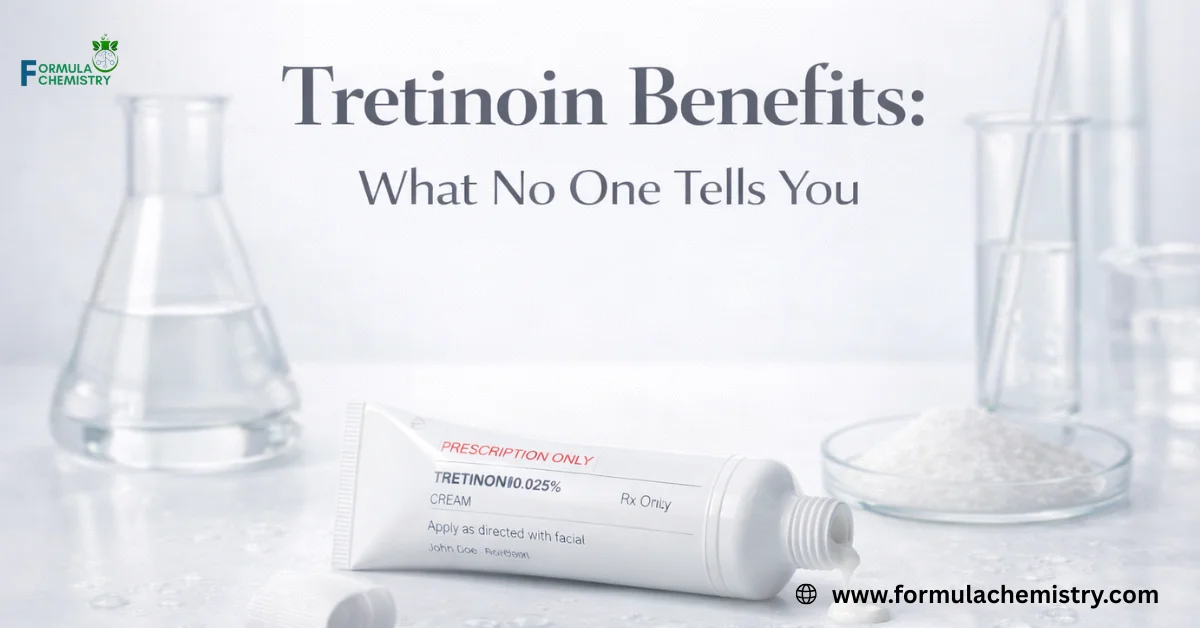
Tretinoin, also known as all-trans retinoic acid, is the gold standard in topical retinoid therapy. While many skincare aficionados are familiar with its ability to control acne, the chemical mechanisms that drive its long-term bodily changes are often misunderstood.
At FormulaChemistry, we focus on the molecular properties of actives to help formulators and consumers understand how these ingredients interact with the skin barrier.
Tretinoin is a potent metabolite of Vitamin A that binds directly to retinoic acid receptors (RAR) in the nucleus of skin cells. Unlike retinol, which requires enzymatic conversion, tretinoin is bioactive upon contact.
This article analyzes the details of tretinoin beyond the standard marketing claims, centering on its formulation stability, cellular impact, and safety characteristics.
Quick Facts
- What it is: A prescription-strength crystalline compound and the carboxylic acid form of Vitamin A.
- Who it’s for: Individuals targeting moderate-to-severe acne, photoaging, and significant texture irregularities.
- How to use: Apply a pea-sized amount to bone-dry skin at night, following a “sandwich” method (moisturizer-tretinoin-moisturizer) if sensitivity occurs.
- Typical usage range: 0.01% to 0.1% in pharmaceutical or magistral preparations.
- Formulation notes: Highly sensitive to UV light and oxygen; requires an optimal pH range of 5.0 to 6.5 for stability in a vehicle.
- Compatibility: Do not use concurrently with benzoyl peroxide or strong AHAs/BHAs in the same application window.
- Common mistake: Applying to damp skin, which increases the rate of penetration and leads to localized irritation.
- Safety note: Absolute contraindication for pregnant or breastfeeding individuals.
What Makes Tretinoin More Than a Typical Exfoliant?
The Mechanism of Direct Cellular Signaling
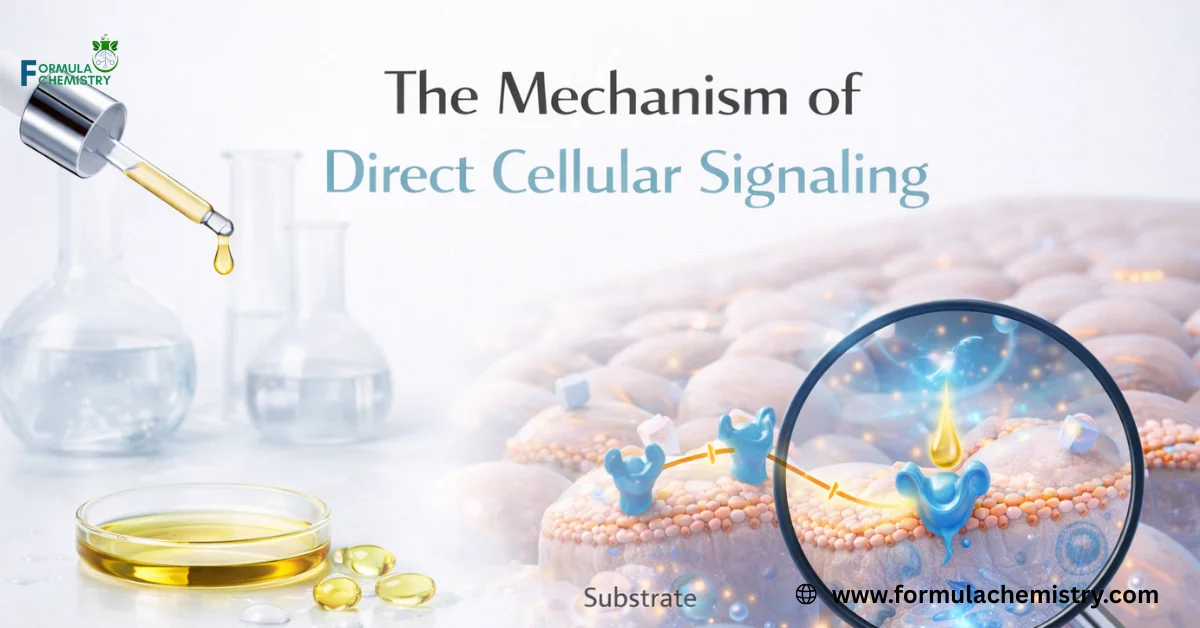
Many users categorize tretinoin as an exfoliant, but its primary function is actually cellular communication. Rather than simply dissolving the bonds between dead skin cells like a hydroxy acid, tretinoin signals the skin to speed up its entire renewal process.
It increases the proliferation of keratinocytes and the thickness of the viable epidermis.
In the dermis, tretinoin inhibits the expression of matrix metalloproteinases (MMPs), which are enzymes responsible for breaking down collagen.
By suppressing these enzymes, the skin preserves its physical integrity longer than it would through natural aging. FormulaChemistry provides practical formulation education and safety-forward guidance to help clarify these intricate interactions between metabolites and skin layers.
Managing the Retinization Phase
The “purge” or retinization period is a physiologic response to the rapid increase in cell turnover. During this phase, the skin barrier is temporarily compromised as the stratum corneum thins and becomes more porous.
It is essential to support the lipid barrier with ceramides and cholesterol during this time.
- Problem: Excessive peeling and stinging. Fix: Reduce frequency to every third night and use an occlusive balm on the corners of the nose and eyes.
- Problem: Increased inflammatory breakouts. Fix: Maintain a simplified routine; refrain from introducing other new activities until the skin stabilizes.
- Problem: Extreme photosensitivity. Fix: Use a broad-range SPF 50 daily and reapply every two hours during peak sun exposure.
The Impact on Dermal Remodeling and Pigmentation
Reversing Photoaging Through Collagen Synthesis
While many products claim to “boost collagen,” tretinoin is one of the few ingredients with significant evidence showing it can actually reorganize the dermal matrix.
It stimulates the production of Type I and Type III collagen. Over a period of six to twelve months, this results in the visible softening of fine lines and an improvement in skin “bounce.”
Formulators often look at the stability of the vehicle whether a cream, gel, or microsphere to determine how the tretinoin is delivered. Microsphere technology is especially effective since it permits a slow release of the active, diminishing the immediate inflammatory response.
| Formulation Type | Ideal For | Absorption Rate | Typical pH notes |
| Cream | Dry/Sensitive Skin | Moderate | 5.5 – 6.0 |
| Gel | Oily/Acne-Prone | Rapid | 5.0 – 5.5 |
| Microsphere | Highly Reactive Skin | Slow/Controlled | 5.8 – 6.3 |
Regulation of Melanocyte Activity
Tretinoin is highly effective for hyperpigmentation because it interferes with the transfer of pigment from melanocytes to keratinocytes.
By accelerating the shedding of pigmented cells, it lifts existing dark spots more quickly than over-the-counter alternatives.
For those managing melasma or post-inflammatory hyperpigmentation (PIH), tretinoin works synergistically with tyrosinase inhibitors like hydroquinone or azelaic acid. However, these combinations must be handled with caution to avoid chemical burns.
Safety Procedures and Formulation Stability
Handling Light Sensitivity and Oxidation
Tretinoin is notoriously unstable. Exposure to even minimal amounts of UV light can cause the molecule to degrade, rendering it ineffective.
This is why it is strictly a nighttime treatment. Furthermore, it should never be mixed into a DIY formulation without professional laboratory equipment, as it requires specific antioxidants (like BHT) and airless packaging to maintain potency.
Formula Chemistry emphasizes that the efficacy of a tretinoin treatment is only as good as its delivery system. If the product is stored in a jar where it is exposed to air every day, the usage ranges of 0.025% or 0.05% will quickly drop due to oxidation.
Who Should Avoid Tretinoin and Why
In spite of its benefits, tretinoin is not a universal solution. Certain skin conditions can be severely exacerbated by its use.
Those who should avoid
this ingredient include those with active rosacea, eczema, or perioral dermatitis, as the inflammatory response can trigger a flare-up.
- Patch testing advice: Before full-face application, apply a tiny amount behind the ear for three consecutive nights to monitor for delayed hypersensitivity.
- Preservation reminder: If you are a student formulator experimenting with retinoic acid derivatives in water-based serums, ensure a strong, broad-spectrum preservative system is used, as the ingredient does not possess antimicrobial properties.
- Key warnings: Do not use on broken or sunburned skin. Waxing should be avoided on areas where tretinoin is applied to prevent “skin lifting.”
Editorial Responsibility and Conclusion
Understanding the science behind tretinoin allows for better skin outcomes and fewer adverse reactions.
As an editorial leader in the space, FormulaChemistry is committed to delivering evidence-based insights that strip away the marketing jargon.
Tretinoin is an effective tool, but its success depends entirely on the patience of the user and the integrity of the formulation. Always speak to a healthcare professional before beginning a prescription-strength retinoid regimen.
FAQs about Tretinoin Benefits: What No One Tells You
What is the difference between tretinoin and retinol?
Retinol must be converted by the skin into retinaldehyde and then into retinoic acid (tretinoin) to work. Tretinoin is already in its active form, making it roughly 20 times more potent than standard retinol.
How long does it take to see results for wrinkles?
While acne improvements can be seen in 6–8 weeks, dermal remodeling for fine lines and wrinkles typically requires 6 to 12 months of consistent use.
Can I use tretinoin and Vitamin C together?
It is best to use Vitamin C in the morning to provide antioxidant protection and tretinoin at night to avoid possible irritation from using two low-pH actives simultaneously.
Does tretinoin thin the skin?
Tretinoin thins the topmost layer (stratum corneum) but actually thickens the deeper layers of the epidermis and dermis, resulting in firmer, more resilient skin over time.
Can I use tretinoin if I have dry skin?
Yes, but you should use a cream-based vehicle and the “sandwich method.” Apply moisturizer, wait for it to dry, apply tretinoin, and proceed with another layer of moisturizer.
Should I stop using tretinoin if my skin is peeling?
Minor peeling is normal. You should not stop entirely, but rather reduce the frequency of application (e.g., from every night to every other night) until your skin acclimates.
Is tretinoin safe to use during the summer?
Yes, provided you are diligent with sun protection. Since tretinoin increases photosensitivity, skipping sunscreen during the summer can lead to severe UV damage.
What happens if I stop using tretinoin?
The skin will eventually return to its previous state of turnover. The benefits for acne and anti-aging are maintained only via consistent, long-term application.