

Quick Answer
Viscosity control in cosmetic formulations is the practice of adjusting a product’s thickness and flow using rheology modifiers, chosen by the mechanism they use rather than by name alone.
The three main mechanisms are chain entanglement from gums like xanthan and guar, cross-linked network swelling from carbomers, and associative thickening from synthetic polymers.
Most cosmetics are shear-thinning, meaning they thin under pressure for easy spreading then recover, and the right modifier depends on your base, pH, and electrolyte load rather than on a single favourite ingredient.
Introduction
A cream that runs like water or a serum that pours like glue is a viscosity problem, and it is one of the most common issues in formulating. Getting thickness right is not decoration, it shapes how a product spreads, feels, stays stable, and is perceived.
Viscosity control in formulations sits within a broader science called rheology, which describes how materials flow. Understanding a little of it turns thickening from guesswork into a deliberate choice.
I adjust viscosity in nearly every formula I build, and the biggest lesson is that the mechanism matters more than the ingredient. Choosing the right type of thickener for your system solves problems that swapping brands never will.
This guide covers the difference between thickening and rheology, how cosmetics actually flow, the main thickener families and their mechanisms, the use levels and pitfalls that matter, and how to choose for your formula.
Thickening Versus Rheology Control
These two terms are used interchangeably, but the distinction is useful. Thickening simply means raising viscosity, while rheology control covers the fuller behaviour of how a product flows and holds together.
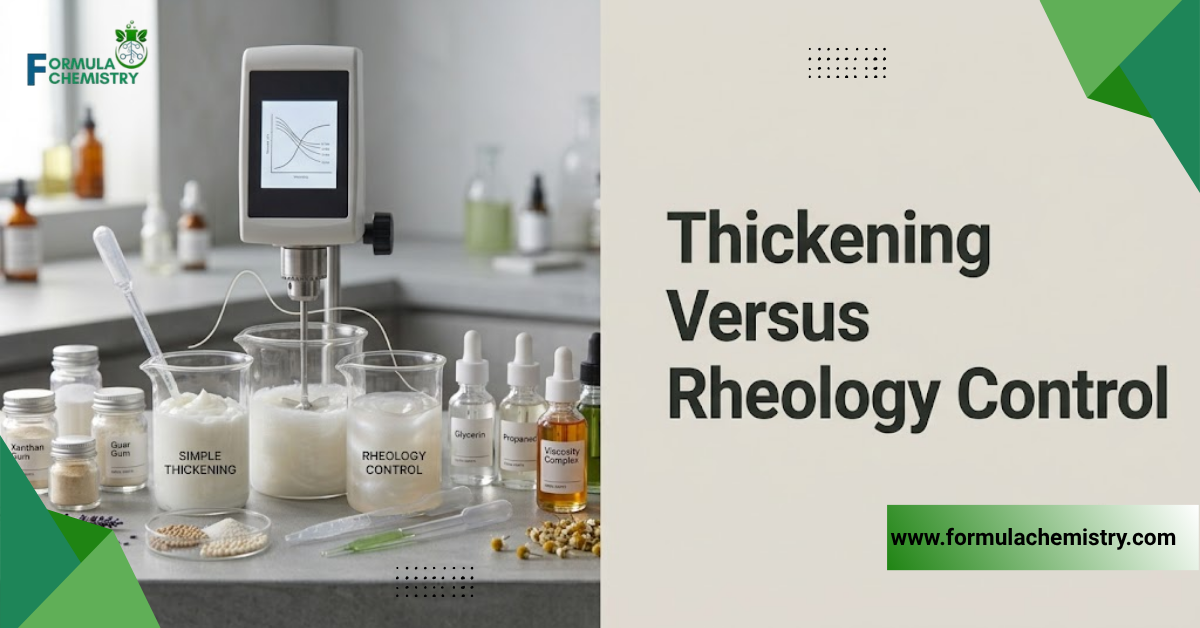
A rheology modifier does more than make a formula thick. It can build yield stress so a product holds its shape, suspend particles or oil droplets, control how a formula levels and spreads, and prevent separation over time.
This is why viscosity control in formulations asks not how do I thicken this, but how do I want this to flow. A product that must suspend exfoliating beads needs different rheology from one that simply needs to feel rich, even if both are thick.
Framing the goal as flow behaviour rather than sheer thickness leads to better choices. It points you toward the mechanism that delivers the texture, stability, and feel you actually want.
How Cosmetics Actually Flow
Most cosmetics do not flow like water, and understanding how they do flow is the foundation of viscosity control. Water is Newtonian, meaning its viscosity stays constant no matter how you handle it.
Shear-Thinning Behaviour
Cosmetic products are usually non-Newtonian, and most are shear-thinning, also called pseudoplastic. This means they become thinner when force is applied and thicker again when it is removed.
You experience this every day. A lotion sits thick in the bottle, thins as you rub it so it spreads easily, then thickens again on the skin, which is exactly the behaviour a good formula is designed to have.
Thixotropy and Yield Stress
Two related properties refine this further. Thixotropy describes a viscosity that recovers over time after shear, so a product spreads under a finger then rebuilds structure once it is left alone.
Yield stress is the force needed before a product flows at all. A formula with yield stress holds suspended beads or oil droplets in place until you apply enough pressure, which is what stops particles sinking or emulsions separating on the shelf.
The Three Thickening Mechanisms
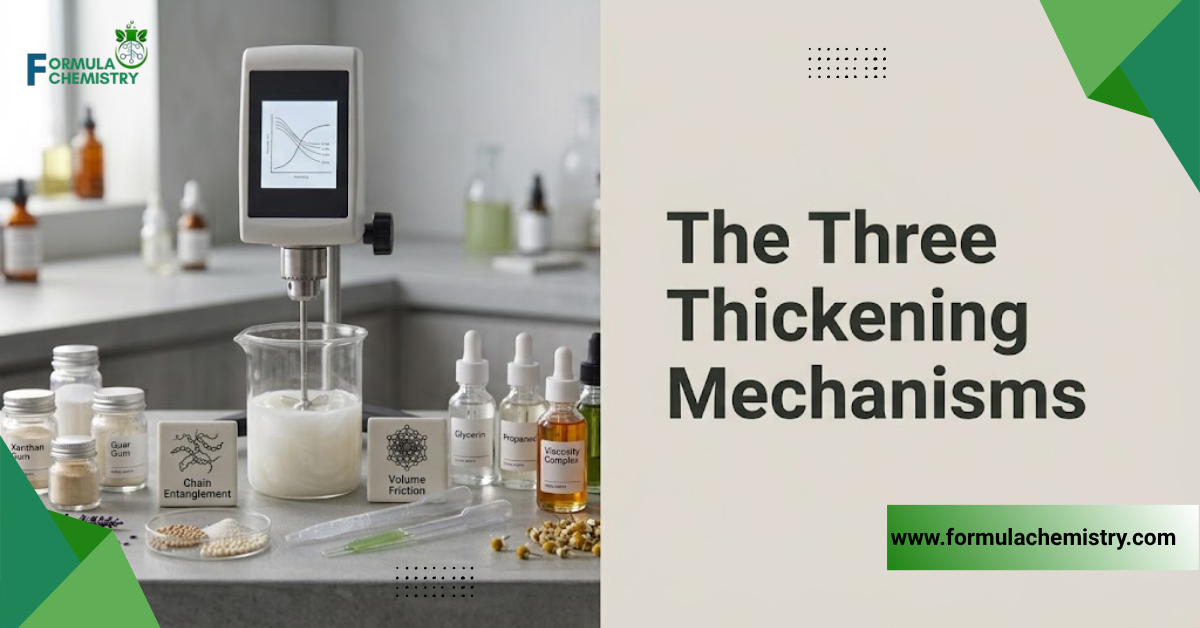
Here is the insight that makes viscosity control click. Rheology modifiers work through three main mechanisms, and choosing the right mechanism for your system matters more than choosing any specific ingredient.
Chain Entanglement
The first mechanism is chain entanglement, used by natural gums such as xanthan and guar. These are long polysaccharide chains that tangle together in water, creating resistance to flow and building viscosity.
Gums that thicken this way tend to give strong shear-thinning behaviour and good suspension. They are also generally tolerant of a wide pH range, which makes them dependable across many formula types.
Cross-Linked Network Swelling
The second mechanism is network swelling, the way carbomers work. Carbomers are cross-linked acrylic acid polymers that, once neutralised, absorb water and swell into a structured gel.
This mechanism gives exceptional clarity and a short, non-stringy feel that consumers associate with premium gels and serums. It is efficient too, building high viscosity at very low use levels, which is why carbomers dominate clear gels.
Associative Thickening
The third mechanism is associative thickening, used by certain synthetic polymers. Rather than simply tangling or swelling, these polymers have hydrophobic sections that associate with oils and surfactants to build a network.
This approach can produce elegant textures, but it is more system-dependent. Changing the oils or surfactants in a formula can shift the viscosity unpredictably, so associative thickeners reward careful testing in the actual base.
The Main Thickener Families
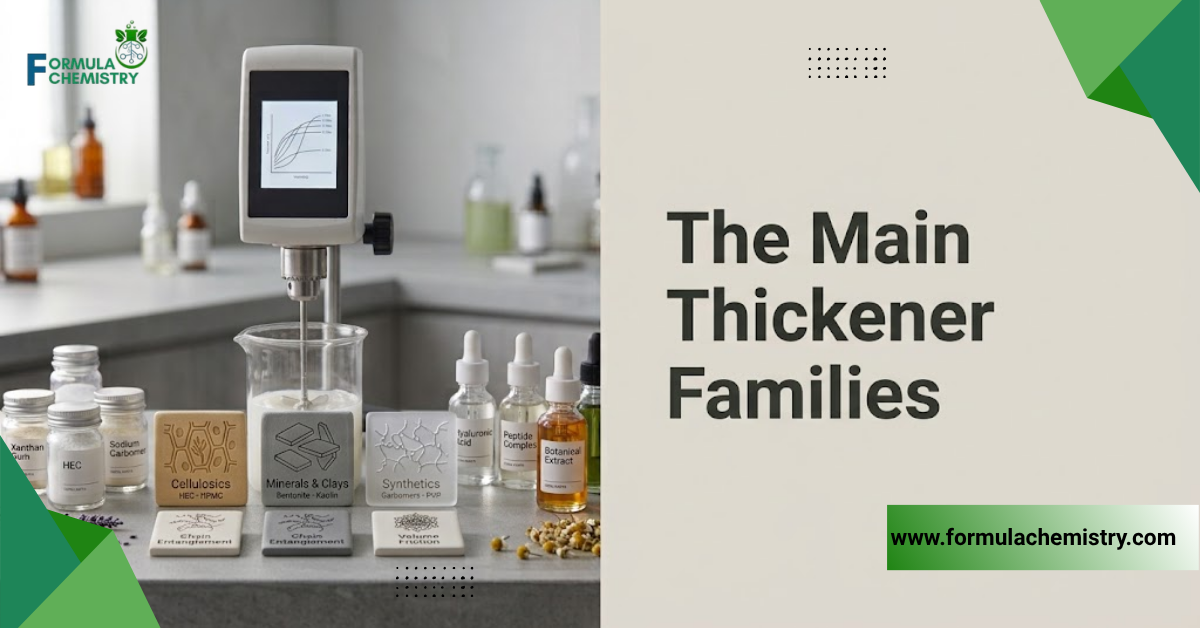
With the mechanisms in mind, the common thickener families become easy to place. Each has a typical use level and a character worth knowing, and we keep several on hand at Formula Chemistry to match the mechanism to the brief.
Natural Gums
Xanthan gum is the most versatile natural rheology modifier, typically used around 0.2 to 0.5% and prized for broad pH stability and good electrolyte tolerance. Its main drawback is a tacky or slightly stringy feel above roughly 0.5%.
Guar gum and guar-xanthan blends extend the natural toolkit, with the guar-xanthan pairing giving a useful synergy of shear-thinning flow and yield stress. Both suit natural and sulfate-free systems where synthetic polymers underperform.
Carbomers
Carbomers are the go-to for clear gels and many oil-in-water emulsions, used at very low levels around 0.1 to 0.5%. They deliver clarity, efficiency, and a clean skin feel that gums cannot match.
Their weakness is electrolytes. Carbomers lose thickening sharply in salty or high-ionic formulas, which is a critical limitation when working with ionic actives, and it explains many mysterious viscosity failures.
Cellulose Derivatives
Cellulose ethers such as hydroxyethylcellulose are non-ionic thickeners that are easy to incorporate and compatible with a broad range of actives and electrolytes. They build viscosity reliably in surfactant systems and emulsions.
Their trade-off is suspension. Cellulose thickeners lack the defined yield stress of anionic systems, so they are strong general viscosity builders but weaker at holding particles in place.
Clays and Specialty Modifiers
Mineral thickeners such as hectorite clays add another option, useful for transparent serums and for building yield stress in specific systems. Specialty synthetic modifiers round out the choices for demanding textures.
These are more niche, but they matter when a standard gum or carbomer cannot deliver the exact clarity, suspension, or electrolyte tolerance a formula needs. The wider the toolkit, the better the match.
Use Levels and Common Pitfalls
Getting viscosity right is as much about avoiding mistakes as choosing an ingredient. A few pitfalls cause most problems.
The most common failure is an electrolyte mismatch, where a carbomer is used in a formula containing salt or ionic actives and simply collapses. The fix is to match the thickener to the ionic load, choosing xanthan or an electrolyte-tolerant modifier instead.
Poor hydration is another frequent issue, especially with gums that clump if added carelessly. Dispersing a gum properly, sometimes in glycerin first or with good mixing, prevents lumps that ruin both texture and appearance.
Overthickening is a subtler trap. Pushing a modifier too high to force thickness often brings tackiness, stringiness, or a heavy feel, so reaching the target through the right mechanism beats simply adding more.
The last pitfall is testing only at one temperature. Viscosity shifts with heat and cold, so a formula should be checked across the range it will actually experience, since a product that is perfect on the bench can thin or thicken unacceptably in storage.
Viscosity Control: Choosing a Thickener for Your Formula
The right choice follows your base, your pH, your electrolyte load, and the feel you want. A few clear patterns cover most situations.
- Clear gel or serum: a carbomer, for clarity and a short, clean feel at low use levels
- Natural or COSMOS formula: xanthan gum, or a guar-xanthan blend for added structure
- Formula with salt or ionic actives: xanthan or an electrolyte-tolerant modifier, not a standard carbomer
- Surfactant cleanser needing simple thickening: a cellulose derivative or a system-appropriate gum
- Product that must suspend beads or particles: a modifier with real yield stress, such as xanthan or a clay
- Low-pH vitamin C or acid formula: an electrolyte-compatible modifier chosen for that environment
Notice that each choice starts from the system and the mechanism, not from a favourite ingredient. That is the core discipline of viscosity control, and it is what turns a thickening problem into a solved one.
Deciding on Your Viscosity Approach
Start by describing how you want the product to flow rather than just how thick it should be. Decide whether you need suspension, clarity, a particular skin feel, or electrolyte tolerance, because those needs point to a mechanism.
Then match the mechanism to your system. Reach for a carbomer when you want clarity and efficiency in a low-electrolyte base, a gum like xanthan when you want natural positioning and robustness, and a cellulose or specialty modifier when their particular strengths fit.
Finally, respect the process. Hydrate the modifier properly, keep the use level within its sensible range, watch for electrolyte and pH effects, and test viscosity across real temperatures. Approach viscosity control this way, as we do at Formula Chemistry, and thickness becomes a designed property rather than a lucky accident.
Frequently Asked Questions
What is viscosity control in cosmetic formulations?
Viscosity control in formulations is the practice of adjusting a product’s thickness and flow using rheology modifiers. It covers not just thickness but how a product spreads, suspends particles, and stays stable. The right modifier depends on the formula’s base, pH, and ionic load.
How do I thicken a homemade cosmetic?
Choose a thickener that matches your system, such as xanthan gum for natural water-based formulas or a carbomer for clear gels. Hydrate it properly to avoid clumps, and use it within its typical range, often a fraction of a percent. Test the result and adjust gradually.
What is the difference between thickening and rheology control?
Thickening increases viscosity, while rheology control encompasses the overall flow behaviour, including yield stress, suspension, and how a product spreads. A rheology modifier does both. Framing the goal as how you want the product to flow leads to better choices.
Why is my cosmetic shear-thinning?
Most cosmetics are deliberately shear-thinning, meaning they thin under pressure and thicken again at rest. This is why a lotion spreads easily when rubbed, then feels stable on the skin. It is a designed property, not a fault.
Why did my carbomer gel go runny?
Carbomers lose thickening sharply in the presence of salt or ionic ingredients, so an electrolyte or ionic active is the likely cause. Switching to xanthan gum or an electrolyte-tolerant modifier usually solves it. Improper neutralisation can also prevent a carbomer from thickening properly.
How much thickener should I use?
It depends on the type. Carbomers typically work at 0.1 to 0.5%, xanthan gum around 0.2 to 0.5%, with other modifiers varying. Start low and build up, since overthickening brings tackiness and a heavy feel.
Which thickener is best for natural formulas?
Xanthan gum is the most versatile natural choice, with broad pH stability and electrolyte tolerance, and guar-xanthan blends add structure. These suit natural and sulfate-free systems. They generally need slightly higher levels than synthetic options to match performance.
How do I stop my gum from clumping?
Disperse the gum well before it hydrates, for example by pre-mixing it into glycerin or adding it slowly with strong agitation. Clumping happens when powder hits water and hydrates on the outside before dispersing. Proper dispersion gives a smooth, lump-free gel.
Key Takeaways
Viscosity control in formulations is best approached by mechanism rather than by ingredient, since the three main mechanisms, chain entanglement from gums, network swelling from carbomers, and associative thickening from synthetic polymers, each suit different systems. Choosing the right mechanism solves problems that swapping brands cannot.
Most cosmetics are shear-thinning, thinning under pressure for easy spreading then recovering, and properties like thixotropy and yield stress govern suspension and stability.
Match the thickener to your base, pH, and electrolyte load, using carbomers for clarity, xanthan for natural robustness, and cellulose or clays for their particular strengths.
Respect the practical details that decide success. Hydrate modifiers properly, stay within sensible use levels, watch for electrolyte and pH effects that collapse carbomers, and test viscosity across real temperatures so thickness behaves as designed rather than by chance.