
Introduction
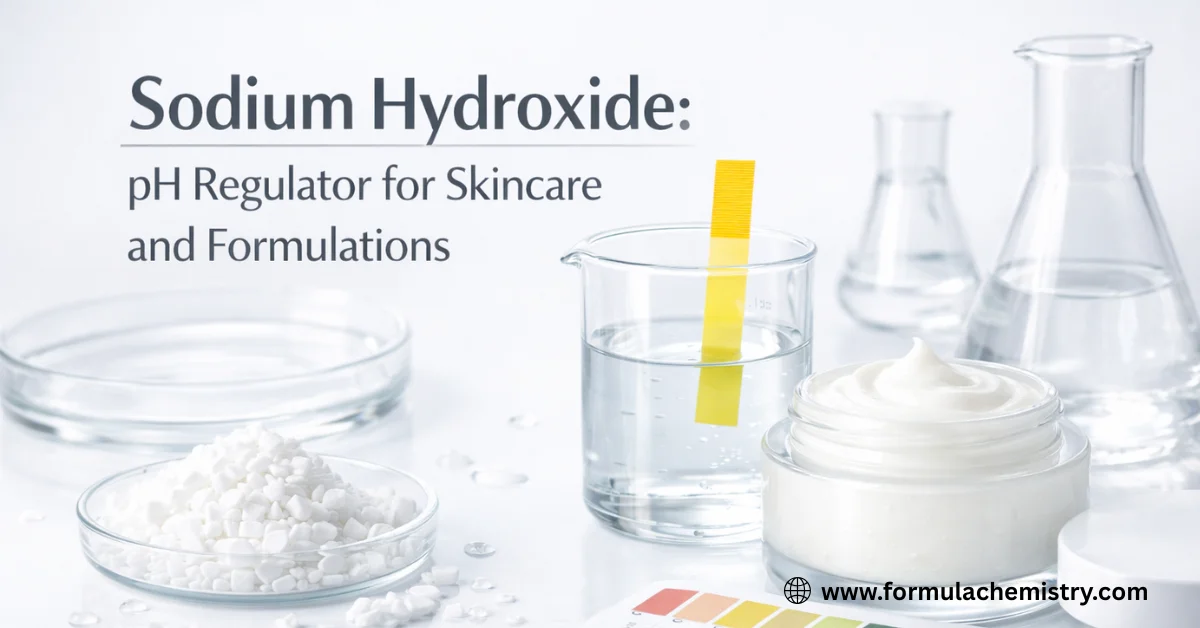
Sodium Hydroxide, commonly known as caustic soda or lye, is a potent inorganic base used extensively in cosmetic formulation. Although often associated with traditional soap making, its function in modern skincare is primarily that of a precision pH adjuster.
It is the gold standard for neutralizing acidic ingredients and activating specific thickeners that require an alkaline environment to function. In the lab, Sodium Hydroxide is rarely used in its solid pellet form during the final stages of a formulation.
Instead, it is employed as a diluted solution to carefully raise the pH of a product drop by drop. This procedure ensures that active ingredients remain stable and that the product falls within a skin-friendly pH range, typically between pH 4.5 and 6.0..
Quick Facts
- INCI Name: Sodium Hydroxide
- Common Names: Caustic Soda, Lye
- Function: pH Adjuster (Buffer), Neutralizing Agent, Saponifier
- Chemical Formula: NaOH
- Typical Usage Rate: 0.1% – 1.0% (as a dilute solution, usually q.s. to target pH)
- Stock Solution Strength: Commonly diluted to 10%, 18%, or 25% for safe handling.
- Solubility: Highly water-soluble; reaction is exothermic (produces substantial heat).
- pH of Raw Material: Extremely Alkaline (pH 13+).
- Safety Note: Corrosive in raw form. Always wear gloves and eye protection. Never add water to Sodium Hydroxide; always add Sodium Hydroxide to water.
What is Sodium Hydroxide and How Does It Work?
Sodium Hydroxide is a strong alkali that dissociates completely in water into sodium ions (Na+) and hydroxide ions (OH-). The hydroxide ions are responsible for raising the pH of a solution by neutralizing excess hydrogen ions (H+), which are acidic.
In cosmetic chemistry, this reaction is instantaneous and irreversible, making it a highly efficient tool for formulators. Because it is a “strong” base, a very small amount is required to effect a large change in pH.
This differs from “weak” bases like Triethanolamine (TEA) or Arginine, which may require higher percentages to achieve the same pH shift. This efficiency level makes Sodium Hydroxide cost-effective and minimizes the addition of unnecessary raw materials into a formula, keeping the ingredient list streamlined.
The Role of Neutralization in Viscosity
One of the most critical applications of Sodium Hydroxide is the neutralization of polymeric thickeners, specifically Carbomers (e.g., Carbopol®). Carbomers are tightly coiled, acidic molecules in their powder form.
When dispersed in water, they remain fluid and cloudy because the molecules are tightly wound. To “activate” the thickener, a base like Sodium Hydroxide is added to the water phase. As the pH rises (typically above pH 6.0), the acid groups on the polymer backbone become ionized.
These negative charges repel each other, causing the molecule to uncoil and expand drastically. This expansion traps water, instantly transforming a liquid dispersion into a crystal-clear, stiff gel. Without a pH adjuster like NaOH, these popular thickeners would remain ineffective.
Saponification vs. pH Adjustment
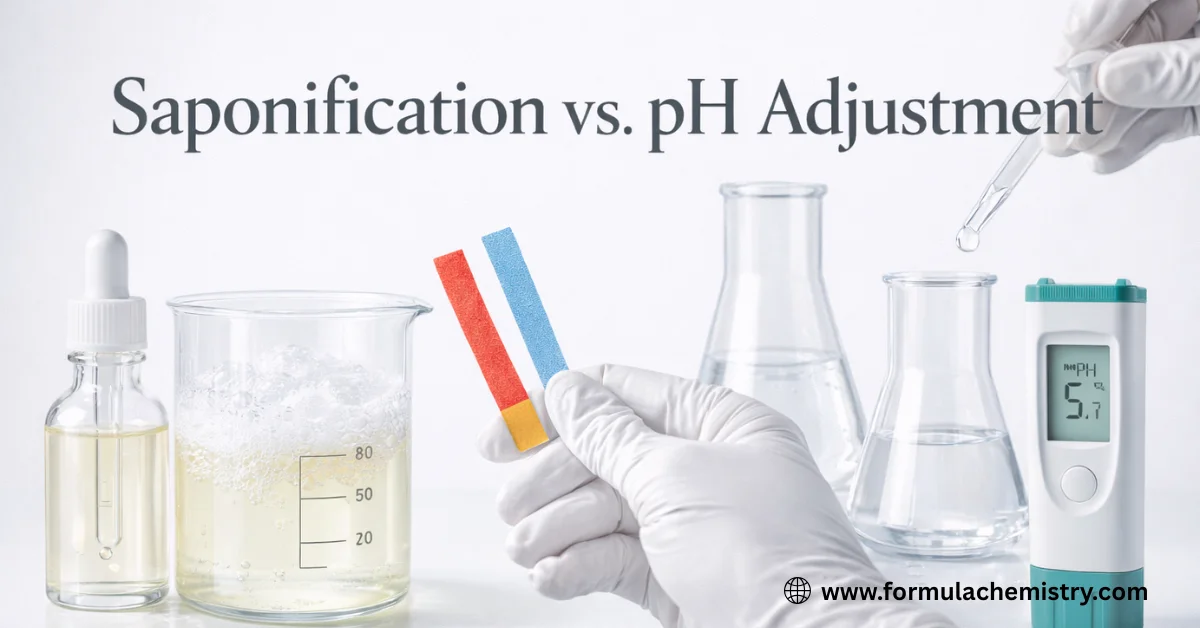
It is vital to distinguish between saponification and pH adjustment. In soap making, large quantities of Sodium Hydroxide are calculated to react chemically with fatty acids (oils and butters).
This reaction breaks the triglyceride bonds and creates soap (salts of fatty acids) and glycerin. In this process, the NaOH is “consumed” entirely, provided the calculations are correct. It is not intended to turn the oils in your lotion into soap.
When used as a pH adjuster, the OH- ions react with the most acidic components present (often citric acid, lactic acid, or the thickener itself) to form water and a mild salt. Therefore, a properly formulated moisturizer containing Sodium Hydroxide is safe and non-irritating.
How to Safely Formulate with Sodium Hydroxide
Handling raw Sodium Hydroxide pellets or flakes requires strict safety procedures. The raw material is hygroscopic, meaning it rapidly absorbs moisture from the air, which can cause the pellets to clump or become wet and slippery. Skin contact with the raw material causes immediate chemical burns because the alkali reacts with the fats in human skin (essentially saponifying the skin tissues).
To use it safely in a lab setting, formulators must prepare a stock solution. You should never toss a solid pellet directly into a lotion batch. Solid pellets create “hot spots” of extreme alkalinity that can hydrolyze esters, break down preservatives, or scorch sensitive ingredients before they dissolve. A pre-dissolved solution ensures the base disperses evenly and gently throughout the batch.
Preparing a Stock Solution
The most common concentration for a lab bench stock solution is 10% or 25%. To make a 10% solution, you would weigh 90 grams of distilled water and slowly add 10 grams of Sodium Hydroxide pellets.
It is important to follow the rule: Add Caustic to Water, never water to caustic. Adding water to a pile of NaOH can cause a violent eruption of steam as well as corrosive liquid.
When the pellets hit the water, the solution will heat up rapidly frequently reaching temperatures over 60°C – 80°C. This is a normal exothermic reaction.
Allow the solution to cool completely to room temperature before bottling it. Store it in a high-density polyethylene (HDPE) plastic bottle with a secure screw cap. Glass containers should be avoided for long-term storage of strong alkalis, as they can etch the glass and cause it to shatter over time.

Neutralizing Techniques and Troubleshooting
When adjusting a batch, add the Sodium Hydroxide solution drop by drop while the batch is under continuous agitation. Use a calibrated pH meter rather than litmus paper for accuracy, as the pH can jump logarithmically. For example, moving from pH 3 to pH 5 might take 2 grams of solution, but moving from pH 5 to pH 9 might take only 0.2 grams.
Common Problems and Fixes
- Problem: The pH shot up too high (e.g., pH 10.0).
- Fix: Do not panic. You can lower it back down with a 50% Citric Acid solution. However, be aware that “yo-yoing” the pH (going up and down repeatedly) creates excess salt in the formula, which is able to destabilize emulsions or thin out salt-sensitive thickeners like Xanthan Gum.
- Problem: The carbomer gel has white clumps or “fish eyes.”
- Fix: This is not a NaOH issue; it is a dispersion issue. The carbomer was not fully hydrated before neutralization. Ensure the powder is fully wetted out before adding the base.
- Problem: The Sodium Hydroxide pellets are stuck together in the jar.
- Fix: Moisture has entered the container. Discard safely and buy fresh material. Keep the new container tightly sealed and potentially store it in a secondary container with a desiccant.
Comparative Study: NaOH vs. Other Adjusters
Formulators often choose between Sodium Hydroxide, Triethanolamine (TEA), and Tromethamine (TRIS). While NaOH is inorganic and strong, the others are organic amines. The choice relies on the specific needs of the formula, such as clarity, yellowing potential, and target pH.
Sodium Hydroxide is preferred for “natural” concepts (as it results in simple salts) and for high efficiency. TEA is easier to handle because it is a liquid at room temperature and acts as a weaker base, making it harder to accidentally overshoot the pH. However, TEA can cause yellowing in formulations over time and has limits on trace heavy metal content (nitrosamines).
Table: pH Adjuster Comparison
| Feature | Sodium Hydroxide (NaOH) | Triethanolamine (TEA) | Arginine |
| Type | Inorganic Strong Base | Organic Weak Base (Amine) | Amino Acid (Weak Base) |
| Strength | Very High (Use carefully) | Moderate | Low (Gentle) |
| Form | Solid Pellets / Flakes | Liquid | Powder |
| Reaction Heat | High (Exothermic) | Low | None / Low |
| Best Application | Neutralizing polymers, final pH fix | Carbomer gels, clear styling gels | AHA Neutralization, “Natural” claims |
| Cost | Very Low | Moderate | High |
Stability and Storage Considerations
Sodium Hydroxide solutions react with carbon dioxide in the air to form Sodium Carbonate. This may appear as a white crust or precipitate around the cap of your stock solution bottle. While small amounts of carbonate are mostly harmless, they reduce the efficacy of your solution over time.
To sustain stability, always recap the stock solution immediately after use. If you notice significant white solids forming in your 10% solution, it is best to prepare a fresh batch. In the final formulation, once the NaOH has reacted with the acids, it is stable. However, always ensure your final product’s packaging is compatible with the pH; aluminum packaging, for instance, can degrade if in contact with high-pH bulk product, though this is rare in finished skincare, which is usually pH-balanced.
FAQ’s about Sodium Hydroxide: pH Regulator for Skincare and Formulations
Is Sodium Hydroxide safe in skincare?
Yes, when used correctly. In finished products, it is not present as “lye.” It reacts with acids to form safe salts and water. The final product is pH-balanced (usually pH 5-6), making it safe for skin application. The danger lies only in the raw material handling.
Can I use Drano as Sodium Hydroxide?
Absolutely not. Drain cleaners often contain metal shavings (aluminum), other reactive chemicals, or foreign substances that are dangerous for cosmetic use. Always use “Reagent Grade,” “FCC,” or cosmetic-grade Sodium Hydroxide to ensure purity and safety.
What happens if I put too much Sodium Hydroxide in my lotion?
The pH will become too alkaline (high). High pH (above 9 or 10) destroys the skin barrier, causes irritation, and can lead to chemical burns. If you overshoot, you must neutralize it with Citric Acid or Lactic Acid until the pH returns to a safe level (4.5 – 6.0).
Does Sodium Hydroxide expire?
The solid pellets do not strictly “expire,” but they degrade by absorbing moisture and CO2 from the air, turning into a wet, clumpy mess of Sodium Carbonate. If stored in an airtight container, they last for years. Stock solutions should be replaced every 6-12 months.
Is Sodium Hydroxide natural?
It is an inorganic mineral compound obtained from salt (brine) via electrolysis. While it is processed, it is allowed in many “natural” standards (like COSMOS/Ecocert) as a pH adjuster because it does not leave synthetic residues, only simple salts.
Why is my Sodium Hydroxide solution hot?
Dissolving Sodium Hydroxide in water is an exothermic reaction, meaning it releases energy in the form of heat. This is normal. Always use cold water to start, and allow the solution to cool down completely before using it in your formulation.
Can I use baking soda instead of sodium hydroxide?
Baking Soda (Sodium Bicarbonate) is a weak base and acts as a buffer. It can raise pH, but it releases CO2 gas bubbles when reacting with acids, which can aerate your cream and ruin the texture. NaOH is preferred because it creates no gas and works more efficiently.
How do I dispose of old Sodium Hydroxide solution?
Do not pour strong concentrations directly down the drain. Neutralize the solution first by adding Citric Acid or Vinegar until the pH is near 7. Once neutralized, it is essentially salt water and can be safely flushed with plenty of running water.