
Quick Answer
Private label vs custom formulation comes down to speed and ownership rather than quality, since both routes can produce excellent products.
Private label uses a manufacturer’s existing formula, launches in roughly 4 to 8 weeks with minimum orders often around 500 to 1,000 units, and leaves the formula owned by the lab.
Custom formulation builds a proprietary formula you own, typically taking 6 to 12 months, with minimums frequently reaching 5,000 to 10,000 units per product, plus development fees.
Introduction
The private label vs custom formulation decision arrives early for every new brand, and founders usually frame it as a question of quality. That framing is wrong because a well-made private label serum can outperform a poorly developed custom one.
The real question is what you are buying. One route buys speed and low risk, and the other buys ownership and differentiation.
I have worked with founders who spent a year and a substantial budget developing a custom formula for a market that never materialised. Others launched on private label, proved demand in three months, then funded custom development from revenue.
By the end of this guide, you will understand what each route actually delivers, what it costs, how long it takes, who owns the formula, and which choice fits your stage.
Defining the Terms Properly
The industry uses these words loosely, which causes expensive misunderstandings. Four distinct arrangements exist.
White label means a manufacturer’s finished stock product to which you add your logo. Customisation is minimal, and minimum orders can start as low as 50 to 100 units.
Private label means a manufacturer’s base formula that you brand, usually with some choice over packaging, scent, or minor adjustments. The base formula remains the lab’s property, and other brands may use it.
Custom formulation means a chemist develops a new formula to your brief, and you typically own the resulting intellectual property. This is sometimes called OEM manufacturing.
A cosmetic copacker sits apart from all three, filling and packing a product you have already blended. Confirm which service a partner actually provides before you negotiate anything.
Private Label vs Custom Formulation Compared
The table below sets out the parameters that genuinely differ. Nothing here concerns product quality, because both routes can deliver it.
| Parameter | Private label | Custom formulation |
| Formula origin | Manufacturer’s existing base | Developed from scratch to your brief |
| Formula ownership | The manufacturer retains it | You typically own the IP |
| Exclusivity | Competitors may sell the same base | Exclusive to your brand |
| Typical MOQ | Often 500 to 1,000 units | Frequently 5,000 to 10,000+ units |
| Time to market | Roughly 4 to 8 weeks | Roughly 6 to 12 months |
| Development fee | Usually none | Several hundred to $10,000+ |
| Safety testing | Often already completed | You commission stability and micro testing |
| Regulatory risk | Lower, the formula is already proven | Higher, the new formula needs a full assessment |
| Differentiation | Limited to brand and packaging | The formula itself can differentiate |
| Best for | Testing demand quickly | Proven demand and long-term equity |
Formula ownership is the parameter that matters most over time. With a private label, you can trademark your brand name and logo, though not the formula, because it is not unique to you.
Custom formulation converts your product into a defensible asset. That distinction determines whether you build brand equity or merely rent a product.
Cost Comparison between Private Label and Custom Formulation
Pricing varies widely by manufacturer, region, and product complexity, so treat the figures below as indicative rather than quotes. Always request written pricing against your exact specification.
| Cost element | Private label | Custom formulation |
| Formula development | Usually, none or a small tweak fee | Roughly $500 to $2,000 for modest work, $10,000+ for full custom |
| Typical startup outlay | Roughly $2,500 to $7,500 at low MOQ | Roughly $15,000 to $50,000+ with premium packaging |
| Per unit, basic product | Around $2.50 to $4.50 at 1,000 units | Similar bulk cost, spread over a higher volume |
| Per unit, active-heavy skincare | Around $5.00 to $8.00+ at 1,000 units | Varies with ingredient selection |
| Testing | Frequently bundled or already done | Stability, micro, and compatibility at your cost |
Volume dominates unit economics. The same product might cost roughly $8 per unit at 500 units and around $4 per unit at 5,000, because setup, cleaning, and calibration costs are fixed regardless of run length.
Ask precisely what a quoted minimum includes. Stability testing, compatibility testing, and microbial challenge fees are sometimes bundled and sometimes billed separately, and the difference reshapes your budget.
Understanding MOQ
Minimum order quantity decides feasibility more often than unit price. A manufacturer sets it because production setup, raw material procurement, and machine time carry fixed costs no matter how few units you order.
Private label MOQs stay lower because the formula already exists and has been tested. Custom formulation MOQs climb because specialty actives arrive in bulk containers, and a lab cannot let expensive raw material expire on a shelf for a formula using 0.5% of it.
One trap catches nearly every first-time founder. Packaging component minimums are separate from formula minimums, so a lab willing to blend 1,000 units may still face a packaging supplier demanding 5,000 for custom-moulded caps or direct printing.
Negotiate structure rather than price. A blanket order commits you to a total volume produced across several smaller batches, which protects cash flow while satisfying the manufacturer’s setup economics.
Timeline Reality of Private Label and Custom Formulation
Private label timelines run roughly 4 to 8 weeks for stock formulations where materials sit in inventory. The work is branding, packaging, and compliance rather than chemistry.
Custom formulation runs 6 to 12 months and sometimes longer. That period covers the brief, bench development, sample rounds, ingredient sourcing, stability testing, microbial challenge testing, packaging compatibility, and regulatory documentation.
Production alone takes 12 to 24 weeks for custom work once the formula is settled. Founders routinely budget for development and forget that manufacturing adds months afterwards.
Rushing costs money without saving much time. Expedited development commonly attracts a premium, and stability testing cannot be compressed because it measures the passage of real time.
Formula Ownership and Exclusivity
Custom formula ownership is the strongest argument for the slower route. A proprietary formula is an asset that survives changing suppliers and supports a genuine performance claim.
Get ownership in writing before development begins. Some agreements leave the lab holding the formula it developed, which converts your investment into their catalogue item.
Private label carries an obvious exposure. Another brand can sell the identical base formula in different packaging, and your only defence is positioning and audience rather than the product.
That exposure is survivable when your differentiation lives elsewhere. Brands competing on community, education, or a specific audience can succeed on a shared base, whereas brands claiming formulation superiority cannot.
The Hybrid Path Most Successful Brands Take
The sensible route for most founders combines both. Launch on private label or a semi-custom base, prove that people reorder, then fund custom development from revenue rather than savings.
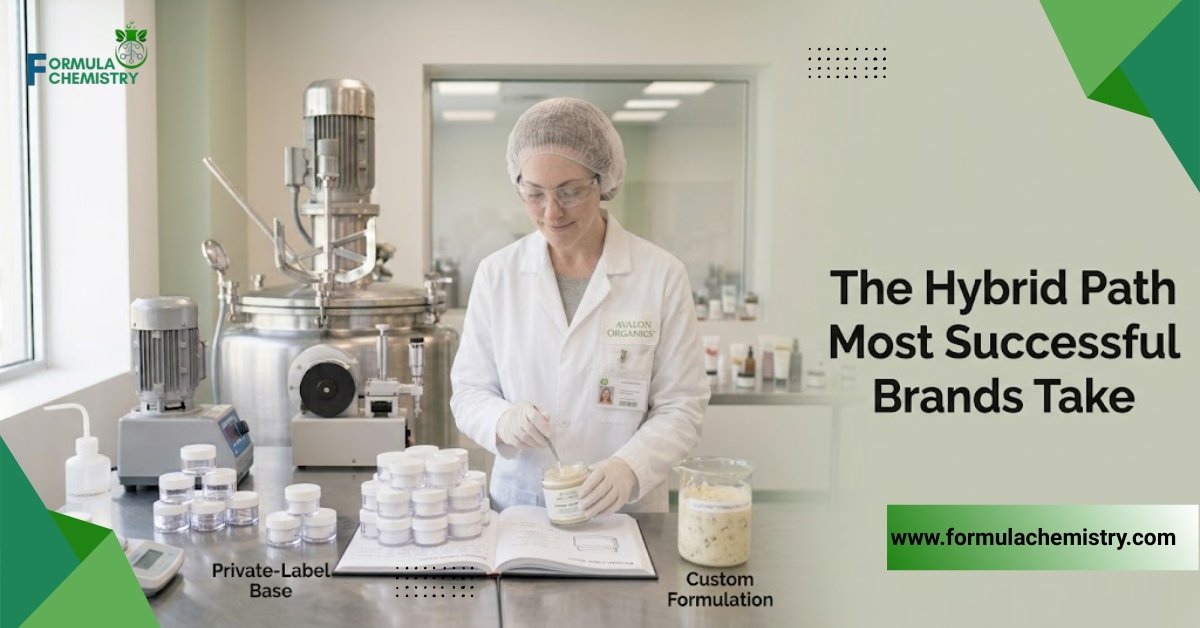
Semi-custom sits between the two. Many manufacturers will adjust actives, texture, or fragrance on an existing base, giving meaningful differentiation without full development cost or timeline.
This sequence removes the single most expensive mistake in the industry. Developing a custom formula for unproven demand risks the entire launch budget on an assumption.
Validate first and differentiate second. Repeat purchase data is what converts a custom formulation from a gamble into an investment, which is the sequencing we recommend to founders at Formula Chemistry.
Common Mistakes in Private Label and Custom Formulation
Founders misjudge this decision in recognisable ways, and each mistake below carries a direct fix. Correcting them saves both money and months.
The first mistake is choosing a custom formulation before proving demand. It commits large capital to an untested market, so launch on private label or semi-custom and let reorders justify development.
Assuming private label means poor quality is a second error. Quality follows the manufacturer’s processes and GMP compliance rather than the order size, so audit the facility instead of dismissing the route.
Overlooking formula ownership terms is a third mistake. Some contracts leave the lab owning your custom formula, so agree ownership in writing before any development work starts.
Budgeting for formula MOQ alone is a fourth error. Packaging components carry their own minimums, so confirm both before committing to a launch quantity.
Ignoring what a quoted minimum includes is a fifth mistake. Testing fees may sit outside the price, so ask explicitly whether stability, compatibility, and microbial testing are bundled.
The sixth error is expecting custom development to move quickly. Stability testing measures real-time and cannot be compressed, so plan for 6 to 12 months and add production time on top.
Which Path Fits You
Founders testing a concept, entering a new category, or working with limited capital should start with a private label or white label. Speed and low minimums let you learn what sells before you invest in chemistry.
Brands with proven repeat purchase, a genuine formulation idea, and the capital to fund minimums should pursue custom formulation. Ownership, exclusivity, and defensible claims justify the longer timeline once demand is established.
Anyone wanting differentiation without the full commitment should ask about semi-custom options. Adjusting activities or texture on a proven base delivers much of the benefit at a fraction of the cost and time.
Brands already blending their own product need a co-packer rather than either route. Match the partner to the service you actually require, and confirm exactly what they will and will not do before you sign.
Frequently Asked Questions
What is private label vs custom formulation?
Private label uses a manufacturer’s existing base formula that you brand as your own. Custom formulation develops a new, proprietary formula to your brief, which you typically own. Private label launches faster and cheaper, while custom offers exclusivity and ownership.
What is the difference from white label?
White label is a finished stock product to which you add only your logo, often with minimums as low as 50 to 100 units. Private label allows some customisation of packaging, scent, or minor formula elements. Custom formulation builds the formula from scratch.
What are typical MOQs?
Private label minimums commonly sit around 500 to 1,000 units per product, while custom formulation frequently requires 5,000 to 10,000 or more. White label can start at 50 to 100 units. Packaging components carry separate minimums that may exceed the formula’s.
How much does custom formulation cost?
Development fees range from roughly $500 to $2,000 for modest customisation up to $10,000 or more for a full custom formula. Total startup outlay commonly reaches $15,000 to $50,000 with premium packaging. Testing costs typically sit on top.
How long does each route take?
Private label stock formulations generally reach the market in 4 to 8 weeks. Custom formulation usually takes 6 to 12 months for development, plus 12 to 24 weeks of production. Stability testing cannot be accelerated because it measures elapsed time.
Who owns a private label formula?
The manufacturer owns the base formula, and other brands may sell the same product. You can trademark your brand name and logo, though not the formula itself. Custom formulation is the route to owning the formula outright.
Is private label lower quality?
No, quality depends on the manufacturer’s processes, testing, and GMP compliance rather than whether the formula is stock or bespoke. Many respected brands use private label bases. Audit the facility rather than judging by the route.
Can I start a private label and switch later?
Yes, and most successful brands do exactly that. Launch on private label to prove repeat purchase, then fund custom development from revenue. Semi-custom options offer a middle step with real differentiation.
Key Takeaways
Private label vs custom formulation is a trade between speed and ownership, not a choice between poor and good products. Private label launches in weeks at low minimums, while custom formulation takes months, demands higher volumes, and delivers a formula you own.
Costs and minimums vary widely, so confirm what a quote includes and check packaging component minimums separately from formula minimums. Agree on formula ownership in writing before any custom development begins.
Most brands should validate demand before investing in chemistry. To decide today, ask whether your differentiation lives in the formula or in the audience, because that single answer points clearly to one route.