

Quick Answer
To start a skincare business, choose a focused niche, write a business plan, secure funding, develop and safety-test compliant products, register your business, and build a brand before marketing to a defined audience.
In regulated markets, you must also meet cosmetic rules such as facility registration, product listing, and safety substantiation, which in the United States fall under the Modernization of Cosmetics Regulation Act of 2022. The order matters, since skipping product safety or regulation to launch faster is the fastest way to a costly recall.
Introduction
Most people who search for how to start a skincare business already have a product idea and no clear map for everything around it. The idea is the easy part, and the business, safety, and regulatory work is where new brands stall or fail.
This roadmap fixes that gap. It walks the full path from niche to launch in a logical order, so you build each stage on a solid one beneath it.
I have formulated for indie brands and watched founders make the same avoidable mistakes. They fall in love with a product, spend on packaging, and only later discover the safety testing and registration they skipped.
This guide keeps them in sequence. By the end, you will have a clear, ordered plan covering niche, business plan, funding, product development, registration, branding, operations, and marketing.
How to Start a Skincare Business in Eight Steps
The roadmap below runs in the order a real launch should follow. Each step feeds the next, so resist the urge to jump ahead to branding or selling before the foundation is set.
Step 1: Choose Your Skincare Niche
Niche selection is the first real decision, and a narrow niche beats a broad one for a new brand. A focused range for a specific audience is easier to formulate, market, and stand behind than a general line trying to serve everyone.
Strong niches solve one clear concern for one clear group. Examples include minimalist products for sensitive skin, barrier-support ranges, or formulations designed for a specific climate or age group.
Validate demand before committing. Check whether people actively search for and buy in your niche rather than assuming interest, since a passion project without a market is a hobby, not a business.
Step 2: Write Your Skincare Business Plan
A skincare business plan turns the idea into a testable model and is the document funders will ask for first. It forces you to price for profit rather than hope, which is where many founders discover their margins do not work.
You do not need a fifty-page document to begin. A working plan covers the essentials clearly, and you can use a simple business plan template built around the sections below.
| Plan section | What it covers |
| Executive summary | The brand, niche, and core offer in brief |
| Market and niche | Target customer, demand evidence, competitors |
| Products | Range, positioning, and how you will make them |
| Operations | Manufacturing, suppliers, and fulfillment |
| Marketing and sales | Channels, launch plan, and customer acquisition |
| Financials | Startup costs, pricing, margins, and break-even |
| Funding | How much do you need, and where does it come from |
Treat the financials as the heart of the plan. If the numbers only work at a scale you cannot reach yet, redesign the model before spending anything.
Step 3: Fund Your Skincare Business
Skincare business funding scales to your ambition, and most indie brands start far smaller than newcomers expect. A home-based, single-product launch can begin on a modest budget, while a broad multi-product line needs real capital.
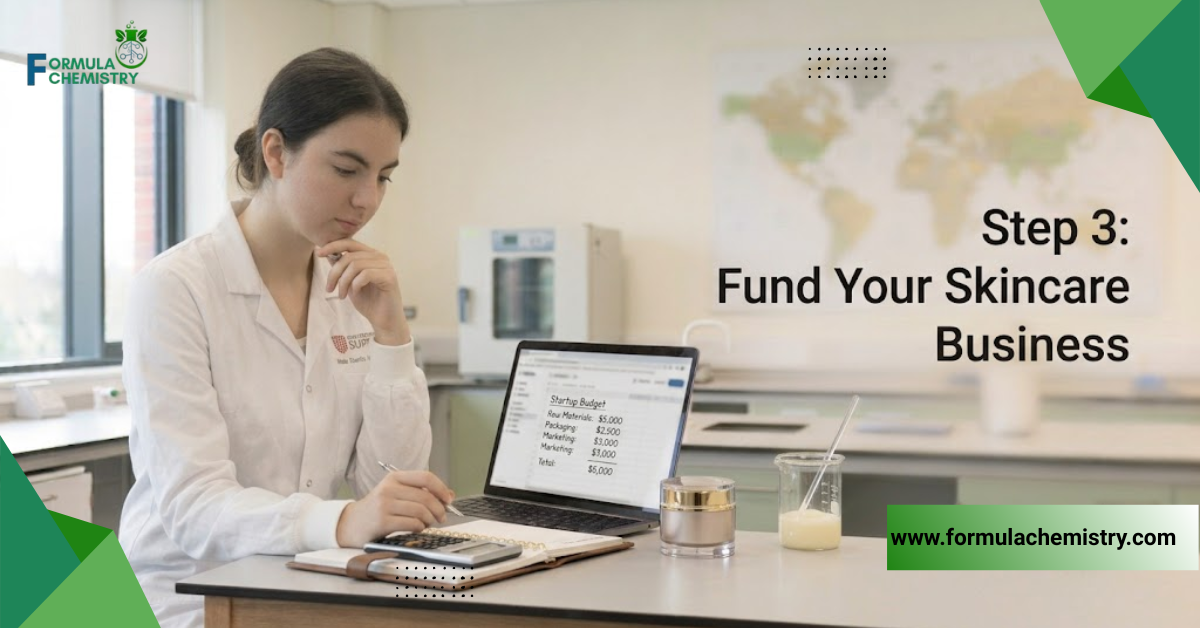
Common funding routes include personal savings, revenue reinvested from early sales, small business loans, and outside investment for larger plans. Bootstrapping from savings and early orders keeps you in control and forces discipline.
Match the funding to the model rather than the dream. Raising a large sum for an unproven brand adds pressure and dilution, so prove demand is small before you scale spending.
Step 4: Develop and Safety-Test Your Products
Product development is where formulation meets responsibility, and this step protects both customers and the business. You can formulate yourself, work with a formulator, or start from a tested base, but every product must be safe, stable, and compliant.
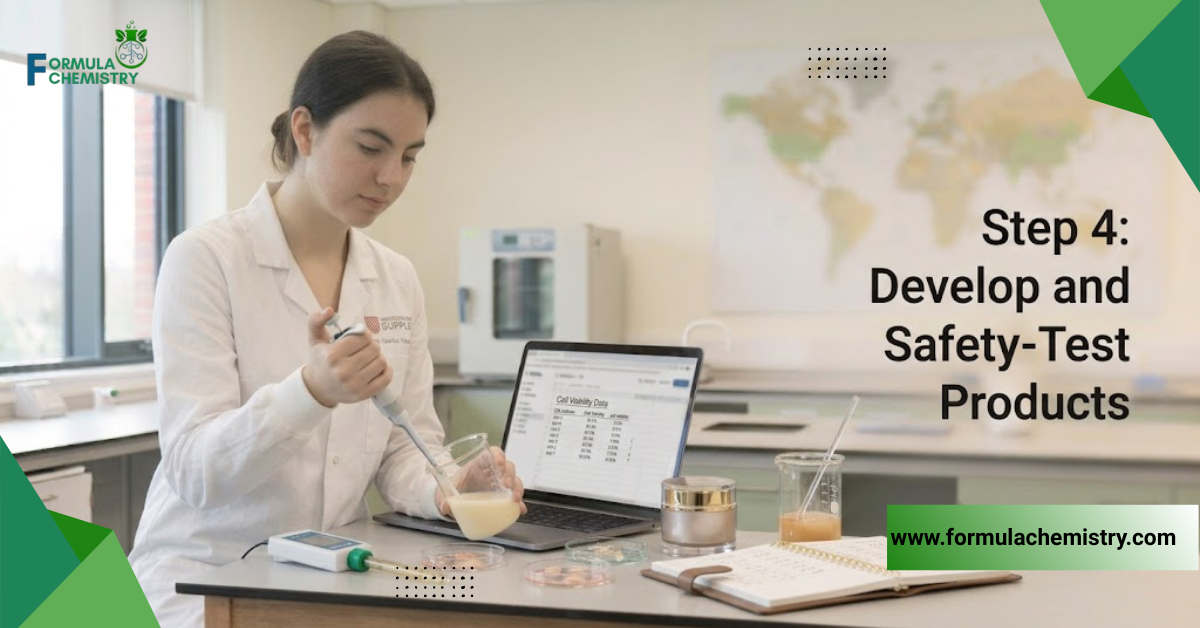
Three forms of testing matter before any product reaches a customer. Stability testing confirms the formula holds up over its shelf life, preservation testing confirms it resists microbial growth, and patch testing checks for irritation on skin.
Preservation deserves particular attention, since inadequately preserved products are a genuine safety risk rather than a cosmetic flaw. This is the stage where guidance from a resource like Formula Chemistry earns its place in your process.
Always conduct a 48-hour patch test with any new formula before wider use. Build safety documentation as you go, because you will need it for the registration step that follows.
Step 5: Register Your Business and Meet Cosmetic Regulations
Skincare business registration has two layers, and new founders often see only the first. You register the business entity itself under local law, and separately, you comply with the cosmetic regulations of every market where you sell.
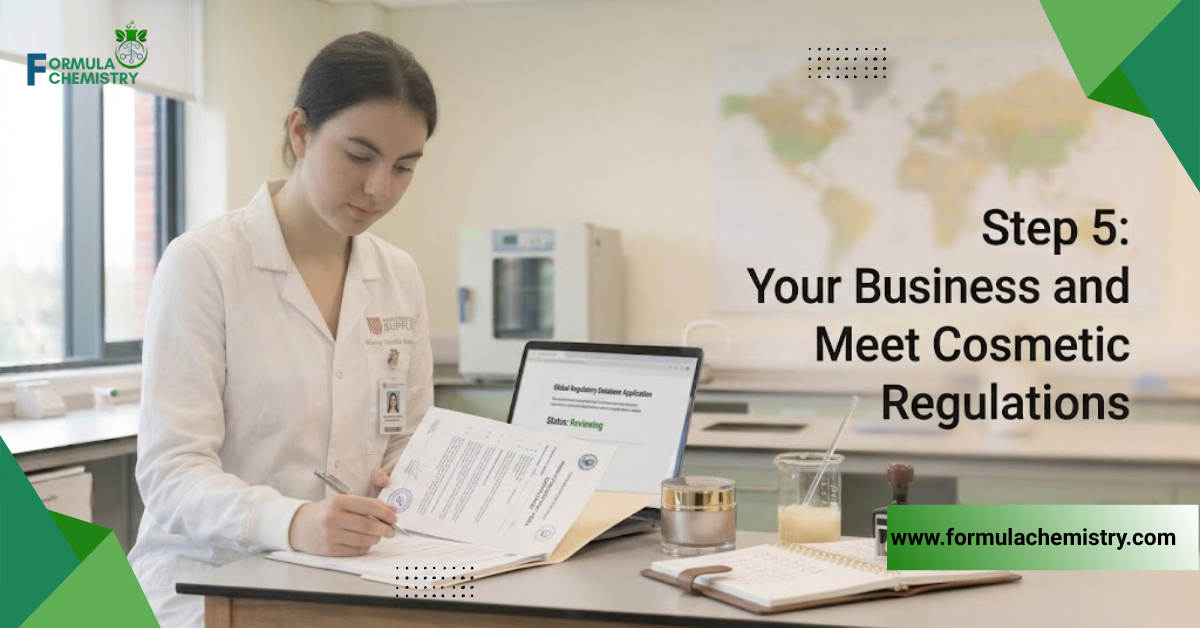
Cosmetic rules vary widely by country, so confirm the requirements with your national regulator before you launch. Selling into the United States means complying with the Modernization of Cosmetics Regulation Act of 2022, known as MoCRA, which replaced the old voluntary system.
Under MoCRA, facilities that manufacture cosmetics must register with the FDA, and the Responsible Person named on the label must list each product and its ingredients. The law also requires safety substantiation, meaning documented evidence that each product is safe under normal use.
Other regions run their own frameworks. The European Union requires a designated Responsible Person, a cosmetic product safety report, and notification through its portal, while the United Kingdom operates a similar separate system after Brexit.
Do not treat registration as paperwork to rush. Compliant labeling, safety records, and correct registration are what keep the business open when a regulator or retailer asks questions.
Step 6: Build Your Brand
Skincare business branding is more than a logo, and it is what lets you charge more than a commodity price. Your brand is the promise the customer buys, built from your niche, values, visual identity, and voice.

Strong branding starts from the niche you have already chosen. A clear position, an honest story, and consistent packaging and messaging turn a good product into one people remember and recommend.
Avoid overspending here before you have proven the product. Elegant packaging cannot rescue a formula that does not work or a niche no one wants, so validate first and polish second.
Step 7: Set Up Operations and Fulfillment
Skincare business operations cover how products get made, stored, and delivered reliably. Your first real choice is your manufacturing route, since it shapes cost, control, and how fast you can scale.

| Route | What it is | Best for | Trade-off |
| In-house | You formulate and produce yourself | Home starts and full control | Time, scaling limits, and full compliance burden |
| Private label | You rebrand a ready-made base product | A fast, low-cost first launch | Limited differentiation from competitors |
| Contract manufacturer | A factory makes your custom formula | Scaling a unique product | Higher order minimums and cost |
Beyond manufacturing, operations means dependable suppliers, sensible inventory, batch records, and a fulfillment method you can trust. Keep batch and supplier records from day one, because traceability is both a safety tool and a regulatory expectation.
Start simple and tighten as you grow. A lean, reliable operation beats an ambitious one that misses orders or loses track of batches.
Step 8: Market and Sell Your Products
Skincare business marketing connects the right product to the right people, and it works best when it flows from your niche. A focused brand speaking to a specific audience markets far more efficiently than a general one shouting at everyone.

An online skincare business is the most common and affordable starting point. Selling through your own store and established marketplaces lets you launch without physical retail, and social content plus email builds an audience over time.
Keep every claim honest and compliant. Describe what a product is formulated to do in cosmetic terms, and never promise to treat or cure a condition, since false claims invite both regulators and lawsuits.
Starting a Skincare Business From Home With Little Money
Starting from home with a small budget is realistic if you keep the scope tight. Begin with one or two well-tested products in a clear niche rather than a full range, and reinvest early sales instead of borrowing heavily.
Keep fixed costs low in the early months. Formulate in small validated batches, use lean packaging, and sell online first, which removes the cost of retail space and large inventory.
The constraint is a feature, not a flaw. A small start forces you to prove demand and get the product right before you risk real money, which is exactly the discipline larger launches often lack.
Two things must never be cut to save money, even at home. Product safety testing and basic regulatory compliance are non-negotiable because a preservation failure or a compliance gap can end the business entirely.
Common Mistakes When Starting a Skincare Business
New brands tend to fail in predictable ways, and each mistake below has a clear fix. Avoiding them is often the difference between a launch that survives and one that stalls.
The first mistake is skipping the business plan. Founders rush to product, then find the numbers never worked, so they build the plan and pressure-test the margins before spending.
Choosing too broad a niche is a second common error. A general line is hard to market and easy to ignore, so narrow it to one audience and one clear concern before you expand.
Underestimating regulation and safety substantiation is a third mistake. It feels like distant paperwork, yet missing registration or safety records can trigger recalls and border delays, so treat compliance as a launch requirement.
Launching without proper stability and preservation testing is a fourth error. Untested products fail in the field and endanger customers, so complete this testing before any sale, without exception.
Overspending on branding before product-market fit is a fifth mistake. Packaging cannot save an unwanted product, so validate demand first and invest in polish second.
Mispricing for margin is a sixth error. Founders price to feel competitive and lose money on every unit, so build pricing from true costs upward with a real margin.
The seventh mistake is trying to do everything alone. Formulating, producing, and scaling solo burns founders out, so use a private label or a contract manufacturer when it frees you to grow.
Which Path Fits You
The right starting point depends on your budget, skills, and appetite for risk. A cautious, low-budget founder is best served by a home-based, single-product online launch that proves demand before scaling.
Founders with capital and a distinctive product can start larger through a contract manufacturer. That route suits a unique formula aimed at meaningful volume, provided the demand evidence justifies the spend.
Those without formulation skills should consider private label or a formulator rather than stalling. It is better to launch a safe, tested product through a partner than to wait indefinitely for self-taught expertise.
Whatever your path, sequence beats speed. Move through niche, plan, product, safety, and registration in order, because a fast launch built on a skipped step rarely survives its first real test.
Frequently Asked Questions
How do I start a skincare business?
Start by choosing a focused niche, then write a business plan, secure funding, and develop safety-tested products. Register your business, meet the cosmetic regulations of your market, build your brand, and market to a defined audience. Following this order prevents the costly gaps that sink many new brands.
How much does it cost to start?
Costs range widely from a modest home-based budget to substantial capital for a broad, professionally manufactured line. A single well-tested product sold online can begin small. A multi-product range with contract manufacturing needs far more.
Can I start a skincare business from home?
Yes, many brands begin at home with one or two products in a clear niche. Keep batches small and validated and sell online to control costs. Product safety testing and regulatory compliance still apply fully, even from home.
Do I need a license to sell skincare?
You must register your business entity and comply with cosmetic regulations in every market you sell to. In the United States, this includes facility registration and product listing under MoCRA. Requirements vary by country, so confirm with your national regulator.
How do I start with no money?
Begin as lean as possible with a single product, low-cost packaging, and online sales, then reinvest early revenue. Prove demand before borrowing or raising funds. Never cut safety testing or compliance to save money, since those failures can end the business.
Do I need to formulate my own products?
No, you can formulate yourself, hire a formulator, or use private label and contract manufacturers. Self-formulating gives control but demands skill and compliance responsibility. Partnering lets you launch tested products without formulating from scratch.
How do I choose a skincare niche?
Pick one clear concern for one clear audience rather than trying to serve everyone. Validate that people actively search for and buy in that niche before committing. A focused niche is easier to formulate, market, and defend.
Is a skincare business profitable?
It can be profitable with disciplined pricing, a focused niche, and controlled costs. Margins depend heavily on the manufacturing route and the customer acquisition cost. Founders who price from true costs upward and validate demand early stand the best chance.
Key Takeaways
Learning how to start a skincare business is really about sequence: niche, plan, funding, product, registration, branding, operations, and marketing, in that order. Each step depends on a solid one beneath it, and skipping ahead is where new brands fail.
Product safety and regulatory compliance are non-negotiable at any budget. Stability testing, preservation, safety substantiation, and correct registration protect both customers and the business itself.
Start focused and prove demand before scaling spend. To take the first real step today, define one narrow niche and one product idea, then draft the financial section of your plan before spending on anything else.