
Quick Answer
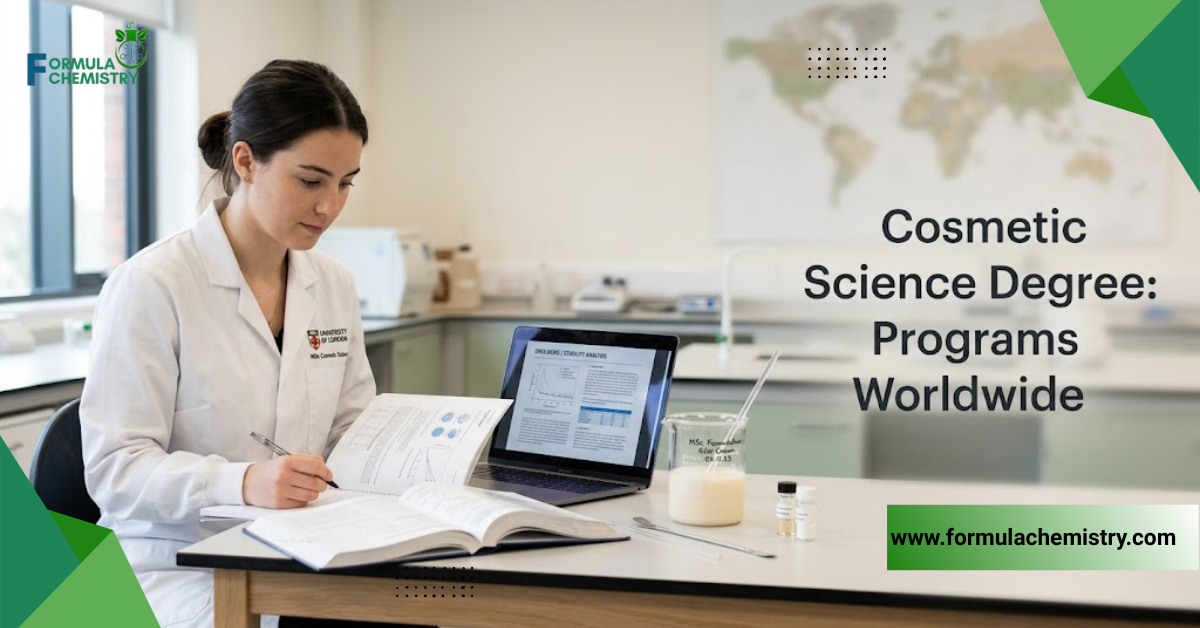
A cosmetic science degree teaches the formulation, chemistry, testing, and regulation of cosmetic and personal care products, and it is offered at bachelor’s, master’s, and doctoral levels across the UK, US, Asia, and Europe.
Recognised examples include the BSc in Pharmaceutical and Cosmetic Science at De Montfort University and the MS in Pharmaceutics with a Cosmetic Science specialization at Long Island University.
Fewer than a hundred universities worldwide run dedicated programs, so location, level, and industry links matter more than brand name when you choose.
Introduction
Anyone searching for a cosmetic science degree quickly hits the same wall I did years ago. The programs are scattered across a handful of countries, the titles vary, and it is hard to tell a serious science course from a beauty-therapy one dressed up in similar language.
This guide fixes that. It maps the real programs worldwide, sorted by region and level, so you can see your genuine options in one place.
I have worked alongside graduates of several of these courses and hired from a few. The right program depends less on prestige and more on level, industry connections, and whether the modules teach real formulation.
By the end, you will know what these degrees cover, how they compare to a chemistry degree, where to study at bachelor’s and master’s level, and what admission actually requires.
What a Cosmetic Science Degree Actually Covers
A strong cosmetic science degree blends chemistry, formulation, and product development rather than surface-level beauty content. The core teaches how raw materials behave, how to build a stable product, and how to test and regulate it.
Typical cosmetic science course modules move from foundations to application. Early study covers core cosmetic and chemical concepts and analytical techniques, then progresses to cosmetic formulation and the design, manufacture, and evaluation of finished products.
Later modules usually add regulation, marketing, sustainability, and a research project. That arc, sometimes called concept to consumer, is what separates a science degree from a cosmetology course.
Cosmetic Science Degree vs Chemistry Degree
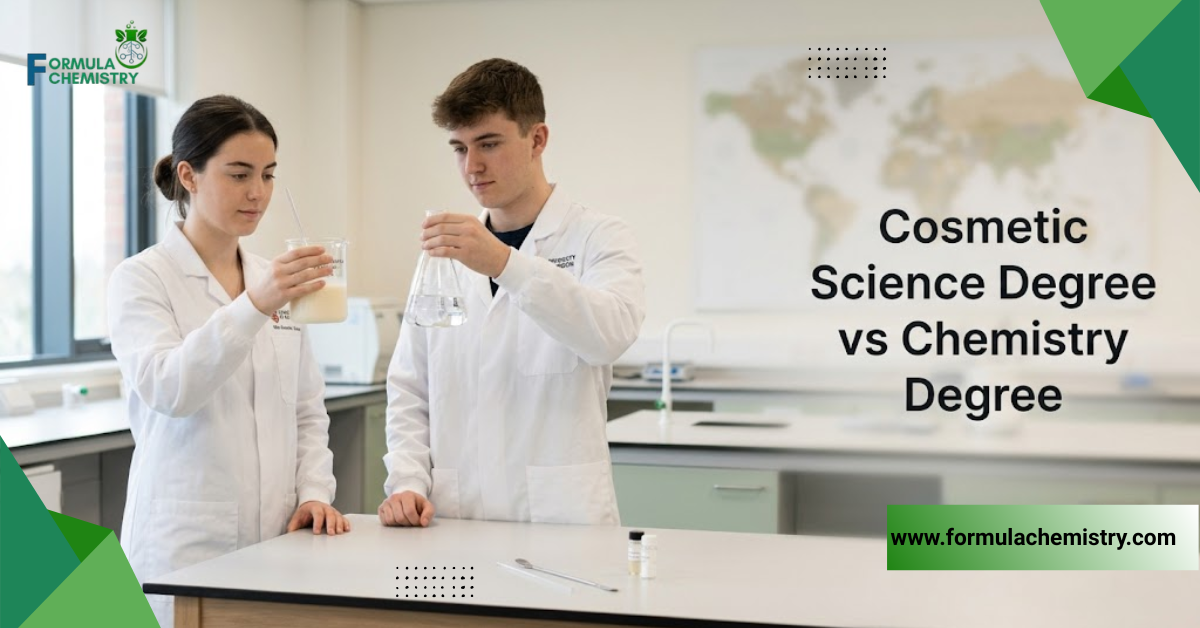
Many applicants weigh a specialised cosmetic science degree against a general chemistry degree, and both can lead to the industry. The difference is focus and flexibility rather than one being better outright.
| Aspect | Cosmetic Science Degree | General Chemistry Degree |
| Primary focus | Formulation and product development | Broad chemical theory and lab science |
| Industry alignment | Direct fit for cosmetics and personal care | Wide, adaptable across many sectors |
| Practical formulation | Central to the course | Usually minimal or absent |
| Career flexibility | Narrower but industry-ready | Broader across chemistry-based fields |
| Best for | Committed to cosmetics from the start | Wanting options beyond one industry |
Choose the specialised route if you already know cosmetics is your target and want to graduate industry-ready. Choose chemistry if you value flexibility and are willing to learn formulation on the job or through a later master’s.
Bachelor’s Versus Master’s Level
Cosmetic science bachelor’s programs suit school leavers who want direct entry into the field without a separate first degree. They build the science from the ground up over three to four years and often include a placement year.
Cosmetic science master’s programs suit graduates who already hold a science degree in chemistry, pharmacy, biology, or a related field. An MSc or MS typically runs one to two years and moves faster because it assumes existing scientific grounding.
Your current stage usually decides the level. A school leaver benefits from a BSc, while a science graduate saves time with a master’s rather than starting over.
Cosmetic Science Degree Programs Worldwide
Dedicated programs cluster in a few countries, with the UK and the US holding the largest concentrations. The table below lists verified universities by region and the levels each offers, drawn from institutional and industry sources.
| Region | University | Levels offered |
| UK | De Montfort University (Leicester) | BSc Pharmaceutical and Cosmetic Science |
| UK | University of Sunderland | BSc Cosmetic Science |
| UK | London College of Fashion (UAL) | Integrated MSc, with BSc exit |
| UK | Liverpool John Moores University | MSc Cosmetic Science |
| UK | University of Greenwich | MSc Formulation Science |
| US | Long Island University | MS Pharmaceutics, Cosmetic Science |
| US | Fairleigh Dickinson University | MS Cosmetic Science |
| US | University of Cincinnati | MS and certificate |
| US | University of Toledo | BS, certificate, MS in Cosmetic Science and Formulation Design |
| US | Rutgers University | MBS Personal Care Science |
| Asia | Mae Fah Luang University (Thailand) | BS, MS, PhD Cosmetic Science |
| Asia | Kaohsiung Medical University (Taiwan) | MA Cosmetic Science |
| Asia | Singapore Polytechnic | Diploma and specialist diploma |
| Europe | University of Hamburg (Germany) | Master’s in Cosmetic Science |
| Europe | ITECH Lyon (France) | Advanced Master’s in cosmetic formulation |
| Canada | Seneca College (Toronto) | Graduate certificate, co-op |
United Kingdom
The UK holds several of the most established options at both levels. De Montfort University runs a BSc in Pharmaceutical and Cosmetic Science through its Leicester School of Pharmacy, and it is one of the few UK degrees that combine pharmaceutics with cosmetics.
At the postgraduate level, Liverpool John Moores University offers an MSc in Cosmetic Science, and London College of Fashion runs an integrated MSc with a bachelor’s exit route. The University of Greenwich provides an MSc in Formulation Science as its closest cosmetic-focused postgraduate path.
United States
The US skews toward master’s and certificate programs rather than undergraduate degrees. Long Island University offers an MS in Pharmaceutics with a Cosmetic Science specialization, which it describes as the only program of its kind in New York City.
Fairleigh Dickinson University and the University of Cincinnati both run master’s routes, with Cincinnati also offering a certificate. The University of Toledo is one of the few US options spanning bachelor’s, certificate, and master’s in cosmetic science and formulation design.
Asia and the Pacific
Asia has strong, dedicated programs, some spanning the full academic ladder. Mae Fah Luang University in Thailand runs a School of Cosmetic Science offering bachelor’s, master’s, and doctoral degrees.
Taiwan and Singapore add further options. Kaohsiung Medical University offers a master’s, and Singapore Polytechnic provides diploma and specialist diploma routes into the field.
Europe and Canada
Beyond the UK, continental Europe offers several specialised master’s programs. The University of Hamburg runs a master’s in cosmetic science, and ITECH Lyon in France offers an advanced master’s focused on cosmetic formulation and industrialisation.
In Canada, Seneca College in Toronto runs a cosmetic science graduate certificate with a co-op component. That route suits graduates who want an applied, shorter qualification with work experience built in.
Admission Requirements
Cosmetic science admission requirements vary by level and country, but a science background is the common thread. Undergraduate programs such as the De Montfort BSc typically ask for chemistry at A-level or equivalent, plus a second science subject.
Master’s programs expect a relevant bachelor’s degree in chemistry, pharmacy, biology, or chemical engineering. International applicants usually need proof of English proficiency through IELTS or TOEFL alongside their academic transcripts.
Applicants without the exact grades are not always shut out. Several universities offer foundation or year-zero routes that build the required science before you enter the main degree.
Common Mistakes When Choosing a Program
Choosing a program goes wrong in predictable ways, and each error below has a clear fix. Getting these right saves both money and years.
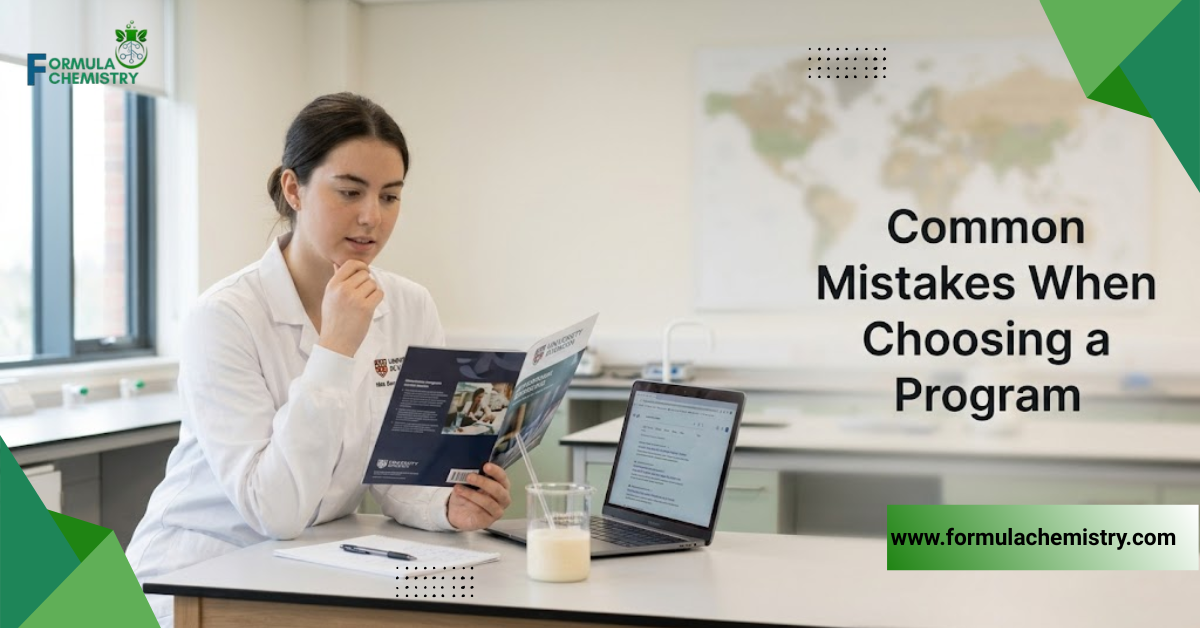
The first mistake is assuming a cosmetic science degree is the only way into the industry. It is not, since chemistry, pharmacy, and chemical engineering graduates also enter formulation, so weigh the specialised degree against a broader one.
Confusing cosmetic science with cosmetology or beauty therapy is a second common error. The names sound similar, yet only the science degree teaches chemistry and formulation, so confirm the course is laboratory-based before applying.
Ignoring industry links and placements is a third mistake. Applicants focus on rankings alone, but programs with placement years and employer connections produce far more job-ready graduates, so prioritise those.
Overlooking master’s options when you already hold a science degree is a fourth error. Restarting at a bachelor’s wastes years, whereas an MSc or MS builds directly on what you already have.
Not reading the module list before applying is a fifth mistake. Prospectus marketing can hide thin content, so check for real formulation, preservation, and analytical modules rather than generic descriptions.
The sixth error is limiting your search to one country. Strong programs exist across the UK, US, Asia, and Europe, and several offer online study, so widening the net reveals better-fitting options.
Which Program Fits You
School leavers who are certain about cosmetics benefit most from a bachelor’s route, such as De Montfort, Sunderland, Toledo, or Mae Fah Luang. These build the full science from scratch and often include industry placements.
Science graduates should target a master’s instead of repeating undergraduate study. Options like Long Island University, Fairleigh Dickinson, Liverpool John Moores, and the University of Hamburg assume prior grounding and move faster.
Career changers balancing work should look at online and part-time routes, which several universities now offer. That flexibility lets you retrain without leaving employment entirely.
If you are undecided, compare module lists and placement records before ranking programs, since a course that looks prestigious on paper matters less than one that teaches formulation and connects you to employers, a point every honest guide at Formula Chemistry keeps returning to.
Frequently Asked Questions
What is a cosmetic science degree?
It is an academic program covering the chemistry, formulation, testing, and regulation of cosmetic and personal care products. Courses span bachelor’s, master’s, and doctoral levels depending on the university. The focus is on scientific product development rather than applied beauty treatment.
Which universities offer cosmetic science?
Established options include De Montfort University, Long Island University, the University of Toledo, and Mae Fah Luang University, among others. Programs exist across the UK, the US, Asia, and Europe. Fewer than a hundred universities worldwide run dedicated degrees.
Can you do cosmetic science at a bachelor’s level?
Yes, several universities offer bachelor’s degrees, including De Montfort, Sunderland, Toledo, and Mae Fah Luang. These suits suit school leavers entering the field directly. Many other institutions offer the subject only at the master’s level.
Is cosmetic science a good degree?
It is a strong choice for anyone committed to the cosmetics and personal care industry. The degree is industry-aligned and can lead to formulation, product development, and research roles. Those wanting broader options may prefer a general chemistry degree instead.
How does it compare to a chemistry degree?
A cosmetic science degree is more specialised and industry-ready, while a chemistry degree is broader and more flexible. The specialised route teaches formulation directly, whereas chemistry covers wider theory. Both can lead to the cosmetics industry.
What are the entry requirements?
Undergraduate programs typically require chemistry plus a second science at A-level or equivalent. Master’s programs expect a relevant science bachelor’s degree. International students usually need English proficiency through IELTS or TOEFL.
Do you need chemistry to apply?
For most undergraduate programs, chemistry at A-level or its equivalent is expected. Master’s applicants need a science degree, which usually includes chemistry. Foundation routes exist for those without the required grades.
Is there an online cosmetic science degree?
Yes, some universities offer online or partly online master’s and certificate programs. These suit working professionals who cannot relocate or study full-time. Check whether any laboratory components require on-site attendance.
Key Takeaways
A cosmetic science degree is offered worldwide at bachelor’s, master’s, and doctoral levels, concentrated in the UK, US, Asia, and Europe. Your current stage usually decides the level, with school leavers suited to a BSc and science graduates to a master’s.
Judge programs on modules, placements, and industry links rather than name recognition alone. Confirm the course is genuinely science-based, since cosmetic science and cosmetology are not the same thing.
Weigh the specialised degree honestly against a broader chemistry degree before committing. To move forward, shortlist three programs at your level this week and compare their module lists and placement records side by side.