
By Dr. SamiUllah, PhD Lead Formulator, Formula Chemistry
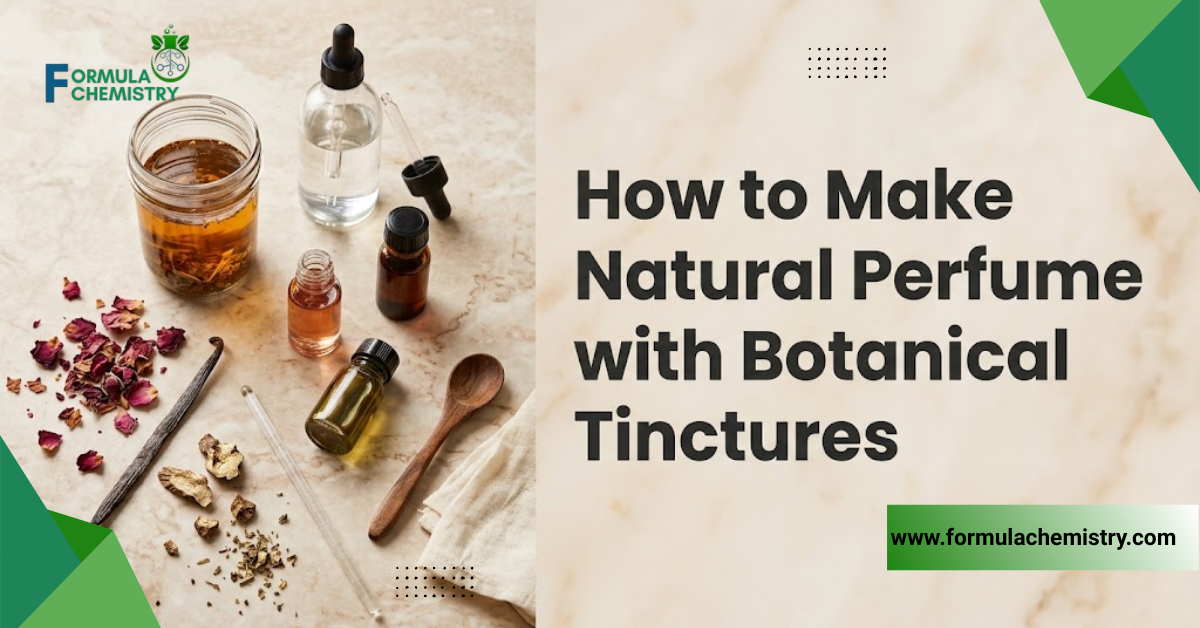
Quick Answer: To learn how to make natural perfume, dissolve 15% essential oils and absolutes (built 30% top, 30% heart, 40% base) in 72% organic undenatured Alcohol (96% ethanol, CAS 64-17-5) with 10% homemade Vanilla Planifolia Fruit Extract tincture, 2.9% water, and 0.1% natural tocopherol. Macerate for 6 to 8 weeks, chill at 2 to 5°C for 48 hours, and filter cold, because botanical absolutes carry more waxes than any other perfume material.
Why Is a Truly Natural Perfume Harder Than It Looks?
Most recipes sold as natural perfume quietly break their own promise. They use perfumer’s alcohol with synthetic denaturants, fragrance oils labeled “nature identical,” or a fixative that came from a lab rather than a plant.
This guide shows how to make natural perfume with a fully botanical palette, from the solvent to the fixative. Every material comes from a plant, and two of them you make yourself as tinctures.
Botanical perfumery also behaves differently at the bench. Natural materials evaporate faster, vary between harvests, and contain waxes that synthetics never do, so the formula and the process both need adjusting.
I have run botanical batches that smelled better than any synthetic accord I could build, and others that collapsed within an hour. The difference almost always came from three decisions: the alcohol, the base structure, and patience with maceration.
What Makes a Perfume Genuinely Natural?
A natural perfume uses only materials obtained from plants by physical processes: distillation, expression, solvent extraction, and tincturing. It excludes synthetic aroma chemicals, nature identical molecules, and petrochemical solvents in the final product.
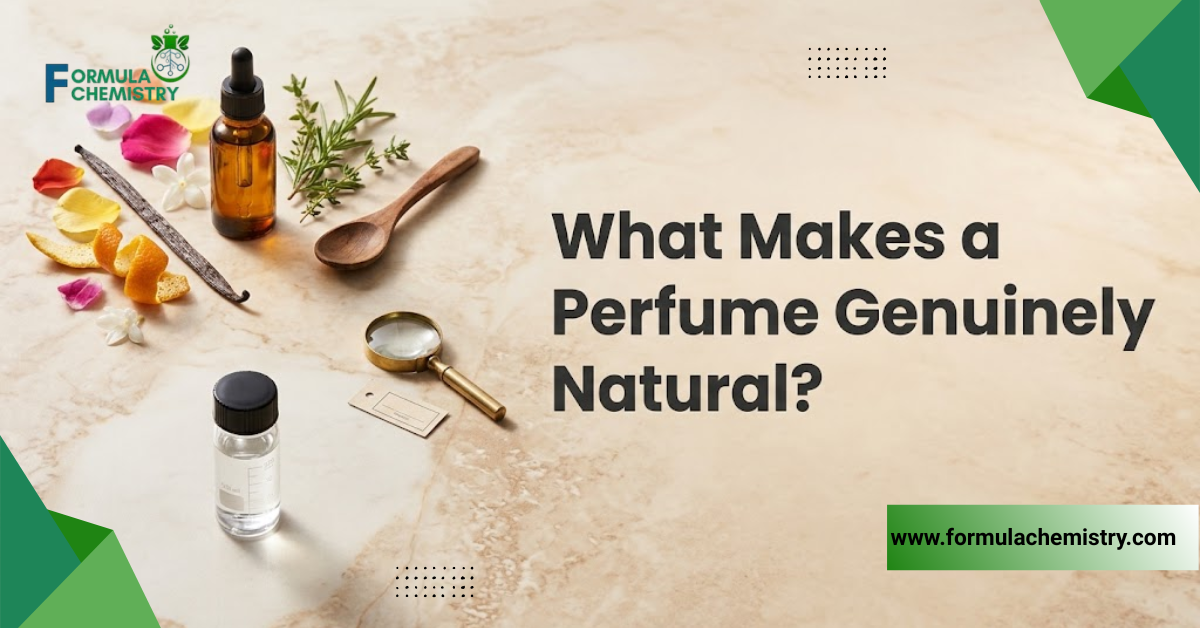
No legal definition of “natural” exists for cosmetics in the US or the EU. ISO 16128 offers a calculation method for natural origin content, and certification bodies such as COSMOS set their own criteria, so any seller must choose a standard and follow it exactly.
The four material types in botanical perfumery are:
- Essential oils, produced by steam distillation or cold expression, such as lavender and bergamot
- Absolutes, produced by solvent extraction and alcohol washing, such as jasmine and rose
- CO2 extracts, produced with supercritical carbon dioxide, which often smell closest to the living plant
- Tinctures, produced by soaking plant material in alcohol for weeks, such as vanilla and benzoin
Absolutes involve a hexane extraction step, and trace solvent remains below regulated limits. Some natural perfumers accept absolutes for this reason, while stricter makers use only CO2 extracts; decide your position before you buy materials.
Natural vs Synthetic Perfume: What Actually Changes?
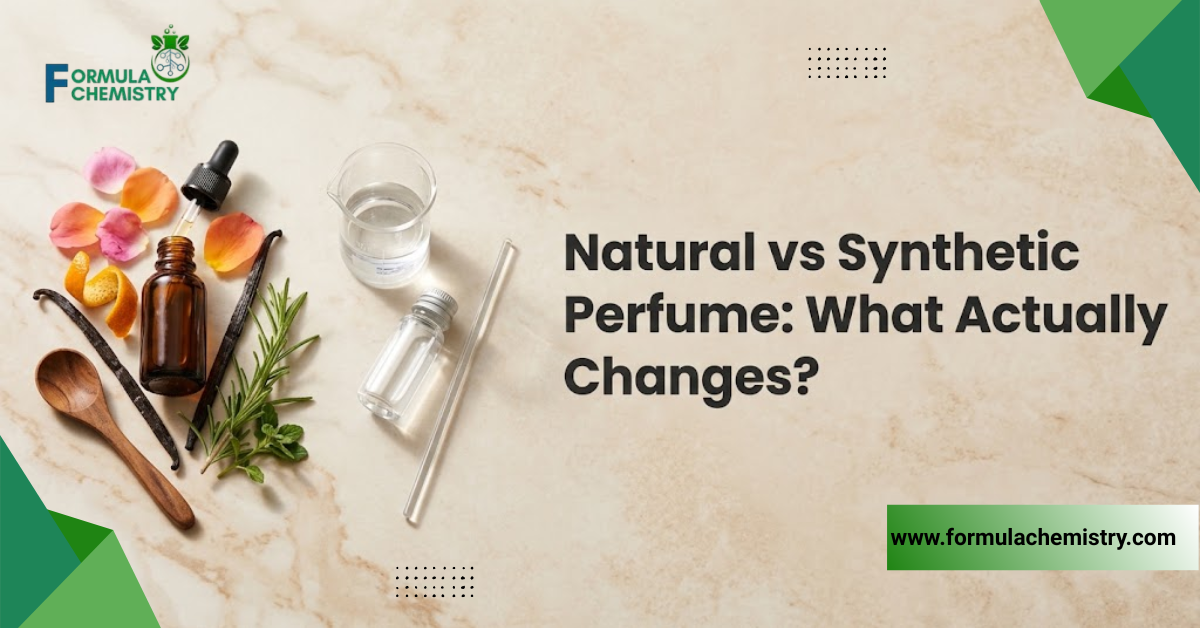
Choosing a fully botanical palette changes far more than the ingredient list. It shifts how long the scent lasts, how consistent each batch is, and what you can honestly print on a label.
| Factor | 100% Natural Perfume | Mixed or Synthetic Perfume |
| Materials | Essential oils, absolutes, CO2 extracts, tinctures | Naturals plus aroma chemicals such as hedione and Iso E Super |
| Solvent | Organic undenatured Alcohol | Usually Alcohol Denat. |
| Typical wear on skin | 2 to 4 hours | 4 to 8 hours |
| Batch consistency | Varies with harvest and distillation | Highly repeatable |
| Base structure needed | About 40% of the concentrate | About 25 to 30% of the concentrate |
| Declarable allergen load | Often higher | Often lower and easier to control |
| Cost per gram of concentrate | High, especially florals and sandalwood | Lower for comparable strength |
| Label claim | Can support a “natural” claim under a chosen standard | Cannot claim natural |
Neither approach is better in every case. A botanical perfume trades longevity and consistency for traceability and a living, shifting character that many wearers prefer.
The rest of this guide covers only the botanical route. Every material, ratio, and process step below assumes that no synthetic aroma chemical or denaturant enters the bottle.
Why Does the Alcohol Decide Whether Your Perfume Is Natural?
Standard perfumer’s alcohol is denatured ethanol. Denaturants such as denatonium benzoate and tert butyl alcohol make it undrinkable and cheaper to tax, but both are synthetic.
A fully botanical perfume uses organic, undenatured ethanol at 96%, distilled from grapes, sugar cane, or grain. Its INCI name is simply Alcohol, not Alcohol Denat., and that single word on a label tells buyers what you used.
Undenatured alcohol costs more and faces stricter purchase rules in most countries. Check your local regulations and supplier licensing before you plan a batch around it.
Grape alcohol gives the cleanest, most neutral drydown in my tests. Cane alcohol runs a close second, while grain alcohol can carry a faint cereal note that clashes with delicate florals.
Can a natural perfume use an oil carrier instead?
Yes, and many botanical perfumers prefer it. A cold pressed carrier such as jojoba oil is naturally stable and nearly odorless, which makes it a clean base for roll on blends.
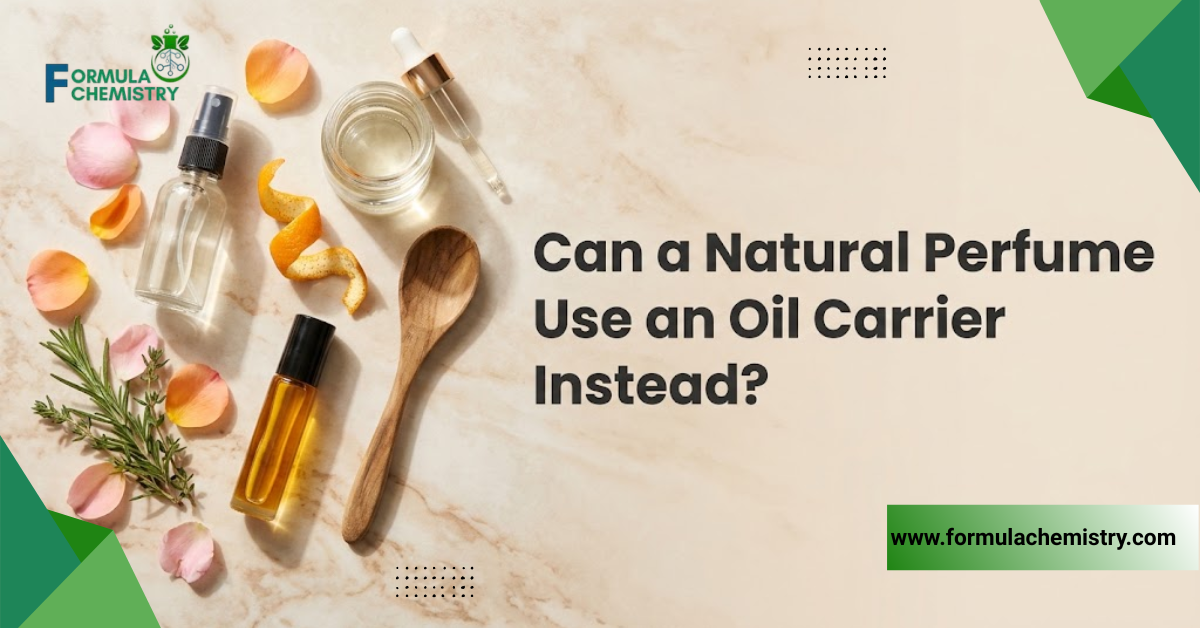
Oil carriers wear closer to the skin and need no maceration filter. The full ratios and methods sit in our guide on how to make perfume oil, while this article stays with the alcohol spray format.
Which Natural Fixatives Actually Hold a Scent?
Natural materials lose their top and heart notes faster than synthetics, because most synthetic perfumes lean on large, slow musks and woody molecules. A botanical perfume must replace that work with plant based fixatives.
These are the fixatives I rely on most:
- Sandalwood (Australian, Santalum spicatum) for creamy, persistent wood with far fewer sustainability concerns than Indian sandalwood
- Vetiver for smoky, earthy depth that can last on fabric for days
- Labdanum, a sticky resin from rockrose, for warm amber and leathery richness
- Vanilla tincture for soft sweetness that rounds sharp edges
- Ambrette seed, the botanical answer to animal musk, used in tiny amounts
- Benzoin for balsamic warmth when vanilla feels too sweet
Botanical perfumes need more base than synthetic ones. I set base notes at 40% of the concentrate, compared with about 30% in a mixed palette formula.
What about oakmoss and tonka beans?
Oakmoss gives the classic chypre base, but IFRA heavily restricts it because of the sensitizers atranol and chloroatranol. Labdanum and vetiver together create a similar dark, mossy warmth without that restriction.
Tonka bean contains coumarin, which carries its own IFRA limits. Use it only after checking the current standard for your product category.
Making Your Own Vanilla Tincture
Vanilla absolute is expensive and often adulterated with synthetic vanillin. A homemade tincture gives you a verifiably natural vanilla note for a fraction of the cost.
| Phase | INCI Name | Common Name | Percentage |
| A | Vanilla Planifolia Fruit | Vanilla beans, split and chopped | 10.00% |
| B | Alcohol | Organic undenatured ethanol, 96% | 90.00% |
| Total | 100.00% |
For a 200 g batch, use 20.00 g chopped vanilla beans and 180.00 g alcohol. That amount supplies enough tincture for twenty 100 g perfume batches at the 10% level.
Split each bean lengthwise, scrape the seeds into the jar, and cut the pods into 1 cm pieces. More cut surface means faster extraction.
Seal the jar, store it in the dark at room temperature, and shake it every few days. Extraction takes 6 to 8 weeks, and the tincture turns deep amber when ready.
Filter the tincture through an unbleached coffee filter and store it in amber glass. Record the harvest origin and date, since Madagascar, Tahiti, and Indian beans all smell noticeably different.
Can you tincture other materials the same way?
Benzoin resin, tonka beans, and dried orris root all tincture well in 96% alcohol. Use 10 to 20% plant material by weight, then extend the time to 8 to 12 weeks for resins and roots.
Fresh flowers make disappointing tinctures, because their water content dilutes the alcohol and their scent molecules sit at very low levels. Leave florals to absolutes and CO2 extracts.
How to Make Natural Perfume: The Botanical Eau de Parfum Formula
This formula produces a warm floral amber: bergamot and petitgrain up top, lavender, jasmine, and rose in the heart, and sandalwood, vetiver, and labdanum underneath. Vanilla tincture ties the drydown together.
| Phase | INCI Name | Common Name | Percentage |
| A (Top) | Citrus Aurantium Bergamia (Bergamot) Fruit Oil | Bergamot oil FCF | 3.00% |
| A (Top) | Citrus Aurantium Amara (Bitter Orange) Leaf/Twig Oil | Petitgrain oil | 1.50% |
| A (Heart) | Lavandula Angustifolia (Lavender) Oil | Lavender oil | 3.00% |
| A (Heart) | Jasminum Grandiflorum (Jasmine) Flower Extract | Jasmine absolute | 1.20% |
| A (Heart) | Rosa Damascena Flower Oil | Rose otto | 0.30% |
| A (Base) | Santalum Spicatum Wood Oil | Australian sandalwood oil | 3.00% |
| A (Base) | Vetiveria Zizanoides Root Oil | Vetiver oil | 1.50% |
| A (Base) | Cistus Ladaniferus Resin Extract | Labdanum absolute | 1.30% |
| A (Base) | Hibiscus Abelmoschus Seed Oil | Ambrette seed oil | 0.20% |
| B | Vanilla Planifolia Fruit Extract | Homemade vanilla tincture | 10.00% |
| B | Alcohol | Organic undenatured ethanol, 96% | 72.00% |
| B | Tocopherol | Natural vitamin E | 0.10% |
| C | Aqua | Distilled water | 2.90% |
| Total | 100.00% |
Phase A totals 15.00%, split into 4.50% top, 4.50% heart, and 6.00% base. That gives the 30/30/40 structure that natural materials need to hold together through the drydown.
To scale, multiply each percentage by your batch weight and divide by 100. A 50 g batch uses 1.50 g bergamot, 0.75 g petitgrain, 1.50 g lavender, 0.60 g jasmine, 0.15 g rose, 1.50 g sandalwood, 0.75 g vetiver, 0.65 g labdanum, 0.10 g ambrette, 5.00 g vanilla tincture, 36.00 g alcohol, 0.05 g tocopherol, and 1.45 g water, for a total of 50.00 g.
The vanilla tincture adds about 1% plant extractives, so the effective aromatic content sits near 16%. That places this blend firmly in eau de parfum territory.
Why each material earns its place
Citrus Aurantium Bergamia (Bergamot) Fruit Oil gives a bright opening, and the FCF grade removes the phototoxic bergapten. Petitgrain adds a green, slightly woody citrus that lasts longer than bergamot alone.
Lavandula Angustifolia (Lavender) Oil bridges citrus and florals through its linalool and linalyl acetate content. Our profile of lavender essential oil explains why high altitude French lavender smells softer than most commercial grades.
Jasminum Grandiflorum (Jasmine) Flower Extract gives the heart its richness and a faint indolic warmth. The profile of jasmine essential oil covers the difference between grandiflorum and sambac, which matters when you substitute.
Rose otto works at just 0.3% because its damascones register at extremely low concentrations. Ambrette at 0.2% adds a soft, skin like musk that makes the whole blend feel finished.
Where does classic cologne fit in natural perfumery?
The original eau de cologne of the early 1700s was fully botanical: bergamot, lemon, neroli, and rosemary in grape alcohol. It remains one of the easiest natural formats to master because it relies on fresh top notes rather than expensive bases.
Its concentration and structure differ sharply from an eau de parfum, so it follows its own method. Our guide on how to make cologne covers the light citrus format in full.
How Do You Substitute Materials Without Breaking the Formula?
Every natural perfumer eventually runs out of a material or finds it too expensive. Knowing how to make natural perfume flexibly means swapping like for like at the same weight, so the structure and the 100.00% total stay intact.
| Original Material | Same Weight Substitute | What Changes in the Scent |
| Jasminum Grandiflorum (Jasmine) Flower Extract | Jasminum Sambac Flower Extract | Greener, fruitier, and more tea like |
| Santalum Spicatum Wood Oil | Amyris Balsamifera Bark Oil | Drier and lighter, with less creaminess and shorter wear |
| Cistus Ladaniferus Resin Extract | Styrax Tonkinensis Resin Extract (benzoin) | Sweeter and more vanilla leaning, with less leathery depth |
| Citrus Aurantium Amara (Bitter Orange) Leaf/Twig Oil | Citrus Aurantium Dulcis (Orange) Peel Oil | Sweeter and juicier, but fades faster |
| Rosa Damascena Flower Oil | Pelargonium Graveolens Flower Oil | Greener and more minty rose at far lower cost |
Swap one material per batch, never several at once. Changing a single variable is the only way to learn what each substitution actually does.
Smell the substitute next to the original on blotters before you commit. Two oils with the same name can differ more than two oils with different names.
Amyris is the most useful budget swap, because it costs a fraction of sandalwood and still fixes well. Expect the drydown to lose about an hour of wear, and consider moving vetiver up slightly in future versions.
Each substitute carries its own IFRA limits and allergen profile. Check both before finalizing any changed formula.
Blending and Maceration, Step by Step
Botanical blends take longer to settle than synthetic ones, and they reward a slower process. Work in a ventilated room away from any flame, because ethanol vapor ignites easily.
- Rinse all glassware with a little alcohol and let it air dry. Label the maceration bottle with the formula name, batch weight, and date.
- Warm the labdanum absolute container in your hand for a few minutes, since it becomes very thick in cool rooms. Weigh it into a small beaker with 10 g of the alcohol and swirl until dissolved.
- Place the maceration bottle on the scale and add the sandalwood, vetiver, and ambrette directly, then add the dissolved labdanum.
- Add the jasmine, rose, and lavender, followed by the petitgrain and bergamot. Moving from heaviest to lightest limits the loss of volatile citrus.
- Pour in the vanilla tincture, the remaining alcohol, and the tocopherol, then cap and swirl for one minute.
- Finish with the distilled water a few drops at a time, swirling after each addition. Stop the moment you see haze and record the amount actually used.
- Store the sealed bottle in a dark cupboard at 18 to 25°C for 6 to 8 weeks, swirling gently once a week.
Rose otto solidifies below about 20°C because of its stearoptene content. Warm the bottle in your palm until it flows before weighing, or the amount you draw will be inaccurate.
Chilling and filtering a botanical blend
Absolutes carry plant waxes that stay dissolved at room temperature and drop out later as haze. Botanical perfumes throw more sediment than any other type, so this step matters here more than anywhere else.
Refrigerate the sealed bottle at 2 to 5°C for 48 hours after maceration. Filter it cold through an unbleached coffee filter, then filter once more through a fresh paper for a clearer finish.
Expect a thin layer of wax on the first filter. That residue is a normal sign of genuine absolutes, not a fault in your batch.
Four Botanical Variants From One Accord
These variants keep the same scent direction while changing strength or cost. Every column totals exactly 100.00%.
| INCI Name | EDT 7.5% | EDP 15% (Base) | Extrait 22.5% | Budget EDP |
| Citrus Aurantium Bergamia (Bergamot) Fruit Oil | 1.50% | 3.00% | 4.50% | 3.00% |
| Citrus Aurantium Amara (Bitter Orange) Leaf/Twig Oil | 0.75% | 1.50% | 2.25% | 1.50% |
| Lavandula Angustifolia (Lavender) Oil | 1.50% | 3.00% | 4.50% | 4.50% |
| Jasminum Grandiflorum (Jasmine) Flower Extract | 0.60% | 1.20% | 1.80% | 0.00% |
| Rosa Damascena Flower Oil | 0.15% | 0.30% | 0.45% | 0.00% |
| Santalum Spicatum Wood Oil | 1.50% | 3.00% | 4.50% | 3.20% |
| Vetiveria Zizanoides Root Oil | 0.75% | 1.50% | 2.25% | 1.50% |
| Cistus Ladaniferus Resin Extract | 0.65% | 1.30% | 1.95% | 1.30% |
| Hibiscus Abelmoschus Seed Oil | 0.10% | 0.20% | 0.30% | 0.00% |
| Vanilla Planifolia Fruit Extract | 5.00% | 10.00% | 15.00% | 10.00% |
| Alcohol | 82.40% | 72.00% | 62.40% | 72.00% |
| Tocopherol | 0.10% | 0.10% | 0.10% | 0.10% |
| Aqua | 5.00% | 2.90% | 0.00% | 2.90% |
| Total | 100.00% | 100.00% | 100.00% | 100.00% |
The Budget EDP removes jasmine, rose, and ambrette, which together make up most of the material cost. Extra lavender and sandalwood keep the heart and base at their original weights, so the structure stays intact.
The extrait contains no water, because high oil loads cloud easily. Check every material against current IFRA limits before making it, since higher concentration pushes restricted materials closer to their ceilings.
Safety Rules That Natural Does Not Remove
Natural origin says nothing about safety. Essential oils and absolutes are complex chemical mixtures, and many contain the same regulated allergens found in synthetic fragrance.
IFRA Standards limit many botanical materials by product category, including jasmine, rose, labdanum, and citrus oils. The 51st Amendment was current at the time of writing; confirm the latest version and limits before finalizing any formula.
Natural perfumes typically contain higher levels of declarable fragrance allergens such as linalool, geraniol, citronellol, eugenol, and limonene.
The EU expanded its allergen labeling list in 2023, so sellers must check current declaration thresholds for their market.
Rose otto contains small amounts of methyl eugenol, which IFRA also restricts. At 0.3% in this formula it falls well within typical limits, but verify the figure for your specific oil and its certificate of analysis.
Eight Mistakes That Undermine a Botanical Perfume
Each of these has cost me a batch or a customer’s trust at some point. The fixes are simple once you see the pattern behind them.
Calling a perfume natural while using denatured alcohol
Perfumer’s alcohol is the default in most tutorials, so few people question it. Its denaturants are synthetic, which breaks any 100% natural claim.
Use organic undenatured ethanol and list it as Alcohol on the label. If you cannot source it, describe the perfume honestly as made with natural aromatics.
Buying fragrance oils labeled natural
Many suppliers sell fragrance oils with names like “natural jasmine.” Most are synthetic blends, sometimes with a small natural fraction.
Buy only materials sold with a botanical name, extraction method, and origin. Ask for a GC/MS report or certificate of analysis on anything expensive.
Using a synthetic style base ratio
Recipes written for mixed palettes often suggest 25 to 30% base. Natural top and heart notes fade so quickly that this leaves the drydown thin and short.
Set base notes at 40% of the concentrate. Sandalwood, vetiver, and labdanum carry the scent where synthetic musks would in a commercial perfume.
Rushing the vanilla tincture
Two weeks of soaking looks dark enough, so impatience wins. The color develops far faster than the aroma, and early tinctures smell thin and boozy.
Wait a full 6 weeks at minimum and smell the tincture on a blotter before using it. A ready tincture smells rich and creamy, with no sharp alcohol edge.
Overdosing jasmine or rose
Absolutes smell beautiful straight from the bottle, which tempts heavy use. At high levels, jasmine turns sharply indolic and rose becomes soapy and flat.
Keep jasmine at 1.5% or less and rise at 0.5% or less of the finished perfume. Their power comes from precision, not quantity.
Trusting cheap sandalwood or jasmine
Low prices look like a bargain for expensive materials. Sandalwood is widely cut with cedarwood or synthetic sandalwood molecules, and cheap jasmine is often a reconstruction.
Pay attention to the price per gram and buy small quantities from specialist suppliers first. If the price seems too good for genuine material, it almost certainly is.
Skipping the cold filter
Clear perfume at bottling feels finished. Absolute waxes appear weeks later as haze or a fine powder at the bottom of the spray bottle.
Chill for 48 hours and filter cold, twice if needed. Botanical perfumes deserve this step more than any other type.
Expecting identical batches every time
Commercial perfumes smell the same every year, so people assume their own should too. Natural materials change with harvest, weather, and distillation, and each batch reflects that.
Record the supplier batch number for every material. Adjust by blotter when a new lot smells different, and accept small variations as part of botanical perfumery.
Fixing a Botanical Batch That Went Wrong
Most problems show up during maceration or the first week of wear. The table below maps each symptom to its likely cause and correction.
| Problem | Likely Cause | Fix |
| Heavy haze after maceration | Waxes from absolutes | Chill at 2 to 5°C for 48 hours and filter cold twice |
| Milky liquid right after mixing | Too much water or wet tincture | Add undenatured alcohol in 2 g steps until clear, and use less water next time |
| Scent gone within an hour | Base below 40% of the concentrate | Raise sandalwood and vetiver, or move to the Extrait variant |
| Sharp alcohol opening | Maceration too short | Age another 2 to 4 weeks in the dark |
| Sour, flat citrus | Oxidized bergamot or petitgrain | Replace old citrus oils and store cooler and darker |
| Soapy, harsh floral heart | Rose or jasmine overdosed | Rebuild with rose at 0.3% or less and jasmine at 1.2% or less |
| Grainy or cereal undertone | Grain alcohol | Switch to grape or cane alcohol for the next batch |
Adding alcohol to rescue a cloudy batch lowers its concentration. Record the new total weight and recalculate every percentage in your notes.
How Long Does Natural Perfume Keep?
Botanical perfumes stored in dark glass at room temperature usually remain pleasant for 1 to 2 years. Citrus notes fade first, while sandalwood, vetiver, and labdanum often grow smoother with age.
Watch for a sour opening, a flattened citrus note, or a sharp change in color. Any of these means the blend has oxidized past its best.
Fill small spray bottles from a sealed master bottle rather than opening the whole batch repeatedly. Air contact is the main driver of decline in natural blends.
Keep a 5 mL reference sample of every batch sealed in the refrigerator. Comparing it with the working bottle after six months shows you exactly how your materials age.
Is Botanical Perfumery Right for You?
This method suits makers who value ingredient transparency over perfect consistency. It asks for more patience and money than a mixed palette formula, and it gives back a scent that changes and deepens on skin.
This method works well for:
- Makers who want every ingredient traceable to a plant and are willing to source carefully
- Small natural beauty brands building a certified or clearly labeled natural line
- Hobbyists who enjoy tinctures, long maceration, and batch to batch variation
It calls for extra care from:
- Anyone with a known fragrance allergy or contact dermatitis, since natural blends often carry more allergens than synthetic ones
- People with eczema or very dry skin, who may tolerate an oil carrier better than alcohol
- Anyone spending long hours in the sun, who must use only FCF bergamot and avoid other expressed citrus on exposed skin
- People with asthma or sensitive airways, who should spray onto clothing rather than into the air
- Children, who should not use concentrated perfumes
Always conduct a 48-hour patch test with any new formula before wider use.
Natural Perfume Questions, Answered
Is natural perfume safer than synthetic?
Not automatically. Essential oils and absolutes contain allergens and restricted constituents, sometimes at higher levels than synthetic blends.
Safety depends on the specific materials and their concentrations. IFRA compliance and a patch test matter for both types.
How long does natural perfume last?
A botanical eau de parfum usually lasts 2 to 4 hours on skin. That is shorter than most synthetic perfumes, because naturals lack large, slow musk molecules.
A 40% base structure and vanilla tincture extend wear. Spraying onto clothing also adds several hours.
What is a natural fixative in perfume?
A natural fixative is a heavy plant material that slows the evaporation of lighter notes. Sandalwood, vetiver, labdanum, benzoin, and vanilla are the most common.
They work by lowering the overall volatility of the blend. Most also add their own warm, lasting character.
Can I use perfumer’s alcohol for natural perfume?
You can, but the perfume will no longer be 100% natural. Perfumer’s alcohol contains synthetic denaturants.
Organic undenatured ethanol keeps the formula fully botanical. It costs more and may require a licensed supplier.
How do I make vanilla tincture for perfume?
Soak 10% chopped vanilla beans in 90% organic ethanol at 96% by weight. Shake it every few days for 6 to 8 weeks.
Filter it through an unbleached coffee filter once it smells rich and creamy. Store it in amber glass away from light.
Why does natural perfume smell different daily?
Skin temperature, hydration, and pH all change how aromatic materials evaporate. Natural blends respond more visibly because their materials are complex mixtures.
Weather matters too, since heat speeds evaporation. Many people see this variation as part of the appeal.
Can I call my perfume natural when I sell it?
“Natural” has no single legal definition for cosmetics in the US or EU. Choose a recognized standard such as ISO 16128 or a COSMOS certification and meet it fully.
Your label must still declare allergens and comply with IFRA and local cosmetic rules. Misleading natural claims can breach consumer protection law.
What essential oils last longest on skin?
Vetiver, sandalwood, patchouli, and labdanum last the longest among botanical materials. Several can remain detectable for a day or more.
Citrus oils fade fastest, often within 30 minutes. Balance them with a strong base to keep the scent alive.
Where Botanical Perfumery Takes You Next
Knowing how to make natural perfume well rests on three choices: an undenatured alcohol, a base heavy structure, and the patience to let tinctures and blends mature. Everything else is refinement you learn batch by batch.
Formula Chemistry treats botanical perfumery as a formulation discipline, with every material weighed and every lot recorded. Start your vanilla tincture today, so it is ready by the time your first sandalwood and bergamot accord has been tested on blotters