

Introduction
A mild cleanser can still fail if the surfactant system is built around marketing language instead of charge type, active matter, foam behavior, and preservation compatibility. Decyl glucoside is one of the most useful nonionic surfactants in natural leaning cleansing systems, but it becomes difficult when formulators ignore its high pH, viscosity behavior, and interaction with other surfactants.
This guide explains usage levels, pH range, foam profile, compatibility, formulation limits, and the technical decisions that matter when using decyl glucoside in facial cleansers, shampoos, body washes, baby washes, and micellar-style products.
Formula Chemistry treats decyl glucoside as a functional surfactant, not a mildness label. Its value comes from correct placement inside a surfactant blend.
What Decyl Glucoside Is
Decyl glucoside is a nonionic alkyl polyglucoside surfactant. It is made by reacting a fatty alcohol fraction with glucose derived from plant starch or sugar sources.
The material sold to formulators is not a single pure molecule. It is a mixture of alkyl glucosides with a decyl rich carbon chain profile.
Its nonionic charge makes it compatible with anionic, amphoteric, and many cationic ingredients. That makes it useful in systems where mildness, foam support, and broad compatibility matter.
Decyl glucoside usually arrives as a viscous aqueous surfactant concentrate. Most supplier grades contain about 50.00% to 55.00% active matter.
Key Properties Table of Decyl Glucoside
| Property | Technical Detail |
| INCI name | Decyl Glucoside |
| Common CAS number | 68515 73 1 |
| Chemical class | Nonionic alkyl polyglucoside surfactant |
| Molecular weight | Mixture dependent, commonly about 320 to 460 g/mol |
| pKa | Not applicable because it is nonionic |
| Active pH range | Commonly usable from pH 4.0 to 11.0 depending on grade |
| Typical supplier pH | Often alkaline, commonly around pH 11.0 to 12.0 |
| Solubility | Water soluble to water dispersible |
| Active matter | Commonly 50.00% to 55.00% |
| Foam profile | Medium to high foam with creamy, open bubbles |
| Ionic character | Nonionic |
| Typical use level in face wash | 2.00% to 8.00% as supplied |
| Typical use level in body wash | 5.00% to 15.00% as supplied |
| Typical use level in shampoo | 5.00% to 20.00% as supplied |
| Typical use level in baby wash | 3.00% to 10.00% as supplied |
| Formulator difficulty level | Intermediate |
Decyl Glucoside Usage Levels
Decyl glucoside usage level depends on product type, active surfactant matter, foam target, and irritation target. A face cleanser needs less surfactant load than a shampoo because scalp oil and styling residue need stronger removal.
| Product Type | Use Level As Supplied | Formulation Goal |
| Micellar cleanser | 1.00% to 3.00% | Gentle solubilizing support |
| Facial gel cleanser | 2.00% to 8.00% | Mild cleansing and soft foam |
| Baby wash | 3.00% to 10.00% | Low irritation cleansing |
| Body wash | 5.00% to 15.00% | Foam and daily cleansing |
| Shampoo | 5.00% to 20.00% | Scalp cleansing and foam support |
| Hand wash | 6.00% to 18.00% | Foam, cleansing, and rinse feel |
Do not judge decyl glucoside only by the supplied percentage. A 10.00% addition of a 55.00% active grade contributes 5.50% active surfactant matter.
Most mild face cleansers perform better when decyl glucoside is blended with amphoteric surfactants. Cocamidopropyl betaine or sodium cocoamphoacetate can improve foam creaminess and reduce harshness.
pH Range And Adjustment of Decyl Glucoside
Decyl glucoside grades usually arrive alkaline. This is one reason many beginner cleansers end at a pH that feels stripping or poorly matched to facial skin.
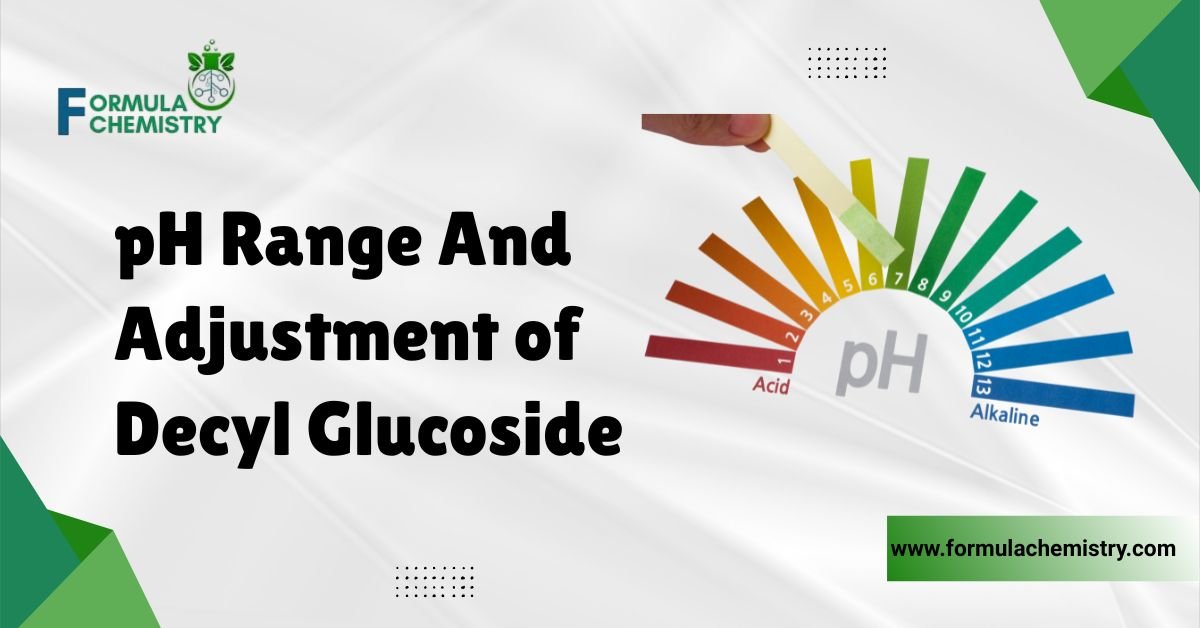
The finished product pH should be chosen for the product type, preservative, and skin area. Facial cleansers often sit around pH 5.0 to 5.8, while shampoos often sit around pH 5.0 to 6.0.
Acid adjustment should be slow. Citric acid or lactic acid solutions should be added drop by drop because surfactant systems can overshoot pH quickly.
Never adjust pH before the formula is fully mixed. Surfactant blends, humectants, preservatives, and salts can shift the final reading.
Foam Profile And Sensory Behavior of Decyl Glucoside
Decyl glucoside creates a medium to high foam with a soft, open bubble structure. It does not usually create dense luxury foam by itself.
Its foam improves when paired with amphoteric surfactants. The blend can feel creamier, rinse cleaner, and show better foam stability.
On skin, decyl glucoside can feel slightly squeaky if the level is too high. That problem becomes more noticeable in facial cleansers with low emollient or humectant support.
On hair, it can cleanse well but may leave a rough feel if used as the main shampoo surfactant without conditioning support. Shampoos need a full surfactant and conditioning strategy, not just a mild primary surfactant.
Compatibility With Other Ingredients of Decyl Glucoside
Decyl glucoside is broadly compatible because it is nonionic. It usually blends well with anionic surfactants, amphoteric surfactants, nonionic solubilizers, humectants, botanical extracts, and many polymers.
It can be difficult with viscosity building. Salt thickening is often weak or inconsistent because alkyl polyglucosides do not behave like standard sulfate or sulfonate surfactant systems.
Polymeric thickeners often give better control. Hydroxyethylcellulose, xanthan gum, sclerotium gum, and acrylates based rheology modifiers can help depending on the product concept.
Cationic polymers can be used with care in shampoos and conditioning cleansers. The formulator must test clarity, viscosity, foam, and deposition because compatibility on paper does not guarantee a stable product.
Preservation Considerations about Decyl Glucoside
Decyl glucoside is supplied in water, so any finished formula using it needs a suitable preservative system. The preservative must match the final pH, surfactant load, packaging, and expected use conditions.
Some preservatives lose effectiveness outside their preferred pH range. That matters because decyl glucoside can push the formula alkaline before adjustment.
Preservative testing is not optional for commercial products. A cleanser can look stable and still fail microbial challenge testing if the preservation system is poorly chosen.
Processing Guidelines about Decyl Glucoside
Add decyl glucoside slowly to the water phase or surfactant phase with gentle mixing. Fast mixing creates foam that traps air and makes batch evaluation harder.
Keep mixing speed low to moderate. A propeller mixer at controlled speed usually works better than aggressive high shear.
If using gums, hydrate the gum fully before adding the surfactant blend. Poor gum hydration creates fish eyes, thin spots, and unstable viscosity.
Adjust pH near the end of the process. Final pH should be measured after the formula is uniform and free of visible air bubbles.
Formulation Example Ranges of Decyl Glucoside
A gentle facial cleanser can use decyl glucoside at 4.00% to 6.00% with cocamidopropyl betaine at 3.00% to 6.00%. This gives mild cleansing without excessive foam aggression.
A natural leaning shampoo may use decyl glucoside at 8.00% to 14.00% with an amphoteric surfactant and a stronger anionic surfactant. This improves cleansing, foam, and rinse feel.
A baby wash should use a conservative total active surfactant level. Mildness depends on the full formula, not on decyl glucoside alone.
A micellar cleanser should use decyl glucoside at low levels. Too much surfactant in a leave on style wipe or low rinse product can leave residue and eye area discomfort.
Common Mistakes about Decyl Glucoside
- Using it as the only surfactant in shampoo. Hair can feel rough, so blend it with amphoteric or anionic surfactants and add conditioning support.
- Ignoring supplied pH. The cleanser may finish too alkaline, so check pH after full mixing and adjust carefully.
- Adding salt to thicken it. Salt may do very little, so use gum or polymeric thickening when needed.
- Overusing it in face wash. High levels can feel squeaky, so reduce the active surfactant matter and improve humectant support.
- Mixing too fast. Foam traps air and slows production, so use gentle controlled mixing.
- Choosing preservative before pH planning. Preservative performance can fail, so select the preservative after deciding the final pH range.
- Assuming natural origin means non irritating. Any surfactant can irritate at high levels, so test mildness through formula design.
- Skipping stability testing. Viscosity, odor, color, clarity, and pH can change, so test the formula under heat and room conditions.
Suitability Guide for Decyl Glucoside
Decyl glucoside suits rinse off facial cleansers, body washes, shampoos, baby washes, hand washes, and mild cleansing gels. It is especially useful when the formula needs a nonionic surfactant with a plant derived positioning.
Dry or sensitive skin formulas should use it at moderate levels with humectants and mild co surfactants. High surfactant loading can still leave the skin feeling tight.
Oily skin cleansers can use higher levels when balanced with amphoteric surfactants. The formula should cleanse without leaving a harsh squeaky finish.
Curly, dry, or chemically treated hair needs conditioning support if decyl glucoside appears in shampoo. The surfactant can support mild cleansing, but it does not replace cationic conditioning agents.
Beginner formulators can use decyl glucoside in simple cleansers, but pH adjustment and viscosity control require practice. Intermediate formulators will get better results because they understand active matter and surfactant blending.
Always conduct a 48-hour patch test with any new formula before wider use.
FAQ’s about decyl Glucoside
Is decyl glucoside safe for skin?
Decyl glucoside is widely used in rinse off skin cleansing products. Safety depends on use level, final pH, total surfactant load, and the sensitivity of the user.
What is decyl glucoside used for?
It is used as a mild nonionic surfactant in cleansers, shampoos, body washes, baby washes, and hand washes. It helps provide cleansing, foam, and compatibility in surfactant blends.
Is decyl glucoside safe for hair?
Decyl glucoside can be used in hair cleansers when the formula includes proper conditioning and surfactant balance. Used alone at high levels, it can leave some hair types feeling rough.
What is decyl glucoside made from?
Decyl glucoside is made from glucose and a fatty alcohol fraction rich in decyl alcohol. The feedstocks are commonly plant derived, but the exact source depends on the supplier.
Is decyl glucoside halal?
Decyl glucoside can be halal suitable when its raw materials and processing aids meet halal requirements. A brand should request supplier documentation or halal certification instead of assuming status from the INCI name.
Is decyl glucoside good for your face?
Decyl glucoside can be suitable for facial cleansers at moderate levels. The finished formula should be pH adjusted and blended to avoid tightness or excessive degreasing.
Is decyl glucoside from coconut?
Some grades use fatty alcohols derived from coconut or palm kernel sources. The INCI name does not prove the botanical source, so supplier documentation is needed.
Which alcohol is haram in cosmetics?
Halal status depends on the alcohol type, source, production method, and certifying authority. Fatty alcohols such as cetyl alcohol are chemically different from drinking alcohol and are often assessed differently.
Key Takeaways
- Decyl glucoside is a nonionic alkyl polyglucoside surfactant.
- It is commonly supplied at about 50.00% to 55.00% active matter.
- The common CAS number is 68515 73 1.
- It usually needs pH adjustment because many supplier grades are alkaline.
- Facial cleansers often use 2.00% to 8.00% as supplied.
- Shampoos often use 5.00% to 20.00% as supplied.
- Foam is moderate to high, but the best sensory profile comes from blending.
- Salt thickening is often unreliable with decyl glucoside systems.
- Preservation must match final pH and surfactant load.
Start with a small surfactant blend, calculate active matter, adjust pH at the end, and test viscosity before increasing the decyl glucoside level.