
Quick Answer
Preservative efficacy testing inoculates a cosmetic with five specified organisms at more than 10⁵ CFU per gram, then measures their reduction at 7, 14, and 28 days.
Under ISO 11930 Criterion A, bacteria must fall by at least 3.0 log by day 7 with no regrowth afterwards, while USP chapter 51 Category 2 requires only a 2.0 log reduction by day 14.
The test runs 28 days, costs from roughly £155 per product at some laboratories, and cannot be performed outside a microbiology facility.
Introduction
Preservative efficacy testing is the study that decides whether your water-based product is safe to sell. A stable emulsion that grows Pseudomonas is not a cosmetic; it is a hazard with good texture.
Formulators often treat the challenge test as a formality to book near launch. That sequencing is backwards, because a failed test means reformulation, and reformulation restarts your stability programme.
I have seen an elegant natural preservative system fail at day 7 against Aspergillus and cost a brand four months. The formula was beautiful, and the mould did not care.
By the end of this guide, you will understand which organisms are used, how the protocol runs, how the three main standards differ, what the pass criteria actually say, what failure looks like, and what the test costs.
What PET Is and Why It Exists
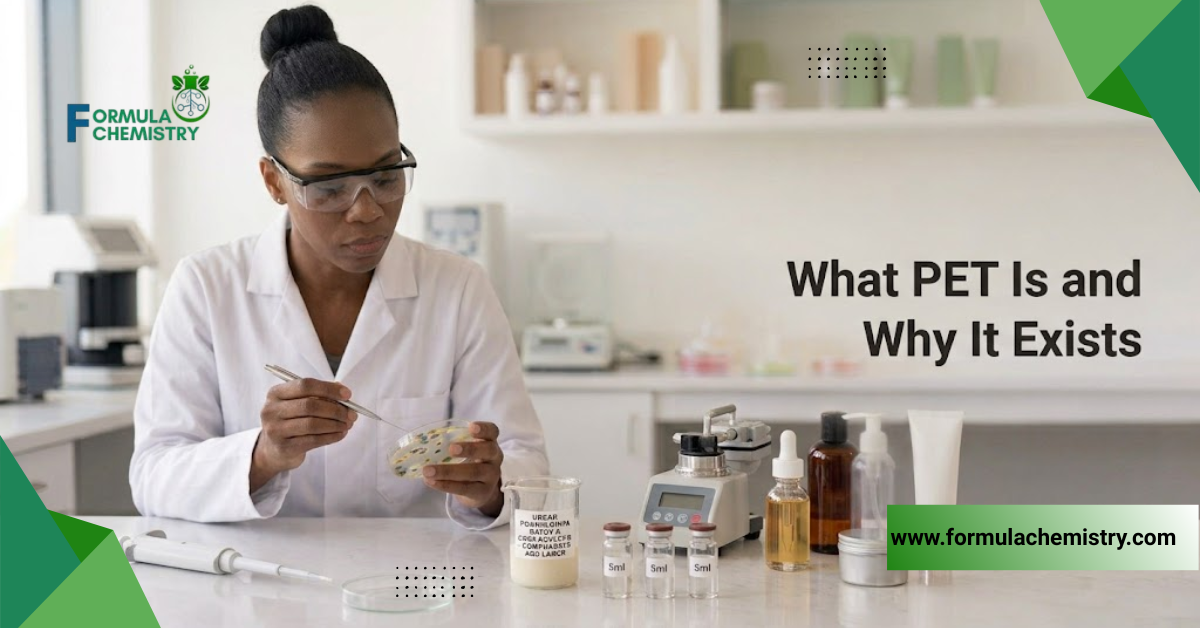
A challenge test deliberately contaminates your product to simulate what a consumer’s fingers do over months of use. The laboratory then counts how effectively your preservative system kills or suppresses those organisms.
Preservation protects against contamination introduced during use rather than during manufacture. Good manufacturing practice handles the second problem, and only a preservative system handles the first.
Testing is not optional for water-containing products in regulated markets. The EU and UK safety assessor expects challenge test data inside the Product Information File before signing a Cosmetic Product Safety Report.
The Five Test Organisms
All three major standards share the same panel, chosen to represent the realistic contamination a cosmetic faces. Each organism probes a different weakness.
- Staphylococcus aureus, a Gram-positive bacterium from skin contact
- Pseudomonas aeruginosa, a Gram-negative organism notorious for surviving in water systems
- Escherichia coli, a Gram-negative faecal indicator
- Candida albicans, a yeast
- Aspergillus brasiliensis, a mould, formerly named Aspergillus niger
Pseudomonas and Aspergillus fail more formulas than the rest combined. The first thrives in aqueous phases and resists many mild preservatives, while the second is slow, persistent, and often the reason a natural system misses its criteria.
Laboratories may add organisms where the product warrants it. A formula containing a specific botanical or intended for a compromised skin barrier sometimes justifies extra strains.
How the Test Actually Runs
The protocol is standardised, which is what makes results comparable between laboratories. These steps describe a typical run.
- Establish the product’s baseline microbiological quality before challenge.
- Divide the sample into five portions, one for each organism.
- Inoculate each portion at more than 10⁵ colony-forming units per gram or millilitre.
- Validate neutralisation and recovery on a separate aliquot at the same time.
- Hold the inoculated samples at controlled room temperature for 28 days.
- Enumerate survivors at 7, 14, and 28 days.
- Calculate log reduction at each interval and compare against the standard’s criteria.
Laboratories typically need 100 to 150 grams of product. Smaller volumes can sometimes be accommodated, though the sample must represent the finished formula rather than a bench approximation.
Submit the product in its final packaging where possible. Preservatives adsorb onto plastics and interact with components, so packaging influences the result you are trying to measure.
Neutralisation Validation, the Step Nobody Discusses
Neutralisation validation confirms that the recovery method deactivates your preservative at the sampling step. Without it, you cannot tell whether an organism died in the product or in the petri dish.
Surfactants, oils, chelating agents, and antimicrobial actives all interfere with enumeration. A test lacking this validation produces flattering results and no useful information.
Ask whether neutralisation was validated before you accept a passing report. A pass without it is not evidence, and a safety assessor may reject it.
Comparing ISO 11930, USP 51, and PCPC
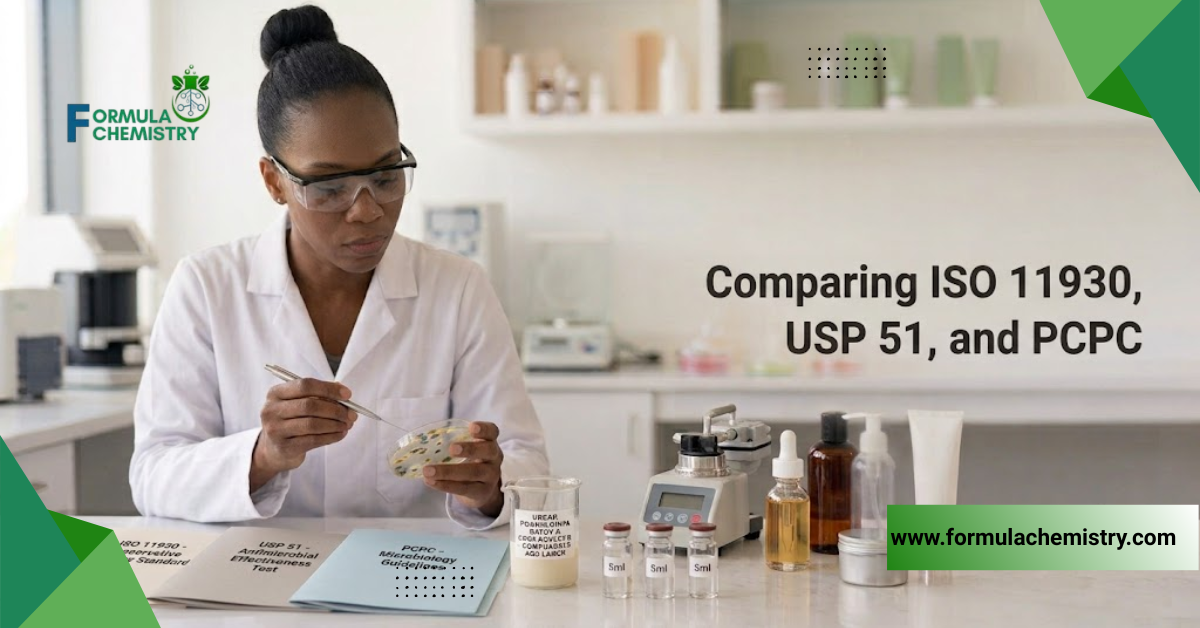
Three methods dominate, and the differences matter more than most brands realise. The table below compares them.
| Aspect | ISO 11930 | USP chapter 51 | PCPC method |
| Written for | Cosmetics | Pharmaceuticals and regulated products | Cosmetics |
| Sampling points | 7, 14, 28 days | 7, 14, 28 days | Initial, 2, 7, 14, 21, 28 days |
| Bacteria requirement | 3.0 log by day 7 under Criterion A | 2.0 log by day 14 for topical Category 2 | 3.0 log by day 7 |
| Pass tiers | Criterion A and Criterion B | Single criterion per category | Single criterion |
| Kinetic detail | Moderate | Moderate | High, more timepoints |
ISO 11930 is the cosmetic standard and applies the strictest early requirement. Its two-tier structure has no equivalent in the pharmacopoeial method.
USP chapter 51 Category 2 covers topical products made with an aqueous vehicle. It asks for a 2.0 log bacterial reduction by day 14 rather than 3.0 log by day 7, which is a materially easier bar.
The PCPC method samples more often, which reveals kill kinetics rather than just endpoints. That data helps diagnose a marginal system, since knowing a formula killed 90% of Pseudomonas by day two tells you something a day-seven reading cannot.
ISO 11930 Pass Criteria in Detail
Two acceptance levels exist, and the difference is timing rather than magnitude for bacteria. The table below sets them out.
| Organism | Criterion A | Criterion B |
| Bacteria | ≥3.0 log reduction at day 7, no increase at 14 and 28 | ≥3.0 log reduction at day 14, no increase at 28 |
| C. albicans | ≥1.0 log reduction at day 7, no increase at 14 and 28 | ≥1.0 log reduction at day 14, no increase at 28 |
| A. brasiliensis | No increase from initial at day 14, ≥1.0 log reduction at day 28 | No increase from initial at day 14 |
Criterion A represents a strongly preserved product and is what you should target. Meeting it removes any argument about adequacy.
Criterion B is acceptable where Criterion A cannot be reached without compromising the product. Passing at this level requires supporting justification in the Product Information File, typically a risk analysis covering packaging, use pattern, and formulation.
Do not treat Criterion B as a lower pass; you can simply choose. It carries a documentation burden and a safety assessor’s scrutiny that Criterion A does not.
When You Can Skip the Test
Some products present genuinely low microbiological risk, and a risk assessment can justify omitting the challenge test. The relevant framework is ISO 29621, which evaluates whether a product can support microbial growth at all.
Three factors usually drive that conclusion. Very low water activity, extreme pH, or high alcohol content can each make a formula inhospitable regardless of added preservative.
Anhydrous products such as oils, balms, and pressed powders often qualify. Water ingress during consumer use still deserves consideration, particularly for products used in a shower.
Document the reasoning rather than assuming an exemption. A safety assessor will want to see the risk assessment that replaced the test, and Formula Chemistry sees more brands assume exemption than earn it.
Why Preservative Systems Fail
Failure rarely means the preservative was wrong. More often, the formula worked against it.
pH sits at the centre of most failures. Organic acid preservatives such as sodium benzoate and potassium sorbate depend on the undissociated acid form, so they lose most of their activity above roughly pH 5.5.
Partitioning is the second common cause. A preservative that dissolves preferentially into the oil phase leaves the water phase, where the microbes actually live, unprotected.
Surfactants and nonionic emulsifiers can sequester preservatives into micelles, removing them from where they act. Chelators like disodium EDTA help by destabilising Gram-negative cell walls, which is why they boost apparently unrelated systems.
Botanical extracts and clays introduce their own bioburden. A formula can be well preserved and still fail because a raw material arrived heavily contaminated.
Cost and Timeline
The test takes 28 days by definition, so realistic turnaround runs 4 to 5 weeks, including reporting. No laboratory can compress it, because the standard measures elapsed time.
Pricing varies by laboratory and market, and published rates start around £155 per product at some UK laboratories. Costs rise with additional organisms, extra timepoints, or the PCPC method’s denser sampling.
Budget for a second test. A first-attempt failure is common with natural preservative systems, and reformulation plus retesting doubles both cost and timeline.
Repeat PET on the first production batch. Scaled processing, a different water source, and new equipment surfaces change the microbial picture, which bench data no longer describes.
Can You Do PET at Home
No, and this deserves a blunt answer. Challenge testing requires controlled reference strains, calibrated inoculum preparation, validated neutralisation, and containment that a domestic kitchen cannot provide.
Attempting it informally is both invalid and unsafe. Culturing Pseudomonas aeruginosa or Aspergillus outside a laboratory creates a genuine health risk.
What you can do at home is design for preservation. Keep pH in range for your preservative, use purified water, control raw material bioburden, choose airless or pump packaging over open jars, and select a preservative appropriate to your product type.
Send a formula for testing only once you believe it will pass. Laboratory time is the expensive step, and preparation is free.
Common PET Mistakes
Brands mishandle challenge testing in recognisable ways, and each mistake below carries a direct fix. Correcting them saves months rather than days.
The first mistake is booking PET immediately before launch. A failure forces reformulation and restarts stability work, so test early in development.
Ignoring pH compatibility is a second error. Organic acid preservatives lose activity above roughly pH 5.5, so match your preservative to your finished pH rather than your target pH.
Accepting a report without neutralisation validation is a third mistake. Uncontrolled preservative carryover produces false passes, so confirm the laboratory-validated recovery.
Testing a bench sample instead of the production formula is a fourth error. Processing and packaging change the result, so test what you will actually sell in what you will sell it in.
Treating Criterion B as a free lower pass is a fifth mistake. It demands documented justification in the PIF, so target Criterion A and use B only with a supporting risk analysis.
The sixth error is assuming an anhydrous product needs no assessment. Water ingress during use remains possible, so complete an ISO 29621 risk assessment and record it.
Which Standard Fits You
Cosmetic brands selling in the EU or UK should test to ISO 11930, since it is the cosmetic standard the safety assessor expects. Target Criterion A and treat Criterion B as a fallback requiring justification.
Brands making products that are regulated as drugs, including sunscreens in the United States, generally need USP chapter 51. The applicable category determines the criteria rather than the product’s marketing description.
Formulators developing a marginal or natural preservative system benefit from the PCPC method’s denser sampling. Kill kinetics tell you which organism is failing and when, which is diagnostic rather than merely pass or fail.
Whatever your market, test before you commit to packaging and stability. To begin, check your finished pH against your preservative’s active range today, because that single number explains more failures than any other variable.
Frequently Asked Questions
What is preservative efficacy testing?
It is a laboratory challenge test that deliberately inoculates a product with five specified organisms and measures their reduction over 28 days. The test confirms the preservative system protects against contamination during consumer use. Water-containing cosmetics require it in regulated markets.
Which organisms are used in PET?
The standard panel is Staphylococcus aureus, Pseudomonas aeruginosa, Escherichia coli, Candida albicans, and Aspergillus brasiliensis. Each is inoculated separately at more than 10⁵ CFU per gram. Additional organisms may be added where a product warrants it.
What is the difference between ISO 11930 and USP 51?
ISO 11930 was written for cosmetics and requires a 3.0 log bacterial reduction by day 7 under Criterion A. USP chapter 51 Category 2 covers aqueous topical products and asks for 2.0 log by day 14. ISO also offers two acceptance tiers.
What are the ISO 11930 pass criteria?
Criterion A requires bacteria to fall at least 3.0 log by day 7 with no regrowth at days 14 and 28. Criterion B allows that 3.0 log reduction by day 14 instead. Criterion B requires documented justification in the Product Information File.
How long does PET take?
The test itself runs 28 days, so a realistic turnaround, including reporting, is 4 to 5 weeks. No laboratory can shorten it, because the method measures elapsed time. Budget for a second round if your system is marginal.
How much does a PET test cost?
Pricing varies by laboratory and market, with published rates starting around £155 per product at some UK laboratories. Additional organisms, extra timepoints, and the PCPC method raise the price. Reformulation after a failure roughly doubles total cost.
Can I do PET at home?
No, challenge testing requires reference strains, validated neutralisation, and laboratory containment. Culturing these organisms domestically is unsafe and produces invalid data. Design for preservation at home and send the formula to a laboratory to prove it.
Do anhydrous products need PET?
Often not, since very low water activity may prevent microbial growth entirely. An ISO 29621 risk assessment can justify omitting the test. Document that reasoning, and consider water ingress during consumer use.
Key Takeaways
Preservative efficacy testing challenges a product with five organisms and measures their reduction at 7, 14, and 28 days, with ISO 11930 Criterion A demanding a 3.0 log bacterial drop by day 7. USP chapter 51 Category 2 sets an easier bar of 2.0 log by day 14, and the PCPC method samples more often to reveal kill kinetics.
Most failures trace to formulation rather than preservative choice, with pH incompatibility, oil-phase partitioning, and micelle sequestration leading the causes. Neutralisation validation separates a real pass from a flattering one.
Test early, in the production formula, in the final packaging, and repeat on the first commercial batch. To act today, confirm your finished pH sits within your preservative’s active range, since that number decides more challenge tests than any other single factor.