
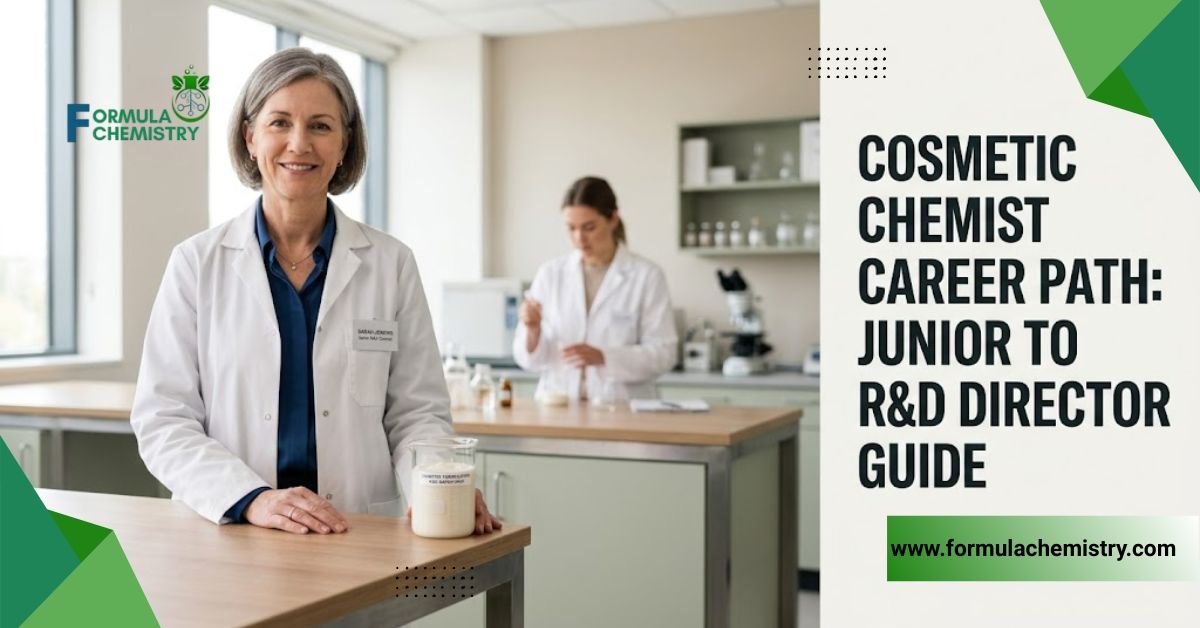
Launching a premium personal care product line requires rigorous scientific planning rather than random experimentation at the laboratory bench. Aspiring scientists often face immediate stagnation because they lack a transparent understanding of corporate advancement structures.
Exploring the structural cosmetic chemist career path provides a clear, high-density map for navigating this specialized industrial hierarchy. This technical guide breaks down every professional milestone, research expectation, and corporate responsibility across the entire career ladder.
By analyzing these specific benchmarks, laboratory professionals will know exactly how to acquire advanced formulation competencies, direct multi-million dollar corporate portfolios, and secure leadership roles.
The Cosmetic Chemist Hierarchy: Core Organizational Framework
Industrial personal care organizations separate laboratory execution from brand commercialization through strict hierarchy structures. Data compiled by Formula Chemistry indicates that rapid promotion depends on mastering interfacial chemistry and large-scale manufacturing mechanics. Scientists must transition from simple ingredient blending to deep optimization of physical chemistry parameters.
The structural matrix below details the progressive phases of a professional scientific trajectory within the modern beauty industry.
| Career Level | Typical Experience | Core Technical Focus | Primary Business Responsibility |
| Junior Chemist | 0 to 2 Years | Stability tracking, raw material preparation, and basic batch duplication | Laboratory notebook accuracy, equipment maintenance |
| Mid-Level Chemist | 2 to 5 Years | Formula optimization, emulsion troubleshooting, color matching | Vendor raw material evaluation, initial pilot batch scale-up |
| Senior Chemist | 5 to 10 Years | Novel architecture design, reverse engineering, and cost reduction | Regulatory dossier approval, cross-department communication |
| Principal Scientist | 10 plus Years | Advanced polymer systems, intellectual property generation | Technology roadmap creation, patent defense strategy |
| Director of R&D | 12 plus Years | Global portfolio risk mitigation, resource allocation | Capital expenditure budgeting, executive board reporting |
Technical mastery requires moving beyond basic formulation cookbooks toward comprehensive product lifecycle tracking. Dr. SamiUllah, PhD, notes that sustainable career advancement relies on linking molecular stabilization with global raw material logistics. Scientists who grasp this multi-layered operational dynamic consistently outpace their peers in climbing the executive ladder.
Level 1: The Junior Cosmetic Chemist (0–2 Years)
Raw Material Cataloging and Bench Preparation
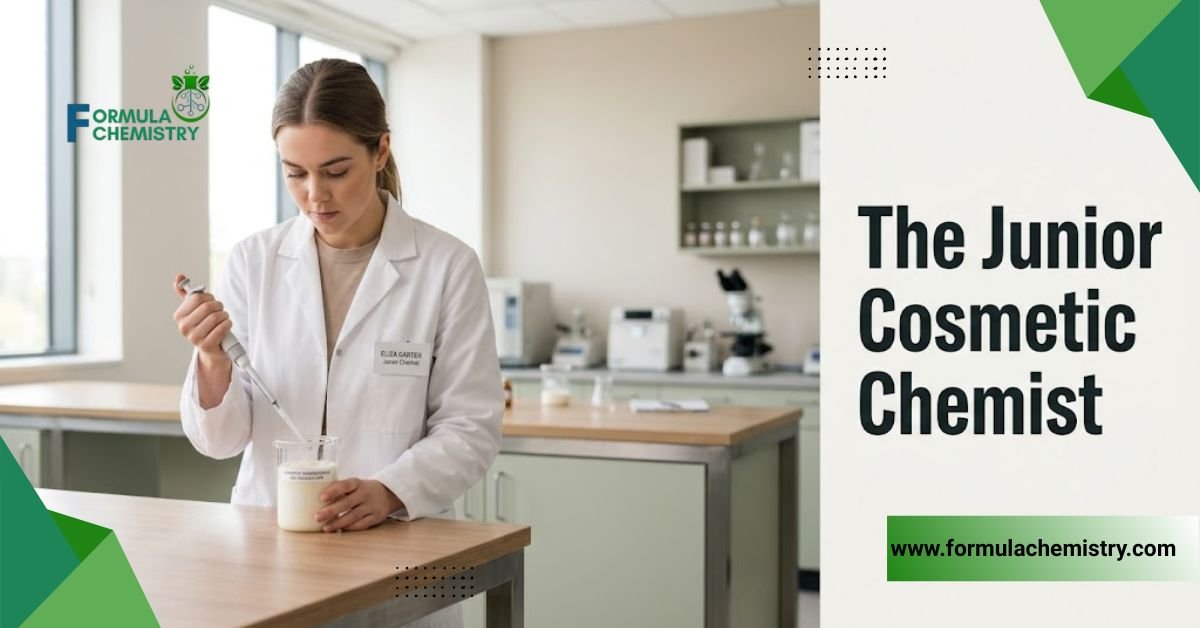
Entry-level positions emphasize technical execution, safety management, and basic laboratory hygiene. A junior cosmetic chemist’s role involves weighing intricate raw materials with absolute precision on analytical balances.
Novices spend significant time cataloging incoming chemical samples and managing comprehensive Safety Data Sheets. This structural repetition builds necessary familiarity with diverse chemical classes, including humectants, lipid fractions, and botanical extracts.
Initial lab work focuses on reproducing established base formulas rather than inventing new systems from scratch. Assistants learn to prepare standard surfactant bases, simple gels, and low-viscosity solutions. This foundational phase instills strict discipline regarding phase addition temperatures, mixing times, and mixer blade geometries.
Analytical Instrumentation and Viscosity Evaluation
Tracking early physical properties of newly created batches requires constant operational monitoring. Junior scientists handle standard analytical gear, including automated pH meters, density cups, and benchtop refractometers.
They spend hours performing Brookfield viscometer measurements, selecting correct spindles, and recording accurate torque percentages. This data collection verifies that every laboratory batch conforms to exact structural specifications before moving forward.
Stability Chambers and Physical Degradation Tracking
Managing product preservation studies forms a vital part of early career training. Entry-level personnel place prototype samples into specialized environmental chambers maintained at elevated temperatures.
They inspect these samples weekly, looking for signs of syneresis, discoloration, or subtle olfactory shifts. This rigorous monitoring teaches beginners to identify chemical incompatibility issues before commercial manufacturing begins.
Accurate documentation within electronic laboratory notebooks is mandatory for future regulatory auditing. This systematic habit ensures total transparency for quality control teams and internal research divisions.
Level 2: The Mid-Level Formulation Chemist (2–5 Years)
Emulsion Architecture and Hydrophilic-Lipophilic Balance
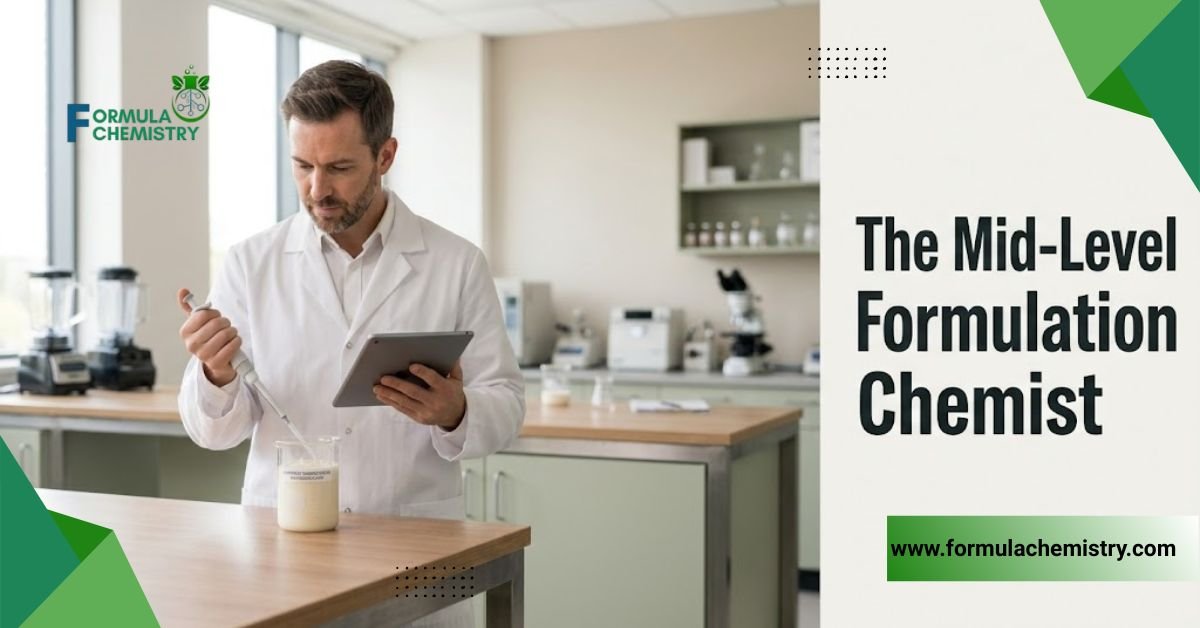
Moving to a mid-level role requires complete independence at the laboratory bench. Scientists at this stage design stable oil-in-water and water-in-oil emulsions based on marketing design briefs.
They utilize Hydrophilic-Lipophilic Balance calculations to select optimal surfactant blends for lipid phase emulsification. This expertise allows the chemist to create sophisticated sensory textures, from light serums to dense barrier creams.
Mid-level professionals also evaluate complex lipid crystallization profiles to control final product melting behaviors. They select appropriate structural waxes, such as Cetyl Esters or ozokerite, to optimize stick integrity and application slip.
This advanced comprehension accelerates cosmetic chemist progression by establishing deep formulation versatility across diverse product formats.
Color Matching and Pigment Dispersion Dynamics
Developing color cosmetics introduces unique challenges regarding particulate wetting and suspension stability. Mid-level chemists analyze pigment surface treatments, utilizing hydrophobic or hydrophilic coatings to prevent agglomeration.
They command industrial three-roll mills to achieve uniform particle dispersion in liquid foundations and lipsticks. This work requires highly sensitive color perception and a deep knowledge of iron oxide blending ratios.
Formulators must verify that pigment sedimentation does not occur over long-term storage periods. They incorporate specialized rheology modifiers, like bentonite clays, to establish high yield values within fluid matrices.
Pilot Scaling and Manufacturing Plant Integration
Transitioning a bench prototype to large-scale industrial manufacturing tanks introduces difficult thermodynamic obstacles. Mid-level scientists collaborate directly with factory engineers to adjust formulation protocols for pilot batches.
They translate laboratory beaker heating rates into realistic steam-jacketed kettle parameters. This integration requires careful planning of mixing cycles, side-scrape agitation settings, and high-shear homogenization loops.
When an industrial batch exhibits unexpected thinning or aerates excessively, the mid-level scientist must resolve the crisis immediately. Diagnosing these processing errors prevents massive material losses and keeps commercial launches on schedule.
Level 3: The Senior Cosmetic Chemist & Technical Lead (5–10 Years)
Analytical Reverse Engineering and Competitor Deconstruction
Senior scientists possess deep insight into competitive landscape dynamics and advanced raw material chemistry. They routinely deconstruct commercial benchmarks using sophisticated instrumentation like High-Performance Liquid Chromatography and Gas Chromatography-Mass Spectrometry.
This reverse engineering capability allows an organization to match premium market innovations while avoiding intellectual property conflicts. Senior formulators identify unique active delivery systems, such as liposomal structures or polymeric matrices, by analyzing raw chemical signatures.
This level also demands deep knowledge of chemical synthesis pathways for natural alternatives. Technical leads reconstruct traditional synthetic formulas using sustainable, biodegradable alternatives without sacrificing performance.
Structural Rheology, Engineering, and Viscoelastic Optimization
Advanced thickening mechanisms require an understanding of polymer entanglement and associative network properties. Senior cosmetic chemist responsibilities involve manipulating complex cross-linked networks like Acrylates/C10-30 Alkyl Acrylate Crosspolymer to achieve unique flow properties.
They analyze viscoelastic behaviors using rotational rheometers, mapping storage and loss moduli against shear stress. This validation guarantees that lotions remain stable in the bottle but shear thin effortlessly upon skin contact.
Engineers at this tier design suspension systems for dense physical sunscreens like Zinc Oxide. They stabilize high-density particulate loads within ultra-light fluid carriers by optimizing steric hindrance and electrostatic repulsion forces.
Global Regulatory Dossiers and Compliance Verification
Formulation validation extends far beyond maintaining basic product stability over time. Senior professionals evaluate intricate toxicology databases to verify absolute consumer safety across global regions.
They build comprehensive regulatory dossiers matching the strict standards of the European Chemicals Agency and the United States Food and Drug Administration. This compliance work requires deep familiarity with international raw material restriction inventories and safety assessment protocols.
Technical leads monitor changing legislative landscapes regarding microplastics, volatile organic compounds, and preservation systems. They proactively alter existing commercial portfolios to prevent sudden regional sales bans.
Level 4: The Principal Scientist & R&D Director (10+ Years)
Technology Roadmaps and Innovation Pipelines
Reaching the pinnacle of the cosmetic chemist hierarchy requires shifting focus from laboratory work to high-level corporate strategy. Principal scientists design long-term technology roadmaps that align technical research with anticipated consumer shifts.
They explore emerging raw material categories, such as bio-fermented actives and biomimetic peptides, before they reach the mainstream market. This strategic planning provides a continuous pipeline of unique concepts for corporate brand managers.
Director-level leaders manage multi-million dollar research budgets, balancing internal laboratory expenses against external contract testing costs. They optimize operational efficiency by selecting advanced high-throughput automated compounding equipment for their teams.
Intellectual Property Defense and Patent Strategy
The R&D director’s role focuses heavily on securing market exclusivity through proprietary asset generation. Directors collaborate with legal teams to draft precise patent applications covering novel chemical combinations, processing techniques, or stabilization mechanisms.
They defend these corporate assets against competitor litigation and evaluate competitive patent portfolios for infringement risks. This legal oversight protects long-term commercial margins and builds significant corporate valuation.
Cosmetic chemistry leadership also involves establishing strict quality management systems across global manufacturing facilities. Directors implement unified Standard Operating Procedures that guarantee total product uniformity regardless of geographic production location.
Cross-Functional Corporate Alignment and Board Reporting
Executive directors serve as the primary link between technical laboratories and corporate boardrooms. They translate complex chemical data into clear financial metrics and growth opportunities for executive stakeholders. This communication helps corporate boards understand the return on investment generated by deep scientific research.
Managing diverse teams of scientists, engineers, and regulatory specialists requires advanced emotional intelligence and clear talent development plans. Directors mentor junior personnel, structuring clear advancement opportunities to retain top scientific talent within the organization.
Common Cosmetic Chemist Promotion Path Mistakes
Advancing through the industrial ranks requires avoiding specific technical mistakes and strategic career missteps. The list below identifies critical operational blind spots that stall growth along the cosmetic chemist promotion path.
- Overlooking Scale-up Shear Rates: Formulators often forget that large industrial turbines impart completely different mechanical forces than bench stirrers. Scientists must analyze tip speed ratios and dimensionless Reynolds numbers rather than focusing exclusively on revolutions per minute.
- Mechanically Copying Existing Formulas: Designing a complex formula using ingredients restricted in major markets creates immediate commercial roadblocks. Scientists should cross-reference international safety databases during the preliminary raw material selection phase.
- Neglecting Early Packaging Compatibility Studies: Testing prototypes exclusively in inert glass containers can hide critical interactions with final plastic packaging. Formulators must evaluate product stability inside final commercial containers from the initial developmental phases.
- Communicating Exclusively via Technical Jargon: Presenting dense chemical mechanisms to marketing executives without explaining the commercial benefits creates major organizational disconnects. Scientists should always translate molecular data into clear consumer claims and distinct market advantages.
- Isolating Lab Formulation from Procurement Teams: Specifying expensive, single-source raw materials without checking global supply chain availability introduces immediate manufacturing vulnerabilities. Formulators should confirm material availability and verify alternative suppliers before locking in final commercial recipes.
Formulation and Skill Suitability Matrix
Progressing safely up the professional ladder requires matching an individual’s technical background with appropriate formulation complexities. Novices achieve excellent results focusing on low-energy cold-process blending systems and basic aqueous formats.
These systems let beginners build essential analytical documentation skills without managing complex liquid crystal phases or high-temperature oil additions.
Senior scientists and directors oversee the design of highly specialized active delivery systems for specific skin types. Formulating corrective products for compromised skin barriers requires a deep understanding of physiological lipid ratios and complex structural stabilizers.
| Experience Tier | Target Substrate Focus | Formulation Complexity Level | Core Material Specialization |
| Entry-Level | Normal to oily skin profiles | Low shear, simple aqueous solutions | Standard anionic surfactants, basic glycols |
| Intermediate | Sensitive skin, dry hair shafts | Medium shear, hot-pour oil-in-water systems | Non-ionic emulsifiers, plant triglycerides |
| Advanced | Hyperpigmented skin, curly hair types | High shear, multi-phase active delivery systems | Encapsulated retinoids, silicone cross-polymers |
Specialized formulas must balance intense consumer efficacy with strict irritation mitigation protocols. Always conduct a 48-hour patch test with any new formula before wider use.
Frequently Asked Questions
What degree is best for a cosmetic chemist?
A bachelor’s degree in chemistry, chemical engineering, or pharmaceutical science provides the strongest foundational training. Specialized master’s degrees in cosmetic science accelerate career progression by offering deep training in colloid and interfacial chemistry.
How do I advance as a cosmetic chemist quickly?
Focus on acquiring scale-up engineering skills and mastering global regulatory compliance alongside daily laboratory bench work. Bridging the gap between scientific innovation and corporate marketing needs significantly accelerates promotion timelines.
Is a PhD required for director roles?
Executive advancement does not strictly require a doctoral degree in most personal care corporations. Proven commercial success, extensive intellectual property generation, and strong cross-functional leadership capabilities carry far more organizational weight.
What does a junior cosmetic chemist do daily?
Daily activities center around precise raw material weighing, batch compounding, and systematic stability chamber tracking. Junior staff also calibrate laboratory instruments, manage chemical inventories, and maintain detailed electronic notebooks.
Is independent consulting a viable path?
Experienced scientists with deep vendor relationships frequently establish profitable independent formulation consultancies. Success requires a comprehensive understanding of global manufacturing networks, raw material logistics, and compliance framework tracking.
How long does it take to become a senior?
Reaching the senior level generally requires five to ten years of verified industrial experience within an R&D setting. Advancement depends on independently managing complex product scale-ups and solving difficult manufacturing stability issues.
Do chemical suppliers hire cosmetic scientists?
Raw material chemical manufacturers employ numerous cosmetic chemists for technical service and application development roles. These scientists create prototype starting formulas to demonstrate specific ingredient benefits to global consumer brands.
Why do formulations fail during scale-up?
Failures typically stem from differences in heating rates, cooling rates, and mechanical shear forces between lab and factory equipment. Ambient manufacturing conditions also introduce variables absent in climate-controlled research labs.
Key Takeaways and Professional Action Plan
- Master Industrial Scale-up Dynamics: Focus on mastering the physical changes that happen when transitioning formulas from beakers to large manufacturing tanks.
- Acquire Deep Global Regulatory Competency: Learn international compliance frameworks early to increase your value to multinational personal care corporations.
- Quantify Scientific Performance Metrics: Focus on clinical claims validation to prove the explicit economic value of your laboratory research.
- Bridge Technical and Commercial Communication: Learn to explain intricate chemical mechanisms using clear commercial terms that marketing teams understand.
Aspiring laboratory leaders must actively seek out scale-up opportunities and regulatory responsibilities to transition successfully from manual bench execution to strategic corporate leadership.