

Understanding Corporate Compensation in Personal Care R&D
Negotiating compensation packages in the beauty industry requires a transparent understanding of market rates across international manufacturing hubs. Many chemists enter the field focusing strictly on formulation aesthetics while ignoring the economic dynamics of corporate laboratories.
Securing a competitive cosmetic chemist salary depends heavily on your mastery of compliance frameworks and raw material cost management. At Formula Chemistry, Dr. SamiUllah, PhD, emphasizes that raw material supply chains heavily influence corporate research budgets and annual hiring trends.
This comprehensive global guide details the exact compensation benchmarks, bonus structures, and regional economic factors that dictate earning potential in modern laboratories. Readers will finish this analysis with the exact data needed to evaluate employment contracts and maximize their professional earning potential.
Structural Variables Influencing Personal Care Financial Compensation
Industrial raw material validation and advanced product testing capabilities directly drive professional market value. Laboratories allocate higher baseline budgets to professionals who can successfully minimize manufacturing batch failures and optimize processing efficiency.
Corporate Scale and Laboratory Category Impacts
Contract manufacturers generally operate on lower profit margins than multinational prestige houses. Consequently, raw bench chemists in high-volume production facilities often handle more diverse product types but receive lower base pay.
Prestige brands require extensive clinical testing, validation, and customized polymer synthesis capabilities. These highly specialized research environments offer premium compensation tiers to secure top-tier analytical talent.
Regulatory Mastery as a Value Multiplier
Navigating complex compliance frameworks represents a major asset for modern research teams. The implementation of modern regulatory protocols increases the demand for specialists who can guarantee immediate market legality.
Formulators who manage complete safety dossiers command a significant market premium. Your ability to defend chemical safety profiles directly protects the manufacturing corporation from liability risks.
Regional Deep-Dive: Cosmetic Chemist Salary Across Global Hubs
Compensation structures vary dramatically based on localized economic factors and the concentration of manufacturing facilities. Analyzing these international differences allows technical professionals to evaluate relocation options or remote consulting arrangements.
Analysis of Cosmetic Chemist Salary USA Performance
The North American market features the highest concentration of corporate research headquarters and raw material distributors. High regulatory demands under modern safety acts have accelerated the baseline compensation for qualified bench scientists.
Entry-level positions in major manufacturing clusters like New Jersey and California command reliable starting wages. Senior researchers who manage intellectual property portfolios regularly receive stock options and performance-based corporate incentives.
Performance of Cosmetic Chemist Salary UK Metrics
The British personal care sector favors professionals who maintain close ties with European regulatory boards and independent testing bodies. Compensation models tend to focus heavily on comprehensive benefit packages alongside basic baseline pay.
Mid-level managers in industrial clusters see steady growth as contract manufacturing expands across the region. Senior technical directors command premium rates when supervising multi-site formulation teams.
Evaluation of Cosmetic Chemist Salary Europe Benchmarks
Western European nations exhibit distinct pay scales influenced by national chemical manufacturing output and local tax frameworks. High-output nations like Germany and France offer substantial compensation to professionals managing complex raw material synthesis.
Southern European hubs focus extensively on natural ingredient sourcing and traditional extraction technologies. These specialized environments value researchers who can validate botanical performance metrics objectively.
Comparison of Global Cosmetic Chemist Salary Data by Experience
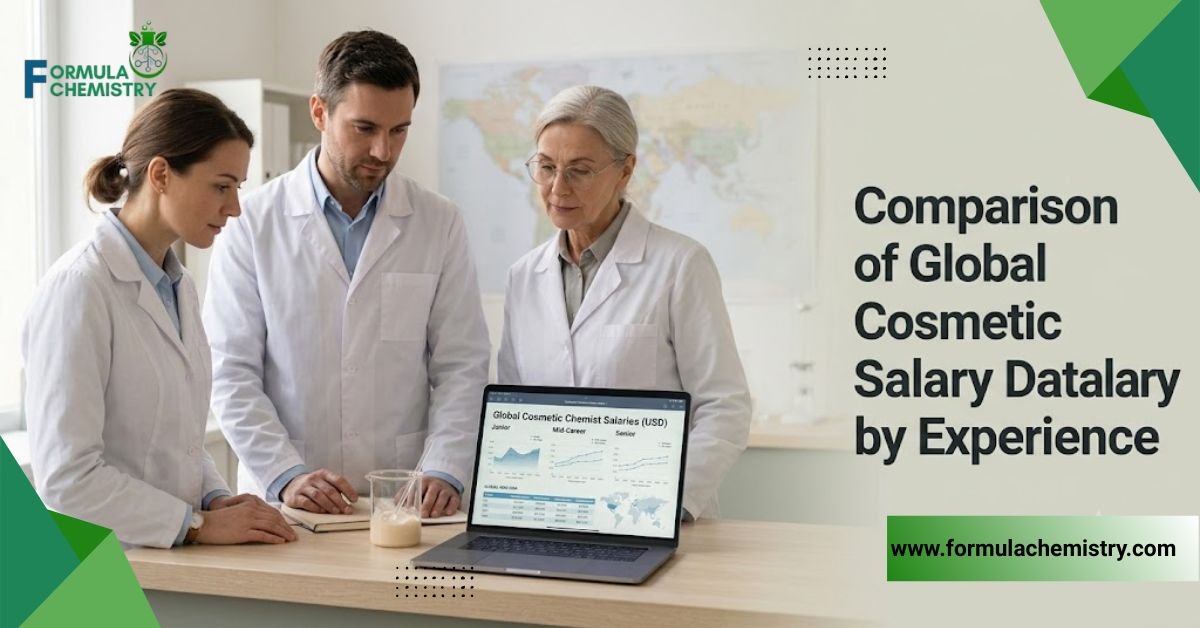
To assist with career mapping, this comprehensive table compares baseline earnings, expected bonuses, and standard benefit access across major international production regions.
| Geographic Region | Experience Classification | Baseline Annual Pay | Average Cosmetic Chemist Bonus | Standard Cosmetic Chemist Benefits |
| United States | Junior (1 to 3 Years) | $55,000 to $68,000 | $2,500 | Health insurance, a matching retirement portfolio, and paid relocation assistance. |
| United States | Mid-Level (4 to 7 Years) | $72,000 to $88,000 | $6,000 | Comprehensive dental coverage, tuition reimbursement, and annual industry conference allowances. |
| United States | Senior (8+ Years) | $105,000 to $145,000 | $15,000 | Equity options, executive health plans, performance incentives. |
| United Kingdom | Junior (1 to 3 Years) | £26,000 to £33,000 | £1,200 | National health supplements, private pension matching, and transit allowances. |
| United Kingdom | Mid-Level (4 to 7 Years) | £36,000 to £47,000 | £3,000 | Extended parental leave, professional organization membership fees, and remote flexibility. |
| United Kingdom | Senior (8+ Years) | £55,000 to £82,000 | £8,500 | Corporate vehicle options, private medical insurance, and performance-based profit shares. |
| Western Europe | Junior (1 to 3 Years) | €34,000 to €42,000 | €1,500 | Standard state benefits, statutory vacation allocations, and localized training credits. |
| Western Europe | Mid-Level (4 to 7 Years) | €46,000 to €58,000 | €3,500 | Flexible working arrangements, child-care subsidies, and continuous education funding. |
| Western Europe | Senior (8+ Years) | €68,000 to €98,000 | €10,000 | Multi-country travel allowances, corporate equity distribution, and executive leave. |
Employment Sectors and Specialized Formulation Niches
Specializing in high-demand chemical classifications can dramatically modify your baseline cosmetic chemist pay. General skincare formulation remains a popular path, but niche markets often face acute talent shortages.
Color Cosmetics and Pigment Dispersion Specialists
Achieving uniform color distribution requires advanced knowledge of surface-treated pigments and structural silicone fluids. Companies pay a premium for experts who can solve complex syneresis problems in liquid foundations.
Syneresis occurs when liquid separates from a gel network, destroying consumer product elegance. Resolving this issue demands extensive experience with specialized rheology modifiers and precise high-shear processing times.
Hair Care Surfactant and Polymer Experts
Shampoo and conditioning systems rely on the delicate balancing of anionic and cationic charges. Formulators who master these complex surfactant interactions command exceptional cosmetic chemist earnings.
Experienced hair care researchers design conditioning polymers that deposit efficiently on keratin fibers without causing excessive product buildup. This capability directly translates to superior product performance and higher consumer repeat purchase rates.
Specialized Analytical and Regulatory Positions
Modern laboratories employ dedicated specialists who focus exclusively on safety validation and microbial protection validation. These technical professionals guarantee that commercial formulas remain stable under varying environmental exposures.
Acquiring specialized certifications in toxicological risk assessment significantly boosts your overall cosmetic chemist income. Corporate directors prioritize candidates who can confidently sign off on safety substantiation files without hiring external consultants.
Evaluating Total Compensation Packages and Performance Incentives
Evaluating a professional offer requires analyzing parameters far beyond the base financial number. Total compensation models in the beauty sector include multiple performance-driven elements that enhance long-term wealth accumulation.
Variable Bonus Metrics and Performance Targets
Most established manufacturing houses tie annual cash incentives to specific product development milestones. Successfully launching an optimized commercial base ahead of schedule routinely triggers a substantial cosmetic chemist bonus.
These targets require deep collaboration with processing engineers to eliminate production bottlenecks. Chemists who streamline the scale-up pipeline save the company thousands in operational overhead.
Executive Benefit Structures and Equity Models
Reaching the upper echelons of research administration shifts your compensation toward long-term equity options. A senior cosmetic chemist’s pay structure often incorporates stock grants tied directly to corporate market share growth.
These arrangements provide substantial financial upside if the brand undergoes an acquisition process. Standard cosmetic chemist benefits also encompass extended healthcare coverage, international conference budgets, and paid publication fees.
Factual Breakdown of Non-Salary Compensation Drivers
To illustrate the financial impact of non-salary incentives, this table categorizes the standard performance targets and structure types utilized across the industry.
| Compensation Component | Standard Industry Allocation Rates | Core Evaluation Performance Metrics |
| Annual Performance Bonus | 5% to 15% of base salary | Successful stability test completions, reduction in raw material processing expenditures. |
| Project Milestone Incentives | Fixed cash awards per product launch | Meeting strict commercial production deadlines and resolving manufacturing batch failures. |
| Corporate Equity Allocations | 2% to 10% in senior positions | Total corporate net profit margin growth and patent approval achievements. |
| Continuing Education Funding | $2,000 to $5,000 annually | Maintaining professional society memberships, completing advanced polymer coursework. |
| Intellectual Property Royalties | Contractually defined percentages | Commercial sales volume of patented structural delivery systems. |
The Impact of Geographic Clusters on Earning Trajectories
Concentrated manufacturing zones create intense local competition for qualified laboratory talent. Working within an active industry cluster speeds up career progression and provides frequent salary enhancement opportunities.
East Coast Versus West Coast Dynamics in North America
The tri-state area of New Jersey, New York, and Pennsylvania houses major corporate research centers and ingredient suppliers. Employers in this region compensate formulators generously to offset high state tax liabilities and competitive talent hunting from neighboring firms.
West Coast laboratories focus heavily on clean beauty trends and independent brand contract manufacturing. This environment rewards agility and rapid prototyping capabilities, offering flexible equity options over high initial cash bases.
European Industrial Belts and Technological Hubs
The French personal care industry centers around specialized luxury formulation and clinical skin performance validation. Researchers in these facilities benefit from strong union protections and highly structured mandatory salary progression systems.
German hubs prioritize industrial process efficiency and advanced surfactant engineering methodologies. This analytical focus ensures that process engineers and scale-up chemists receive premium initial compensation packages.
How Specialized Instrument Competence Adjusts Baseline Income
Demonstrating mastery over advanced analytical equipment immediately shifts a candidate out of entry-level salary brackets. Laboratories prefer formulators who can validate their own batch metrics without relying on separate analytical departments.
Spectroscopy and Chromatography Fluency
Operating high-performance liquid chromatography systems allows chemists to track active ingredient degradation over accelerated stability cycles. This technical capability protects manufacturing brands from regulatory enforcement actions stemming from under-performing active levels.
Chemists who configure these instruments independently save laboratories significant operational downtime. Consequently, technical directors allocate higher baseline wages to candidates possessing verified analytical spectroscopy certifications.
Advanced Rheological Profiling Tools
Digital rheometers measure the complex flow characteristics and yield stress points of structural gel networks. Understanding this data allows formulators to modify consumer skin feel parameters with extreme precision.
Proving that you can manipulate yield stress to stabilize heavy mineral suspensions prevents downstream package separation. This processing skill is highly valued by premium color cosmetic houses globally.
Corporate vs Indie Brand Consulting Revenue Models
Deciding between a structured corporate career and independent technical consulting requires evaluating different financial risk profiles. Both pathways offer clear mechanisms for maximizing your long-term personal care income.
Stability and Progression in Corporate Environments
Corporate positions offer predictable financial growth through established annual performance evaluation cycles. Employees benefit from robust legal protections, corporate matching portfolios, and structured professional ladders.
This path minimizes personal financial liability when unexpected batch scaling issues occur in manufacturing plants. The corporate model provides a secure foundation for chemists who prefer long-term scientific research.
Maximizing Income via Independent Consulting
Experienced chemists frequently exit corporate laboratories to establish independent technical consulting firms. This model allows formulators to charge premium hourly rates or fixed project fees to independent brand owners.
Dr. SamiUllah, PhD, notes that successful consultants must balance technical formulation skills with intense business acquisition efforts. Independent operators must also fund their own liability insurance policies and laboratory testing equipment.
Educational Tiers and Their Long-Term Financial Return
The type of academic credential you obtain sets the baseline for your initial corporate salary negotiations. Higher educational tiers alter your long-term earning ceiling within major personal care research divisions.
Evaluating the Return on Doctoral Degrees
Holding a doctorate in chemical engineering or colloid science opens immediate paths to executive research roles. Multinational corporations routinely place doctoral graduates directly into senior innovation tracks, bypassing junior bench titles entirely.
This academic distinction justifies premium starting salary requirements during initial contract discussions. The advanced training also facilitates the generation of patented technologies that yield long-term royalty revenue.
Professional Certifications as Cost-Effective Accents
Completing specialized post-graduate diplomas in cosmetic science provides immediate practical value without the temporal commitment of a doctorate. These targeted courses focus heavily on industrial manufacturing rules and practical chassis design.
Acquiring these credentials signals a high level of dedication to prospective beauty industry employers. This focused knowledge allows candidates with general science degrees to command mid-level salaries quickly.
The Financial Lifecycle of a Personal Care Formulation Career
Understanding the typical compensation progression allows researchers to benchmark their professional advancement accurately. Earning trajectories follow distinct patterns as a formulator shifts from manual bench work to corporate administration.
The Initial Consolidation Phase
The first three years of an industrial career focus entirely on acquiring baseline technical competence and mastering equipment protocols. Junior chemists should prioritize high-volume contract facilities to gain exposure to diverse product classifications rapidly.
Wages during this phase remain modest but lay the groundwork for future negotiation leverage. Focus your efforts on mastering batch reproducibility and minimizing document drafting errors.
The Mid-Career Acceleration Phase
Reaching five years of industrial experience triggers significant market value appreciation as headhunters target verified formulation talent. Chemists at this stage possess the independent capability to take a concept from initial beaker trials to final production.
This phase represents the ideal window to negotiate performance bonuses tied directly to successful product launches. Shifting employers laterally during this period frequently yields substantial increases in baseline pay.
The Senior Leadership Horizon
Surpassing a decade in active product development shifts your primary responsibilities from manual bench compounding to strategic department management. Senior directors focus on regulatory defense strategies, intellectual property protection, and cross-department budget allocations.
Compensation at this level relies heavily on corporate profit-sharing models and long-term equity distribution. Successful leaders leverage their industry reputations to secure advisory board seats and premium consulting contracts.
Common Mistakes in Career Planning and Compensation Negotiations
Maximizing your earning potential requires avoiding several strategic missteps during initial employment interviews and annual reviews. Review these frequent errors to ensure you receive equitable compensation for your laboratory expertise.
- Accepting Base Offers Without Analyzing Regional Cost Metrics: Beginners often accept entry wages in high-cost manufacturing hubs without calculating local housing expenditures. Fix: Utilize localized cost index registries to adjust your target compensation requirements before initiating contract talks.
- Failing to Document Personal Process Optimization Successes: Formulation professionals frequently request raises based on general tenure rather than detailing quantifiable corporate cost savings. Fix: Maintain an independent laboratory log documenting every batch optimization and raw material cost reduction you execute.
- Neglecting the Financial Impact of Specialized Certifications: Chemists often assume general bench experience automatically matches the premium earning power of regulatory specialists. Fix: Complete formal postgraduate training in regulatory compliance or toxicological risk assessment to justify higher pay scales.
- Overlooking Non-Cash Benefits During Contract Evaluations: Job seekers regularly decline positions with excellent equity models because they focus entirely on the initial baseline number. Fix: Calculate the total value of matching retirement portfolios and premium health coverage before rejecting an offer.
- Remaining Enmeshed in Stagnant Internal Corporate Promotion Paths: Formulators frequently spend decades at a single facility expecting automatic market adjustments over time. Fix: Evaluate external employment opportunities every three to five years to recalibrate your true market valuation.
- Ignoring the Value of Public Intellectual Property Contributions: Researchers regularly assign complex patent designs to corporate entities without negotiating independent milestone bonuses. Fix: Insert specific patent compensation clauses into your initial employment agreement before finalizing hiring terms.
Suitability Guide for Industrial Career Sectors
Selecting an appropriate employment track requires matching your technical and scientific training with specific corporate environments. Determining your target niche depends heavily on your tolerance for regulatory scrutiny and your mastery of specific chemical classes.
High-volume contract manufacturing facilities are perfectly suited for junior chemists seeking rapid exposure to diverse product classifications. These fast-paced settings build exceptional troubleshooting capabilities but generally offer lower baseline compensation models.
Multinational prestige houses suit experienced researchers who excel in targeted polymer synthesis and long-term stability validation studies. These environments provide premium salary rates alongside matching retirement structures and extensive resource allocations.
Independent consulting pathways require advanced doctoral credentials and decades of verified bench success. This high-level independent path offers exceptional income potential but demands total legal accountability for formula safety validation.
Always conduct a 48-hour patch test with any new formula before wider use.
Frequently Asked Questions
How much does a cosmetic chemist make?
The average baseline compensation generally ranges from $55,000 to over $140,000 annually, depending on geographic location. Specialized analytical skills and senior management roles command the upper tiers of this global scale.
What is a cosmetic chemist’s salary in the USA?
Junior researchers typically start between $55,000 and $68,000 across major North American production clusters. Experienced senior scientists in prestigious corporate headquarters regularly exceed $145,000 in baseline pay.
Does a PhD increase a formulation salary?
Advanced doctoral degrees regularly command higher initial starting offers and faster promotion tracks within research departments. Dr. SamiUllah, PhD, notes that corporate talent directors prioritize advanced analytical degrees for specialized synthesis roles.
What is a senior cosmetic chemist’s pay?
Senior researchers supervising active development teams earn between $105,000 and $145,000 in major manufacturing regions. European equivalents range from €68,000 to €98,000, depending on localized national tax frameworks.
Do contract manufacturing labs pay well?
High-volume production facilities usually offer lower starting salaries compared to premium independent consumer brands. These spaces compensate for lower base wages by providing rapid, comprehensive exposure to diverse ingredient classes.
Are regulatory specialists paid more?
Managing complex global safety documentation routinely commands a significant financial premium over standard bench work. Corporations allocate high budgets to compliance experts to avoid expensive international shipping delays.
What benefits do cosmetic chemists get?
Standard laboratory packages include comprehensive healthcare coverage, private pension matching, and continuing education allocations. Senior executives frequently receive corporate equity options and milestone-driven performance incentives.
How can I increase my formulation income?
Acquiring specialized certifications in toxicological risk assessment directly elevates your professional market value. Moving laterally between manufacturing corporations every few years also secures higher baseline wage increases.
Key Takeaways for Industry Professionals
- Geographic location and manufacturing cluster density remain the primary drivers of global baseline compensation.
- Specializing in complex pigment dispersions or advanced surfactant rheology yields significantly higher earnings than standard skincare formulation.
- Regulatory mastery under modern global compliance acts provides immediate negotiation leverage during corporate contract reviews.
Acquire advanced analytical credentials to solidify your position at the upper limits of the global compensation scale.