

Quick Answer
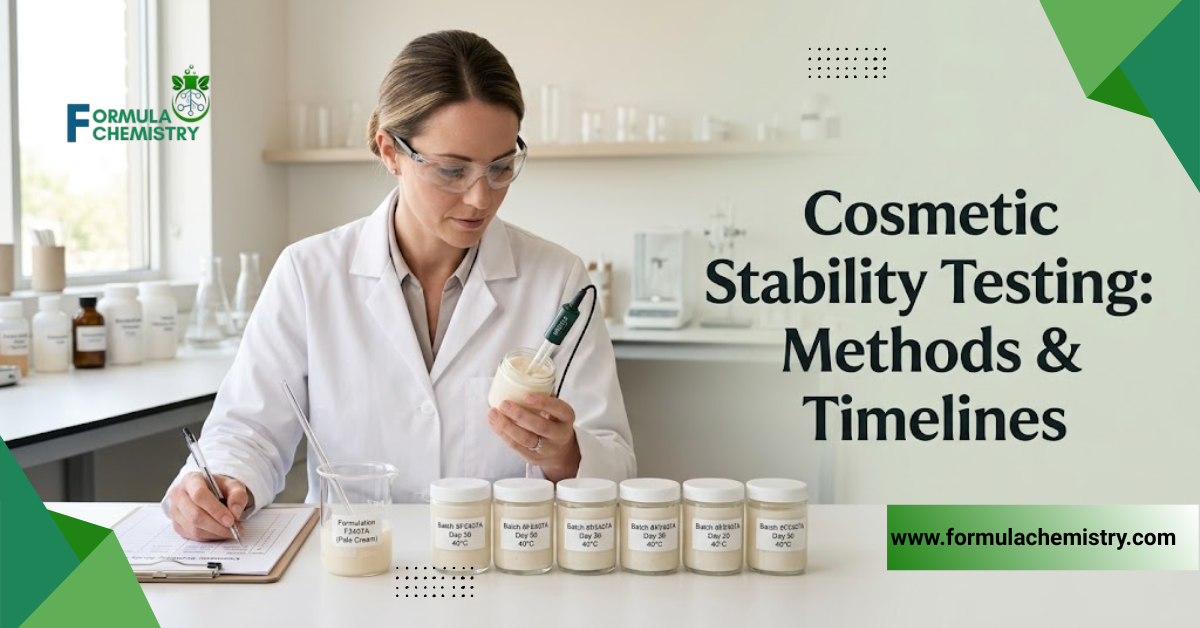
Cosmetic stability testing combines accelerated storage, commonly 12 weeks at 40°C, with real-time storage at 25°C across the full claimed shelf life, supported by freeze-thaw cycling, centrifugation, and light exposure.
Accelerated data predicts shelf life rather than proving it, because physical instability in emulsions does not follow the temperature relationship that chemical degradation does.
Preservative efficacy testing under ISO 11930 runs separately, and every test must be performed in the final packaging rather than a laboratory jar.
Introduction
Cosmetic stability testing is the discipline that separates a product from a recipe. A cream that looks perfect on the day you make it tells you nothing about how it behaves in a warm bathroom eighteen months later.
Most indie formulators run one test and treat the result as proof. That single misunderstanding, treating an accelerated result as a guarantee, causes more product failures than any formulation error I have seen.
Stability work is unglamorous, and it is where products are saved. A formula that fails at week six in a chamber costs a bench batch, while the same failure discovered on a customer’s shelf costs the brand.
By the end of this guide, you will know which methods exist, what each one actually measures, realistic timelines, why accelerated data has limits, and what you can and cannot do without a laboratory.
What Stability Testing Proves and What It Does Not
Stability testing establishes that a product retains its physical, chemical, and microbiological quality across its intended life in its intended packaging. It answers whether the emulsion holds, the pH stays put, the colour survives, and the packaging cooperates.
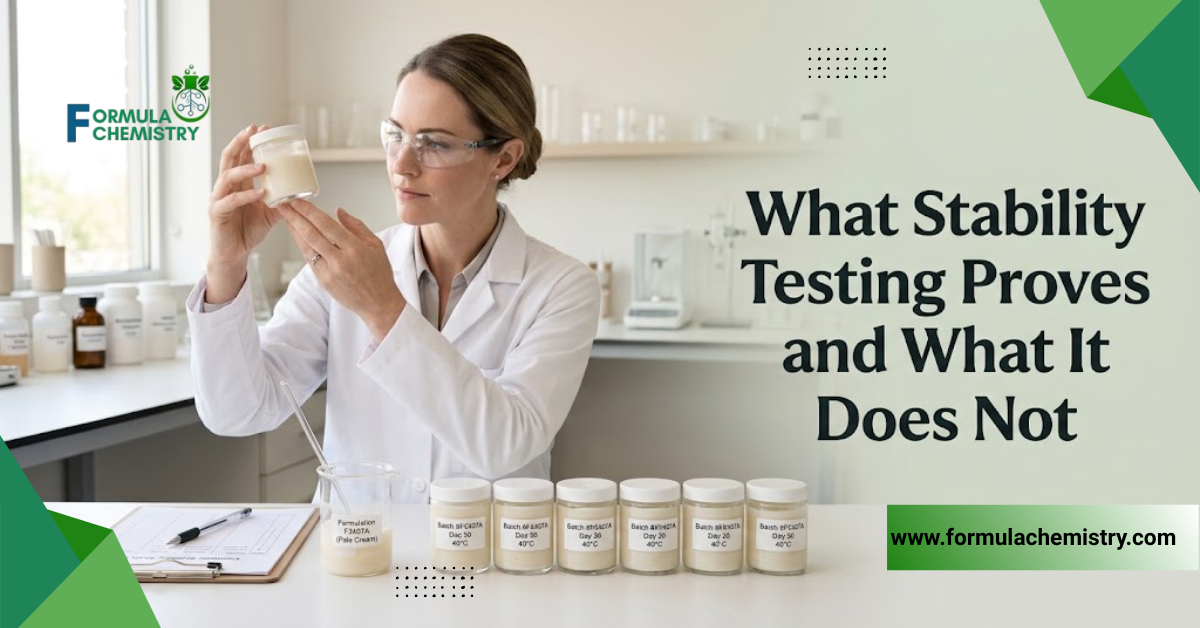
The testing does not certify safety on its own. A stable product can still be unsafe, which is why preservative efficacy and the wider safety assessment sit alongside stability rather than inside it.
Regulators expect appropriate data rather than a fixed protocol. The EU and UK safety assessor reviews your stability evidence as part of the Cosmetic Product Safety Report, and inadequate data undermines the entire submission.
The Core Testing Methods
Five methods cover almost every cosmetic programme. Each answers a different question, and none substitutes for another.
| Method | Typical condition | What it detects | Duration |
| Centrifugation | Roughly 3,000 rpm for 30 minutes | Early emulsion weakness | Hours |
| Freeze-thaw cycling | Alternating between -10°C and 25°C | Robustness to transport extremes | 2 to 5 weeks |
| Accelerated storage | 40°C, sometimes 45°C | Chemical degradation, gross instability | 12 weeks |
| Real-time storage | 25°C at controlled humidity | True shelf life | Full claimed life |
| Photostability | Daylight or UV exposure, with dark control | Colour fade, fragrance, and active degradation | 2 to 12 weeks |
Centrifugation is a screening tool rather than a stability result. Spinning an emulsion forces creaming or separation that gravity would take months to reveal, which makes it useful on day one and meaningless as evidence of shelf life.
Freeze-thaw cycling simulates what a courier does to your product in winter. Three to five cycles of freezing and returning to ambient will break a marginal emulsion quickly.
Accelerated storage at elevated temperature speeds chemical reactions. Twelve weeks at 40°C is the common protocol, with results reviewed at intervals rather than only at the end.
Real-time storage at 25°C is the only definitive answer. It runs for the full shelf life you intend to claim, plus a margin, and no shortcut replaces it.
Photostability exposes the product to daylight or controlled UV, alongside a dark control. Cosmetic practice borrows heavily from pharmaceutical guidance here, since no cosmetic-specific standard dominates.
What You Measure at Each Timepoint
Record the same parameters every time so you can see drift rather than guess at it. A stability study without a baseline at time zero is not a study.
- Appearance, including phase separation, creaming, syneresis, and sedimentation
- Colour and odour against the time zero reference
- pH, always measured at a controlled temperature
- Viscosity under identical shear conditions each time
- Microscopy of emulsion droplet size and distribution
- Weight loss, which reveals packaging permeability
- Packaging performance, including pump function and closure integrity
Measure pH at the same temperature every time. pH shifts with temperature, so a reading taken on a warm sample straight from a 40°C chamber is not comparable to one taken at ambient.
Microscopy deserves more use than it gets. Droplet size distribution coarsens before an emulsion visibly separates, which gives you weeks of warning that appearance alone will not.
Realistic Timelines
Timelines depend on your claimed shelf life, and the table below reflects common practice. Timepoints matter as much as duration.
| Stage | Condition | Timepoints |
| Screening | Centrifuge | Day zero |
| Cycling | Freeze-thaw, 3 to 5 cycles | Weekly observation |
| Accelerated | 40°C | 0, 4, 8, and 12 weeks |
| Elevated control | 4°C and 37°C | 0, 4, 8, and 12 weeks |
| Real-time | 25°C | 0, 3, 6, 12, 24, and 36 months |
Run a refrigerated arm alongside the heated one. Cold storage reveals crystallisation and thickening that elevated temperature actively hides.
Twelve weeks of accelerated data gives most brands enough confidence to launch while real-time testing continues. That is a commercial compromise rather than a scientific one, and it works only if you keep the real-time study running.
Never stop real-time testing at launch. The study is the evidence that supports your claimed shelf life, and abandoning it leaves the claim unsupported.
Why Accelerated Testing Is Prediction, Not Proof
Formulators repeat a rule of thumb that twelve weeks at 40°C approximates a year at ambient. That heuristic comes from chemical kinetics, where reaction rates roughly double for each 10°C rise.
The rule holds reasonably for chemical degradation, such as oxidation or hydrolysis. Physical instability follows different rules entirely, which is where the heuristic quietly fails.
Emulsion breakdown, wax crystallisation, and gel network formation are physical processes. Heating a product can mask a physical failure by keeping waxes fluid, or induce one that would never occur at ambient temperature.
Treat accelerated results as a filter rather than a verdict. Anything that fails at 40°C is dead, whereas anything that passes has earned only the right to continue in real-time study.
Test in the Final Packaging
Stability data from a laboratory jar describes the jar. Your customer receives the product in a pump, a tube, or an airless bottle, and each interacts with the formula differently.
Packaging compatibility testing runs alongside stability rather than after it. Watch for weight loss through permeable walls, migration between formula and container, discolouration of the component, and failure of pumps or closures.
Headspace matters for oxidation-sensitive products. A half-empty jar behaves differently from a full one, which is why some protocols include partially filled units. Run the study in the exact component you will ship. Switching packaging after testing invalidates the data you paid for.
Preservative Efficacy Is a Separate Test
Stability and preservation answer different questions, and conflating them is dangerous. A product can remain physically stable while supporting microbial growth.
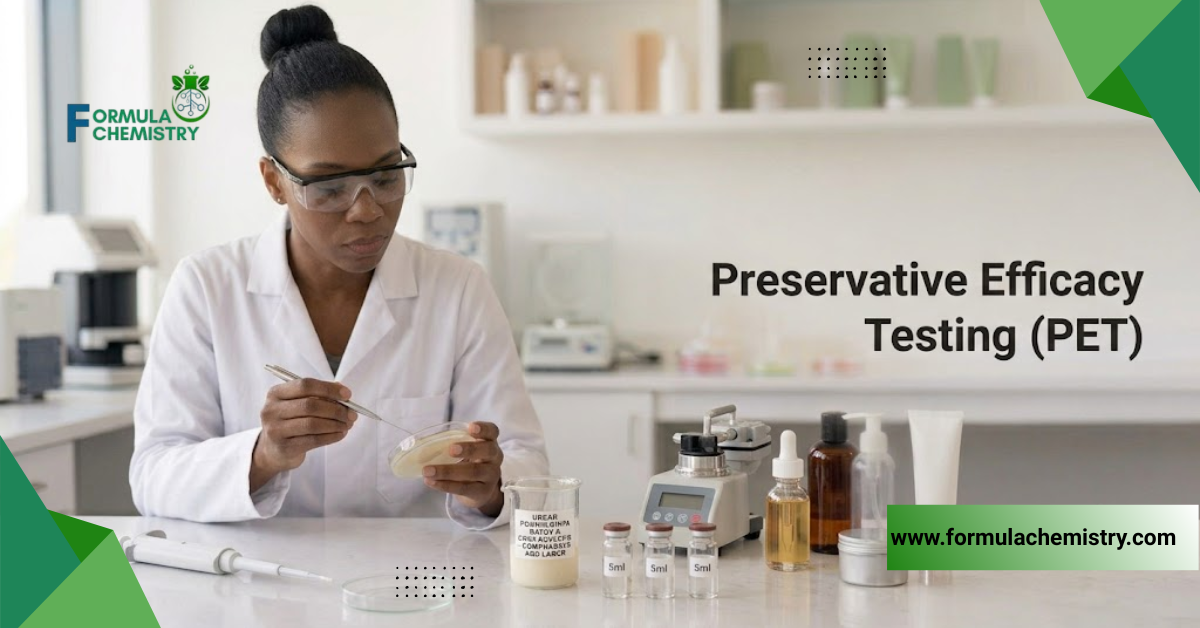
Preservative efficacy testing, often called a challenge test, follows ISO 11930 in cosmetics or USP chapter 51 in some markets. The laboratory inoculates the product with specified organisms and measures their reduction over defined intervals.
Water-containing products require this without exception. Anhydrous products face a lower risk, though water ingress during consumer use still warrants consideration.
Repeat the challenge test on your first production batch. A scaled batch has a different processing history, water source, and equipment contact, so bench data no longer describes it, a point Formula Chemistry raises with every brand approaching production.
Stability Testing Outside a Laboratory
Founders ask constantly whether they can run stability testing at home, and the honest answer has two halves. You can perform useful preliminary screening, but you cannot generate the evidence your market legally requires.
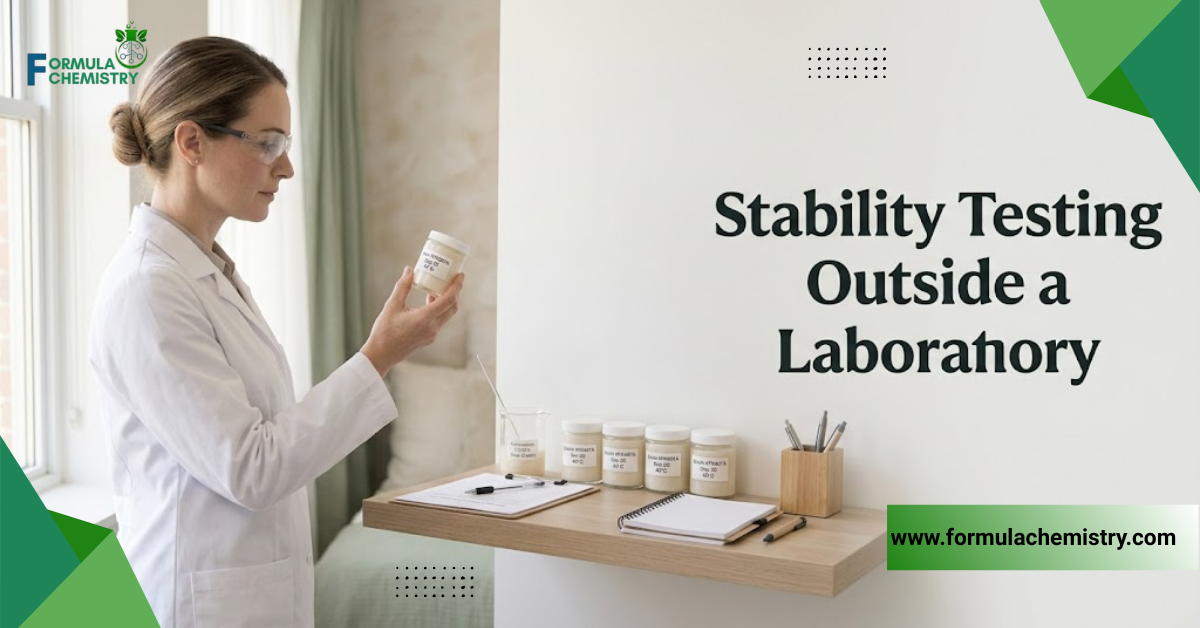
Meaningful home screening is possible. Store samples at ambient, in a refrigerator, and in a warm location around 40°C if you can control it, run freeze-thaw cycles, photograph everything against a reference, and track pH with a calibrated meter rather than strips.
That work catches gross failures early and saves money. It tells you which formulas deserve laboratory time.
What you cannot do at home is microbiological challenge testing, which requires controlled organism cultures and containment. Nor can you produce data that a safety assessor will accept for a Cosmetic Product Safety Report.
Use home screening to fail formulas cheaply. Use a laboratory to prove the ones that survive.
Common Stability Testing Mistakes
Stability programmes fail in patterns, and each mistake below has a direct fix. Catching them costs a batch instead of a recall.
The first mistake is treating accelerated data as proof of shelf life. It predicts rather than proves, so keep real-time testing running and let it validate your claim.
Skipping the time zero baseline is a second error. Without it you cannot demonstrate drift, so characterise the fresh product fully before any sample enters a chamber.
Testing in a laboratory jar rather than final packaging is a third mistake. Packaging interacts with the formula, so run the study in the exact component you will ship.
Measuring pH at inconsistent temperatures is a fourth error. Readings shift with temperature, so equilibrate every sample to the same temperature before measuring.
Confusing stability with preservation is a fifth mistake. They answer different questions, so run a challenge test under ISO 11930 alongside your stability study.
The sixth error is reusing bench data after scale-up. Production changes microstructure and microbial exposure, so re-run both stability and preservative efficacy on the first production batch.
Which Protocol Fits You
A home formulator refining a concept should screen with centrifugation, freeze-thaw cycling, and simple temperature storage. That programme costs almost nothing and eliminates weak formulas before they consume real money.
A brand preparing to launch needs a laboratory programme covering twelve weeks accelerated at 40°C, refrigerated and ambient arms, photostability, packaging compatibility, and an ISO 11930 challenge test. Real-time study begins at the same moment and continues past launch.
Brands selling into the EU or UK must produce data that their safety assessor will accept for the CPSR. Confirm what your assessor expects before you commission testing rather than afterwards.
Anyone scaling to production repeats the programme on the first commercial batch. To begin today, characterise your current formula fully at time zero and place samples at 4°C, 25°C, and 40°C, because a study you never started cannot support a claim you want to make.
Frequently Asked Questions
What is cosmetic stability testing?
It is the assessment of whether a product retains its physical, chemical, and microbiological quality across its intended shelf life in its final packaging. Testing combines accelerated and real-time storage with cycling and light exposure. It supports the shelf life you claim on the label.
How long does stability testing take?
Accelerated testing commonly runs twelve weeks at 40°C with readings at 0, 4, 8, and 12 weeks. Real-time testing runs the full claimed shelf life, often 24 to 36 months. Most brands launch on accelerated data while the real-time study continues.
What is accelerated stability testing?
Accelerated testing stores the product at an elevated temperature, usually 40°C, to speed chemical degradation. It screens formulas quickly and predicts rather than proves shelf life. Physical emulsion failures do not reliably follow the same temperature relationship.
Is 3 months at 40°C equal to a year?
That heuristic derives from chemical kinetics and holds only approximately. It works reasonably for oxidation and hydrolysis, and poorly for physical instability such as emulsion breakdown or wax crystallisation. Real-time data remains the only definitive evidence.
What is a freeze-thaw cycle test?
Freeze-thaw cycling alternates samples between freezing and ambient temperature, typically for three to five cycles. It simulates transport and storage extremes. Marginal emulsions usually break within the first few cycles.
Can I do stability testing at home?
You can run useful preliminary screening using ambient, refrigerated, and warm storage plus freeze-thaw cycling and pH tracking. You cannot perform microbiological challenge testing at home. Nor can home data support a Cosmetic Product Safety Report.
Do I test in the final packaging?
Yes, always, because packaging interacts with the formula through permeability, migration, and headspace. Data from a laboratory jar does not describe your finished product. Changing packaging after testing invalidates the study.
Is preservative testing part of stability?
No, preservative efficacy testing is a separate study, commonly following ISO 11930. Stability confirms physical and chemical quality, while a challenge test confirms microbial protection. Water-containing products need both.
Key Takeaways
Cosmetic stability testing pairs accelerated storage, commonly twelve weeks at 40°C, with real-time storage across the full claimed shelf life, supported by centrifugation, freeze-thaw cycling, and photostability. Accelerated data screens and predicts, while real-time data proves.
Physical instability does not follow the temperature relationship that chemical degradation does, so a formula passing at 40°C has earned continued study rather than a shelf life claim. Run every test in the final packaging, and treat preservative efficacy under ISO 11930 as a separate obligation.
Home screening fails weak formulas cheaply, and only laboratory data supports a regulatory submission. To act now, fully characterise your formula at time zero and place samples at 4°C, 25°C, and 40°C today, since the clock on real-time data only starts when you begin.