
Introduction
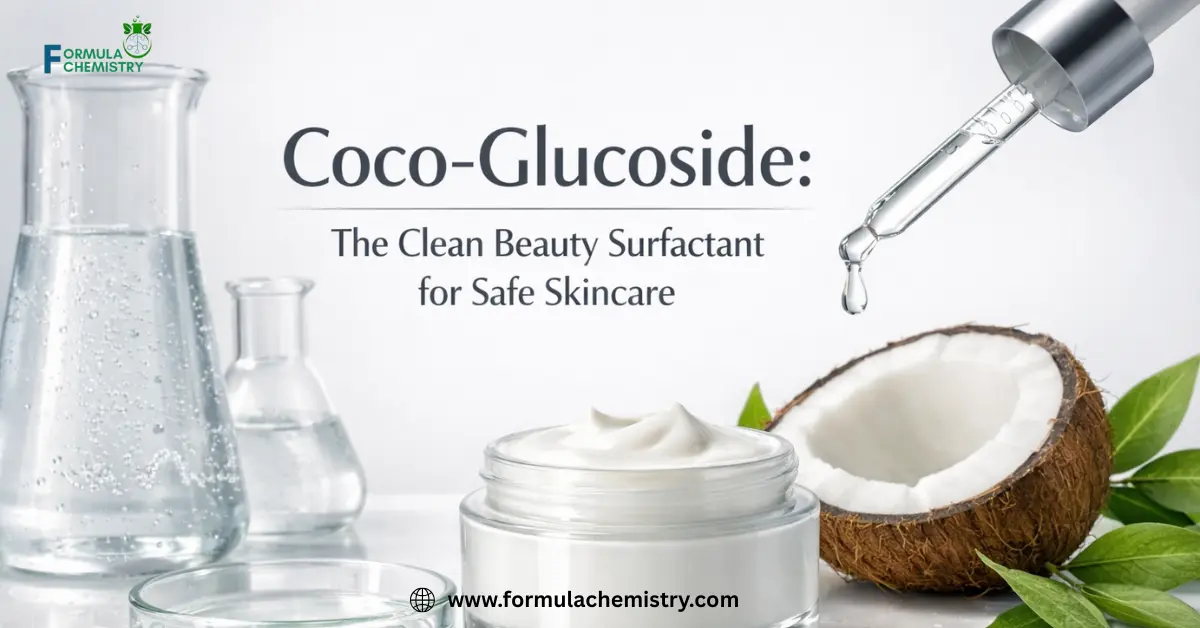
Coco-Glucoside has emerged as a cornerstone ingredient in the modern clean beauty movement.
Derived from the condensation of coconut oil fatty alcohols and glucose, this non-ionic surfactant is prized for its biodegradable profile and exceptional skin compatibility.
At FormulaChemistry, we focus on ingredients that balance high performance with ecological accountability, making this alkyl polyglucoside (APG) a fundamental part of our recipe guides.
Quick Facts
- What it is: A non-ionic, plant-derived surfactant used for cleansing and foaming.
- Who it’s for: Suitable for all skin types, especially sensitive, reactive, and baby skin.
- How to use: Incorporate into the water phase of surfactant systems, often used as a co-surfactant.
- Typical usage range: 1% to 15% for leave-on or rinse-off products.
- pH/Solubility: High pH (11–12) in raw form; water-soluble and stable in acidic environments.
- Compatibility: Works well with anionic, cationic, and other non-ionic surfactants.
- Common mistakes: Failing to adjust the final pH of the formula down to skin-neutral levels.
- Safety note: Always perform a patch test to rule out individual alkyl glucoside sensitivities.
The Rise of Alkyl Polyglucosides in Modern Formulation
The shift away from ethoxylated surfactants like SLES and SLS has led formulators toward the APG family. Coco-Glucoside stands out because it offers a dense, stable foam without the harshness often associated with traditional detergents.
FormulaChemistry provides practical formulation education and safety-forward guidance to help developers steer through these transitions successfully.
Its low toxicity profile and sustainable sourcing make it a perfect candidate for “green” certifications and eco-friendly product lines.
What are the Chemical Characteristics and Advantages of Coco-Glucoside?
Coco-Glucoside is a complex mixture of C8-C16 fatty alcohols linked to glucose molecules. Unlike ionic surfactants, it does not carry a charge in solution, which greatly reduces its possibility to disrupt the skin barrier.
This molecular structure allows it to lower the surface tension of water effectively, facilitating the removal of oils and debris without stripping the stratum corneum of its essential lipids.
Physical Characteristics and Stability
In its raw state, Coco-Glucoside is a cloudy, viscous liquid. The cloudiness is a natural characteristic of its high solids content and does not signal spoilage.
It is remarkably stable in high-electrolyte environments and maintains its foaming capabilities across a wide pH spectrum.
However, because it is supplied at a pH of 11–12 to prevent microbial growth, it calls for major acidification during the formulation process to reach a skin-compatible pH of 4.5–5.5.
Benefits for Sensitive Skin and Hair
The main advantage of this surfactant is its ultra-mildness. Clinical studies often show that Coco-Glucoside can actually reduce the irritation potential of other surfactants when used in a blend.
For hair care, it provides gentle cleansing that prevents the “straw-like” feel often caused by harsh sulfates.
It is also highly biodegradable, breaking down quickly in wastewater systems, which is consistent with the safety-forward ethos maintained at FormulaChemistry.
How to Formulate with Coco-Glucoside Effectively
Successful formulation with Coco-Glucoside requires an knowledge of its thickening behavior and pH requirements. Because it is non-ionic, it does not respond to salt-thickening (the “salt curve”) like anionic surfactants do.
Formulators must instead rely on natural gums, polymers, or fatty alcohols to achieve the desired viscosity in shampoos and body washes.
Recommended Usage Rates and Compatibility
The versatility of Coco-Glucoside allows it to function in a variety of product formats. It is rarely used as the sole surfactant because the foam, though stable, may occasionally seem “flashy” or thin compared to blends.
Combining it with amphoteric surfactants like Cocamidopropyl Betaine creates a more luxurious, creamy lather.
| Product Type | Recommended Usage Rate | Role in Formula |
| Micellar Water | 0.5% – 2% | Primary Cleanser |
| Facial Cleanser | 3% – 10% | Co-surfactant |
| Shampoo | 10% – 15% | Primary/Secondary Surfactant |
| Baby Wash | 5% – 12% | Primary Surfactant |
| Leave-on Lotion | 1% – 3% | Emulsifier stabilizer |
Overcoming Common Formulation Challenges
While Coco-Glucoside is user-friendly, beginners often meet issues with clarity as well as pH drift.
Because of its high alkalinity, adding it to a formula will cause a sharp rise in pH. Failure to correct this can lead to skin irritation and preservative failure.
- Common Problems and Fixes:
- Problem: The final product is too thin.
- Fix: Add 0.5%–1.0% Xanthan Gum or a similar rheology modifier.
- Problem: The formula turned cloudy after adding fragrance.
- Fix: Use a solubilizer or increase the surfactant ratio to fragrance.
- Problem: pH keeps drifting upward.
- Fix: Use a buffer like Sodium Citrate or check the stability of your acidifier.
- Problem: High pH during mixing destabilizes actives.
- Fix: Pre-acidify the water phase before adding the surfactant.
Safety Profiles and Regulatory Considerations
Coco-Glucoside is widely recognized as safe for both leave-on and rinse-off applications. It is non-mutagenic and non-sensitizing for the vast majority of the population.
However, safety-first formulation at FormulaChemistry dictates that we acknowledge the small percentage of individuals who may develop contact dermatitis from alkyl glucosides.
Sensitivities and Who Should Avoid
While rare, “Glucoside allergy” is a documented condition. Individuals with a known history of reacting to multiple botanical extracts or other APGs (like Decyl Glucoside) should exercise caution.
Who should avoid: Those with a diagnosed allergy to alkyl polyglucosides should avoid this ingredient entirely.
Key warnings: Never use the raw surfactant directly on the skin; its high pH will cause chemical burns. Always dilute to the recommended usage ranges and adjust the pH before testing.
Preservation and Shelf Life
Even though Coco-Glucoside has a high pH that inhibits growth in its concentrated form, once it is diluted into a final product (especially at a skin-neutral pH), it becomes highly susceptible to microbial contamination.
Preservation reminder: All water-based formulations containing Coco-Glucoside must include a strong, broad-spectrum preservative system.
FormulaChemistry emphasizes that natural surfactants do not provide antimicrobial protection once formulated into a finished product.
FAQs about Coco-Glucoside: The Clean Beauty Surfactant for Safe Skincare
What is the difference between Coco-Glucoside and Decyl Glucoside?
Coco-Glucoside generally provides a slightly more stable, creamier foam and has a longer carbon chain length than Decyl Glucoside, making it marginally milder for some skin types.
Is Coco-Glucoside sulfate-free?
Yes, it is a 100% sulfate-free surfactant, making it popular for “Clean Beauty” and color-safe hair care products.
Can I use Coco-Glucoside in a leave-on product?
Yes, at low levels (usually under 3%), it can act as a gentle emulsifier or stabilizer in creams and lotions without needing to be rinsed off.
Does Coco-Glucoside cause acne?
No, it is non-comedogenic. It effectively removes excess sebum without blocking pores, making it excellent for oily or acne-prone skin.
Is it 100% natural?
It is “naturally derived.” While it starts with coconut oil and sugar, it goes through chemical processing (acetalization) to create the final surfactant molecule.
Why is my Coco-Glucoside solid or chunky?
In cold temperatures, the fatty alcohols may crystallize. Gently warm the container in a water bath to return it to a homogenous, liquid state before use.
Can I use it in “Tear-Free” formulations?
Yes, it is frequently used in baby products because it has a low potential for eye irritation compared to anionic surfactants.
Is it palm-oil free?
Not always. While the name suggests coconut, some manufacturers use a mixture of coconut and palm kernel oil. Check with your supplier for specific palm-free documentation.
Editorial responsibility is a core value at FormulaChemistry; we recommend that all formulators preserve detailed batch records and conduct stability testing for every new iteration of a formula.
By complying with these guidelines, you are able to harness the power of Coco-Glucoside to create effective, professional-grade skincare.