
Introduction
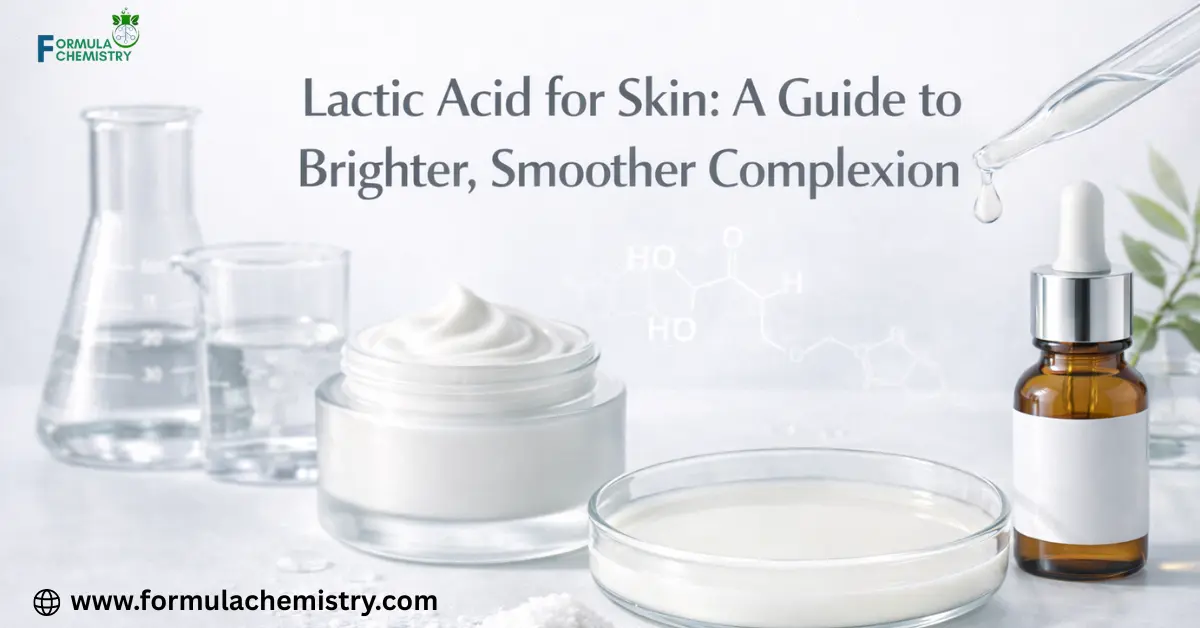
Lactic acid is a foundation of modern dermatological formulation, prized because of its dual ability to exfoliate and hydrate.
As a member of the Alpha Hydroxy Acid (AHA) family, it is naturally derived from fermented milk or produced synthetically for vegan-friendly cosmetic applications.
Unlike its smaller cousin, glycolic acid, lactic acid possesses a bigger molecular size, which limits its depth of penetration and makes it the favored option for sensitive skin types seeking renewal without excessive irritation.
At FormulaChemistry, we focus on the science of topical delivery, making sure that formulators and aficionados understand the chemical nuances that make an ingredient effective yet safe.
Lactic acid works by dissolving the protein bonds the “glue” that hold dead skin cells together, supporting a more radiant and even-toned appearance.
Quick Facts
- What it is: A water-soluble Alpha Hydroxy Acid (AHA) used for chemical exfoliation and humectancy.
- Who it’s for: Ideal for dry, mature, and sensitive skin types, as well as those with hyperpigmentation.
- How to use: Apply to clean, dry skin in the evening; follow with a moisturizer and daily SPF.
- Typical usage range: 2% to 10% for over-the-counter products; professional peels may go higher.
- pH notes: Effective exfoliation occurs at a pH of 3.5 to 4.0; efficacy drops as pH rises.
- Solubility: Highly soluble in water and ethanol.
- Compatibility: Pairs well with Hyaluronic Acid and Niacinamide; do not mix with Retinoids or Vitamin C in the same step.
- Common mistake: Using high concentrations daily without a transition period, leading to barrier disruption.
- Safety note: Always perform a patch test; AHAs increase sun sensitivity (photosensitivity).
Discover how Azelaic Acid: The Ultimate Solution for Clear, Healthy Skin can support a smooth, radiant complexion.
What Are the Main Benefits of Lactic Acid for Skin?
Lactic acid is unique among exfoliants because it is a component of the skin’s Natural Moisturizing Factor (NMF).
This means that while it works to remove surface debris, it simultaneously improves the skin’s ability to hold onto water. For formulators at FormulaChemistry, this dual-purpose profile makes it a necessary tool for treating dullness and dehydration simultaneously.
Surface Renewal and Texture Refinement
The main mechanism of lactic acid is the stimulation of cell turnover. Thinning the stratum corneum (the outermost layer of the skin) reveals fresher, more compact skin cells underneath. This process smooths out “chicken skin” (keratosis pilaris) and reduces the appearance of fine lines.
Because it is less aggressive than other AHAs, it provides a “glow” effect without the significant peeling often linked to chemical treatments.
Hyperpigmentation and Brightening Effects
Lactic acid is highly effective at fading superficial discolorations, such as post-inflammatory hyperpigmentation (PIH) and sunspots.
It inhibits the enzyme tyrosinase, which is responsible for melanin production. Over time, regular application results in a more uniform skin tone.
Common Problems and Fixes:
- Stinging upon application: This is common with low pH formulas. Fix: Ensure skin is completely dry before application, as water can speed up acid penetration.
- Increased dryness: Though a humectant, over-exfoliation can cause dryness. Fix: Reduce frequency to twice a week and increase emollient use.
- Product pilling: Lactic acid serums can be “tacky.” Fix: Wait 2 minutes for the product to absorb fully before applying oils or creams.

How to Formulate and Apply Lactic Acid Safely
When working with lactic acid, precision is mandatory. At FormulaChemistry, we emphasize that the “free acid” content the amount of acid actually available to work on the skin is determined by the final pH of the product.
If the pH is too high, the acid is neutralized and becomes a simple salt (sodium lactate), which hydrates but does not exfoliate.
Concentration and pH Guidelines
For daily home use, a concentration of 5% to 8% is generally considered the “sweet spot” for efficacy and safety.
Professional-grade products may reach 10% to 15%, but these require a strong skin barrier and experienced handling.
| Formulation Factor | Recommended Range / Specification |
| Typical Usage Range | 2% (gentle) to 10% (active) |
| Optimal pH Range | 3.5 to 4.5 |
| Solubility | Water-soluble |
| Incompatibilities | Strong oxidizers, copper peptides, highly alkaline ingredients |
| Preservation | Required (water-based) |
| Storage | Cool, dark place; avoid direct sunlight |
Application Protocols and Layering
Lactic acid should be integrated into a skincare routine slowly. Start with a low-percentage wash-off product or use a leave-on serum only twice a week.
It is best applied at night, as the removal of dead skin cells leaves the new skin vulnerable to UV damage. Always follow with a broad-spectrum sunscreen the next morning.
Who Should Use Lactic Acid and What Are the Risks?
While lactic acid is often touted as the “gentle AHA,” it is still a potent chemical. Knowing individual skin tolerance is the foundation of safety-forward skincare.
FormulaChemistry provides practical formulation education to help users deal with these choices without harming their skin health.
Identifying Ideal Candidates
Lactic acid is the gold standard for individuals with dry or mature skin who find glycolic acid too irritating. It is also an excellent entry point for people of color, as it carries a lower risk of causing “rebound hyperpigmentation” compared to deeper-penetrating acids.
Who should avoid:
- Individuals with active eczema or rosacea flares.
- Those with broken or recently waxed skin.
- Users currently on prescription retinoids (tretinoin) should consult a professional.
Managing Side Effects and Photosensitivity
The most significant risk associated with lactic acid is Sunburn Cell formation. Because AHAs thin the protective layer of dead skin, your skin’s natural UV defense is lowered.
Key warnings
include the mandatory use of SPF 30+ and the avoidance of other physical scrubs while using chemical exfoliants to prevent “over-processing” the skin.
FAQs about Lactic Acid for Skin: A Guide to Brighter, Smoother Complexion
Is lactic acid safe for daily use?
It depends on the concentration and your skin’s tolerance. While 5% formulas can often be used daily once the skin is acclimated, 10% formulas are generally better suited for 2–3 times per week.
Can I use lactic acid and Vitamin C together?
It is not recommended to layer them simultaneously, as the low pH of the acid can affect the stability of some forms of Vitamin C. Use Vitamin C in the morning and Lactic Acid in the evening.
Does lactic acid help with acne?
While Salicylic Acid (BHA) is better for deep pore cleaning, Lactic Acid helps by clearing surface clogs and fading the dark marks left behind by old breakouts.
How long does it take to see results?
An immediate “glow” can be seen after one use. However, significant changes in skin texture and hyperpigmentation usually require 4 to 6 weeks of regular application.
Is lactic acid vegan?
In the modern cosmetic industry, most lactic acid is produced via the fermentation of carbohydrates (like corn starch or beet sugar), making it vegan-friendly. Always check the supplier’s MSDS to verify.
Can I use lactic acid while pregnant?
Lactic acid is generally considered one of the safer acids during pregnancy when used in low concentrations, but you should always consult your medical provider first.
Should I apply lactic acid to wet or dry skin?
Always apply to dry skin. Applying acids to damp skin increases the rate of absorption, which considerably increases the risk of stinging and irritation.
What should I do if my skin starts peeling?
Peeling is a sign of over-exfoliation. Stop use immediately, focus on barrier repair with ceramides and petrolatum, and wait at least one week before reintroducing the acid at a lower frequency.
Formula Chemistry is dedicated to offering evidence-based knowledge of the complex world of cosmetic science. When incorporating active components such as lactic acid, the balance between pH, concentration, and skin barrier integrity is critical for achieving a shinier, smoother complexion safely.