
Emulsifiers in Face Creams: The Decision Most AHA Formulas Get Wrong
More AHA face creams fail because of emulsifier selection than because of acid concentration errors. The acid gets the blame when the cream separates at week six, but the root cause is almost always an emulsifier that was never rated for the pH the formula demands. That is a formulation architecture problem, not an ingredient problem.
At Formula Chemistry, emulsifier selection is the first technical conversation we have with any brand owner building an AHA cream. Get this decision right at the start and every other formulation variable becomes easier to manage.
Get it wrong and no amount of adjustment at cool-down will save the formula. This guide gives you the complete technical picture on emulsifiers in face creams built for AHA systems: how they work, which ones hold at low pH, and exactly how to build a stable base before a single acid is added.
Why Emulsifiers in Face Creams Matter for AHA Formulas
Emulsifiers in face creams are the structural molecules that hold the oil and water phases together in a stable, uniform dispersion. In a standard moisturiser at pH 5.5 to 6.5, most emulsifier systems perform reliably.
In an AHA face cream at pH 3.5 to 4.5, the majority of commonly used emulsifiers destabilise, causing phase separation, texture breakdown, and shelf life failure within weeks of manufacture. Selecting an emulsifier confirmed stable at low pH is the single most important technical decision in AHA face cream formulation.
Emulsifiers in Face Creams: How They Work at a Chemistry Level
An emulsion is a thermodynamically unstable system. Without an emulsifier, oil and water separate immediately because their molecular polarity is incompatible. Emulsifiers in face creams are amphiphilic molecules carrying both a hydrophilic head group and a lipophilic tail.
The head orients toward water and the tail toward oil, positioning the emulsifier molecule at the oil-water interface and reducing interfacial tension enough to create a stable droplet structure.In an oil-in-water face cream, oil droplets are dispersed throughout a continuous water phase.
The emulsifier forms a protective film around each oil droplet, preventing coalescence and maintaining the uniform texture the finished product requires. When that interfacial film is weakened or disrupted, droplets merge, the emulsion breaks, and the cream separates.
What disrupts the interfacial film in an AHA cream is low pH. Many emulsifier head groups are sensitive to hydrogen ion concentration. At pH 3.5 to 4.5, ionic emulsifiers with charged head groups lose their interfacial stability.
Because the charge behaviour of the head group changes in a highly acidic environment. Non-ionic emulsifiers with uncharged head groups are far more resistant to this effect, which is why emulsifier class selection matters before individual ingredient selection begins.
Emulsifier Classification: What Every Face Cream Formulator Needs to Know
Understanding emulsifier classification is the prerequisite for AHA cream formulation. The class determines pH tolerance before any supplier data sheet is consulted.
Ionic Emulsifiers in Face Creams and Why AHA Formulas Avoid Them
Ionic emulsifiers carry a net electrical charge on their head group. Anionic emulsifiers carry a negative charge and include sodium stearoyl lactylate, triethanolamine stearate, and soap-based systems. Cationic emulsifiers carry a positive charge and are primarily used in hair conditioning systems rather than skin creams.
Anionic emulsifiers perform well at neutral to mildly acidic pH, which is why they dominate standard moisturiser formulation. Below pH 4.5, the acidic environment protonates the charged head group and neutralises the charge that stabilises the interfacial film.
The protective layer around oil droplets weakens, coalescence begins, and phase separation follows. This is not a concentration problem or a processing problem. It is a fundamental incompatibility between the emulsifier class and the pH the formula requires.
Formula Chemistry consistently sees this failure in submitted AHA cream formulas, where the formulator has used a standard moisturiser emulsifier base without checking its pH tolerance. The cream looks stable at day zero and separates between weeks four and eight, often after the first temperature fluctuation during transit or storage.
Non-Ionic Emulsifiers in Face Creams: The AHA-Compatible Class
Non-ionic emulsifiers carry no net electrical charge. Their head groups are typically polyethylene glycol chains, glucoside units, or polyol structures that maintain interfacial stability independent of the pH of the surrounding aqueous phase. This makes them the appropriate emulsifier class for any face cream formulated below pH 4.5.
Within the non-ionic class, not every individual emulsifier is confirmed stable at AHA pH ranges. Supplier confirmation of pH tolerance is required before any non-ionic emulsifier is committed to an AHA formula. The class sets the direction. The data sheet and supplier confirmation set the final selection.
HLB Value and Its Role in Face Cream Emulsifier Selection
HLB stands for Hydrophilic-Lipophilic Balance, a numerical scale from 0 to 20 that describes where an emulsifier sits between fully oil-soluble and fully water-soluble.
For oil-in-water face creams, the required HLB range is typically 8 to 16. Emulsifiers with HLB values below 8 favour water-in-oil emulsions and are not appropriate as primary emulsifiers in an oil-in-water AHA cream.
Most face cream formulas use a blend of a high-HLB primary emulsifier and a low-HLB co-emulsifier to create a more robust interfacial film than either component provides alone.
This blended approach improves emulsion stability, texture consistency, and resistance to temperature stress during shelf life. In an AHA cream, both components of the blend must be non-ionic and pH-stable below 4.5.
Emulsifiers in Face Creams: The AHA-Compatible Options
These are the emulsifier systems that Formula Chemistry uses and recommends for AHA face cream formulation at pH 3.5 to 4.5. Each has confirmed pH stability at low pH ranges and is appropriate for leave-on daily-use products.
Cetearyl Alcohol and Cetearyl Glucoside: The Benchmark AHA Emulsifier
Cetearyl Alcohol (and) Cetearyl Glucoside, sold commercially as Montanov 68, is the most reliable non-ionic emulsifier for AHA face cream formulation available at cosmetic grade. The glucoside head group is pH-stable across a wide acidic range, confirmed stable below pH 4.0 by the supplier. It is Ecocert-approved and natural-origin, which supports natural positioning in brand communication.
Usage level is typically 4 to 6% in a finished face cream. It produces a medium-weight, skin-comfortable emulsion texture that holds well under temperature stress. At Formula Chemistry, this is the first recommendation for any formulator building their first AHA cream base, because its pH stability removes one critical variable from an already technically demanding formulation process.
Polyglyceryl Emulsifiers for Lightweight AHA Face Creams
Polyglyceryl esters are a class of non-ionic emulsifiers produced by esterification of polyglycerol with fatty acids. They are broadly pH-stable, natural-origin, and Ecocert-compatible. Commonly used members include Polyglyceryl-3 Methylglucose Distearate and Polyglyceryl-6 Distearate.
These emulsifiers produce lighter textures than Montanov 68 and are appropriate for gel-cream and lightweight lotion formats within the AHA pH range. Usage levels typically sit between 2 and 5% depending on the specific ester and target viscosity.
Confirm pH stability below 4.5 with your specific supplier before use, as performance varies across polyglyceryl ester grades.
PEG-Based Emulsifiers: Performance Without Natural Certification
PEG-derived emulsifiers such as PEG-100 Stearate (and) Glyceryl Stearate and Polysorbate 60 are non-ionic and broadly pH-stable at AHA pH ranges.
They are widely used in conventional cosmetic manufacturing and deliver reliable emulsion stability with predictable texture outcomes. They are not Ecocert-approved and are not appropriate for natural or organic-certified product lines.
For brand owners where natural certification is not a requirement, PEG-based non-ionic systems are a cost-effective and technically sound option for AHA face cream bases. Usage levels are typically 2 to 4% depending on the specific emulsifier and oil phase composition.
Sucrose Esters for Sensitive Skin AHA Face Creams
Sucrose esters are non-ionic emulsifiers produced by esterification of sucrose with fatty acids. Sucrose Stearate and Sucrose Distearate are the most commonly used cosmetic-grade members of this class.
They are gentle, skin-compatible, and confirmed stable at low pH, making them a strong option for AHA face cream formulas targeting sensitive or reactive skin types.
Usage levels are typically 3 to 6%. Sucrose esters can be more difficult to process than other non-ionic options due to their sensitivity to temperature during emulsification. They require precise heating and mixing protocols and are less forgiving of processing errors than Montanov 68 at the bench scale.
Building the Right Emulsifier Base for AHA Face Creams
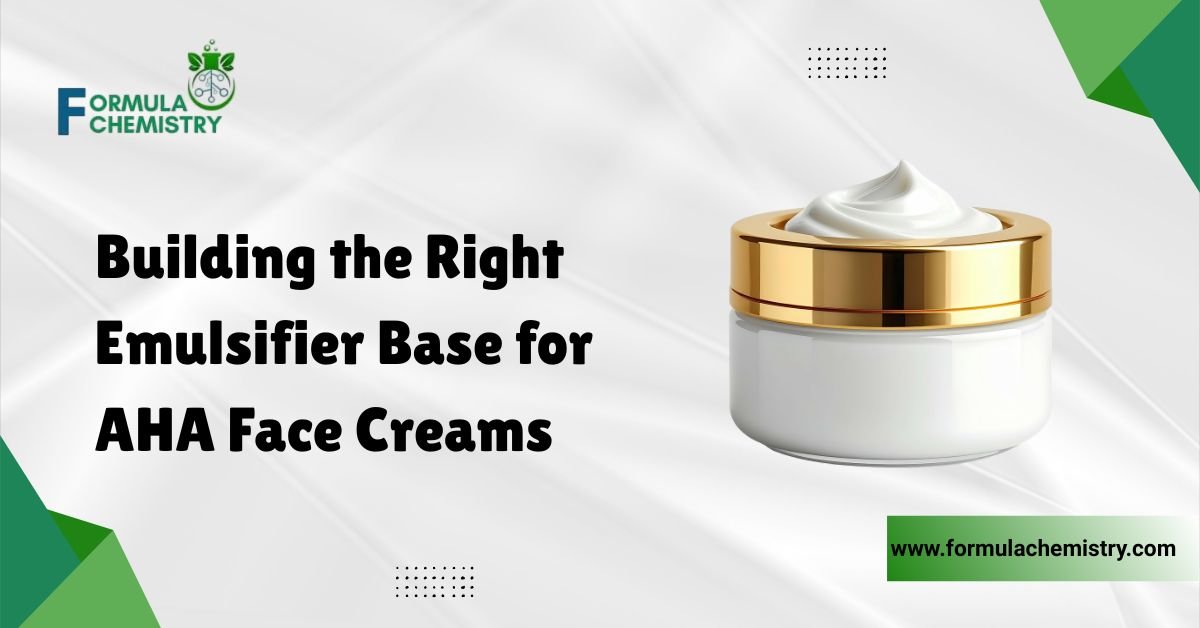
Selecting the right emulsifier is necessary but not sufficient. The base architecture around it determines whether the emulsion survives long-term at low pH.
Co-Emulsifiers and Fatty Alcohols in AHA Face Cream Bases
A primary emulsifier alone rarely produces a face cream with adequate viscosity, stability, and skin feel. Co-emulsifiers and fatty alcohols are added to reinforce the interfacial film, build viscosity, and improve the sensory profile of the finished product.
Cetearyl Alcohol at 1 to 3% is the standard co-emulsifier and viscosity builder in oil-in-water face creams. It is pH-stable across the AHA range and contributes a smooth, non-greasy after-feel.
Behenyl Alcohol at 1 to 2% produces a richer, more occlusive texture suitable for dry skin AHA formulas. Both are non-ionic and appropriate for low-pH AHA systems.
Emollient Selection to Support Emulsifier Performance in Face Creams
The oil phase composition directly affects emulsifier performance. Polar esters with high polarity indices are generally easier to emulsify than non-polar hydrocarbons at low pH.
Caprylic/Capric Triglyceride at 5 to 8% is the most compatible emollient for AHA face cream bases due to its low polarity, lightweight feel, and absence of reactive functional groups that could interact with the acid system.
Squalane at 2 to 4% is a stable hydrocarbon emollient that does not interfere with the emulsifier system or the acid phase. Avoid highly unsaturated vegetable oils like rosehip or sea buckthorn in AHA cream bases.
Their reactive double bonds are vulnerable to acid-catalysed oxidation at low pH, which shortens shelf life and introduces off-odour development over time.
Water Phase Composition and Its Effect on Emulsifier Stability
The water phase in an AHA face cream must be kept simple to avoid introducing ingredients that destabilise either the emulsifier or the acid system. Distilled or deionised water only.
Humectants such as glycerin at 4 to 5% and sodium PCA at 1 to 2% are fully compatible with all non-ionic emulsifier systems at AHA pH ranges. Tetrasodium EDTA at 0.1% should be included in every AHA face cream water phase to chelate metal ions that accelerate oxidation and compromise emulsifier integrity over time.
Technical Formulation Data for Emulsifiers in Face Creams
Emulsifier pH Stability Comparison for AHA Face Creams
| Emulsifier | Type | pH Stable Below 4.5 | Natural Origin | Typical Use Level |
| Cetearyl Alcohol (and) Cetearyl Glucoside | Non-ionic | Yes, confirmed | Yes, Ecocert | 4 to 6% |
| Polyglyceryl-3 Methylglucose Distearate | Non-ionic | Yes, confirm with supplier | Yes, Ecocert | 2 to 5% |
| Sucrose Stearate | Non-ionic | Yes | Yes, Ecocert | 3 to 6% |
| PEG-100 Stearate (and) Glyceryl Stearate | Non-ionic | Yes | No | 2 to 4% |
| Polysorbate 60 | Non-ionic | Yes | No | 1 to 3% |
| Sodium Stearoyl Lactylate | Anionic | No | Yes | Avoid in AHA |
| Triethanolamine Stearate | Anionic | No | No | Avoid in AHA |
| Glyceryl Stearate SE | Anionic component | No | Partial | Avoid in AHA |
Processing Notes for Emulsifiers in AHA Face Cream Production
Heat both water and oil phases to 75 to 80°C before combining. Add water phase to oil phase slowly with continuous homogenisation for 3 to 5 minutes at medium speed.
Allow the emulsion to cool with continuous stirring. Add the AHA acid system only after the emulsion has cooled to 40°C and is fully formed. Adding acid to a hot or partially formed emulsion risks disrupting the interfacial film before it has fully set, which causes irreversible instability that no amount of additional mixing corrects.
Common Mistakes With Emulsifiers in Face Cream AHA Formulas
- Using an anionic emulsifier in an AHA face cream because it performs well in a standard moisturiser at pH 5.5. Anionic emulsifiers lose interfacial stability below pH 4.5. The formula will appear stable at day zero and separate within four to eight weeks. Replace with a confirmed non-ionic system before running any stability testing.
- Failing to confirm pH tolerance below 4.5 with the emulsifier supplier before building the formula. Not all non-ionic emulsifiers are stable at AHA pH ranges. Supplier confirmation is a required step, not an optional one.
- Adding the acid system to the emulsion before it has cooled to 40°C. The interfacial film is not fully set in a warm emulsion. Acid addition disrupts the film before it stabilises, producing an emulsion that looks acceptable but fails under temperature stress within weeks.
- Using highly unsaturated vegetable oils in the oil phase of an AHA cream. Reactive double bonds in oils like rosehip or evening primrose are vulnerable to acid-catalysed oxidation at low pH. Use stable esters and hydrocarbons in the oil phase and reserve reactive vegetable oils for neutral-pH formulas.
- Relying on a single emulsifier without a co-emulsifier or fatty alcohol to reinforce the interfacial film. Single-emulsifier systems produce thinner, less stable emulsions that are more vulnerable to pH-related disruption. Always build in a co-emulsifier at 1 to 3% to strengthen the base architecture.
- Skipping accelerated stability testing and assuming the cream is stable because it looks uniform at room temperature after two weeks. AHA emulsions can appear stable at ambient conditions while failing at 40°C within four to six weeks. Accelerated testing at 40°C for a minimum of four weeks is required before any commercial release.
- Over-emulsifying by running the homogeniser for too long at high speed after the AHA system is added. Excess shear after acid addition can disrupt the already-formed interfacial film. Keep post-acid mixing to gentle paddle stirring only until pH adjustment is complete.
Emulsifier Suitability and Safety in AHA Face Cream Formulation
Non-ionic emulsifiers as a class are well tolerated across all skin types at standard usage levels. Individual emulsifiers within the class have their own sensitisation profiles and formulators should consult available safety data for each specific ingredient before use in a commercial formula.
For sensitive or reactive skin formulations, sucrose esters and cetearyl glucoside-based systems are the most skin-compatible options within the AHA-stable non-ionic class.
PEG-derived emulsifiers are broadly safe but are occasionally flagged by consumers with sensitivity to ethoxylated ingredients.
Formula Chemistry recommends selecting natural-origin non-ionic emulsifiers for any AHA face cream targeting sensitive skin demographics regardless of certification requirements.
Regulatory compliance for emulsifiers in face creams is governed by the EU Cosmetics Regulation Annex listings and FDA guidelines in the US market. All emulsifiers recommended in this guide are listed as approved cosmetic ingredients under current regulations.
Always confirm the regulatory status of any emulsifier in every target market before commercial release.Always conduct a 48-hour patch test with any new formula before wider use.
Ingredients Related to Emulsifiers in Face Cream AHA Systems
Xanthan Gum: is a water-phase rheology modifier used alongside emulsifiers in face creams to increase viscosity and improve emulsion stability under temperature stress. At 0.1 to 0.3%, it contributes to a more stable droplet network without contributing to pH instability at AHA ranges.
Carbomer: is a synthetic polymer thickener widely used in face cream formulation that requires neutralisation at pH 6.0 to 7.0 to activate. It is incompatible with AHA face cream formulas at pH 3.5 to 4.5 and should not be used as a viscosity builder in low-pH systems.
Cetyl Alcohol: is a C16 fatty alcohol used as a co-emulsifier and viscosity builder in face creams. It is pH-stable across the AHA range and functions similarly to cetearyl alcohol at a slightly lighter texture outcome. It is appropriate as a partial or full substitution for cetearyl alcohol in AHA face cream bases where a lighter body is the target.
FAQ’s about Emulsifiers in Face Creams for AHA Formulation
Why do most standard emulsifiers fail in AHA face creams at low pH?
Most standard face cream emulsifiers are anionic, meaning they carry a negative electrical charge on their head group that stabilises the oil-water interface. At pH 3.5 to 4.5, the high hydrogen ion concentration protonates and neutralises this charge.
Collapsing the interfacial film and allowing oil droplets to coalesce and separate. Non-ionic emulsifiers carry no charge and are therefore unaffected by this pH-related mechanism, which is why they are the only appropriate class for AHA face cream formulation below pH 4.5.
What is the best emulsifier for an AHA face cream formula?
Cetearyl Alcohol and Cetearyl Glucoside, commercially available as Montanov 68, is the most consistently reliable emulsifier for AHA face creams at pH 3.5 to 4.5. It is confirmed pH-stable below 4.0, natural-origin, Ecocert-approved, and produces a medium-weight cream texture that performs well under temperature stress.
Formula Chemistry recommends it as the starting emulsifier for any formulator building their first low-pH AHA cream base before exploring alternative non-ionic systems.
Can you use a natural emulsifier in an AHA face cream without compromising stability?
Yes. Cetearyl glucoside-based systems, polyglyceryl esters, and sucrose esters are all natural-origin non-ionic emulsifiers confirmed stable at AHA pH ranges. Natural origin does not automatically mean pH-stable, however.
Always confirm the pH tolerance of any natural emulsifier with your supplier before committing it to an AHA formula architecture. Natural certification and low-pH stability are independent properties that must both be verified separately.
At what pH do emulsifiers in face creams start to fail?
Anionic emulsifiers typically begin to show instability below pH 4.5 and fail reliably below pH 4.0. Non-ionic emulsifiers are generally stable well below pH 4.0, though individual tolerance varies by specific ingredient and supplier grade.
The failure is not always immediately visible. Phase separation in an AHA cream often begins at the microscopic droplet level weeks before visible creaming or separation is apparent to the eye.
Which is why accelerated stability testing rather than visual inspection is the only reliable stability assessment method.
How does emulsifier concentration affect stability in AHA face creams?
Emulsifier concentration directly determines the density of the interfacial film surrounding oil droplets. Under-emulsification, using less than 3 to 4% in a face cream with a 10 to 15% oil phase.
Which produces a sparse interfacial film that is more vulnerable to coalescence under temperature or pH stress. Over-emulsification above 8% rarely improves stability further and can introduce tackiness and an unpleasant skin feel.
The optimal range for most AHA face cream oil phases is 4 to 6% primary emulsifier supported by 1 to 3% co-emulsifier or fatty alcohol.
Emulsifiers in Face Creams: Summary for Formulators
- Emulsifier class selection is the most critical technical decision in AHA face cream formulation. Anionic emulsifiers fail below pH 4.5. Non-ionic emulsifiers with confirmed low-pH stability are the only appropriate class for AHA face cream systems at pH 3.5 to 4.5.
- Cetearyl Alcohol and Cetearyl Glucoside at 4 to 6% is the benchmark AHA-stable emulsifier for face creams. It is confirmed stable below pH 4.0, natural-origin, and produces a medium-weight texture that performs reliably under temperature stress during shelf life testing.
- The emulsifier base must be fully formed and cooled to 40°C before the AHA acid system is added. Acid addition to a warm or partially formed emulsion disrupts the interfacial film before it sets and produces irreversible instability that cannot be corrected at cool-down.
- Co-emulsifiers and fatty alcohols at 1 to 3% reinforce the interfacial film and are required in any face cream formula targeting commercial shelf life. Single-emulsifier systems are more vulnerable to pH-related disruption and should not be used in AHA cream formulation without co-emulsifier support.
- Accelerated stability testing at 40°C for a minimum of four weeks is mandatory before commercial release of any AHA face cream. Visual stability at room temperature is not a reliable indicator of long-term emulsion performance at the pH ranges AHA formulas require.
- Formula Chemistry recommends starting every AHA face cream base with Montanov 68 at 5%, cetearyl alcohol at 2%, and caprylic/capric triglyceride at 6%, confirming emulsion stability at the target pH before introducing any additional actives or texture modifiers into the formula architecture.