
Introduction
Dry, dull skin that resists every moisturiser you throw at it usually has one thing in common: a build-up of dead surface cells blocking hydration from getting through. That is the exact problem this malic acid face cream formula is designed to solve.
This is a leave-on AHA moisturising cream that combines malic acid as a gentle exfoliating and humectant active with a structured emulsion base. It delivers barrier repair, sustained hydration, and a soft, non-greasy finish.
It is formulated for beginners and intermediate makers who want a genuinely functional daily-use cream. The formula totals exactly 100%, uses clearly defined phases, and is ready to scale.
Malic acid benefits for skin in this formula include surface cell turnover support, improved texture, and secondary humectant action within a pH range safe for daily leave-on use.
This post covers the full formula table, ingredient breakdown, step-by-step method, pH guidance, troubleshooting, and variations.
Quick specs for this malic acid face cream formula
Here is everything you need to know before you begin making this cream.
| Spec | Detail |
| Product type | Leave-on AHA moisturising cream (O/W emulsion) |
| Concern targeted | Dull skin, uneven texture, dryness, mild surface congestion |
| Best for skin type | Normal to dry, dull, or slightly rough skin |
| Texture and finish | Medium-weight cream, non-greasy, soft skin feel |
| Difficulty level | Beginner to Intermediate |
| Batch size options | 100g and 500g |
| Target pH range | 3.5 to 4.0 |
| Estimated shelf life | 12 months unopened, 6 months after opening |
| Preservative system | Phenoxyethanol (and) Ethylhexylglycerin at 1% |
The target pH of 3.5 to 4.0 places malic acid within its effective exfoliant range while remaining tolerable for daily use on normal to dry skin.
Above pH 4.5 the exfoliant activity of malic acid drops off significantly. Below pH 3.2 the formula becomes too aggressive for a daily leave-on product.
Malic acid face cream formula table
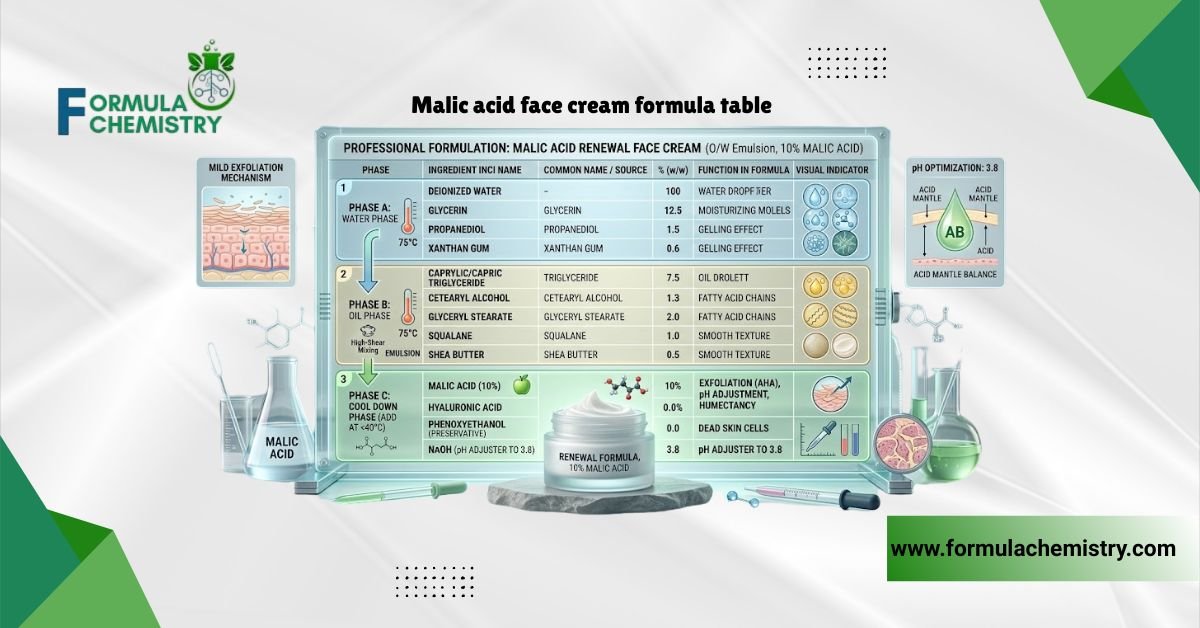
Below is the complete formula. All percentages are by weight and the formula totals exactly 100%.
| Phase | INCI and Common Name | % | Function | Notes |
| A – Water Phase | Aqua (Purified Water) | 58.50 | Solvent and base | Use distilled or deionised water |
| A – Water Phase | Glycerin (Glycerin) | 4.00 | Humectant | Pharmaceutical grade, 99.5%+ |
| A – Water Phase | Sodium PCA (Sodium PCA) | 2.00 | Humectant, NMF component | Skin-identical moisture factor |
| A – Water Phase | Panthenol (Panthenol) | 1.00 | Humectant, soothing agent | DL-Panthenol powder or 75% liquid |
| A – Water Phase | Disodium EDTA (Disodium EDTA) | 0.10 | Chelator | Sequesters metal ions, protects emulsion |
| B – Oil Phase | Cetearyl Alcohol (and) Ceteareth-20 (Emulsifying Wax NF) | 5.00 | Primary O/W emulsifier | Emulsifying Wax NF or Polawax |
| B – Oil Phase | Cetearyl Alcohol (Cetearyl Alcohol) | 2.00 | Emulsion stabiliser, emollient | Adds body and smooth skin feel |
| B – Oil Phase | Caprylic/Capric Triglyceride (Caprylic/Capric Triglyceride) | 6.00 | Emollient, skin feel modifier | Fractionated coconut oil; lightweight and stable |
| B – Oil Phase | Squalane (Squalane) | 4.00 | Emollient, barrier support | Plant-derived; stable and non-comedogenic |
| B – Oil Phase | Shea Butter (Butyrospermum Parkii Butter) | 3.00 | Emollient, occlusive | Refined for neutral scent |
| B – Oil Phase | Cetyl Alcohol (Cetyl Alcohol) | 1.50 | Emollient, thickener | Contributes to final cream texture |
| C – Cool-Down Phase | Malic Acid (Malic Acid) | 2.00 | AHA exfoliant, humectant | Pre-dissolve in water before adding; adjust pH after |
| C – Cool-Down Phase | Niacinamide (Niacinamide) | 3.00 | Skin tone support, barrier function | Add below 40°C to preserve activity |
| C – Cool-Down Phase | Allantoin (Allantoin) | 0.20 | Soothing agent | Can be added to Phase A if it dissolves cleanly |
| C – Cool-Down Phase | Phenoxyethanol (and) Ethylhexylglycerin (Phenoxyethanol, Ethylhexylglycerin) | 1.00 | Broad-spectrum preservative | Add below 45°C |
| C – Cool-Down Phase | Sodium Hydroxide Solution 10% (Sodium Hydroxide) | 0.50 | pH adjuster | Use 10% dilution; adjust to pH 3.5 to 4.0 |
| C – Cool-Down Phase | Fragrance optional (Fragrance / Parfum) | 0.20 | Sensory modifier | Omit for fragrance-free version |
| Total | 100.00% |
Understanding the phases in this formula
Phase A is the water phase. It contains all water-soluble humectants and the chelator, heated together to 70 to 75°C (158 to 167°F).
Heating ensures full dissolution and heat sanitisation of the water phase before emulsification begins.
Phase B is the oil phase, heated separately to the same temperature range. All waxes and solids must be fully melted and uniform before combining with Phase A.
Combining both phases at matched temperatures is critical. A temperature difference greater than 2°C (4°F) between phases is one of the most common causes of emulsion failure at this stage.
Phase C is the cool-down phase, added once the emulsion has dropped below 40°C (104°F). This is where malic acid, niacinamide, preservative, and fragrance are introduced to protect their activity.
Why this formula works for dull and dry skin
Malic acid loosens the bonds between dead surface corneocytes, allowing them to shed more readily. This improves light reflection at the skin surface, which translates to a more even and brighter look over consistent use.
At 2% within a pH of 3.5 to 4.0, the formula delivers meaningful exfoliant activity without the rebound irritation risk of higher-concentration leave-on acids.
The emollient base compensates for any potential dryness by reinforcing the barrier with occlusive and film-forming ingredients. This dual action makes a well-formulated AHA cream more effective than an AHA serum worn alone under a separate moisturiser.
Key actives and what each one contributes
- Malic acid (Malic Acid) at 2% may help improve skin surface texture and support cell turnover at pH 3.5 to 4.0, and also acts as a secondary humectant drawing moisture to the skin surface.
- Niacinamide (Niacinamide) at 3% can support the look of even skin tone and may help improve the appearance of pores and skin barrier function over consistent use.
- Glycerin (Glycerin) at 4% is a reliable humectant that helps the skin surface hold moisture throughout the day.
- Sodium PCA (Sodium PCA) at 2% is a component of the skin’s natural moisturising factor and can support balanced moisture levels in the upper stratum corneum.
- Squalane (Squalane) at 4% helps restore surface lipids and contributes to a non-greasy moisturised skin feel.
- Panthenol (Panthenol) at 1% is a provitamin B5 derivative that may help soothe the skin following exfoliant use.
Ingredient breakdown and substitutions for this malic acid cream
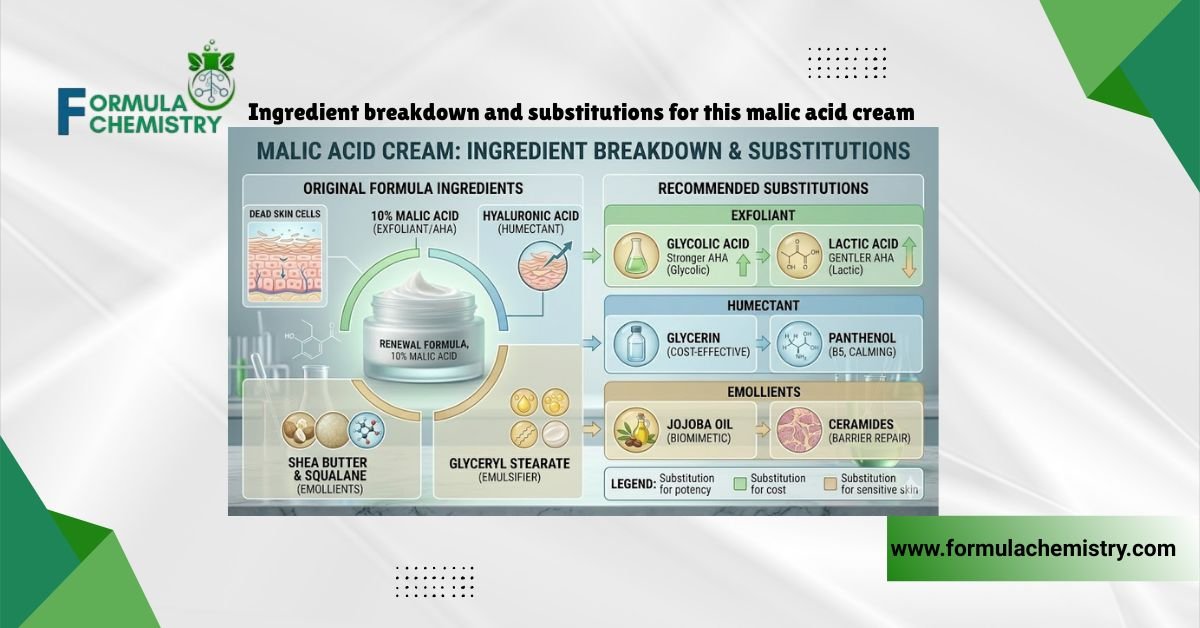
Each key ingredient below is covered with formulation-level detail that goes beyond standard supplier data sheets.
Malic acid (Malic Acid)
Malic acid is a dicarboxylic alpha-hydroxy acid naturally present in apples and many stone fruits. It has a slightly larger molecular weight than glycolic acid, which means it penetrates the skin more slowly.
This is genuinely useful in a leave-on cream at 2%. Slower penetration reduces the risk of over-exfoliation in a daily-use product.
The standard usage rate for malic acid as an active exfoliant in leave-on products is 1 to 5%. This formula uses 2% because it is positioned as a beginner-accessible daily cream.
At bench level, malic acid dissolves cleanly in warm water and has minimal impact on emulsion viscosity when added in the cool-down phase. It does not discolour the formula or create stability issues with the other actives here.
Substitution: Lactic acid (Lactic Acid) at 2 to 3% is the closest swap with similar humectant properties. Mandelic acid (Mandelic Acid) at 1 to 2% is an option for very sensitive skin formulations.
Emulsifying Wax NF (Cetearyl Alcohol and Ceteareth-20)
This is the backbone of the emulsion. At 5% it produces a medium-weight cream body suitable for normal to dry skin without requiring multiple co-emulsifiers.
One bench observation: Emulsifying Wax NF can leave a slightly waxy drag if used above 6% without a complementary fatty alcohol. The 2% Cetearyl Alcohol in Phase B offsets this and smooths out the skin feel considerably.
Substitution: Polawax (Emulsifying Wax NF, same INCI) is a direct swap at the same percentage. BTMS-50 (Behentrimonium Methosulfate and Cetearyl Alcohol) is better suited to hair conditioners and introduces a conditioning feel that may not suit all skin types.
Caprylic/Capric Triglyceride (Caprylic/Capric Triglyceride)
This is the primary emollient in the oil phase, derived from fractionated coconut oil. It has excellent oxidative stability, which is important in a formula containing an acid and an amine-based active like niacinamide.
At 6% it ensures the finished cream spreads easily without drag. Going above 8 to 10% with this emulsifier load can make the cream feel slightly oily on less dry skin types.
Substitution: Isopropyl Myristate (Isopropyl Myristate) at 3 to 4% for a drier finish, or Dicaprylyl Carbonate (Dicaprylyl Carbonate) at a similar rate for a silky alternative.
Squalane (Squalane)
Plant-derived squalane mirrors the squalane found in sebum, which means it integrates well with the skin’s own surface lipids. At 4% it adds subtle richness without contributing to congestion.
A bench note: squalane can slow viscosity build slightly compared to heavier esters. If you want a thicker finished cream, reduce squalane by 1% and increase shea butter by the same amount.
Substitution: Hemp Seed Oil (Cannabis Sativa Seed Oil) at 3 to 4% for added linoleic acid content, though it reduces shelf stability. Jojoba (Simmondsia Chinensis Seed Oil) at 3% is a very stable alternative.
Niacinamide (Niacinamide)
Niacinamide is added at 3% in the cool-down phase specifically to avoid a reaction between niacinamide and glycerin at elevated temperatures above 50°C (122°F).
That reaction can produce trace nicotinic acid, which causes a flushing response in some users. Supplier data sheets do not always flag this, but it is a consistent bench observation.
In this formula both niacinamide and glycerin are present, so strict cool-down addition below 40°C (104°F) is non-negotiable.
Substitution: Alpha-arbutin (Alpha-Arbutin) at 1% works through a different mechanism but also supports an even-looking skin tone. If removing niacinamide entirely, replace the 3% with distilled water or add 1% additional panthenol.
Phenoxyethanol and Ethylhexylglycerin (Phenoxyethanol, Ethylhexylglycerin)
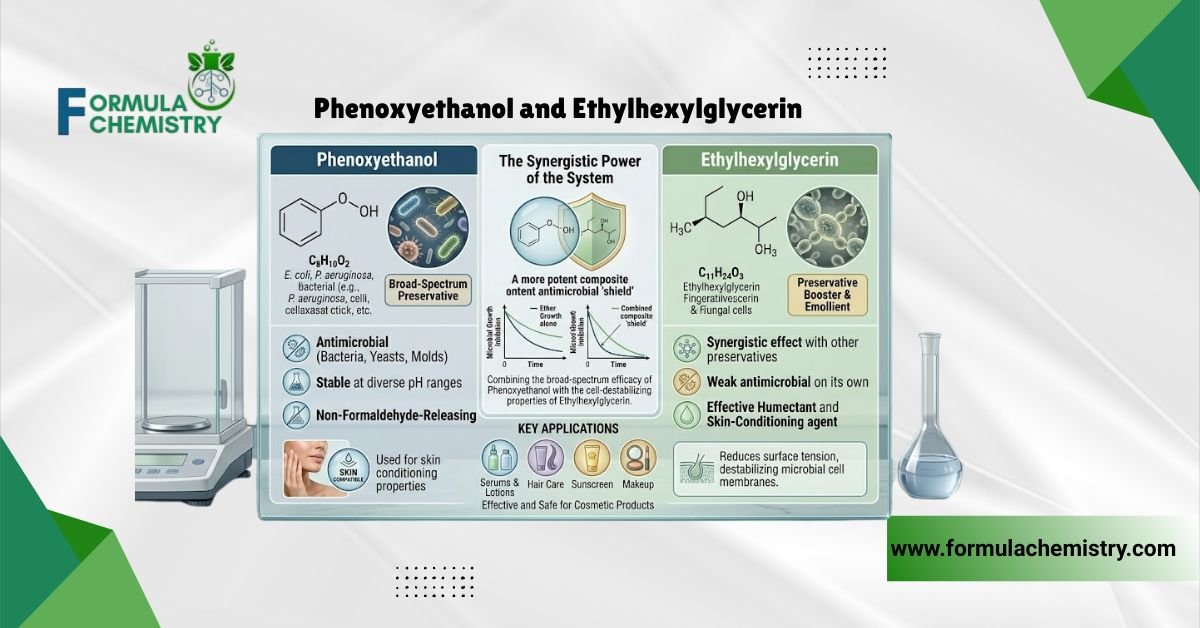
This preservative system covers gram-positive and gram-negative bacteria, yeasts, and moulds. At 1% it sits in the middle of the effective range for a water-phase-heavy emulsion.
It is stable and effective within a pH range of 3.0 to 8.0, which makes it well-matched for this low-pH formula. Many alternative preservatives lose broad-spectrum coverage below pH 5.0.
A bench note: this blend can add a very faint characteristic scent at formula level. In a fragrance-free version this is generally undetectable in the finished product, but it is worth knowing if you are sensitive to it.
Equipment and prep before making this cream
Having the right setup before you start prevents the most common errors in AHA emulsion making.
Tools and equipment you will need
- Digital scale with 0.01g precision for accurate weighing of actives and preservative
- Two heat-resistant glass or stainless steel beakers, one for Phase A and one for Phase B
- Digital thermometer accurate to 1°C (2°F) for monitoring phase temperatures
- Overhead stirrer for the emulsification step, or an immersion blender used in 5-second pulses to avoid excess aeration
- Calibrated pH meter with buffer solutions verified before use
- Glass or silicone spatulas for scraping down beaker walls
- Pipettes or droppers for small additions of sodium hydroxide solution
- Labels and batch record sheet for traceability
Sanitation and hygiene
Wipe down all equipment, beakers, spatulas, and work surfaces with 70% isopropyl alcohol (Isopropyl Alcohol) and allow to air dry before use.
The 70% concentration is more effective than 99% for surface disinfection because the water content improves contact time with microbial cell walls.
Work in a clean, dust-free environment with windows closed. Airborne contamination is a commonly underestimated source of batch failure in home and small studio settings.
Wear nitrile gloves throughout the entire process. When handling the sodium hydroxide solution, add safety glasses as well. Even a 10% NaOH solution is caustic on contact with eyes.
How to make this malic acid face cream step by step
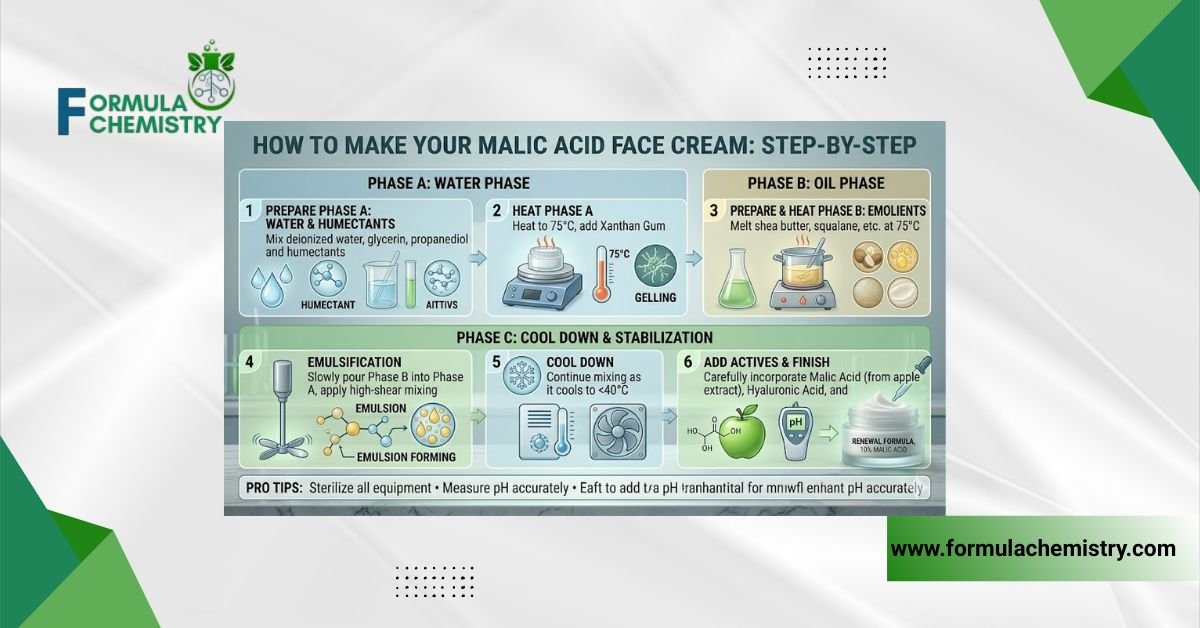
This method follows a heated emulsion process with cool-down actives. Read through all steps before you begin.
Preparing and combining the water and oil phases
Step 1. Weigh Phase A ingredients into your water phase beaker: purified water, glycerin, Sodium PCA, panthenol, and Disodium EDTA. Heat to 70 to 75°C (158 to 167°F) with gentle stirring. Hold at temperature for 20 minutes.
Step 2. Weigh Phase B ingredients into your oil phase beaker: Emulsifying Wax NF, Cetearyl Alcohol, Caprylic/Capric Triglyceride, squalane, shea butter, and cetyl alcohol. Heat to 70 to 75°C (158 to 167°F) until all waxes and solids are fully melted and uniform.
Step 3. Confirm both phases are within 2°C (4°F) of each other. Slowly pour Phase B into Phase A with continuous stirring in a steady, even stream.
Step 4. Mix with an overhead stirrer at medium speed, or use an immersion blender in 5-second pulses. Continue for 3 to 5 minutes until the emulsion is white, opaque, and shows no visible oiliness.
Critical step: Do not stop stirring during initial emulsification. Inconsistent mixing at this stage leads to phase separation on cooling.
Step 5. Continue slow, continuous stirring as the emulsion cools. Do not rush cooling with an ice bath, as rapid cooling disrupts emulsion structure.
Adding cool-down actives and adjusting pH
Step 6. When the emulsion reaches 40°C (104°F), begin adding Phase C ingredients one at a time, stirring well between each addition.
Start with malic acid, pre-dissolved in 1 to 2g of distilled water. Pre-dissolving prevents localised pH shock to the emulsion structure.
Step 7. Add niacinamide and stir until fully dissolved. Add allantoin if it was not added to Phase A. Add the preservative blend and fragrance if using.
Step 8. Leave the batch to cool to room temperature, approximately 25°C (77°F), before measuring pH. Always use a calibrated pH meter, not strips.
Step 9. Check pH. Target is 3.5 to 4.0. If pH is below 3.5, add drops of 10% sodium hydroxide solution, stir fully, and recheck. If pH is above 4.0, add small amounts of pre-dissolved malic acid solution.
Critical step: Add pH adjusters one drop at a time and restir fully before rechecking. Overshooting pH in either direction is the most common error at this stage.
Step 10. Once pH is confirmed within range, transfer to a clean labelled jar or pump bottle. Leave 24 hours before final pH check and stability assessment.
pH, stability, and testing for this malic acid face cream formula
Getting pH right is the single most important quality control step in any AHA formula. It determines both safety and efficacy.
pH measurement and adjustment
The target pH for this malic acid face cream formula is 3.5 to 4.0. At this range, malic acid functions as an effective AHA exfoliant within safe leave-on use guidelines.
Always measure pH at room temperature after the batch has fully cooled. A warm emulsion will read differently from the same emulsion at 25°C (77°F).
Use 10% sodium hydroxide solution to raise pH. Use additional pre-dissolved malic acid solution to lower it. Add each in 1 to 3 drop increments for a 100g batch.
Stability testing checklist
| Test | Day 7 | Day 14 | Day 30 | Day 90 |
| pH | Check and record | Check and record | Check and record | Check and record |
| Appearance and colour | Uniform white cream | No change expected | No change expected | Check for yellowing |
| Odour | Characteristic mild scent | No change | No change | Off-notes indicate rancidity or microbial issue |
| Viscosity and texture | Smooth, even consistency | No significant change | Check for thinning | Should be stable |
| Phase separation | None expected | None expected | None expected | Watch for water pooling or oil rings |
| Microbial challenge test | Inoculate sample | Check progress | Check count | Final count confirms preservative efficacy |
Run stability samples at three conditions: ambient room temperature (20 to 25°C / 68 to 77°F), elevated temperature (40°C / 104°F), and freeze-thaw cycling. All three together give a reliable picture of real-world stability.
Preservation and shelf life of this malic acid skincare formula
Preservation in a low-pH AHA emulsion is not optional. Water-based emulsions support bacterial, yeast, and mould growth readily, and glycerin as a nutrient source increases that risk.
Preservative selection and justification
This formula uses Phenoxyethanol (and) Ethylhexylglycerin (INCI: Phenoxyethanol, Ethylhexylglycerin) at 1%, available as Euxyl PE 9010 or equivalent blends from multiple suppliers.
The system covers gram-positive bacteria, gram-negative bacteria, yeasts, and moulds. It is stable and effective within pH 3.0 to 8.0, which is critical for this low-pH formula.
Many alternative preservatives such as sodium benzoate and potassium sorbate lose broad-spectrum coverage below pH 5.0. This makes them unsuitable here.
At 1%, this preservative is within the standard usage range and has a clean skin feel, no reported comedogenicity, and global regulatory compliance under EU, US, and most international frameworks.
Shelf life and storage guidance
Unopened and stored below 25°C (77°F) away from direct sunlight, this formula has an estimated shelf life of 12 months. Once opened, use within 6 months.
Store in a pump or disc-top closure rather than a wide-mouth jar to reduce contamination from fingers. Use a spatula for dispensing if a jar format is chosen.
Warning: Do not attempt to use this formula without a preservative. Omitting preservation from a water-based emulsion produces an unpreserved product that can harbour invisible microbial contamination within days of opening. This is a genuine safety risk.
Troubleshooting common problems in AHA cream making
Most issues with this cream type come from one of three sources: temperature management, pH handling, or cool-down timing. The table below covers the specific problems you are most likely to encounter.
Common issues with emulsion and pH stability
| Problem | Likely Cause | Fix |
| Emulsion separated immediately after making | Phases at mismatched temperatures or stirring stopped too early | Reheat gently to 60°C (140°F) and re-emulsify; check emulsifier percentage if it fails again |
| Grainy or lumpy texture | Shea butter or cetyl alcohol not fully melted, or cool-down phase added too hot | Reheat carefully and stir; ensure all Phase B solids are fully molten next time |
| pH too low after adding malic acid | Malic acid raised acidity more than expected, common in soft water | Add 10% NaOH solution drop by drop, stir, and recheck until pH reaches 3.5 to 4.0 |
| pH too high above 4.5 | Insufficient acid or NaOH overshot during adjustment | Add more pre-dissolved malic acid solution in small increments until target pH is reached |
| Cream turns watery on shelf | Insufficient emulsifier or water phase proportion too high | Increase Emulsifying Wax NF to 6% and Cetearyl Alcohol to 2.5% in next batch |
| Niacinamide causing flushing or redness | Niacinamide added too hot and converted to nicotinic acid | Ensure niacinamide is added strictly below 40°C (104°F); reduce to 2% for sensitive skin versions |
| Preservative clouding the emulsion | Preservative added when batch was still above 45°C (113°F) | Always wait until below 40°C (104°F) to add; slight cloudiness on addition is normal and clears on stirring |
| Fragrance causing emulsion to thin | Fragrance contains a high proportion of esters or alcohols that disrupt emulsifier structure | Switch fragrance, reduce percentage, or omit entirely |
Formula variations for different skin types and needs
This base formula is stable and flexible. The variations below require targeted changes only, not a complete reformulation.
Sensitive skin version with lower AHA concentration
Reduce malic acid from 2% to 1% and add 1% distilled water to maintain the total. Increase allantoin from 0.20% to 0.30% and reduce water by the same amount.
This is one of the most practical adjustments in malic acid skincare for anyone new to chemical exfoliation. The target pH for this version sits at 3.8 to 4.2, slightly higher to reduce exfoliant intensity while preserving humectant activity.
Richer barrier-repair version for very dry skin
Increase shea butter from 3% to 5% and reduce Caprylic/Capric Triglyceride from 6% to 4%. Add ceramide NP (Ceramide NP) at 0.5% to the oil phase and reduce water by 0.5%.
Emulsify more slowly in this version as the higher solid fat content makes the oil phase thicker. An overhead stirrer is strongly recommended over an immersion blender here.
Brightening version with alpha-arbutin
Add alpha-arbutin (Alpha-Arbutin) at 1% to the cool-down phase and reduce distilled water by 1% to maintain the total.
Alpha-arbutin is water-soluble and stable at pH 3.5 to 5.0. It works through a different mechanism from malic acid, so the combination is complementary rather than redundant.
Keep pH within 3.5 to 4.0 and note that alpha-arbutin is sensitive to high temperatures. Cool-down addition below 40°C (104°F) is especially important in this variation.
How to use this malic acid face cream
This cream is formulated as a leave-on daily moisturiser with exfoliant activity. It is not a treatment product or mask.
Application routine guidance
Apply a pea-sized amount to clean, dry skin in the morning or evening as the moisturising step. If using in the morning, always follow with a broad-spectrum SPF of 30 or higher.
AHA use at any concentration increases photosensitivity. Daily SPF use is a responsible requirement to include alongside any AHA product.
When introducing an AHA cream for the first time, consider applying every other day for the first two weeks before moving to daily use. This is general guidance only, not a personalised skincare prescription.
This cream sits after any toner or essence step and before a facial oil if one is used. It works best as the final moisturising step in the routine.
Safety notes for this formula
Perform a patch test before first use. Apply a small amount to the inner forearm and check the area after 24 hours.
Avoid contact with eyes, broken skin, or any area of active irritation.
If irritation occurs, discontinue use.
This formula is not recommended for use during pregnancy without guidance from a healthcare professional, as it contains alpha-hydroxy acids.
| Ingredient | Function | Weight % | Amount (ml/g) |
|---|
Frequently asked questions about malic acid face cream
What is malic acid used for?
Malic acid is used in cosmetics primarily as an alpha-hydroxy acid exfoliant and as a humectant. In skincare formulas it may help improve the look of skin texture and surface dullness by supporting surface cell turnover.
It is also used as a pH adjuster at lower concentrations. Its dual role as an AHA exfoliant and secondary humectant makes it particularly useful in leave-on moisturising cream formulas targeting dull, dry, or uneven skin.
Is malic acid bad for you?
Malic acid is not considered harmful when used at appropriate concentrations in cosmetic formulas within the correct pH range. At 1 to 3% in a leave-on cream at pH 3.5 to 4.0, it is well tolerated by most normal to dry skin types.
Higher concentrations, very low pH values, or use on broken or sensitised skin can cause irritation. If you have reactive skin, start with a lower concentration and patch test first. Malic acid in food is widely regarded as safe by regulatory bodies globally.
What is malic acid good for?
Malic acid in skincare is useful for improving the look of dull, rough, or uneven skin texture. At functional pH levels it may help loosen dead surface cells, which over time can support a smoother, more even skin surface.
As a humectant it also helps the skin surface hold moisture. In a cream formula it combines exfoliant action with hydration in a single step, which is why it appears in daily-use moisturisers rather than only in rinse-off or spot treatments.
How to use malic acid on skin?
In a formulated leave-on cream like this one, malic acid is used as part of a daily moisturising routine applied after cleansing to dry skin. It should not be applied to broken, sunburned, or recently waxed skin.
Always follow with SPF in the morning. If using a standalone malic acid toner or serum, apply to clean skin and follow with a separate moisturiser. Start with lower frequencies and increase as tolerated. Always patch test any new AHA product before full facial use.
What does malic acid do for skin?
Malic acid functions as an alpha-hydroxy acid that may help improve the appearance of skin texture and surface tone by supporting surface exfoliation. Its humectant properties also help the skin draw and hold moisture.
In a leave-on cream at 2% within a pH of 3.5 to 4.0, it contributes to a smoother, softer skin surface over consistent use. It is generally considered a gentler AHA compared to glycolic acid due to its larger molecular size, which means it absorbs more gradually.
What is malic acid in skincare?
Malic acid (INCI: Malic Acid) is an alpha-hydroxy acid sourced naturally from apples and other fruits, or produced synthetically for cosmetic use. In skincare formulations it serves as an exfoliant at active concentrations of 1 to 5%, as a pH adjuster at lower concentrations, and as a humectant across all usage levels.
Its molecular weight sits between glycolic acid and mandelic acid, positioning it as a mid-range AHA in terms of skin penetration speed and exfoliant intensity.
What are malic acid side effects?
The most commonly reported side effect of malic acid in leave-on cosmetics is mild stinging or tingling on first application, particularly on sensitive or barrier-compromised skin. Redness, dryness, or peeling can occur if the concentration is too high, the pH is too low, or the product is used too frequently.
These effects are characteristic of all AHA actives. Using SPF daily while using any AHA product is important because AHAs can increase sun sensitivity. Patch testing before full use reduces the risk of an unexpected reaction.
Is malic acid good for skin?
Yes, malic acid can be beneficial for most normal to dry skin types when used in a well-formulated product at an appropriate pH. It may help improve the look of dull or textured skin, support moisture retention, and contribute to a smoother surface over time.
It is considered one of the gentler AHAs available, making it a practical choice for formulators building an introductory exfoliant cream. As with any AHA, it is not suited to broken, sensitised, or reactive skin without professional guidance.
Why this malic acid face cream formula is worth making
This formula is a complete, functional, and scalable starting point for anyone developing an AHA moisturising cream.
- Combines AHA exfoliation with barrier-supporting emollients in a single leave-on product, removing the need to layer a separate moisturiser over an acid serum
- Malic acid at 2% within pH 3.5 to 4.0 delivers effective surface exfoliation at a concentration appropriate for daily use on normal to dry skin
- Niacinamide at 3% adds skin tone and barrier support benefits without interfering with the AHA mechanism when added correctly at cool-down
- The preservative system is matched to the low pH range and covers the full spectrum of potential microbial contaminants
- The formula is beginner-accessible but built to professional standards with accurate percentages, phase logic, and stability guidance throughout
Use the Formula Chemistry Formulation Calculator to scale this batch to any size.
Have a formulation question? Book a one-to-one session with our expert.