
Introduction
Sorbitan Oleate is a mono-ester of oleic acid and hexitol anhydrides derived from sorbitol. In the world of cosmetic chemistry, it is widely recognized as a flexible, nonionic surfactant and emulsifier. While it often works behind the scenes, its role in stabilizing formulations and improving texture is indispensable for both professional and indie formulators.
Known commercially as Span 80, this ingredient performs well in water-in-oil (W/O) systems due to its lipophilic nature. However, its utility reaches far beyond simple emulsions. It acts as an effective wetting agent for pigments in color cosmetics and a dispersing agent in sunscreens. Its ability to modify viscosity and improve the sensory profile of a product makes it a mainstay in modern skincare.
For those creating cleansers, moisturizers, or makeup, understanding how to balance Sorbitan Oleate with high-HLB emulsifiers is key to avoiding separation. Formula Chemistry provides practical formulation education and safety-forward guidance to help you build stable, effective products without the guesswork.
Sorbitan Oleate at a Glance
| Property | Value |
|---|---|
| INCI Name | Sorbitan Oleate |
| Trade Names | Span 80, Sorbitan Monooleate, SMO |
| CAS Number | 1338-43-8 |
| EC / EINECS Number | 215-665-4 |
| CosIng Ref No. | 38181 |
| Molecular Formula | C₂₄H₄₄O₆ |
| Molecular Weight | ~428.6 g/mol |
| E-Number (food use) | E494 |
| HLB Value | 4.3 (lipophilic) |
| Appearance | Amber to yellow viscous liquid |
| Melting Point | ~10–12 °C |
| Function | W/O emulsifier, co-emulsifier, pigment dispersant, wetting agent |
| Solubility | Soluble in vegetable and mineral oils; dispersible in water |
| Typical Use Level | 0.5–5% (up to 10% in colour cosmetics) |
| pH Stability | 3.0–8.0 |
| Origin | Vegetable-derived (sorbitol + oleic acid) |
| Charge | Non-ionic |
Identifiers verified against SpecialChem and supplier technical data: CAS 1338-43-8, EINECS 215-665-4, CosIng Ref 38181; molecular formula C₂₄H₄₄O₆ and molecular weight approximately 428.6 g/mol; E-number E494, melting point 10–12 °C.
Keep your skin soft and balanced with Sucrose Stearate: The Skincare Game-Changer.
Is Sorbitan Oleate Safe? Regulatory Status Explained
Sorbitan Oleate has one of the longest safety records of any cosmetic emulsifier, and it is approved for both cosmetic and food use across all major jurisdictions.
Cosmetic Ingredient Review (CIR): The CIR Expert Panel assessed the sorbitan ester family and concluded that Sorbitan Oleate is safe as used in cosmetic products under present conditions of concentration and use. This assessment covers its role as an emulsifier, emollient and emulsion stabiliser across leave-on and rinse-off formats.
United States (FDA): Sorbitan Monooleate holds Generally Recognised as Safe (GRAS) status for food use under 21 CFR 172.842. In cosmetics, it is unrestricted, with typical inclusion levels sitting between 0.5% and 5% depending on the emulsion type and the stability required.
European Union: Sorbitan Oleate is listed in the CosIng database under Regulation (EC) No 1223/2009 with reported functions of emulsifying and skin conditioning. It carries no Annex III restriction, meaning there is no regulatory concentration cap for cosmetic use. As E494, it is also a permitted food additive.
Understanding the EWG Rating
Sorbitan Oleate appears in the EWG Skin Deep database as a low-hazard ingredient, but the entry carries a cell-mutation flag alongside secondary notes on organ system toxicity and irritation. This causes understandable confusion, so it is worth explaining what that data actually represents.
The mutation reference traces back to in-vitro assays in which isolated cells were exposed to high concentrations of the raw material. Studies of this type establish a hazard signal, not a use-level risk. Two things separate that laboratory condition from a finished cosmetic: concentration and exposure route.
In a real emulsion, Sorbitan Oleate sits at roughly 1–5%, bound into an oil phase, applied topically to intact stratum corneum. It is a large, non-ionic, oil-soluble molecule with negligible systemic penetration.
The CIR Expert Panel reviewed this same body of evidence, including the animal data on liver effects at high oral doses and irritation at elevated topical concentrations, and still concluded the ingredient is safe as used. That is the distinction that matters for formulators: a hazard identified at extreme exposure is not the same as a risk at cosmetic use levels.
A Note on Comedogenicity
Comedogenicity ratings for Sorbitan Oleate vary widely between sources, with some listing it as non-comedogenic and others assigning a moderate rating. This spread reflects a weakness in the rating system rather than genuine disagreement about the ingredient.
Most published comedogenicity scores originate from rabbit-ear assays conducted on raw materials at high or neat concentrations, a model with poor correlation to human facial skin. A rating assigned to neat Sorbitan Oleate tells you very little about a lotion containing 1.5% of it.
In practice, at typical inclusion levels and particularly in rinse-off products, the pore-clogging risk is low. Formulators working on acne-prone claims should still run consumer-use testing on the finished product rather than relying on ingredient-level scores.
Add these three outbound links inside this section (authority signals — Google wants to see them on YMYL-adjacent content):
- CIR →
cir-safety.org - FDA → the eCFR page for 21 CFR 172.842
- EU → the CosIng entry for Sorbitan Oleate
Sourcing: the CIR Expert Panel evaluated the scientific data and concluded that Sorbitan Oleate and other Sorbitan Esters were safe as cosmetic ingredients under present conditions of concentration and use; EWG treats it as low hazard while noting a potential carcinogen flag from cell-mutation studies, with lesser concerns over organ system toxicity and irritation based on animal studies showing liver effects at high doses and skin irritation at moderate doses; FDA affirms it as GRAS under 21 CFR 172.842; cosmetic use levels typically run 0.5–5%.
What Makes Sorbitan Oleate Essential for Formulators?
Sorbitan Oleate is structurally composed of a hydrophilic (water-loving) sorbitan head and a lipophilic (oil-loving) oleic acid tail. Because the oleic acid tail dominates the molecule’s behavior, it has a low Hydrophile-Lipophile Balance (HLB) value of 4.3. This low HLB indicates that the ingredient strongly prefers oil over water, making it an exceptional choice for water-in-oil emulsions where water droplets are suspended within an oil phase.
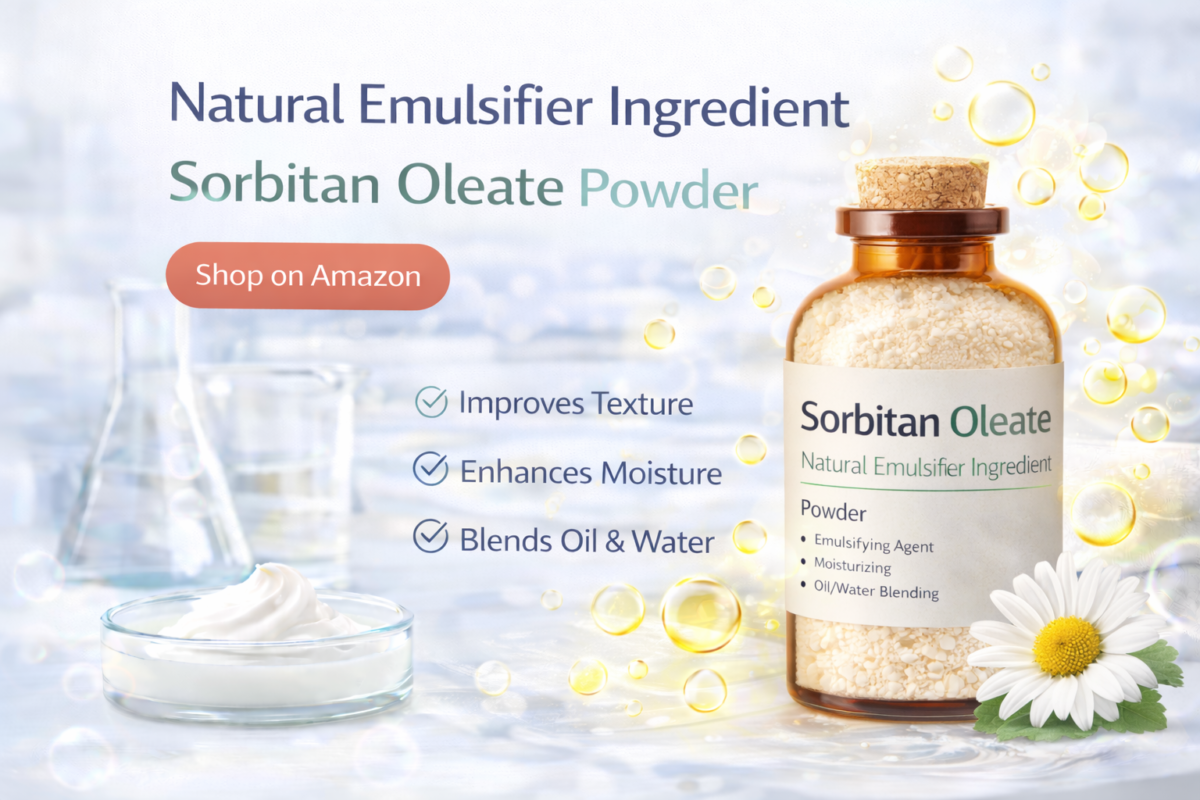
This chemical structure allows Sorbitan Oleate to reduce the surface tension between two immiscible liquids effectively. By orienting itself at the interface of oil and water, it prevents the droplets from coalescing. Formulators rely on this mechanism to create “heavy” creams, barrier-repair balms, and waterproof sunscreens that require a continuous oil phase to function correctly on the skin.
The Chemistry of Span 80 vs. Polysorbates
It is impossible to discuss Sorbitan Oleate without referring to its chemical partner, Polysorbate 80 (Tween 80). Sorbitan Oleate is the base molecule; when ethoxylated (reacted with ethylene oxide), it becomes Polysorbate 80. This relationship is critical because these two ingredients are frequently used in tandem to create the “perfect” emulsion.
The Span Series: Choosing the Right Sorbitan Ester
Span 80 is one member of a family. Each variant pairs sorbitan with a different fatty acid, and that choice sets the HLB, the physical state and the ideal application.
| Product | INCI Name | HLB | State at 25 °C | Best Suited To |
|---|---|---|---|---|
| Span 20 | Sorbitan Laurate | 8.6 | Liquid | Light O/W co-emulsifier, solubilising |
| Span 40 | Sorbitan Palmitate | 6.7 | Solid | Mid-HLB blends, creams |
| Span 60 | Sorbitan Stearate | 4.7 | Solid | Hot-process W/O creams, stick products |
| Span 65 | Sorbitan Tristearate | 2.1 | Solid | Very low HLB, heavy anhydrous balms |
| Span 80 | Sorbitan Oleate | 4.3 | Liquid | W/O emulsions, pigment wetting, cleansing oils |
| Span 85 | Sorbitan Trioleate | 1.8 | Liquid | Ultra-low HLB, W/O sunscreens, dispersions |
The practical takeaway: Span 60 and Span 80 sit close together on HLB (4.7 versus 4.3), so formulators often treat them as interchangeable. They are not. Span 60 is a solid at room temperature and must be melted into the oil phase, while Span 80 remains fluid and pours cold. If you are running a cold-process formula, a pumpable production line, or anything requiring room-temperature dosing, Span 80 is the only realistic choice of the two.
Anchor values confirmed: Span 65 sorbitan tristearate at HLB 2.1, Span 80 sorbitan monooleate at 4.3, Span 85 sorbitan trioleate at 1.8; Span 60 is solid at room temperature, whereas Span 80 stays fluid, making it the go-to low-HLB emulsifier for cold-process formulations.
While Sorbitan Oleate drags the HLB down (favoring oil), Polysorbate 80 pulls the HLB up (favoring water). By mixing them in specific ratios, a formulator can fulfill the required HLB of their lipid phase precisely. This cooperation creates a much more stable interface than using a single emulsifier alone. If you are formulating a standard oil-in-water lotion, using Sorbitan Oleate alone will likely fail; it must be paired with a high-HLB counterpart to stabilize the system.
The Role of Pigment Wetting in Color Cosmetics
Beyond basic emulsification, Sorbitan Oleate acts as a superior wetting agent. In color cosmetics including liquid foundations, lipsticks, and cream blushes, iron oxides and micas can clump together, creating a gritty texture or uneven color payoff. Sorbitan Oleate coats these pigment particles, lowering the energy required to disperse them into the oil base.
This wetting action makes certain that the pigments remain suspended and do not settle to the bottom of the bottle or tube. For sunscreen formulations, this same principle applies to physical UV filters like Zinc Oxide and Titanium Dioxide. Sorbitan Oleate helps create a uniform dispersion of these minerals, which is key for achieving the labeled SPF rating and preventing a patchy application.
Sorbitan Oleate vs Sorbitan Sesquioleate
These two appear on INCI lists so often that they are routinely mistaken for one another, but they are different materials. Sorbitan Oleate (Span 80) is predominantly the mono-ester: one oleic acid chain per sorbitan unit, HLB 4.3.
Sorbitan Sesquioleate (Arlacel 83) is a mixed ester, averaging roughly 1.5 oleate chains per sorbitan, which drops the HLB to approximately 3.7. The extra lipophilicity makes sesquioleate the stronger W/O emulsifier of the two, but it is also more oil-locked and contributes a heavier skin feel.
There is one further distinction worth knowing. Sorbitan Sesquioleate is an established contact allergen and appears on several standard patch-test series, with cosmetics and topical medicaments reported as the most common exposure sources in sensitised patients.
Allergic contact dermatitis from sorbitol derivatives as a class remains uncommon, and Sorbitan Oleate is not itself a recognised patch-test allergen. If you are formulating for sensitive-skin or dermatologist-tested positioning, this is a meaningful reason to specify Span 80 rather than substituting sesquioleate.
Sourcing: sorbitan sesquioleate is a widely used W/O emulsifier, and cosmetics and topical medicaments are the most commonly reported sources of allergic contact dermatitis in patients allergic to it, though ACD from sorbitol derivatives is uncommon.
Nourish and protect your skin using Glyceryl Oleate: Skin-Conditioning Agent.
Formulating with Sorbitan Oleate: Real-World Applications
When incorporating Sorbitan Oleate into aformula, it is almost always added to the oil phase. Because it is a viscous, amber-colored liquid at room temperature, it mixes easily with carrier oils, esters, and hydrocarbons. Heating the oil phase to 70°C – 75°C helps to ensure it is fully homogeneous with solid butters or waxes before the emulsification process begins.
For cleansing oils and balms, Sorbitan Oleate serves a different function. Here, it facilitates “rinsability.” When the user applies the oil to their face and adds water, the Sorbitan Oleate helps the oil emulsify instantly into a milk, allowing it to rinse away cleanly without leaving a greasy residue. In this context, it is often used at higher percentages, typically ranging from 3% to 5%, always alongside a higher-HLB solubiliser..
Optimizing Usage Rates for Stability
Determining the correct percentage of Sorbitan Oleate depends heavily on the type of product you are making. For a standard co-emulsifier role in a lotion, a range of 0.5% to 2.0% is standard. This amount is sufficient to stabilize the oil interface without negatively impacting the viscosity or feel of the final product.
However, for Water-in-Oil (W/O) barrier creams or diaper balms, the usage rate increases significantly. You may need 3.0% to 6.0% to maintain a stable water suspension within the thick oil phase. Below is a comparison of how Sorbitan Oleate functions compared to its common partner.
Table: Sorbitan Oleate (Span 80) vs. Polysorbate 80 (Tween 80)
| Feature | Sorbitan Oleate (Span 80) | Polysorbate 80 (Tween 80) |
| HLB Value | 4.3 (Low) | 15.0 (High) |
| Solubility | Oil Soluble | Water Soluble |
| Primary Type | W/O Emulsifier | O/W Emulsifier / Solubilizer |
| Texture Impact | Rich, substantive feel | Light, wash-off feel |
| Main Use | Stabilizer, Pigment Wetter | Solubilizing Oils, Fragrance |
Creating Balanced Cleansing Oils
The “bloom” effect seen in high-end cleansing oils is frequently achieved by a precise combination of Sorbitan Oleate and a high-HLB surfactant. If a cleansing oil formula only contains high-HLB surfactants, it may strip the skin or feel too astringent. Sorbitan Oleate mitigates this by keeping the mixture conditioning.
To formulate a balanced cleansing oil, try a ratio of 80% Carrier Oil, 15% High HLB Surfactant (like Polysorbate 80 or PEG-40 Hydrogenated Castor Oil), and 5% Sorbitan Oleate. This combination ensures the product removes waterproof makeup effectively (thanks to the oleic component) while rinsing off completely upon contact with water.
Worked Example: W/O Barrier Cream with Sorbitan Oleate
The following is a complete, balanced water-in-oil barrier cream demonstrating Sorbitan Oleate in its primary role.
| Phase | Ingredient (INCI) | % w/w |
|---|---|---|
| A | Caprylic/Capric Triglyceride | 14.00 |
| A | Butyrospermum Parkii (Shea) Butter | 6.00 |
| A | Cera Alba (Beeswax) | 2.00 |
| A | Sorbitan Oleate | 4.00 |
| A | Polyglyceryl-3 Polyricinoleate | 2.00 |
| A | Tocopherol | 0.10 |
| B | Aqua | 66.40 |
| B | Glycerin | 4.00 |
| B | Magnesium Sulfate (heptahydrate) | 0.70 |
| C | Preservative (broad spectrum) | 0.80 |
| Total | 100.00 |
Method
- Combine Phase A and heat to 75 °C until fully molten and uniform.
- Combine Phase B separately and heat to 75 °C, stirring until the magnesium sulfate fully dissolves.
- Add Phase B to Phase A slowly — water into oil, never the reverse — under continuous high-shear mixing.
- Homogenise for three to five minutes, then cool to below 40 °C with gentle stirring.
- Add Phase C, mix until uniform, and adjust for water loss.
Why the magnesium sulfate? W/O emulsions are stabilised electrolytically, not just sterically. The salt increases the ionic strength of the internal water droplets, which suppresses coalescence and dramatically improves long-term stability. Omit it, and this formula will separate within weeks. This is the single most common reason home-formulated W/O creams fail.
Calculating Your Emulsifier Blend
The blend HLB is the weighted average of each emulsifier by its contribution to the total emulsifier load:
Blend HLB = Σ (weight of emulsifier × its HLB) ÷ total emulsifier weight
For the formula above, using Sorbitan Oleate (HLB 4.3) and Polyglyceryl-3 Polyricinoleate (HLB ≈ 1.0):
(4.00 × 4.3) + (2.00 × 1.0) = 19.2
19.2 ÷ 6.00 = HLB 3.2
That lands squarely in the 3–6 window required for a stable water-in-oil system.
Reversing the calculation for O/W. If you are building an oil-in-water lotion instead and your oil phase has a required HLB of 10, you can hit it precisely by blending Span 80 with Polysorbate 80 (HLB 15.0). Solve for the fraction of the high-HLB partner:
10 = 15.0x + 4.3(1 − x)
10 = 4.3 + 10.7x
x = 0.53
So your emulsifier blend should be 53% Polysorbate 80 and 47% Sorbitan Oleate. At a 5% total emulsifier load, that is 2.65% Polysorbate 80 and 2.35% Sorbitan Oleate.
➤ Run your own numbers in the Formula Chemistry Formulation Calculator; it auto-assigns phases and checks your percentages sum correctly.
Diagnosing Common Formulation Issues
Even experienced chemists encounter instability when working with low HLB emulsifiers. One of the most common issues is “creaming,” where the oil droplets migrate to the top of the container, or phase inversion, where the emulsion breaks completely. This often happens because the HLB of the emulsifier system does not correspond to the required HLB of the oil phase.
If you are noticing oil accumulating at the top of your lotion, your emulsifier system likely has an HLB that is too low. Conversely, if water separates at the bottom, the HLB might be too high. Adjusting the ratio of Sorbitan Oleate (to lower HLB) vs. Polysorbate 80 (to raise HLB) is the standard fix.
Common Problems and Fixes
- Problem: The emulsion is grainy or has a “curdled” appearance.
- Fix: This is often a temperature issue. Make sure both the water and oil phases are heated to 70°C – 75°C before mixing. If the oil phase contains high-melt point waxes, ensure they are fully melted.
- Problem: Pigments in liquid foundation are settling or streaking.
- Fix: Increase the concentration of Sorbitan Oleate. It acts as a suspending agent. Ensure you are high-shear mixing the pigments with the Sorbitan Oleate before adding the rest of the base.
- Problem: The cleansing oil makes vision blurry (oil film on eyes).
- Fix: The emulsifier percentage may be too low, preventing the oil from rinsing fully. Increase the total surfactant load or adjust the ratio to include slightly more high-HLB emulsifier.
Texture and Sensory Modifications
Sorbitan Oleate contributes a distinct richness to formulations. While this is desirable in night creams, it can feel “draggy” or heavy in light day lotions. If your product feels too greasy, do not assume it is just the carrier oils; it could be the emulsifier.
To lighten the texture while retaining stability, reduce the Sorbitan Oleate to the minimum effective percentage (0.5% – 1.0%) and supplement with a polymeric emulsifier or rheology modifier like Xanthan Gum to assist with stability. Always remember that regardless of texture, any product containing water requires a broad-spectrum preservative. Preservative efficacy is not optional and must be verified, as Sorbitan Oleate is biodegradable and can be a food source for microorganisms if left unprotected.
Oxidative Stability: The Overlooked Weakness of Span 80
Almost every guide to Sorbitan Oleate discusses microbial preservation and stops there. That leaves out a second, entirely separate failure mode that catches formulators out repeatedly.
Sorbitan Oleate is built on oleic acid — a C18:1 fatty acid carrying one carbon-carbon double bond. That double bond is a chemical liability. The allylic positions flanking it have weakened C–H bonds, making them easy targets for hydrogen abstraction. Once a radical forms, autoxidation proceeds as a self-sustaining chain reaction: the radical captures atmospheric oxygen to form a peroxyl radical, which abstracts hydrogen from a neighbouring molecule, generating a hydroperoxide and a fresh radical to continue the cycle. The hydroperoxides eventually fragment into aldehydes and ketones, which is what you smell.
How to Recognise Oxidised Sorbitan Oleate
- Colour: progressive darkening from clear amber toward deep brown
- Odour: a sharp, waxy, crayon-like or fatty rancid note replacing the near-neutral smell of fresh material
- Analytical: rising peroxide value — fresh material should test below roughly 5 meq O₂/kg — accompanied by a climbing acid value as hydrolysis runs in parallel
- In the finished product: off-odour developing at 40 °C stability well before any microbial issue appears
Protecting Against Oxidation
Add an antioxidant. Tocopherol at 0.05% to 0.2% of the total formula is the standard approach. Mixed tocopherols outperform alpha-tocopherol alone. Add it to the oil phase during cool-down rather than at 75 °C, since heat degrades it.
Add a chelator. Trace transition metals — iron and copper picked up from water, raw materials or equipment — catalyse the initiation step. Disodium EDTA or sodium phytate at 0.1% to 0.2% removes that catalyst. An antioxidant without a chelator is doing half the job.
Control storage. Keep raw material below 25 °C, out of light, tightly closed. Minimise headspace in partly used containers; oxygen in the void space is the reactant. For bulk quantities, a nitrogen blanket is standard practice. Unopened material typically carries a 24-month shelf life, but that clock accelerates sharply once the drum is broached.
Antioxidant and Preservative Are Not Interchangeable
This distinction matters and is frequently confused. A preservative controls microbial growth in the water phase. An antioxidant interrupts radical chain reactions in the oil phase. Neither substitutes for the other, and a formula containing Sorbitan Oleate needs both — a broad-spectrum preservative for the aqueous portion and tocopherol plus a chelator for the lipid portion.
Choosing a More Stable Alternative
If your product requires an exceptionally long shelf life or will be exported through hot-climate distribution, consider the saturated members of the family. Sorbitan Stearate (Span 60) is built on stearic acid, which has no double bond and is therefore far more resistant to autoxidation.
The trade-off is that it is solid at room temperature and demands a hot process. At the opposite end, Sorbitan Trioleate (Span 85) carries three oleate chains and therefore three times the oxidation-susceptible sites — the least oxidatively stable option in the range.
Where You Will Find Sorbitan Oleate
Sorbitan Oleate appears across cleansing oils, balms, mineral sunscreens and rich moisturisers. Products currently on the market that list it include Sunday Riley C.E.O., the Glow Recipe Papaya Sorbet Enzyme Cleansing Balm, Sukin Signature Cleansing Oil and By Terry Cellularose Cleansing Oil.
Its presence is a reliable indicator of the formulation type. In a cleansing balm, it is delivering rinsability. In a mineral sunscreen, it is dispersing zinc oxide or titanium dioxide. In a barrier cream, it is holding the internal water phase in place.
Product examples per INCIDecoder’s listing, which names Sunday Riley C.E.O., Glow Recipe Papaya Sorbet Enzyme Cleansing Balm, Sukin Signature Cleansing Oil and By Terry Cellularose Cleansing Oil among products containing sorbitan oleate — verify each INCI list before publishing, as reformulations happen.
FAQ’s about Sorbitan Oleate: The Gentle Emulsifier for Balanced Skincare
Is Sorbitan Oleate safe for sensitive skin?
Yes, Sorbitan Oleate is generally considered mild and safe for sensitive skin. It is non-ionic, meaning it carries no electrical charge, which greatly lowers the chance of irritation compared to anionic surfactants. However, patch testing is always recommended for new products.
Is Sorbitan Oleate natural or synthetic?
It is considered semi-synthetic or naturally derived. It is made by reacting sorbitol (from corn or fruit) with oleic acid (from vegetable fats like olive or sunflower oil). While the starting materials are natural, the chemical processing classifies it as a derived ingredient.
Is Sorbitan Oleate comedogenic?
Sorbitan Oleate is generally rated as low to moderately comedogenic (typically a 3 on a 0-5 scale). While it may be problematic for very acne-prone skin in high concentrations, it is usually safe in wash-off products or when used at low levels in emulsions.
Can I use Sorbitan Oleate as the only emulsifier?
In most cases, no. Because of its low HLB value (4.3), it works best as a co-emulsifier alongside a high-HLB ingredient (like Polysorbate 80). Using it alone typically results in separation unless you are making a specific water-in-oil anhydrous balm.
What is the difference between Sorbitan Oleate and Polysorbate 80?
Sorbitan Oleate is lipophilic (oil-loving) with a low HLB, making it great for W/O emulsions. Polysorbate 80 is Sorbitan Oleate that has been ethoxylated, making it hydrophilic (water-loving) with a high HLB. They are often used together to stabilize lotions.
Is Sorbitan Oleate vegan?
Yes, Sorbitan Oleate is typically vegan. The oleic acid is usually sourced from vegetable oils (like olive, peanut, or sunflower), and sorbitol is derived from plant sources. Always check the supplier’s documentation to ensure no animal-derived fatty acids were used.
What is the typical usage rate for Sorbitan Oleate?
For co-emulsification in lotions, 0.5% to 2.0% is standard. In water-in-oil barrier creams, 3.0% to 6.0% is typical. Cleansing oils use 3.0% to 5.0% alongside a high-HLB surfactant. Colour cosmetics requiring heavy pigment dispersion can go as high as 10%.
Does Sorbitan Oleate need to be heated?
Yes, it is best added to the heated oil phase of your formulation. While it is liquid at room temperature, heating it to 70°C – 75°C with your carrier oils ensures proper blending with other fatty alcohols, waxes, and butters before emulsification occurs.
What is the CAS number for Sorbitan Oleate?
The CAS number is 1338-43-8. Its EC/EINECS number is 215-665-4, and its CosIng reference number is 38181. In food applications, it is designated E494.
Is Sorbitan Oleate the same as Span 80?
Yes. Span 80 is the trade name for Sorbitan Oleate, part of the Span series of sorbitan ester emulsifiers. You may also see it listed as Sorbitan Monooleate or SMO. All four names refer to the same material with an HLB of 4.3.
Does Sorbitan Oleate go rancid?
Yes, it can. Sorbitan Oleate is derived from oleic acid, an unsaturated fatty acid, which makes it susceptible to oxidation over time. Signs include darkening colour and a sharp rancid odour. Protect it with tocopherol at 0.05–0.2% plus a chelator such as disodium EDTA, and store it cool, dark and tightly sealed.