
By Dr. SamiUllah, PhD, Lead Formulator, Formula Chemistry
Quick Answer: Natural toothpaste is built from a mild abrasive such as calcium carbonate or sodium bicarbonate (30 to 50% of the formula), a humectant like glycerin (10 to 20%), a binder such as xanthan gum (0.5 to 1.5%), and flavoring oils.
Learning how to make natural toothpaste at home mostly comes down to one decision: build an anhydrous, oil-based paste that needs no preservative, or a water-based paste that requires one to control microbial growth.
Most home formulators start anhydrous because it removes the preservation question entirely.
Why Most Homemade Toothpaste Recipes Fall Apart After a Week
Home formulators usually start with a Pinterest recipe that lists coconut oil, baking soda, and peppermint oil in loose spoon measurements. The paste looks fine on day one, then separates, dries out, or turns gritty by day five.
The failures aren’t random. They trace back to three decisions nobody explains: whether the system is anhydrous or water-based, how much abrasive is too much for enamel, and what actually holds a paste together once it’s out of the tube.
Answering how to make natural toothpaste properly means answering those three questions first, and building the recipe around the answers.
This guide walks through the chemistry, gives you a complete master formula with exact percentages, and shows where to branch off toward a baking-soda-forward or coconut-oil-forward version depending on what you want the paste to feel like in the mouth.
The Chemistry That Decides Whether Your Toothpaste Works
Anhydrous or Water Based: Pick This First
An anhydrous toothpaste contains no free water. Oils and glycerin carry the abrasive powder, so there’s no water activity for bacteria or mold to exploit, which means no preservative system is required.
A water-based toothpaste behaves more like a commercial product. It needs a broad-spectrum preservative rated for the pH range, because any formula with meaningful water content is a microbial risk the moment it leaves the jar.
| Factor | Anhydrous (Oil-Based) | Water-Based |
| Preservative required | No | Yes |
| Shelf stability | 6 to 12 months typical | Preservative-dependent |
| Texture | Dense, oily paste | Lighter, more spreadable |
| Rinse-off feel | Slight oil film | Cleaner rinse |
| Formulating difficulty | Lower | Higher |
For a first batch, anhydrous is the more forgiving system, and it’s what the master formula below is built around.
| Ingredient | Function | Weight % | Amount (g) |
|---|
All amounts are by weight. Use only oral-care-grade ingredients and validated processing methods. This prototype is not a substitute for a dentist-recommended fluoride toothpaste and has not been validated for enamel safety, abrasivity, preservation, or oral mucosal tolerance. Do not use until safety, microbial, stability, and pH testing are completed. Avoid inhaling fine powders during manufacture.
Abrasion and RDA: The Number Most Recipes Ignore
Every abrasive has a Relative Dentin Abrasivity (RDA) value, a lab-measured score of how much it wears down dentin compared to a reference standard.
Sodium bicarbonate sits low on this scale, generally cited around 7, while calcium carbonate runs moderate, often cited in the 100 to 200 range depending on particle size and grade.
The FDA and most dental researchers treat an RDA under 250 as safe for daily use, but “safe” isn’t the same as “ideal for sensitive enamel.”
Fine-milled calcium carbonate combined with a smaller fraction of sodium bicarbonate gives cleaning power without the abrasion load of either ingredient used alone at a high percentage.
pH, Binder, and Mouthfeel
Sodium bicarbonate pushes formula pH toward 8.0 to 8.5, which is mildly alkaline and part of why it has a distinctive taste.
Xanthan gum, CAS 11138-66-2, is the workhorse binder that keeps a powder-and-oil paste from separating in the tube, and 0.5 to 1.5% is usually enough to build the right body.
Skip the binder and the abrasive settles to the bottom within days. That single ingredient is the difference between a stable paste and a jar of oily sediment.
The Master Natural Toothpaste Formula
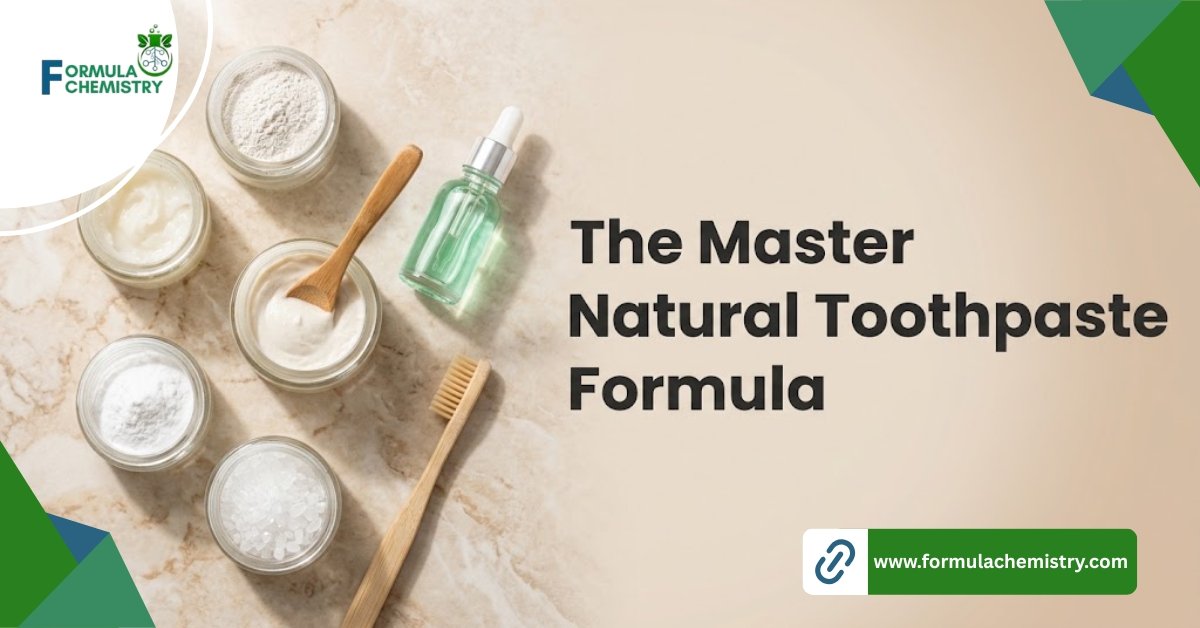
This is a complete anhydrous batch, formulated to total exactly 100.00%. Every ingredient here earns its place; nothing is filler.
| Phase | INCI Name | Common Name | Percentage |
| A: Abrasive | Calcium Carbonate | Chalk powder | 40.00% |
| A: Abrasive | Sodium Bicarbonate | Baking soda | 10.00% |
| B: Carrier | Caprylic/Capric Triglyceride | Fractionated coconut oil | 25.00% |
| B: Humectant | Glycerin | Vegetable glycerin | 15.00% |
| C: Binder | Xanthan Gum | Xanthan gum | 1.00% |
| D: Active | Xylitol | Xylitol | 8.00% |
| D: Flavor | Mentha Piperita Oil | Peppermint essential oil | 1.00% |
| Total | 100.00% |
To scale the batch, multiply each percentage by your target weight. A 50-gram batch means weighing 20g calcium carbonate, 5g sodium bicarbonate, 12.5g fractionated coconut oil, 7.5g glycerin, 0.5g xanthan gum, 4g xylitol, and 0.5g peppermint oil.
Fractionated coconut oil stays liquid at room temperature and carries the powders without the melt-point issues whole coconut oil introduces. Its lightweight behavior in oral and topical formulas is covered in more depth in our guide to fractionated coconut oil for lightweight moisture.
Glycerin’s hygroscopic pull is what keeps the paste from drying into a hard block inside the tube. The same hydration mechanism it performs here is the subject of our breakdown of glycerin as a hydration booster for skin and hair.
Mixing the Batch, Step by Step
Weigh the dry phase first. Combine calcium carbonate, sodium bicarbonate, and xylitol in a glass bowl, then whisk them together until the color and texture look uniform.
Disperse the xanthan gum into the glycerin before adding any oil. Xanthan gum clumps instantly in water or glycerin if it’s dumped in without agitation, so sprinkle it in slowly while stirring continuously.
Warm the fractionated coconut oil slightly if your kitchen runs cold, though it should already be liquid at normal room temperature. Add the glycerin and xanthan gum mixture into the oil and stir until it looks smooth and slightly thickened.
Fold the dry powder blend into the oil phase in three additions rather than all at once. Adding it gradually prevents the dry ingredients from clumping into pockets that never fully hydrate.
Add the peppermint oil last, once the paste has come together. Transfer the finished paste into a clean, dry jar or squeeze tube, and label it with the batch date.
Adapting the Base: Where to Branch Off
The master formula above is a starting point, not the only correct ratio. Once you understand why each phase is there, you can shift the balance toward a different feel or a different primary ingredient.
If you prefer a paste with a stronger baking soda presence and a different mixing order built specifically around that ingredient, our guide on how to make toothpaste with baking soda walks through that ratio in full.
It suits people who want the higher-alkalinity, deep-clean feel that a bicarbonate-forward paste delivers.
If you’d rather build a fully oil-centered paste where coconut oil carries more of the formula’s weight and function, our coconut oil toothpaste recipe is the dedicated version of that approach. It produces a denser, more emollient paste with a longer working time before it firms up in the jar.
A third option worth knowing about is a clay-based variant, where bentonite clay replaces part or all of the calcium carbonate.
Bentonite brings its own mineral content and a noticeably different, slightly grittier mouthfeel that some formulators prefer over calcium carbonate’s chalkier texture.
Six Places Home Batches Break Down
Skipping the binder entirely. Formulators leave out xanthan gum thinking the oil alone will hold the powder in suspension. It won’t, and the fix is simply including 0.5 to 1.5% xanthan gum, properly dispersed before the oil phase is added.
Using kitchen baking soda as the only abrasive. Straight sodium bicarbonate at high percentages tastes harsh and can feel overly abrasive to some users despite its low RDA score. Blending it with calcium carbonate at a lower ratio, as in the master formula, balances cleaning power with a milder taste.
Adding essential oils above 1 to 2%. Concentrated essential oils in the mouth can cause tissue irritation at higher percentages than skin would tolerate. Stay at or under 1% for oral formulas and always confirm the specific oil is rated safe for oral use before including it.
Storing the paste in a bathroom with high humidity. Even an anhydrous formula can pick up ambient moisture over time if the container isn’t sealed properly. Use a jar with a tight lid, or a proper squeeze tube, and keep it away from direct steam exposure.
Guessing at ratios instead of weighing ingredients. Volume measurements like teaspoons compress differently depending on how the powder settles, which throws off the abrasive-to-carrier ratio. A basic gram scale removes that variability entirely and is worth the ten-dollar investment.
Assuming natural means gentler automatically. Some natural abrasives, particularly coarse-ground salts or unrefined clays, can carry a higher RDA than a well-formulated commercial paste.
Checking particle size and grade before choosing an abrasive matters more than the word “natural” on the label.
Who This Formula Fits and Who Should Adjust It
This master formula suits formulators and home users who want an anhydrous, preservative-free paste with a mild, balanced abrasive profile. It’s a reasonable starting point for people newly transitioning away from commercial fluoride toothpaste who still want a functional daily product.
It’s not the right build for anyone managing diagnosed enamel erosion, active cavities, or a dental condition requiring a specific prescribed oral care regimen.
Those situations call for guidance from a dentist first, since a DIY formula is not a substitute for clinical oral care.
Anyone with a known sensitivity to essential oils should reduce or omit the peppermint oil and consider a fragrance-free version instead. Always conduct a 48-hour patch test with any new formula before wider use.
Common Questions About Making Natural Toothpaste at Home
Is homemade toothpaste as effective as store-bought?
It can clean effectively when the abrasive and binder ratios are correct, but it typically lacks fluoride, which most commercial pastes include for cavity support.
Formulators who want fluoride-free daily cleaning generally find a well-built natural paste sufficient for routine use.
Does natural toothpaste need a preservative?
An anhydrous, oil-based paste like the master formula above doesn’t require one because there’s no free water for microbes to use. A water-based version does need a preservative system rated for its pH range.
Can I use whole coconut oil instead of fractionated?
Yes, but whole coconut oil solidifies below about 24°C, which changes the texture and working time significantly. Fractionated coconut oil stays liquid at room temperature and gives a more consistent paste year-round.
Why did my toothpaste separate after a few days?
This almost always traces back to a missing or under-dosed binder. Adding 0.5 to 1.5% properly dispersed xanthan gum solves the issue in most cases.
Is baking soda too abrasive for daily use?
Sodium bicarbonate actually has a low RDA score, generally cited around 7, which is gentler than many commercial abrasives. The harsher feel some people notice comes from its alkaline pH and taste, not its abrasion level.
How long does homemade toothpaste last?
An anhydrous formula typically holds up for 6 to 12 months when stored in a sealed, dry container. Any change in smell, color, or texture is a sign to discard the batch.
Can I add fluoride to a homemade formula?
Fluoride requires precise, low-percentage dosing and regulatory-grade sourcing that isn’t practical or safe to replicate at home. If fluoride is a priority, a commercial product remains the more reliable route.
What percentage of essential oil is safe for toothpaste?
Most formulators cap essential oils at 1% for oral care products, given the sensitivity of oral tissue. Confirm the specific oil’s oral safety data before using it at any percentage.
Your Next Batch Starts With One Ratio, Not the Whole Recipe
The formula in this guide works because every ingredient has a defined job, not because the ingredient list sounds natural. Change one ratio at a time, whether that’s shifting toward more sodium bicarbonate or a heavier coconut oil base, and you’ll understand exactly what that change does to texture and cleaning feel.
Formula Chemistry exists to make that kind of understanding accessible outside a lab setting. If you want to move from single recipes toward full formulation training, our roundup of the best cosmetic formulation courses online is a reasonable next step.
Weigh your first batch on a scale, not by spoon, and you’ll already be ahead of most DIY attempts.