

Quick Answer
A DIY barrier repair cream works by delivering the three lipids your skin barrier is built from: ceramides, cholesterol, and fatty acids, ideally in the clinically supported 3:1:1 ratio that mirrors natural skin.
All three must be present together, since single-lipid or two-lipid mixtures can actually slow barrier recovery rather than help it.
The most important formulation step is fully melting the ceramides at high heat so they do not crystallise, then supporting the lipids with niacinamide, humectants, and a fragrance-free base for a cream that helps restore the look and feel of a healthy barrier.
Introduction
A DIY barrier repair cream is not just a rich moisturiser; it is a formula designed to replace the specific lipids a compromised skin barrier has lost. Getting it right means understanding what the barrier is actually made of.
The science here is unusually precise. Decades of research have identified the exact lipids and even the ratio that best supports barrier recovery, which gives formulators a clear, evidence-based target to build toward.
I formulate barrier repair creams around that science rather than guesswork. Matching the skin’s own lipid composition, in the right ratio and properly incorporated, is what separates a genuine barrier cream from an ordinary moisturiser.
This guide covers what the skin barrier is made of, the golden 3:1:1 ratio, the key ingredients and their levels, how to build the formula, and the mistakes that undermine barrier repair. Because a damaged barrier can accompany medical skin conditions, this is educational, and a dermatologist should guide those cases.
| Ingredient | Function | Weight % | Amount (g) |
|---|
All amounts are by weight. Weigh every ingredient, including liquids, on a scale accurate to 0.01 g.
What the Skin Barrier Is Made Of
The skin barrier, or stratum corneum, is often described as a brick wall, with skin cells as the bricks and lipids as the mortar holding them together. When that lipid mortar breaks down, skin cannot hold moisture in or keep irritants out.
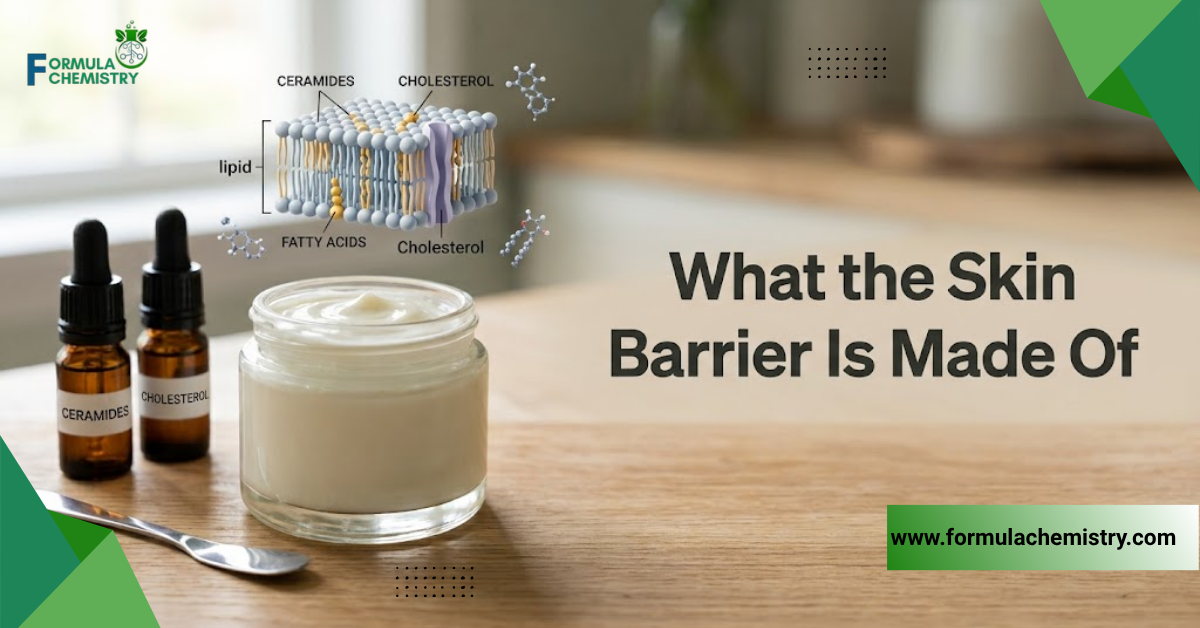
Three lipids make up that mortar in a specific balance. By mass, the barrier is roughly 50% ceramides, 25% cholesterol, and 25% free fatty acids, arranged into organised lamellar layers.
Each lipid plays a structural role. Ceramides form the backbone, cholesterol provides fluidity, and fatty acids complete the structure; only together do they build the dense, organised layers a healthy barrier needs.
When the barrier is compromised, these lipids are depleted. Over-exfoliation, harsh products, ageing, and environmental damage all reduce barrier lipids, raising water loss and leaving skin dry, sensitive, and reactive, which is exactly what a barrier repair cream sets out to correct.
The Golden 3:1:1 Ratio
At the heart of barrier repair formulation is a ratio you have to get right. The 3:1:1 ratio of ceramides to cholesterol to fatty acids is the clinically supported benchmark for barrier repair.
Why the Ratio Matters
This ratio is not an arbitrary convention. Research, including work published in dermatology journals, has shown that a 3:1:1 lipid ratio mimics the native barrier and accelerates its recovery better than poorly balanced formulas.
The dominant lipid is usually ceramide, reflecting its roughly 50% share of barrier lipids. A ceramide-dominant 3:1:1 mixture is the standard target, giving the skin the main structural lipid it most needs to rebuild.
All Three Must Be Present
Here is the point that catches many formulators out. Applying ceramides alone, or any two of the three lipids, can actually delay barrier recovery rather than help it.
Incomplete mixtures produce disorganised lamellar structures, so a ceramide-only cream is not a true barrier repair cream. Only when all three lipids are present together do they form the dense, organised layers that restore the barrier, which is why the full trio is non-negotiable.
Ratio Variations
The 3:1:1 ratio has some accepted variations worth knowing. Some formulas split the fatty acids into essential and non-essential types for a 3:1:1:1 version, and a cholesterol-dominant 3:1:1 has been shown to accelerate recovery, particularly in ageing skin.
For most purposes, a ceramide-dominant 3:1:1 is the reliable default. The key principle across all versions is the same: all three lipid types, present together, in a barrier-mimicking balance.
The Key Ingredients and Their Levels
Building a DIY barrier repair cream means choosing the right form and level of each lipid, plus the supporting ingredients that complete the formula. Precision here matters.
Ceramides
Ceramides are the primary barrier lipid, with ceramide NP the most common, typically used at around 0.5 to 3%. Including multiple ceramide types, such as NP, AP, and EOP, more closely mimics natural skin than a single ceramide.
Phytosphingosine, at around 0.1 to 0.5%, is a useful companion, acting as both a stabiliser and a ceramide precursor. Together, these build the structural backbone of the formula.
Cholesterol
Cholesterol, used at around 0.3 to 2%, provides the fluidity the lipid matrix needs. A genuine barrier formula benefits from true cholesterol, since plant oils contain phytosterols rather than cholesterol itself.
This is a subtle but real distinction. Phytosterols are valuable, but ingredients that closely mimic the skin’s own cholesterol give the most faithful barrier repair, so the cholesterol source is worth attention.
Fatty Acids
Free fatty acids, at around 0.3 to 1.5%, complete the lipid structure, typically stearic, palmitic, or behenic acid. The choice of accompanying oils also matters here.
Oils rich in linoleic acid, such as safflower, evening primrose, or oat oil, support the barrier and help calm the look of inflammation, whereas oils very high in oleic acid can sometimes disrupt a compromised barrier further. Matching the oil’s fatty acid profile to barrier repair is a mark of careful formulation.
Supporting Ingredients
Beyond the lipids, a few ingredients round out a barrier repair cream. Niacinamide supports the barrier and helps the skin build its own ceramides, while humectants like hyaluronic acid and glycerin add hydration.
Keeping the formula fragrance-free matters, since a barrier cream is usually aimed at compromised, sensitive skin. Soothing agents and antioxidants can support comfort, always within a short, gentle ingredient list.
How to Build the Formula
Turning these ingredients into a stable DIY barrier repair cream follows a clear method, with one step that makes or breaks the result. A barrier repair cream is an emulsion, so it combines an oil phase and a water phase.
Dissolving the Ceramides Properly
The single most important formulation step is fully dissolving the ceramides. Ceramides are difficult to melt and must be heated to a high temperature in the oil phase, or added as a pre-dispersed complex, so they incorporate completely.
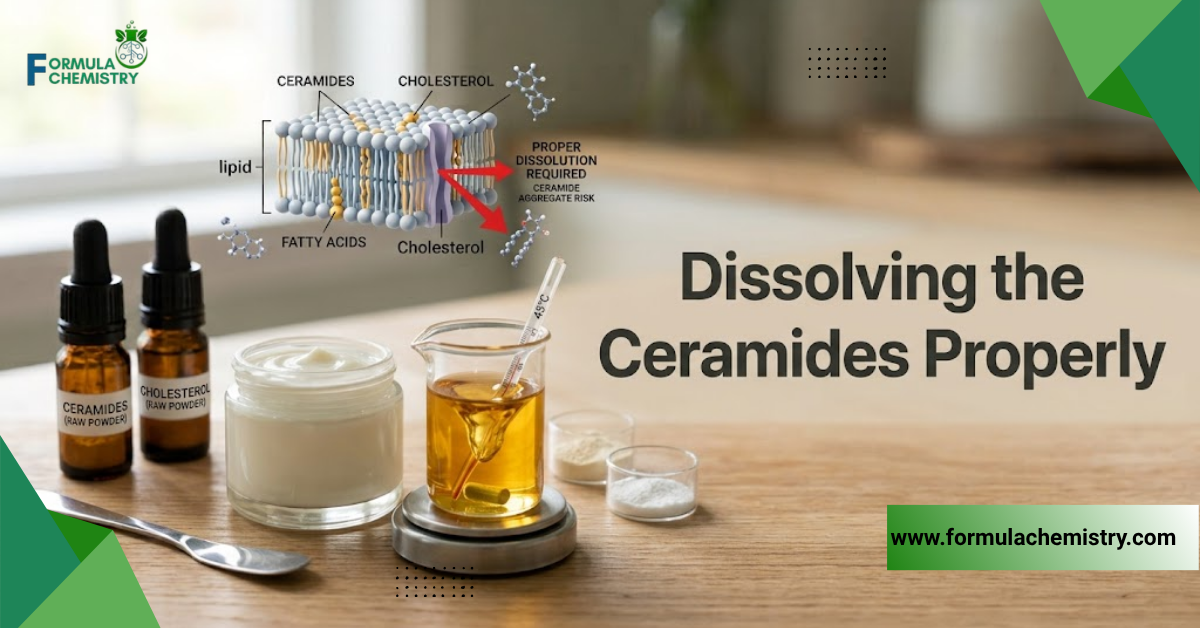
Undissolved ceramides are worse than useless. If they crystallise rather than dissolving, they can actually work against barrier repair, so patience with the melt is essential, and this is the mistake that quietly ruins many home barrier creams.
Building the Emulsion
With the ceramides dissolved, the lipids go into the oil phase alongside cholesterol, fatty acids, and the chosen oils, while humectants sit in the water phase. The two are combined at a temperature and emulsified into a smooth cream.
A lamellar-style emulsion, which arranges into layers resembling the skin’s own, is the ideal structure for a barrier cream. This is why gentle, skin-mimicking emulsifiers are often chosen for these formulas, an approach we favour at Formula Chemistry when building for barrier repair.
Finishing the Formula
Heat-sensitive ingredients go in during the cool-down, including niacinamide, any pre-dispersed ceramide complex if used that way, and the preservative. A water-based cream must be properly preserved and pH-balanced like any emulsion.
Testing completes the process. Checking stability, feel, and performance ensures the cream is both pleasant and effective, since a barrier repair cream must be used daily to work.
A Sample Barrier Repair Formula Framework
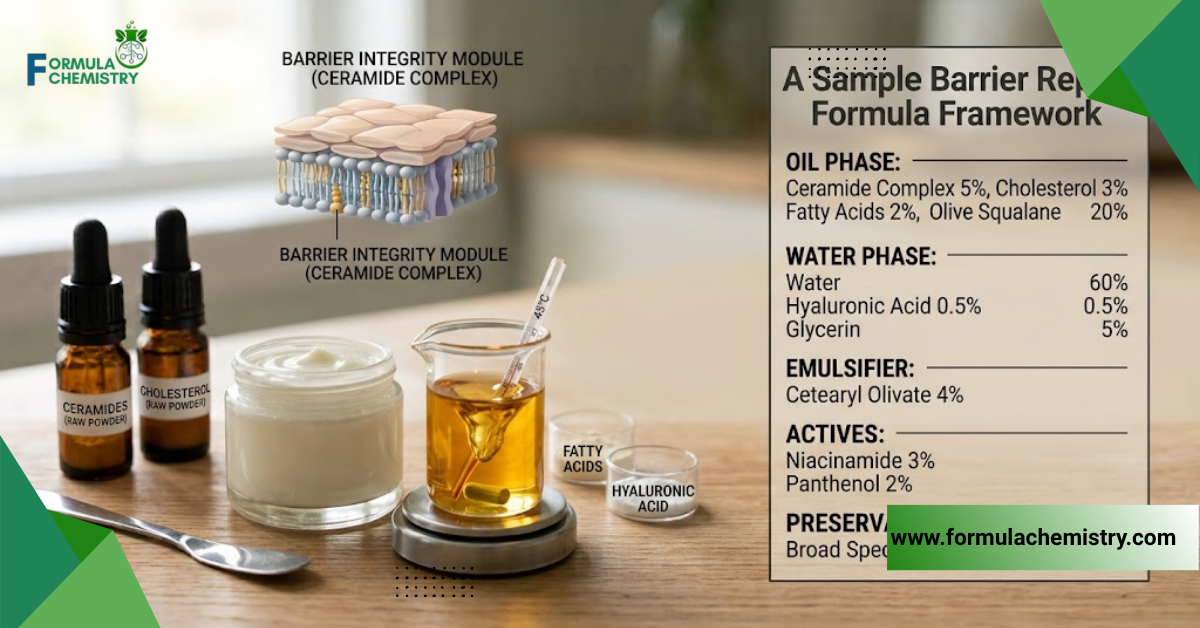
Bringing the numbers together, a barrier repair cream can be sketched as a simple framework you adapt and test. This shows how the pieces fit into a real formula.
The Oil Phase
The oil phase carries the lipids and must be heated enough to dissolve the ceramides fully. It typically holds the ceramides, cholesterol, free fatty acids, a linoleic-rich oil such as safflower or evening primrose, a gentle emulsifier, and a stabilising fatty alcohol.
Aiming the ceramide, cholesterol, and fatty acid levels toward a 3:1:1 balance is the goal here. This phase is where the barrier-mimicking lipid matrix is built, so it deserves the most care.
The Water Phase
The water phase carries the humectants and the bulk of the formula, usually water, glycerin, and hyaluronic acid, sometimes with panthenol for soothing. Kept simple, it hydrates without adding anything irritating.
Combining the two phases at temperature and emulsifying well creates the cream. A lamellar-style structure, mimicking the skin’s own layered lipids, is the ideal outcome.
The Cool-Down
Heat-sensitive additions go in as the emulsion cools, including niacinamide, any soothing extracts, and the preservative. Final pH adjustment brings the cream into the skin-friendly range.
This staged approach protects the delicate ingredients while ensuring the lipids are properly incorporated. It is the same disciplined method we apply at Formula Chemistry to every barrier-focused emulsion.
Who Needs a Barrier Repair Cream
Understanding who benefits helps you formulate and position the product well. Barrier repair creams suit specific situations rather than every skin.
Compromised, damaged, or over-exfoliated skin is the obvious candidate, since it has lost the lipids the cream replaces. Sensitive and reactive skin, and skin that feels tight, dry, or stinging, also benefit from rebuilt barrier support.
Anyone using strong actives such as retinoids or acids can benefit too, since these can stress the barrier. Pairing active use with a barrier repair cream helps keep the skin resilient, which is why lipid support belongs in so many modern routines.
The Mistakes That Undermine Barrier Repair
A handful of errors stop a barrier cream from doing its job. Each is avoidable with attention to the science.
Using ceramides alone is the most common mistake. Without cholesterol and fatty acids in the proper ratio, the lipids cannot form organised layers, so a ceramide-only cream is not true barrier repair.
Failing to dissolve the ceramides is a second, subtle error. Crystallised ceramides can hinder rather than help, so thorough melting or a pre-dispersed complex is essential.
Ignoring the ratio is a third mistake. Randomly adding lipids without aiming for something close to 3:1:1 misses the balance that research shows works best, so the ratio deserves real attention.
The last errors are adding fragrance and over-complicating the formula. Barrier creams serve compromised, sensitive skin, so fragrance-free and simple beats a long, potentially irritating ingredient list every time.
Building Your Barrier Repair Cream
Start from the science: aim for the 3:1:1 ratio of ceramides, cholesterol, and fatty acids, include all three together, and choose multiple ceramide types with a true cholesterol source and linoleic-rich oils. This is the foundation of genuine barrier repair.
Dissolve the ceramides fully, build a gentle lamellar-style emulsion, support it with niacinamide and humectants, and keep everything fragrance-free and simple. Preserve and pH-balance the cream, then test it for stability and feel before regular use.
Above all, respect both the science and the skin. A DIY barrier repair cream helps restore the look and feel of a healthy barrier when built correctly, but a barrier damaged by a medical condition needs a dermatologist’s guidance too. Formulate to the ratio, dissolve the lipids properly, keep it gentle, and a barrier repair cream becomes one of the most rewarding formulas you can make.
Frequently Asked Questions
What is a barrier repair cream?
A barrier repair cream is a moisturiser formulated to replace the specific lipids the skin barrier is made of: ceramides, cholesterol, and fatty acids. Ideally, these are in a 3:1:1 ratio that mimics natural skin. It helps restore the look and feel of a compromised barrier.
What is the 3:1:1 ratio in barrier repair?
The 3:1:1 ratio refers to ceramides, cholesterol, and fatty acids combined so one lipid, usually ceramide, is present at three times the others. Research shows this barrier-mimicking ratio supports recovery better than unbalanced formulas. All three lipids must be present together.
Can I use just ceramides for barrier repair?
No, ceramides alone are not enough and can even slow barrier recovery. Cholesterol and fatty acids must be present too, since only all three together form the organised lipid layers the barrier needs. This is why the 3:1:1 ratio matters.
What ingredients go in a DIY barrier repair cream?
Core ingredients are ceramides at 0.5 to 3%, cholesterol at 0.3 to 2%, and free fatty acids at 0.3 to 1.5%, ideally near a 3:1:1 ratio. Phytosphingosine, niacinamide, hyaluronic acid, glycerin, and linoleic-rich oils support the formula. Keep it fragrance-free.
Why do my ceramides need to be melted properly?
Ceramides are hard to dissolve and must be heated to a high temperature in the oil phase, or added as a pre-dispersed complex. If they crystallise instead of dissolving, they can work against barrier repair. Proper melting is the most important formulation step.
Which oils are best for barrier repair?
Oils rich in linoleic acid, such as safflower, evening primrose, and oat oil, support the barrier and calm the look of inflammation. Oils very high in oleic acid can sometimes disrupt a compromised barrier. Matching the oil to barrier repair improves results.
Is cholesterol necessary in a barrier cream?
Yes, cholesterol provides fluidity to the lipid matrix and is one of the three essential barrier lipids. Note that plant oils contain phytosterols, not true cholesterol, so a genuine barrier formula benefits from a real cholesterol source. Without it, the lipids cannot organise properly.
How long does a barrier repair cream take to work?
Barrier repair is gradual and depends on consistent daily use, with the barrier rebuilding over days to weeks. A well-formulated cream supports this by supplying the lipids the skin needs. For a barrier damaged by a medical condition, a dermatologist should guide treatment.
Key Takeaways
A DIY barrier repair cream works by supplying the three lipids the skin barrier is built from: ceramides, cholesterol, and fatty acids, ideally in the clinically supported 3:1:1 ratio that mirrors natural skin. All three must be present together, since incomplete mixtures can slow barrier recovery rather than help it.
The key ingredients are ceramides at 0.5 to 3%, cholesterol at 0.3 to 2%, and fatty acids at 0.3 to 1.5%, supported by phytosphingosine, niacinamide, humectants, and linoleic-rich oils, all kept fragrance-free. The single most important step is fully dissolving the ceramides, since crystallised ceramides can work against repair.
Build to the ratio, include all three lipids, dissolve them properly, and keep the formula gentle and simple. A well-made barrier repair cream helps restore the look and feel of a healthy barrier, while a barrier damaged by a medical condition also needs a dermatologist’s guidance.