
Quick Answer
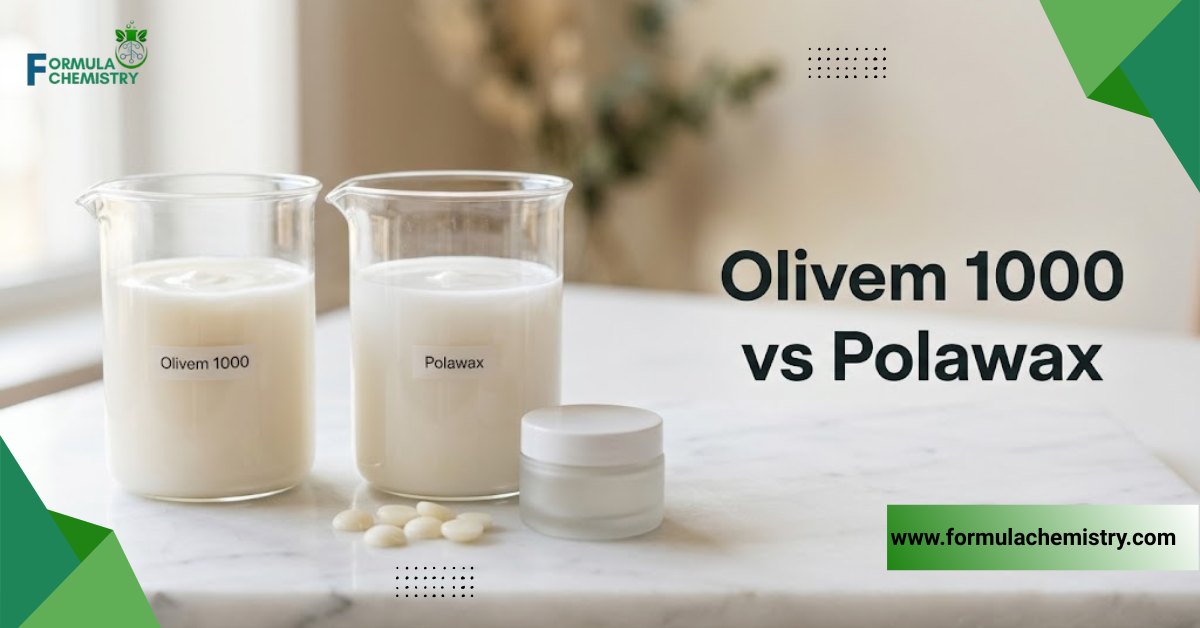
Olivem 1000 vs Polawax: both are non-ionic, self-emulsifying oil-in-water emulsifiers used at around 3 to 5%, but they differ in origin and behaviour.
Olivem 1000 is olive-derived and COSMOS-validated, forms skin-mimicking liquid crystal structures for a silky, moisturising feel, and needs a separate thickener because it has little viscosity of its own.
Polawax is a synthetic emulsifying wax based on cetearyl alcohol and polysorbate 60, self-thickening, extremely forgiving, and gives a rich, dense cream, but it is not suitable for natural or organic certified formulas.
Introduction
Choosing between Olivem 1000 and Polawax comes down to a decision most beginners do not realise they are making, which is natural positioning against sheer reliability. Both create stable oil-in-water emulsions, and both are beloved, yet they pull a formula in different directions.
The two are not really competing on quality. They are competing on what a brand values, since one carries a natural certification and a distinctive skin feel while the other offers forgiving, dependable performance.
I keep both on the shelf and reach for them for different briefs. When a formula needs to be certifiably natural, one is the obvious answer, and when it just needs to work every time, the other rarely disappoints.
This guide covers what each emulsifier is, how they differ in chemistry and skin feel, the thickening difference that catches people out, whether one suits your face cream, and how to choose or substitute between them.
What Olivem 1000 Is
Olivem 1000 is a non-ionic, self-emulsifying oil-in-water emulsifier derived from olive oil. Its INCI name is Cetearyl Olivate and Sorbitan Olivate, and it is prized in natural and clean-beauty formulating.
Its defining feature is how it behaves in the emulsion. Olivem 1000 forms liquid crystal structures that mimic the lipid organisation of the skin’s own surface, which gives it a deeply moisturising, non-soapy, silky after-feel.
It is also PEG-free and COSMOS-validated, which means it can be used in certified natural and organic formulas. That certification, combined with its olive origin, is a large part of why natural brands favour it.
One practical trait shapes how you formulate with it. Olivem 1000 has very little viscosity of its own, so it emulsifies beautifully but does not thicken the product, which is a feature rather than a flaw once you understand it.
What Polawax Is
Polawax is a non-ionic, self-emulsifying wax and one of the most trusted oil-in-water emulsifiers in cosmetic history. It is a branded form of Emulsifying Wax NF, meaning it meets the National Formulary standard.
Its composition is commonly cited as cetearyl alcohol and polysorbate 60, though there is an important nuance. Croda, its maker, does not officially disclose the exact INCI beyond Emulsifying Wax NF, and the refined blend is understood to tilt toward cetearyl alcohol with a small amount of PEG-150 stearate.
That composition matters for positioning. Polysorbate 60 and PEG-150 stearate are synthetic, so Polawax is not suitable for strictly natural or Ecocert-certified formulas, which is the single biggest practical difference from Olivem 1000.
What Polawax offers instead is reliability and richness. It self-thickens, tolerates a wide pH and temperature range, forgives beginner mistakes, and produces a dense, elegant cream, which is why it has been a workhorse for decades.
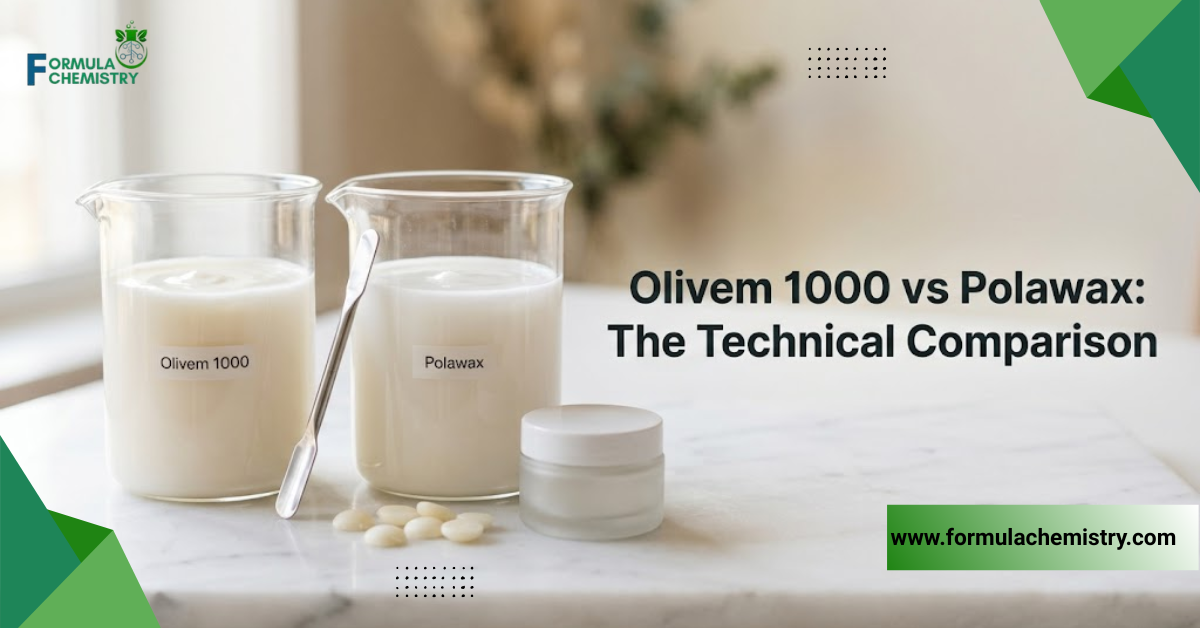
Olivem 1000 vs Polawax: The Technical Comparison
The two align as emulsifier types and diverge on origin, feel, and handling. The table below sets out the properties that decide a formula.
| Property | Olivem 1000 | Polawax |
| INCI | Cetearyl Olivate, Sorbitan Olivate | Cetearyl Alcohol, Polysorbate 60 (Emulsifying Wax NF) |
| Origin | Olive-derived, natural | Synthetic components |
| Charge | Non-ionic | Non-ionic |
| Emulsion type | Oil-in-water | Oil-in-water |
| HLB | ~9 | ~12 to 13 |
| Melting point | ~70°C | ~48 to 52°C |
| Self-thickening | No, needs a thickener | Yes |
| Skin feel | Silky, moisturising, liquid crystal | Rich, dense, cushioned |
| Certification | COSMOS-validated | Not natural-certifiable |
| Typical use level | ~3 to 5% | ~3 to 5% lotions, 5 to 10% creams |
Read the origin and self-thickening rows together, because they carry the practical decision. Olivem wins on natural credentials and needs help with thickness, while Polawax wins on convenience and builds its own body.
Neither is better in the abstract. The choice depends on whether certification and skin feel or reliability and simplicity matter more for your product.
How Their Chemistry Differs
Both are non-ionic, and both make oil-in-water emulsions, so they share a foundation. The differences that matter come from their building blocks and their HLB.
HLB and Emulsion Behaviour
HLB, the hydrophilic-lipophilic balance, describes an emulsifier’s affinity for water versus oil. Olivem 1000 sits around 9 and Polawax around 12 to 13, and both are well within the range that favours oil-in-water emulsions.
That difference is modest in practice, since both reliably make the same type of emulsion. It does hint at Polawax’s slightly more water-loving character, which pairs with its self-thickening nature to build stable, bodied creams easily.
The Liquid Crystal Difference
The more meaningful chemistry is Olivem’s liquid crystal structure. As it emulsifies, Olivem 1000 arranges into lamellar layers that echo the organisation of lipids in the skin barrier.
This structure is why Olivem feels the way it does, delivering moisture in a way that reads as skin-friendly and elegant rather than heavy or soapy. Polawax can also form some lamellar structure, but Olivem’s skin-mimicking behaviour is its signature.
The Thickening Difference That Trips People Up
This is the practical point most beginners learn the hard way, and it is worth stating plainly. Olivem 1000 does not thicken your product, while Polawax does.
Formulating With Olivem 1000
Because Olivem has almost no viscosity of its own, an Olivem emulsion can come out thin unless you build the thickness separately. This is actually an advantage, since it lets you control viscosity independently of the emulsifier.
The standard approach is to add a water-phase thickener such as xanthan gum at around 0.2%, and often a co-emulsifier or fatty alcohol for stability and body. Cetyl or cetearyl alcohol in the oil phase thickens and firms an Olivem cream nicely.
Formulating With Polawax
Polawax carries its own thickening, so it builds a bodied cream without much help. Higher use levels produce thicker products, which makes it very simple to reach a rich consistency straight from the emulsifier alone.
This is why Polawax is often called the more beginner-friendly of the two for a quick, thick cream. You can get a stable, luxurious result with fewer moving parts, whereas Olivem asks you to think about thickening as a separate step.
Skin Feel and Performance
Skin feel is where formulators often make the final call, and the two give genuinely different results. Olivem 1000 feels light, silky, and moisturising, with a non-soapy finish that its liquid crystal structure produces.
Polawax feels rich, dense, and cushioned, giving that classic thick-cream experience. It is a more traditional emulsion feel, substantial and comforting rather than the elegant slip of Olivem.
Both perform well on stability when formulated correctly. Olivem rewards the addition of a thickener and co-emulsifier and a proper heat-and-hold, while Polawax is more forgiving and holds together with less fuss.
The difference suits different products. Olivem shines in facial moisturisers and elegant lotions where feel and natural positioning matter, and Polawax excels in rich body creams and dependable everyday emulsions.
Which One for a Face Cream?
For a facial moisturiser, Olivem 1000 is often the stronger choice, and the reasons are specific. Its liquid crystal structure, skin-mimicking behaviour, and silky non-soapy feel are exactly what a face cream wants.
Its natural certification adds to the case for clean-beauty facial products. A COSMOS-validated, olive-derived emulsifier fits the positioning of most modern facial skincare far better than a synthetic wax.
Polawax is not wrong for the face, and it makes a perfectly good, rich facial cream. It simply reads as heavier and cannot carry a natural claim, so it suits richer or more traditional facial products rather than lightweight, naturally positioned ones.
The deciding questions are feel and certification. If you want a light, elegant, certifiable face cream, choose Olivem, and if you want a rich, forgiving one and certification is irrelevant, Polawax will serve you well.
Substituting One for the Other
You can swap Olivem 1000 and Polawax, but you must adjust for their different behaviour rather than dropping one in at the same weight. The thickening difference is the main thing to manage.
Replacing Polawax With Olivem
Moving to Olivem usually makes the product thinner, because Olivem does not self-thicken. Add a water-phase thickener such as xanthan gum and consider a co-emulsifier or fatty alcohol to rebuild the body Polawax provided on its own.
You also gain a natural certification and a lighter, silkier feel in the process. For a brand moving toward clean positioning, that trade is often the whole point of the switch.
Replacing Olivem With Polawax
Moving to Polawax usually makes the product thicker and richer, and you may need to reduce added thickeners to compensate. You lose the natural certification and the liquid crystal skin feel, gaining simplicity and forgiveness in return.
Treat either swap as a small reformulation to confirm. Make a test batch, run heat-cool cycles, and allow natural emulsions like Olivem’s a week to fully form their structure before judging stability, since they can keep evolving for several days.
Getting a Stable Emulsion With Either One
Both emulsifiers reward good process, and both punish shortcuts, though in slightly different ways. A few habits make the difference between a stable cream and a separated one.
Heat and Hold
Heat the oil and water phases separately to around 70 to 75°C before combining, and give the emulsion a hold at temperature so the emulsifier fully integrates. Skipping the hold is a common cause of an emulsion that looks fine on day one and separates within days.
Combine the phases with good mixing, ideally a hand blender or homogeniser, and keep mixing as the formula cools. Adequate shear during cooling is what locks the droplets into a fine, stable emulsion.
Supporting Olivem’s Stability
Olivem 1000 in particular benefits from support, because it does the emulsifying job without adding structure. A water-phase thickener such as xanthan gum at around 0.2% and a co-emulsifier like glyceryl stearate or a fatty alcohol markedly improve its stability.
Keeping the oil phase within a moderate range also helps, since very high oil loads strain a natural emulsifier. A sensible oil phase, a thickener, and a co-emulsifier turn Olivem from finicky into dependable.
Judging Natural Emulsions Fairly
Natural emulsions like Olivem’s can keep evolving for several days as their crystalline structures fully form. Allow at least a week of observation, alongside heat-cool cycling and a centrifuge check, before deciding whether a formula is truly stable.
Polawax is more forgiving on all of these points, which is part of its appeal. It still needs the heat and hold, but it tolerates a wider margin of error in phase ratios and process, making it the safer bet when reliability outweighs everything else.
Deciding Between Olivem 1000 and Polawax
Choose Olivem 1000 when you need a natural or COSMOS-certified formula, want a light, silky, skin-mimicking feel, and are willing to manage thickness with a separate thickener. It is the emulsifier for elegant, naturally positioned facial and body products.
Choose Polawax when you want maximum reliability, a rich self-thickening cream, and forgiving handling, and natural certification is not a requirement. It is the dependable workhorse for traditional creams and lotions where the finish and ease matter more than the story.
Many formulators keep both for exactly this reason, matching the emulsifier to the brief rather than forcing one to do every job. Whichever you choose, respect the process, heating both phases to around 70 to 75°C, holding to integrate fully, and confirming stability with a test batch before you scale.
Frequently Asked Questions
What is the difference between Olivem 1000 and Polawax?
Olivem 1000 is an olive-derived, COSMOS-validated emulsifier that forms skin-mimicking liquid crystal structures and needs a separate thickener.
Polawax is a synthetic emulsifying wax based on cetearyl alcohol and polysorbate 60 that self-thickens and is very forgiving. Both are non-ionic oil-in-water emulsifiers used at similar levels.
Which is better for a face cream, Olivem 1000 or Polawax?
Olivem 1000 is often better for facial moisturisers because of its silky, non-soapy liquid crystal feel and its natural certification. Polawax makes a good but richer, heavier cream and cannot carry a natural claim. For light, clean-beauty face creams, Olivem is usually the stronger choice.
What are the HLB values of Olivem 1000 and Polawax?
Olivem 1000 has an HLB of around 9, while Polawax sits around 12 to 13. Both fall within the range suited to oil-in-water emulsions. The difference is modest in practice, since both reliably make the same emulsion type.
Is Olivem 1000 natural and Polawax not?
Yes, Olivem 1000 is olive-derived, PEG-free, and COSMOS-validated for natural and organic formulas. Polawax contains synthetic components such as polysorbate 60 and PEG-150 stearate, so it is not suitable for strictly natural or Ecocert-certified products. This is a key difference in positioning.
Why is my Olivem 1000 cream too thin?
Olivem 1000 has very little viscosity of its own, so it does not thicken the product. Add a water-phase thickener such as xanthan gum at around 0.2%, and a co-emulsifier or fatty alcohol for body. This lets you control thickness independently.
Can I substitute Olivem 1000 for Polawax directly?
Not at the same weight without adjustment. Olivem does not self-thicken, so replacing Polawax with it usually makes a thinner product that needs an added thickener. Always confirm the result with a test batch and stability testing.
What use levels do they need?
Both are typically used at around 3 to 5%, with Polawax often going up to 5 to 10% for thicker creams. Olivem’s level stays similar but pairs with a separate thickener. The oil phase is usually kept within a moderate range for stability.
Does Polawax have a fixed INCI?
Polawax is commonly listed as cetearyl alcohol and polysorbate 60, but Croda does not officially disclose the exact INCI beyond Emulsifying Wax NF. The refined blend is understood to include a small amount of PEG-150 stearate. This is why different emulsifying waxes labelled NF are not always identical.
Key Takeaways
Olivem 1000 and Polawax are both non-ionic, self-emulsifying oil-in-water emulsifiers used at around 3 to 5%, but they differ most in origin and thickening.
Olivem is olive-derived, COSMOS-validated, and forms skin-mimicking liquid crystals for a silky feel, while Polawax is synthetic, self-thickening, forgiving, and richer.
The two decisive differences are certification and viscosity. Olivem suits natural, certified, elegant formulas but needs a separate thickener like xanthan gum, whereas Polawax builds its own body and suits reliable, traditional creams but cannot carry a natural claim.
Choose Olivem for light, certifiable, skin-mimicking products, especially facial moisturisers, and Polawax for rich, dependable, easy creams where certification is irrelevant. Whichever you pick, heat both phases to around 70 to 75°C, hold to integrate, manage thickness accordingly, and confirm stability in a test batch before scaling.