
Quick Answer
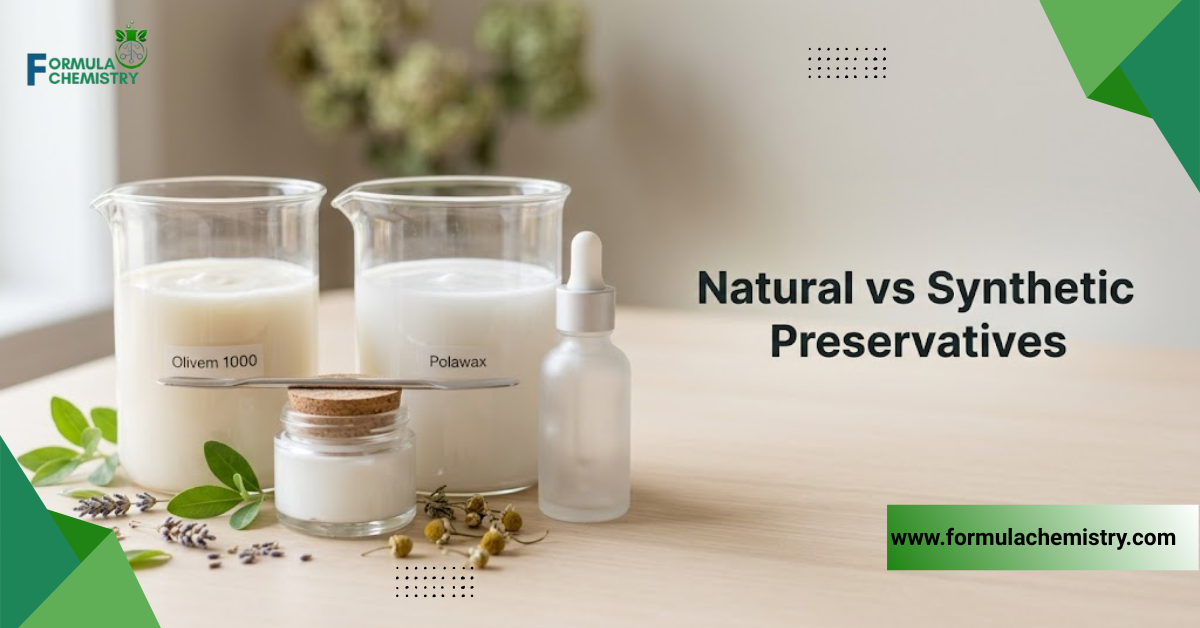
The truth about natural vs synthetic preservatives is that origin does not determine safety, effectiveness does not belong to one camp, and much of the debate rests on marketing rather than science.
Synthetic preservatives are well-studied, effective at low levels, and broadly reliable, while natural options can work well but often need higher levels, careful pH matching, and combinations to match that reliability.
The real danger is not synthetics but under-preservation, since a poorly preserved product marketed as natural can be more hazardous than a well-preserved conventional one.
Introduction
The natural versus synthetic preservative debate is one of the most emotionally charged and least accurate conversations in skincare. Both sides trade in half-truths, and a consumer trying to make a sensible choice is caught between fear of chemicals and faith in plants.
The reality is calmer and more useful than either camp admits. Safety and effectiveness depend on the specific ingredient, the dose, and the formula, not on whether a molecule came from a lab or a leaf.
I formulate with both, and I have watched good products fail because a brand chose a preservative for its story rather than its performance. Cutting through the myths is the only way to preserve a product both safely and honestly.
This guide sets out what is actually true, where natural preservatives genuinely fall short, where synthetics have been unfairly maligned, how greenwashing distorts the whole picture, and how to choose based on evidence.
Defining the Natural vs Synthetic Preservatives Honestly
The first problem is that the words themselves are slippery. Natural and synthetic are marketing categories as much as scientific ones, and the line between them is blurrier than most labels suggest.
What “Natural” Really Means Here
A truly natural preservative is derived from a plant, mineral, or fermentation source with minimal processing. Very few preservatives are natural in that strict sense, and fewer still are strong enough to protect a water-based product on their own.
Many so-called natural preservatives are actually nature-identical, meaning the molecule occurs in nature, but the version used is synthesised in a lab. Sorbic acid, benzyl alcohol, and dehydroacetic acid are common examples, chemically identical to their natural counterparts but manufactured for consistency.
What “Synthetic” Really Means Here
Synthetic preservatives are manufactured compounds such as phenoxyethanol, parabens, and formaldehyde donors. They are designed for reliability, and most carry decades of safety and efficacy data.
The irony is that some of the most trusted natural preservatives sit in a grey zone. Once you accept nature-identical ingredients, the clean line between natural and synthetic largely dissolves, which is the first myth this topic needs to shed.
Myth One: Natural Automatically Means Safer
This is the central belief driving the whole trend, and it does not hold up. Natural origin tells you nothing reliable about a substance’s toxicity or its potential to irritate.
Plenty of natural substances are potent allergens or irritants, and essential oils used as preservatives are a common cause of sensitisation. A molecule is not gentle because it came from a plant, and it is not harmful because it was made in a factory.
Safety is a question of the specific compound and its dose, a principle as old as toxicology itself. The poison is in the dose, and that applies equally to a botanical extract and a synthetic preservative.
The most important consequence is counterintuitive. A product under-preserved in pursuit of a natural label can grow bacteria, yeast, and mould, which is a far more immediate hazard than any well-regulated synthetic preservative.
Myth Two: Natural Preservatives Do Not Work
The opposite overstatement is just as wrong, and it is often pushed by people dismissive of the natural movement. Modern natural and nature-identical preservatives can be genuinely effective when used correctly.
The truth sits in the conditions. A well-chosen natural system, matched to the formula’s pH and used at the correct concentration, can protect a product reliably, and some perform very well within their range.
Where Naturals Genuinely Struggle
Being fair to the evidence means naming the real limitations, and they are practical rather than imaginary. Natural preservatives more often provide narrower protection, so a single one may cover bacteria but not fungi.
They tend to be more sensitive to pH and temperature, which narrows the formulas they suit and complicates manufacturing. They also frequently need higher use levels or combinations of several ingredients to reach the broad-spectrum coverage a single synthetic can provide alone.
Where Naturals Perform Well
None of that makes them useless, and that is the balance most debates miss. Organic acids such as sorbic and benzoic acid, used correctly in acidic formulas, offer solid protection, and combinations designed as systems can achieve genuine broad-spectrum coverage.
The key is respecting their conditions rather than expecting them to behave like synthetics. A natural system asked to work outside its pH range or at too low a level will fail, but the same system used properly can protect a product well.
Myth Three: Synthetic Preservatives Are Dangerous
Parabens sit at the centre of this fear, and the claims around them are frequently overstated. Parabens are among the most studied preservatives in the world, effective at very low concentrations with a long safety record.
The dramatic assertions, such as firm links to cancer or established endocrine harm at cosmetic levels, are not supported by the scientific consensus.
Regulators including the European Union’s Scientific Committee on Consumer Safety have assessed parabens and restricted certain ones to defined limits rather than banning the class, which reflects managed risk, not proven danger.
This does not mean every synthetic is above scrutiny. Some, such as certain isothiazolinones, are genuine sensitisers and are tightly restricted for good reason, and formaldehyde donors carry real concerns that justify caution.
The honest position is nuance. Synthetic preservatives are neither uniformly safe nor uniformly dangerous; they are specific compounds with specific profiles, and lumping them together as toxic chemicals is as unscientific as calling all naturals gentle.
The Greenwashing Problem
This is where the debate turns genuinely misleading, and it is the part consumers most need to understand. A large share of natural preservative marketing relies on perception rather than fact.
Nature-Identical Sleight of Hand
Many products advertised as naturally preserved use nature-identical synthetics, which is chemically reasonable but often presented dishonestly. A label implying a plant preserved the product, when a lab-made molecule did the work, is marketing rather than chemistry.
Claims like paraben-free and chemical-free lean on fear rather than information. Everything is a chemical, and paraben-free says nothing about whether the replacement is safer or even effective.
The Grapefruit Seed Extract Lesson
One case captures the whole problem. Grapefruit seed extract was promoted for years as a potent natural preservative, until studies revealed that its microbial activity came largely from synthetic disinfectants added during processing, not from the extract itself.
Pure grapefruit seed extract is not a reliable broad-spectrum preservative, and relying on it alone is a real safety gamble. The episode is a lasting reminder that a natural claim deserves scrutiny, not trust, especially when a product’s safety depends on it.
Natural vs Synthetic Preservatives: What Actually Determines a Good One
Strip away the natural and synthetic labels and the criteria that matter are the same for both. A preservative earns its place through evidence, not origin.
- Proven efficacy against bacteria, yeast, and mould, confirmed by challenge testing
- Compatibility with the formula’s pH, ingredients, and packaging
- A sound safety profile at the use level, backed by data rather than sentiment
- Broad-spectrum coverage, alone or as a designed combination
- Stability through manufacturing and across the product’s shelf life
Notice that natural and synthetic appear nowhere on that list. The question is never whether a preservative is natural; it is whether it protects the product safely and reliably, which is a matter of testing and formulation.
The single most important point follows from this. No preservative choice, natural or synthetic, is proven until a challenge test confirms it protects your specific formula, which is a standard we hold to for every product at Formula Chemistry.
The Environmental Angle Nobody Resolves
Sustainability is often folded into the natural argument, and it deserves an honest look rather than an assumption. The environmental case is more mixed than either side claims.
Biodegradability and Sourcing
Some synthetic preservatives are petrochemically derived and less readily biodegradable, which is a fair concern for brands weighing their footprint. That is a genuine mark in favour of certain plant-derived and nature-identical options.
The picture is not one-sided, though. Because natural preservatives often need higher use levels or several ingredients to match a synthetic’s coverage, the total material and processing involved can offset part of the apparent benefit.
Certification Realities
For brands pursuing organic or natural certification, the choice narrows to preservatives those standards permit. Certifying bodies maintain approved lists that include specific nature-identical acids and preservative systems deemed acceptable.
Working within those lists is the practical path to an honest certified claim. It also removes guesswork, since a certified system has already been judged against the standard rather than left to marketing interpretation.
A Practical Comparison between Natural and Synthetic Preservatives
Set side by side, the two approaches trade different strengths, and neither dominates. The table summarises how they actually compare on the points that matter.
| Factor | Natural and nature-identical | Synthetic |
| Broad-spectrum coverage | Often needs combinations | Frequently achieved alone |
| pH sensitivity | Usually higher | Usually lower |
| Typical use level | Often higher | Often very low |
| Safety data depth | Variable, growing | Extensive and long-standing |
| Formulation ease | More demanding | More forgiving |
| Consumer perception | Favourable | Often negative |
| Greenwashing risk | High | Low |
Read the coverage and formulation rows against the perception row, because that gap is the whole tension. Synthetics are often easier and more reliable, while naturals win on perception, and honest formulating means not letting perception override protection.
Neither column is a verdict. The right choice depends on your brand positioning, your formula, and above all the challenge test that proves whichever route you pick actually works.
Making an Honest Choice for Your Product
If your brand is committed to natural positioning, you can preserve effectively, but you must respect the constraints. Choose a natural or nature-identical system suited to your pH, use it at the correct level, often as a combination, and confirm it with challenge testing rather than assuming it works.
If your priority is maximum reliability across a wide range of formulas, well-studied synthetics such as phenoxyethanol-based systems remain the dependable choice. They offer broad-spectrum protection at low levels with strong safety data, and there is no shame in using them well.
Either way, market honestly. Describe what actually preserves the product, avoid fear-based claims about the alternative, and let the safety and testing speak, since a truthful natural claim is worth far more than a greenwashed one.
The real decision is not natural against synthetic at all. It is a well-preserved, safe, honestly labelled product against an under-preserved or misleadingly marketed one, and that is the choice that actually protects the person using it.
Frequently Asked Questions
Are natural preservatives safer than synthetic ones?
Not automatically, since origin does not determine safety. Some natural substances are irritants or allergens, and a poorly preserved natural product can be more hazardous than a well-preserved synthetic one. Safety depends on the specific compound, its dose, and proper formulation.
Do natural preservatives actually work?
Yes, when chosen correctly for the formula’s pH and used at the right concentration, often in combination. They tend to offer narrower coverage and need more care than synthetics, but modern natural and nature-identical systems can be genuinely effective. Challenge testing confirms whether one works in your formula.
Are parabens really dangerous?
Parabens are among the most studied preservatives, effective at low levels with a long safety record. The strong claims linking them to cancer or endocrine harm at cosmetic levels are not supported by scientific consensus. Regulators have restricted certain parabens to defined limits rather than banning them.
What does nature-identical mean?
Nature-identical means a molecule that occurs in nature but is synthesised in a lab for consistency. Sorbic acid, benzyl alcohol, and dehydroacetic acid are examples. They are chemically identical to their natural versions, which blurs the line between natural and synthetic.
Is grapefruit seed extract a good preservative?
No, not reliably. Studies found that the antimicrobial activity in many commercial grapefruit seed extracts came from synthetic additives, not the extract itself. Pure grapefruit seed extract is not a dependable broad-spectrum preservative and should not be relied on alone.
Why do brands say paraben-free or chemical-free?
These are marketing claims that lean on consumer fear rather than science. Everything is a chemical, and paraben-free does not indicate the replacement is safer or effective. Such claims are a common form of greenwashing.
Can a product be preserved with only essential oils?
Rarely and unreliably in water-based products. Essential oils have some antimicrobial properties but are seldom strong enough for broad-spectrum protection, and they can cause sensitisation. Depending on them alone is a genuine safety risk.
How do I know a preservative is protecting my product?
Only a preservative efficacy test, or challenge test, confirms protection. It inoculates the product with microbes and measures whether the system controls them. No preservative, natural or synthetic, should be trusted without this evidence.
Key Takeaways
The truth about natural versus synthetic preservatives is that origin does not determine safety or effectiveness. Synthetics are well-studied and reliable; naturals can work when chosen and used correctly, and both are judged properly by evidence rather than by the natural or synthetic label.
Natural preservatives genuinely tend toward narrower coverage and greater pH and temperature sensitivity, while the fears around synthetics such as parabens are largely overstated relative to the scientific consensus.
The blurriest and most misleading area is greenwashing, from nature-identical sleight of hand to the grapefruit seed extract cautionary tale.
Choose a preservative on efficacy, compatibility, safety data, and challenge test results, not on its story.
The real danger is never a well-regulated synthetic but an under-preserved or dishonestly marketed product, so preserve properly, test rigorously, and label honestly whichever route you take.