
Quick Answer
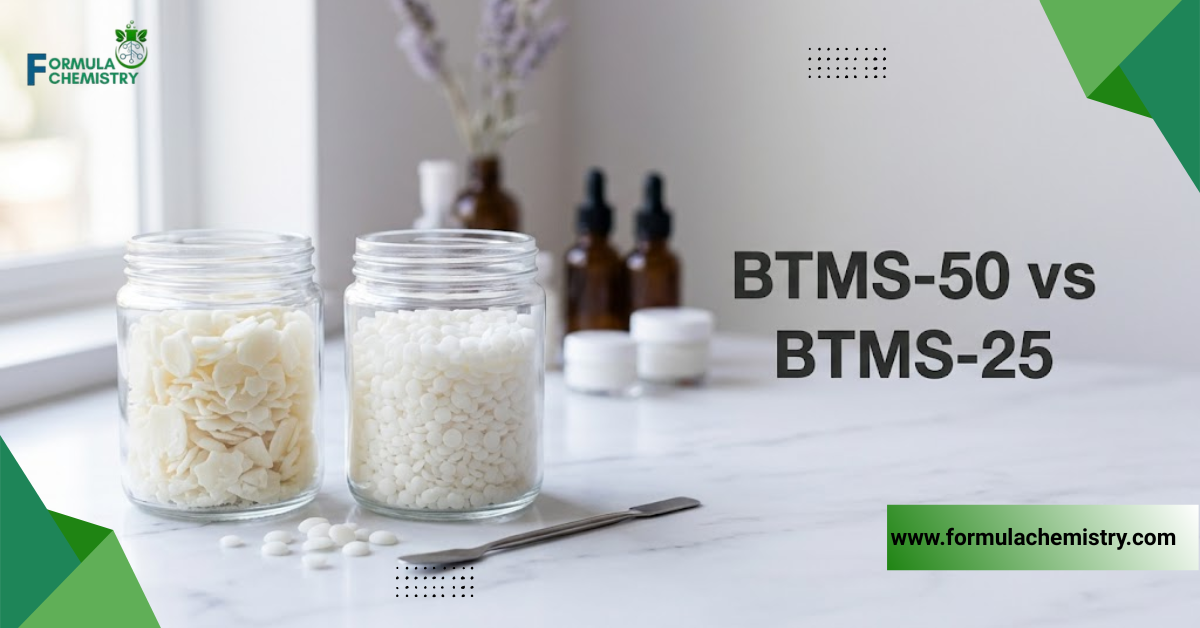
BTMS-50 vs BTMS-25 differ mainly in active content: BTMS-50 carries 50% behentrimonium methosulfate on cetyl alcohol and butylene glycol, while BTMS-25 carries 25% on cetearyl alcohol.
BTMS-50 conditions more and thickens less, making it the stronger choice for rinse-off conditioners, leave-ins, and conditioner bars, whereas BTMS-25 thickens more and suits richer creams and lotions where body matters.
Both work at roughly 1 to 10%, and they cannot be swapped one for one, because equal weights deliver very different amounts of active.
Introduction
Choosing between BTMS-50 and BTMS-25 confuses almost every new formulator, and the numbers in the names are the reason. They look like grades of the same thing, so people assume the higher number is simply better.
The number is the active percentage, not a quality score. Once you understand what that percentage changes, the choice stops being a guess and becomes a formulation decision.
I have rescued more than one conditioner bar that turned draggy and waxy because someone swapped one for the other by weight. The formula was fine; the substitution math was not.
This guide covers what each material actually contains, how they behave differently in real products, the substitution trap that catches people out, and which one belongs in your specific formula.
What They Actually Are
Both are cationic conditioning emulsifiers, meaning they carry a positive charge that binds to hair and emulsify oil and water at the same time. That dual function is why a single ingredient can build an entire conditioner.
The active in both is behentrimonium methosulfate, a quaternary ammonium compound. Despite the word methosulfate, it is not a harsh sulfate detergent like SLS, and it does not strip.
What differs is the carrier each active sits on. BTMS-50 is delivered on cetyl alcohol with a little butylene glycol, while BTMS-25 is delivered on cetearyl alcohol.
BTMS-50 vs BTMS-25: The Core Difference in Composition
The full ingredient breakdown explains every behavioural difference between them. The table below sets out what each one contains.
| Property | BTMS-50 | BTMS-25 |
| INCI | Behentrimonium Methosulfate, Cetyl Alcohol, Butylene Glycol | Behentrimonium Methosulfate, Cetearyl Alcohol |
| Active BTMS | 50% | 25% |
| Fatty alcohol | Cetyl alcohol, roughly 35 to 45% | Cetearyl alcohol, roughly 75% |
| Extra components | Butylene glycol, 5 to 10% | None |
| Conditioning strength | Higher | Lower |
| Thickening contribution | Lower | Higher |
| Typical usage | 1 to 10%, often around 5% | 1 to 10%, often around 5% |
Read the two rows that matter together. BTMS-50 puts twice the conditioning active into your formula per gram, while BTMS-25 puts far more fatty alcohol in.
That single trade explains everything downstream. More active means more slip and detangling, and more fatty alcohol means more thickness and firmness.
The butylene glycol in BTMS-50 is easy to overlook and worth understanding. It aids solubility and dispersion, which is part of why BTMS-50 emulsifies cleanly even in more challenging formulas.
The fatty alcohols themselves also differ. Cetearyl alcohol in BTMS-25 is a blend of cetyl and stearyl alcohols, and that stearyl fraction contributes more firmness than the pure cetyl alcohol in BTMS-50.
How They Behave Differently in a Formula
The active drives conditioning, so BTMS-50 delivers stronger detangling, better wet comb, and more slip at the same use level. A formula built on it feels more conditioning without feeling heavier.
The fatty alcohol drives structure, so BTMS-25 thickens and firms a product more per gram used. Its high cetearyl alcohol content acts like a built-in thickener that BTMS-50 does not supply in the same quantity.
This is why the same 6% inclusion produces two different products. On BTMS-50 you get a richly conditioning, softer result, and on BTMS-25 you get a firmer, thicker, less intensely conditioning one.
Neither is superior in the abstract. The right choice depends entirely on whether your product needs conditioning power or structural body.
The Substitution Trap
Here is the mistake that ruins formulas, and it is pure arithmetic. Swapping BTMS-25 for BTMS-50 at the same weight does not give you the same product; it doubles your active and halves your fatty alcohol.
Work a real example. A formula with 8% BTMS-25 contains 2% behentrimonium methosulfate and 6% cetearyl alcohol.
Replace that with 8% BTMS-50, and you now have 4% active and only around 3% cetyl alcohol. You have doubled the conditioning agent and stripped out half the structure.
In a lotion or body butter, this can destabilise the emulsion, because you have effectively changed how much emulsifier and how much fatty thickener the system relies on. In a bar, it can turn the result draggy or, conversely, too soft.
To convert properly, match the active and rebuild the structure. Replacing 8% BTMS-25 means using roughly 4% BTMS-50 to match the 2% active, then adding about 4% extra cetearyl alcohol to replace the lost fatty alcohol.
Which to Use in Each Product Type
The application usually settles the decision faster than any property table. Each format rewards a different balance of conditioning and structure.
- Rinse-off conditioner: BTMS-50, for maximum slip and detangling at a lower use level
- Leave-in conditioner: BTMS-50, since you want conditioning without loading the hair with fatty alcohol
- Conditioner bar: BTMS-50, because the bar already needs added hardeners and BTMS-25 brings too much fatty alcohol
- Rich cream or lotion: BTMS-25, where the extra cetearyl alcohol builds welcome body
- Detangling spray: BTMS-50, for conditioning at very low inclusion
- Thick styling cream: BTMS-25, where thickness is part of the appeal
Conditioner bars deserve a specific note. They rely on hardeners for a solid form, and BTMS-25 already carries so much fatty alcohol that adding more makes the bar waxy and draggy, which is why BTMS-50 is the cleaner base.
Matching to Hair Type and Format
The hair you formulate for nudges the choice as much as the product format does. Fine hair is weighed down easily, so a conditioner on BTMS-50 at a modest level delivers slip without the heaviness that extra fatty alcohol brings.
Thick, coarse, or curly hair tolerates and often wants more richness. Here the higher fatty alcohol of BTMS-25, or a BTMS-50 conditioner boosted with added fatty alcohol, gives the body and coating those textures reward.
Rinse-off and leave-on formats also pull in different directions. A rinse-off conditioner can carry more of either material because most washes away, while a leave-in demands restraint so the hair does not feel coated or greasy.
Skin products change the calculus again. In a body lotion or hand cream, the conditioning active matters less and the emulsifying and thickening role matters more, which is one context where BTMS-25 earns its place on structure alone.
Cost and Availability
BTMS-50 is often described as the premium option and can cost more per kilogram. That headline can mislead, since you frequently use less of it to reach the same conditioning effect.
Compare on cost per unit of conditioning, not cost per kilogram. A more expensive material used at a lower level can work out cheaper in the finished formula.
Both are widely stocked by cosmetic suppliers in pellet or flake form. One practical caution matters, since some suppliers mislabel their material, so check the INCI on the certificate rather than trusting the product name alone.
Melting Point and Processing
Both process the same way in practice, which simplifies the choice. Each goes into the oil phase, heats and melts with your oils, then emulsifies as you combine phases and cool.
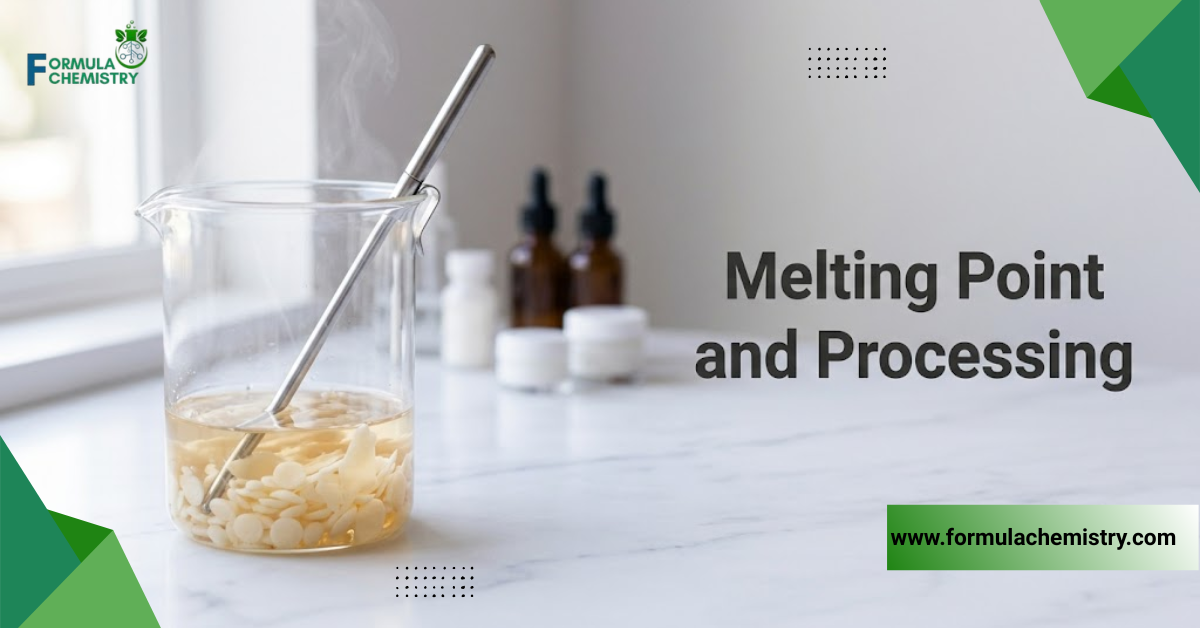
Their fatty alcohols melt in a similar range, broadly around 50 to 70°C depending on grade, so both are comfortable heated-phase ingredients. Heat both phases to roughly 70 to 75°C before combining for a clean emulsion.
BTMS-25 disperses readily in hot water, which supports simple one-pot methods. BTMS-50 emulsifies just as reliably with standard heat-and-hold processing.
Pairing BTMS With Other Ingredients
Neither material has to work alone, and how you pair it shapes the result. Both play well with humectants and proteins, which is why glycerin, panthenol, and hydrolysed proteins appear in so many BTMS conditioners.
Cationic partners can extend conditioning further. Cetrimonium chloride adds slip and detangling in rinse-off products, and a small amount alongside BTMS-50 lifts a conditioner without adding thickness.
Fatty alcohols are the natural texture lever. Adding cetyl alcohol keeps a product softer, while cetearyl or stearyl alcohol firms it, which lets you tune either BTMS toward the body you want.
Both excel in low-pH systems, and the finished conditioner usually sits around pH 4 to 5 for hair. Adjusting to that range with a mild acid improves both feel and cationic deposition.
Common Mistakes With BTMS Selection
A handful of errors account for most BTMS problems, and each has a clear correction.
Swapping the two by equal weight is the error I see most, because the names imply interchangeability. Convert to active content instead, roughly halving the amount when moving from BTMS-25 to BTMS-50, then rebuild the fatty alcohol.
Choosing BTMS-25 for a conditioner bar is a second common misstep. The bar turns waxy and draggy because BTMS-25 already carries so much fatty alcohol, so reach for BTMS-50 and add only the hardeners the bar actually needs.
Overloading BTMS-50 in a leave-in causes a third problem: a white residue on hair. Drop the use level rather than the ingredient, since a little goes a long way at 50% active.
Trusting the product name over the certificate is a fourth mistake, and it burns formulators when a supplier mislabels material. Check the INCI on the certificate of analysis before you build a formula around it.
The last error is comparing the two on price per kilogram. Judge cost per unit of conditioning delivered, because the more concentrated material often works out cheaper in the finished product.
Choosing for Your Formula
Reach for BTMS-50 when conditioning is the priority, and you do not want the product to thicken heavily. Hair conditioners, leave-ins, bars, and detangling sprays almost always point here.
Choose BTMS-25 when you want conditioning plus genuine body, and the extra fatty alcohol works in your favour. Rich creams, thick lotions, and structured styling products suit it well.
If you already own one and want to use it in a formula written for the other, convert on active content rather than weight. Match the behentrimonium methosulfate first, then adjust fatty alcohol to rebuild the texture.
The fastest way to decide is to name your product’s job. Write down whether you need conditioning power or structural thickness, and the correct BTMS chooses itself, which is exactly the reasoning we walk through at Formula Chemistry before a single trial batch.
Frequently Asked Questions
What is the difference between BTMS-50 and BTMS-25?
BTMS-50 contains 50% active behentrimonium methosulfate on cetyl alcohol and butylene glycol, while BTMS-25 contains 25% on cetearyl alcohol. BTMS-50 conditions more and thickens less. BTMS-25 thickens more and conditions less.
Which BTMS is better for hair conditioner?
BTMS-50 is usually the better choice for hair conditioners, since its higher active content gives stronger slip and detangling at a lower use level. BTMS-25 works too but conditions less. For leave-ins and bars, BTMS-50 is generally preferred.
Can I substitute BTMS-50 for BTMS-25?
Not at equal weight, because that doubles the active and halves the fatty alcohol. Match the behentrimonium methosulfate content instead, roughly halving the amount, then add extra cetearyl alcohol to replace the lost structure. A direct one-to-one swap often destabilises emulsions.
What percentage of BTMS should I use?
Both BTMS-50 and BTMS-25 are typically used at 1 to 10%, with around 5% being common for conditioners. Higher levels increase conditioning and body. The right level depends on the product and the effect you want.
Which BTMS thickens more?
BTMS-25 thickens more because roughly 75% of it is cetearyl alcohol, a fatty thickener. BTMS-50 contains less fatty alcohol and more active ingredients, so it thickens less. This makes BTMS-25 useful in richer creams.
Is BTMS-50 better for conditioner bars?
Yes, BTMS-50 is generally better for conditioner bars. Bars already need added hardeners, and BTMS-25 brings so much fatty alcohol that it can make the bar draggy and waxy. BTMS-50 gives cleaner conditioning without over-thickening.
Do BTMS-50 and BTMS-25 melt at the same temperature?
Their fatty alcohols melt in a broadly similar range, around 50 to 70°C depending on grade, so both process as heated-phase ingredients. Heat both phases to roughly 70 to 75°C before combining. Their processing is essentially the same.
Is BTMS a sulfate?
No, despite the methosulfate in its name, behentrimonium methosulfate is a cationic quaternary ammonium compound, not a harsh sulfate detergent. It conditions rather than strips. It has no relation to SLS or SLES.
Key Takeaways
BTMS-50 and BTMS-25 are the same active on different carriers, and the number is the active percentage rather than a quality rank. BTMS-50 conditions more and thickens less, while BTMS-25 thickens more and conditions less.
Match the material to the product’s job: BTMS-50 for conditioners, leave-ins, and bars where slip matters, and BTMS-25 for creams and lotions where body matters. Never swap them by equal weight, since that changes both the active and the structure and can break an emulsion.
Decide by naming what your product needs most, conditioning or thickness, then convert on active content if you are working from a formula written for the other. Pull your recipe, check whether it calls for slip or body, and the right BTMS is already obvious before you weigh a thing.