

Quick Answer
Scaling a DIY cosmetic to commercial production fails when formulators copy percentages and ignore process, because heat transfer, shear, and hold time all change with vessel size.
A 500-gram beaker cools in minutes while a 500-kilogram jacketed vessel takes hours, which alters emulsion droplet size, wax crystallisation, and preservative performance.
Scale in stages through a pilot batch, re-run stability and preservative efficacy testing on the first production batch, and treat the scaled formula as a new product rather than a bigger version of the old one.
Introduction
Scaling a DIY cosmetic to commercial production is where good formulators discover that a recipe is not a process. The percentages transfer perfectly, and the product does not.
I have watched a cream that was flawless at 400 grams separate at 40 kilograms with an identical formula. Nothing in the ingredient list had changed, and everything about how it was made had.
The physics of a large vessel differ from a beaker on a hot plate. Understanding those differences is the whole discipline of scale-up.
By the end of this guide, you will know what actually changes at scale, how to run a pilot batch, why stability must be re-tested, and how to choose between in-house production, private label, and a contract manufacturer.
Why a Formula That Works at 500g Fails at 500kg
The formula is a list of ingredients and ratios. The process is everything else, and only the formula scales linearly.
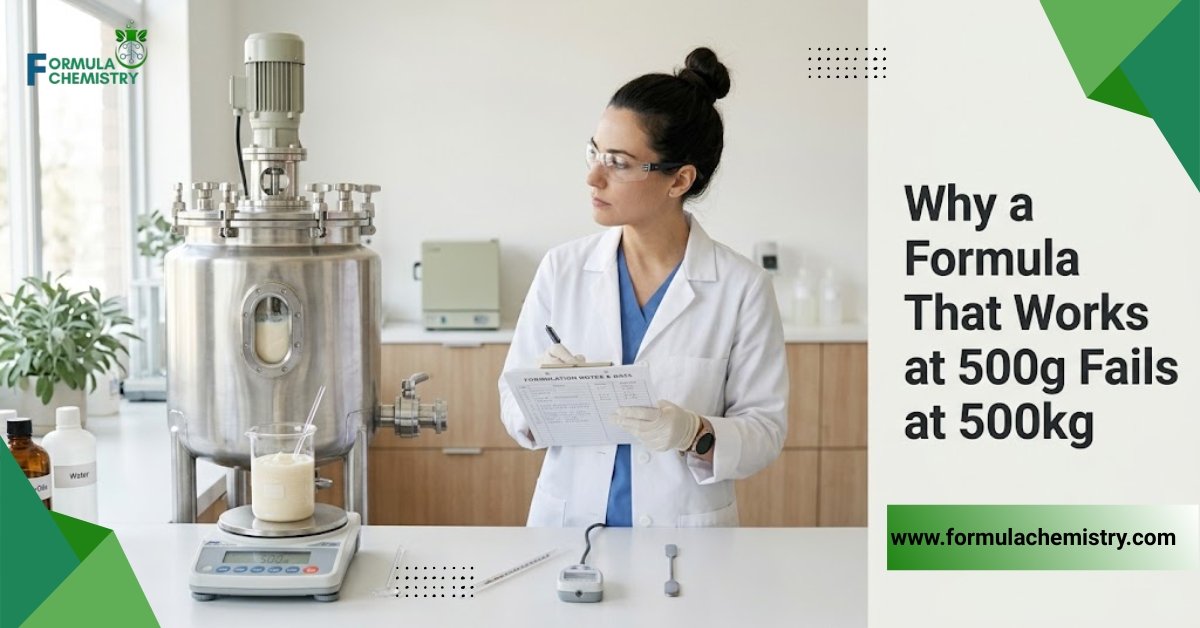
Consider heat. Surface area grows with the square of a vessel’s dimensions while volume grows with the cube, so the ratio of surface area to volume falls sharply as batches get larger.
That single relationship drives most scale-up failures. A small beaker loses heat rapidly through its walls, while a production vessel holds heat, and the product cools far more slowly.
Slow cooling changes structure rather than composition. Waxes and butters crystallise differently, gel networks form differently, and an emulsion that set tight and fine at bench scale can set coarse and unstable at volume.
What Actually Changes at Scale
Several process variables shift together, and each one affects the finished product. The table below maps them.
| Variable | Bench scale | Production scale | Consequence |
| Surface area to volume | High | Low | Much slower heating and cooling |
| Cooling rate | Minutes | Hours | Altered crystal and gel structure |
| Shear | High, localised | Depends on impeller geometry | Different droplet size distribution |
| Hold time at temperature | Short | Long | Thermal degradation, fragrance loss |
| Air incorporation | Minimal | Significant vortexing risk | Aeration, oxidation, density change |
| Heat source | Uniform water bath | Jacketed wall | Hot spots near the vessel wall |
| Mixing uniformity | Immediate | Zones of poor mixing | Localised pH or concentration variation |
Shear deserves particular care because formulators try to match RPM. Rotational speed is meaningless across different impeller diameters, and the parameter that transfers is tip speed in metres per second.
Recognised scale-up criteria include geometric similarity, constant tip speed, and constant power input per unit volume. None of them transfers perfectly, so a pilot batch remains the only reliable test.
The Scale-Up Sequence
Scale in deliberate stages rather than one jump. Each stage answers a question that the previous one could not.
- Finalise the bench formula at 500 grams to 1 kilogram with complete documentation.
- Confirm the raw material specifications and lock supplier grades.
- Run a pilot batch at roughly ten times bench scale and record every parameter.
- Compare the pilot batch against the bench standard on appearance, pH, viscosity, and microscopy.
- Adjust process parameters rather than the formula wherever possible.
- Run the first production batch and re-test stability and preservative efficacy.
- Release only after the production batch passes on its own evidence.
Move in increments of roughly tenfold. Jumping from a kitchen batch straight to a thousand kilograms removes every opportunity to learn cheaply.
Change one variable at a time. A pilot batch that fails after three simultaneous adjustments teaches you nothing about which one mattered.
Running a Meaningful Scale-Up Trial Batch
A scale-up trial batch exists to expose process problems, so record everything rather than only the result. Note actual temperatures, actual times, actual tip speeds, and the exact point at which each phase was added.
Match phase temperatures closely before emulsification, typically within a few degrees. Adding a cool oil phase to a hot water phase at volume produces a coarser emulsion than the same mismatch at bench scale.
Watch cool-down triggers carefully. Heat-sensitive actives, preservatives, and fragrance are added at defined temperatures, and a large vessel passes through that window slowly enough to change the outcome.
Take samples through the batch rather than only at the end. Mid-process microscopy of droplet size tells you whether your emulsion formed correctly, long before the product reaches the fill line.
Reformulating for Manufacturability
Some DIY formulas cannot scale as written, and honesty about that saves months. Ingredients bought in 50-gram bags may not exist in commercial grades, and supplier specifications vary between lots in ways a home formulator never sees.
Cost enters the formula for the first time. An ingredient at 3% that was affordable in a 200-gram batch can make a product unsellable at production volume.
Simplify where the chemistry allows. Long ingredient lists multiply supplier risk, regulatory documentation, and the chance that one raw material becomes unavailable.
Design for the equipment that will actually make the product. A formula requiring twenty minutes of high shear homogenisation may not suit a co-packer whose vessels lack a rotor-stator head.
Stability After Scaling Is Not Optional
Stability after scaling must be re-established from scratch, because the product you tested at bench scale is not the product coming off the line. The formula is identical, and the microstructure is not.
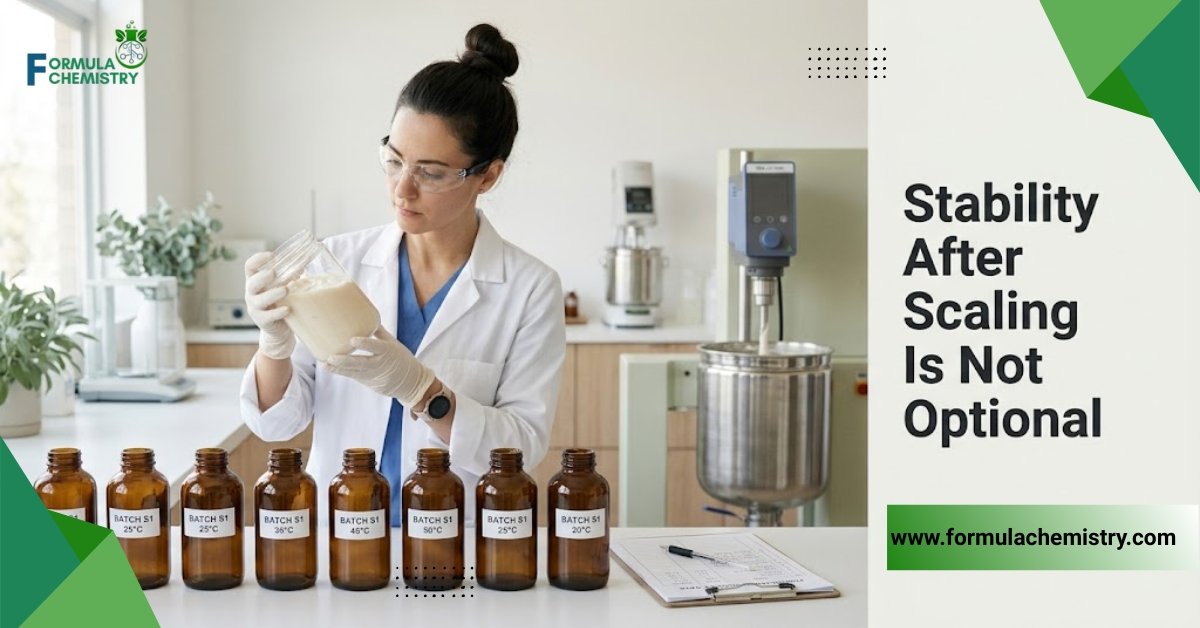
Run accelerated stability on the production batch, commonly at elevated temperature over several months alongside freeze-thaw cycling and real-time storage. Accelerated data predicts rather than proves, so real-time testing continues in parallel.
Preservative efficacy testing must be repeated too. A slower cool-down, longer hold times, different water quality, and new equipment surfaces all change the microbial challenge the preservative system faces.
Test in the final packaging rather than a laboratory jar. Packaging compatibility, headspace, and closure interaction all influence stability and are invisible until you test the actual component.
Never release a production batch on bench-scale data. That single shortcut causes more indie brand recalls than any formulation error.
Batch Documentation and Quality Records
Commercial batch documentation turns a repeatable process into a defensible one. Once you sell to strangers, you must be able to reconstruct any batch from paper.
A production batch record captures the batch number, every raw material with lot numbers, actual process parameters, in-process checks, deviations, yield reconciliation, and a release signature. Record what happened rather than what was supposed to happen.
Retain a sealed sample of every batch for its full shelf life. When a complaint arrives eighteen months later, that retention sample is your only diagnostic tool.
Documentation is also a regulatory expectation rather than good housekeeping. GMP under ISO 22716 requires it, and it feeds directly into the safety documentation your market demands before sale, a linkage Formula Chemistry raises with every founder approaching production.
Choosing Your Production Route
Four routes exist, and each trades control against capacity. The table below sets out what you gain and give up.
| Route | What it means | Control | Typical trade-off |
| In-house scaling | You buy vessels and produce yourself | Highest | Capital, GMP burden, capacity ceiling |
| Private label | You brand an existing stock formula | Lowest | Fast and cheap, but no differentiation |
| Co-packer | A partner fills and packs your product | Moderate | You still own formulation and blending |
| Contract manufacturer | A partner makes your custom formula | Moderate | Higher minimums and cost, real scale |
In-house scaling suits brands whose formula is their differentiator and whose volumes stay modest. You keep every process secret and accept the full compliance and capital burden.
Private label launches fastest and cheapest, though the product is available to anyone else who asks. It suits a brand competing for audience and marketing rather than formulation.
A co-packer handles filling and packing while you retain blending, whereas a contract manufacturer takes your formula and manufactures it end-to-end. The distinction matters when you negotiate, since people use the terms loosely.
Working With a Contract Manufacturer
Bring a complete technical transfer package rather than a recipe. Your partner needs the formula, process parameters, raw material specifications, in-process controls, finished product specification, and your stability and preservation data.
Expect minimum order quantities, often running into thousands of units per product. That figure, more than price per unit, decides whether a contract manufacturer suits your stage.
Audit the facility rather than accepting a certificate. Ask to see batch records, cleaning validation, water testing, and how they handle deviations, because their GMP posture becomes yours the moment they make your product.
Agree who owns the formula in writing before any development work begins. A partner who reformulates your product and claims the result has cost you your only durable asset.
Common Scale-Up Mistakes
Scale-up fails in patterns, and each mistake below carries a clear fix. Recognising them early costs a pilot batch instead of a production run.
The first mistake is scaling the formula while ignoring the process. Percentages transfer and physics does not, so document and translate process parameters deliberately.
Matching RPM instead of tip speed is a second error. Rotational speed means nothing across different impeller sizes, so calculate tip speed and match that.
Jumping straight from kitchen to full production is a third mistake. It removes every cheap learning opportunity, so scale in roughly tenfold increments through a pilot batch.
Reusing bench stability data is a fourth error. The scaled product has a different microstructure, so re-run stability and preservative efficacy on the production batch.
Ignoring cool-down rate is a fifth mistake. Slow cooling changes crystal and gel structure, so control and record the cooling profile rather than letting the vessel find its own pace.
The sixth error is choosing a manufacturing partner on price alone. Their quality system becomes your liability, so audit the facility and read the formula ownership clause before you sign.
Which Path Fits You
A formulator whose formula is the differentiator, selling modest volumes, gains most from in-house scaling. Accept the capital cost and GMP burden in exchange for total control.
Founders who need speed and lack formulation expertise are better served by a private label. Launching a safe, tested product quickly beats waiting years to develop one you cannot yet manufacture.
Brands with a genuinely distinctive formula and proven demand should approach a contract manufacturer. Bring a full technical package and real sales evidence, since minimums make this route expensive to test speculatively.
Whatever your route, run the pilot batch before you commit. To begin, write down every process parameter from your last bench batch, including actual temperatures and cooling times, because you cannot transfer what you never recorded.
Frequently Asked Questions
Can I scale a DIY formula directly?
Not usually, because the formula scales linearly while the process does not. Heat transfer, shear, and hold times all change with vessel size and alter the product’s structure. Scale in stages and validate each one with a trial batch.
Why does my cream separate at larger volumes?
Larger vessels cool far more slowly, which changes emulsion droplet size and gel network formation. Mismatched phase temperatures and different shear conditions compound the effect. A pilot batch with recorded parameters usually reveals the cause.
Do I need to retest stability after scaling?
Yes, always, since the scaled product has a different microstructure despite an identical formula. Re-run accelerated and real-time stability plus preservative efficacy testing on the production batch. Test in the final packaging rather than a laboratory jar.
What is a pilot batch?
A pilot batch is an intermediate production run, typically around ten times bench scale, used to expose process problems cheaply. It sits between your bench formula and full production. Record every parameter and compare against the bench standard.
Contract manufacturer or co-packer?
A contract manufacturer makes your custom formula end-to-end, while a co-packer generally fills and packs a product you have blended. Control, cost, and minimum quantities differ between them. Confirm exactly which service a partner provides before signing.
What are typical minimum order quantities?
Contract manufacturers commonly require minimums running into thousands of units per product, though this varies widely. Private label minimums are usually far lower. Minimums, rather than unit price, often decide whether a route suits your stage.
Should I match RPM when scaling up?
No, rotational speed does not transfer across different impeller diameters. Match tip speed in metres per second instead, alongside geometric similarity and power per unit volume. Even then, a pilot batch remains necessary to confirm.
What documentation does production need?
Each batch needs a record capturing the batch number, raw material lot numbers, actual process parameters, in-process checks, deviations, yield, and release signature. Retain a sealed sample for the full shelf life. GMP requires this, and safety documentation depends on it.
Key Takeaways
Scaling a DIY cosmetic to commercial production means translating a process, not multiplying a recipe. Surface area to volume ratio, cooling rate, shear, and hold time all shift with vessel size and change the product’s structure.
Scale through a pilot batch in roughly tenfold increments, changing one variable at a time and recording every parameter. Re-run stability and preservative efficacy on the first production batch in its final packaging, because bench data no longer describes what you are selling.
Choose your production route by what you are actually protecting, whether that is formula control, speed, or capacity. To start today, write down the actual temperatures, cooling times, and mixing speeds from your last bench batch, since scale-up begins with data you may not yet have collected.