
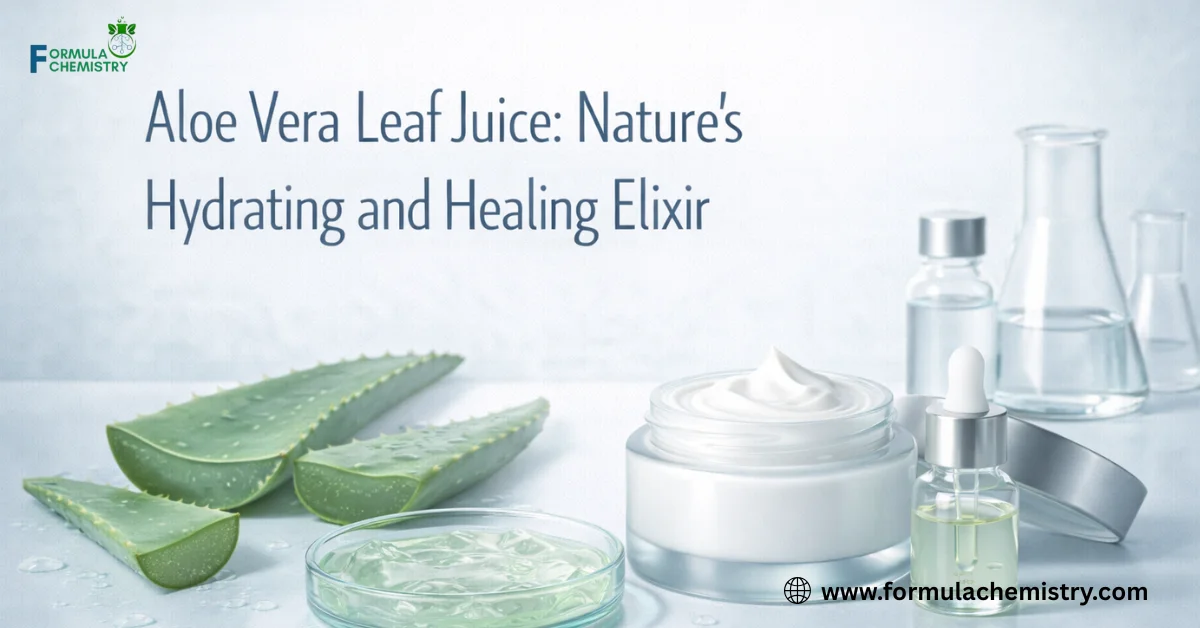
Aloe Vera Leaf Juice (Aloe Barbadensis) is one of the most recognized botanical ingredients in the cosmetic industry.
Derived from the inner mucilaginous gel of the Aloe plant, it is composed of approximately 99% water, with the remaining 1% containing a complex mixture of polysaccharides, vitamins, enzymes, and amino acids.
At FormulaChemistry, we view this ingredient as a basic humectant that provides structural benefits to water-based formulations while delivering biological activity to the skin.
Quick Facts
- What it is: A water-soluble botanical juice extracted from the inner leaf parenchyma of the Aloe barbadensis Miller plant.
- Who it’s for: All skin types, especially helpful for dehydrated, sensitive, or sun-damaged skin.
- How to use: Used as a direct replacement for water (solvent) or as an active additive in serums, creams, and cleansers.
- Typical usage range: 1% to 100% (as a base) or 0.1% to 5% for concentrated 200x powder forms.
- pH/Solubility: Water-soluble; typically maintains a natural pH of 4.0 to 5.0.
- Compatibility: Highly compatible with most humectants and thickeners, though high electrolyte content is capable of destabilizing certain carbomers.
- Common Mistakes: Failing to adjust preservation systems for its high nutrient load or overheating the juice, which degrades enzymes.
- Safety Note: Use only “decolorized” aloe to avoid aloin, which can cause skin sensitivity and photo-toxicity.
Introduction
Aloe Vera Leaf Juice is prized for its capacity to deliver instant hydration and soothe inflammatory responses. Unlike plain water, it contains acemannan, a complex polysaccharide that helps bind moisture to the stratum corneum and supports the skin’s natural regeneration processes.
FormulaChemistry provides practical formulation education and safety-forward direction to ensure that botanicals like Aloe are used at their peak efficacy.
While frequently marketed as a simple “healing” gel, the chemistry of Aloe is quite sophisticated. It functions as a film-former, serving as a protective barrier that reduces transepidermal water loss (TEWL).
In the context of modern formulation, it functions as an excellent vehicle for other active ingredients, boosting the overall sensory profile of a product by reducing the tackiness often associated with high-glycerin formulas.
The Chemical Composition of Aloe Barbadensis
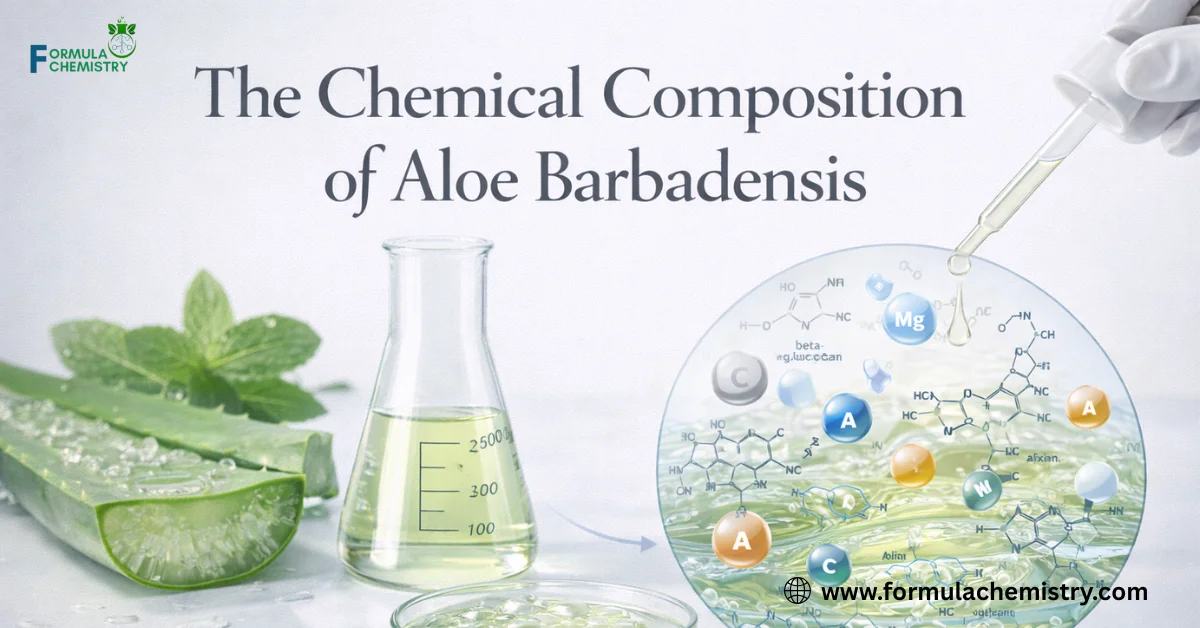
The primary bioactive component in Aloe Vera is acemannan, which has been studied for its immunomodulatory properties.
Additionally, the juice contains bradykinase, an enzyme that helps reduce excessive inflammation when applied topically. These components make it a mainstay in post-treatment care and sun-care products.
Beyond polysaccharides, Aloe contains vitamins A, C, and E, which are potent antioxidants. It also features salicylic acid in small, natural quantities, providing a very mild keratolytic effect.
For formulators, understanding this complex profile is important to prevent ingredient interactions that could lead to oxidation or precipitation within the final product.
Sourcing and Extract Types
Formulators generally choose between liquid juice, concentrated extracts (10x, 40x), or freeze-dried powders (200x).
The 200x powder is highly popular in professional labs as it saves on shipping costs and storage space while sustaining the integrity of the active molecules. When reconstituted with distilled water, it returns to the biological profile of the fresh juice.
Discover the benefits of urea for smooth, healthy skin in What Is Urea in Skincare?
What are the Main Benefits of Aloe Vera in Skincare?
The biological activity of Aloe Vera Leaf Juice spans hydration, wound healing, and anti-aging. Its ability to penetrate the skin quickly makes it a chosen humectant over man-made alternatives in natural-focused brands.
Because it mimics the skin’s natural moisturizing factors, it is rarely rejected by the skin barrier, making it a universal ingredient for various populations.
Who should avoid:
Individuals with a known allergy to plants in the Liliaceae family (such as onions or garlic) should exercise caution. While rare, contact dermatitis can occur if the aloe juice has not been properly filtered to remove aloin, a yellow latex found just beneath the leaf skin.
Hydration and Transepidermal Water Loss
Aloe Vera creates a humectant film on the skin’s surface. This film attracts water from the environment as well as the deeper layers of the dermis, making sure the stratum corneum remains pliable.
Unlike occlusives, it does not feel heavy or greasy, which is why it is frequently utilized in “oil-free” gel moisturizers.
- Common Problems and Fixes:
- Problem: High concentrations of Aloe cause a “tightening” or “filming” effect that some users find unpleasant.
- Fix: Blend with a small percentage of a lipid or a surfactant-based solubilizer to soften the film.
- Problem: The formula turns brown over time.
- Fix: Maintain a pH of 4.5 to 5.5 and include a chelating agent like Disodium EDTA or Sodium Phytate to prevent oxidation.
- Problem: The viscosity of a carbomer-based gel drops when Aloe is added.
- Fix: Switch to a salt-stable thickener like Xanthan Gum or Sclerotium Gum, as the electrolytes in Aloe can collapse sensitive polymer networks.
Anti-Inflammatory and Healing Properties
The soothing nature of Aloe is ascribed to its ability to inhibit the cyclooxygenase pathway, which reduces the production of pro-inflammatory prostaglandins.
This makes it an ideal inclusion in formulations for acne-prone skin, where reducing redness is a primary goal. Formula Chemistry (spaced version) states that while Aloe aids in soothing, it should not replace medical treatments for severe burns or chronic skin conditions.
Formulation Guidelines and Stability Requirements
When formulating with Aloe Vera Leaf Juice, the most essential factor is the preservation system. Because the juice is nutrient-rich, it is a perfect breeding ground for bacteria, yeast, and mold.
Preservation reminder:
Any water-based product containing even a small percentage of Aloe must include a strong, broad-spectrum preservative.
The following table outlines the technical specifications for incorporating Aloe into various cosmetic formats:
| Format | Recommended Usage Range | Phase Addition | Compatibility Notes |
| Fresh Juice | 10% – 100% | Water Phase | Replace water 1:1; adjust pH |
| 200x Powder | 0.1% – 0.5% | Water Phase | Dissolve before adding thickeners |
| Oil-Soluble Extract | 1% – 5% | Oil Phase | Useful for anhydrous balms |
| Concentrated 10x | 1% – 10% | Cool Down | Avoid high heat (>40°C) |
pH Stability and Adjustment
Aloe Vera is naturally acidic. When used at high levels, it will significantly lower the pH of your formulation.
This must be monitored closely, especially if your formula contains other pH-sensitive ingredients like Niacinamide (which can turn into nicotinic acid at low pH) or certain preservatives like Sodium Benzoate.
pH notes:
Most Aloe-based formulas should be buffered to a range of 4.5 to 5.5. This range is optimal for both skin health and the stability of the Aloe polysaccharides. Using a digital pH meter is mandatory when working with high-volume Aloe juices to ensure batch-to-batch consistency.
Temperature Sensitivity
While the water content of Aloe can withstand heating, the bio-active enzymes and vitamins are thermolabile. For maximum “healing” efficacy, it is best to add concentrated Aloe extracts during the cool-down phase of an emulsion.
If you are using the juice as the primary solvent and must heat it to melt emulsifiers, try to limit the exposure time to temperatures above 70°C.
Safety, E-E-A-T, and Editorial Responsibility
In accordance with our pledge to safety at FormulaChemistry, we advise all formulators to source “decolorized” or “charcoal-filtered” Aloe Vera.
This process removes anthraquinones (aloin), which are the constituents responsible for the laxative effect of the plant and its possible skin-sensitizing properties.
Guaranteeing the purity of your raw materials is a hallmark of professional-grade skincare manufacturing.
As an editorial responsibility, we must note that while Aloe is exceptionally safe, the quality of the raw material varies wildly between suppliers.
Always request a Certificate of Analysis (COA) to verify the microbial count and the presence of solids. This makes sure that the “Aloe” you are using isn’t just water with a green tint.
Patch Testing and Sensitivity
Even the most natural ingredients can trigger a reaction. Patch testing advice: Always advise end-users to test a finished product on a small area of the inner forearm for 24 hours before full-face application.
This is especially important for DIY formulators who may be using fresh aloe from a garden plant, as the risk of contamination as well as aloin exposure, is significantly higher than with processed cosmetic-grade juice.
Key warnings:
Do not apply undiluted fresh aloe latex (the yellow sap) to broken or severely abraded skin. Stick to the inner leaf gel or commercially prepared juices that have undergone purification. Following these safety-forward protocols ensures that your final product is equally effective and dermatologically sound.
Storage and Shelf Life
Aloe-containing products typically have a shorter shelf life if not adequately protected from light and air. Polysaccharides can undergo hydrolysis, and vitamins can oxidize.
Using opaque packaging and adding an antioxidant like Vitamin E (Tocopherol) or Sodium Metabisulfite can help preserve the juice’s “freshness” and prevent the yellowing that often plagues botanical gels.
FAQs about Aloe Vera Leaf Juice: Nature’s Hydrating and Healing Elixir
Can I replace all the water in my formula with Aloe Vera Juice?
Yes, you can use it at 100% usage range as the water phase, but you must ensure your preservative and thickener are compatible with the electrolyte load.
Is Aloe Vera juice better than the powder?
Both are effective. The 200x powder is more convenient for shipping and storage, while the juice is easier for beginners who do not want to calculate reconstitution ratios.
Does Aloe Vera protect against the sun?
No. While it soothes sunburn, it does not contain SPF and should never be used as a substitute for a dedicated sunscreen.
Why does my Aloe gel feel sticky?
Stickiness is caused by the natural sugars and polysaccharides. Reducing the concentration or adding a “dry” emollient may help reduce this texture.
Is Aloe Vera safe for acne?
Yes, its anti-inflammatory properties and natural salicylic acid content make it excellent for calming acne-prone skin without blocking pores.
Can I use fresh Aloe from my houseplant?
For personal use, yes, but for stable products, it is discouraged. Fresh aloe lacks preservatives and contains aloin, which can irritate the skin.
What is the ideal pH for an Aloe Vera serum?
A pH of 4.5 to 5.5 is ideal for stability and corresponds to the skin’s natural acid mantle.
Does Aloe Vera help with aging skin?
Yes, by providing deep hydration and antioxidant vitamins, it helps improve skin elasticity and reduce the appearance of fine lines caused by dehydration.