
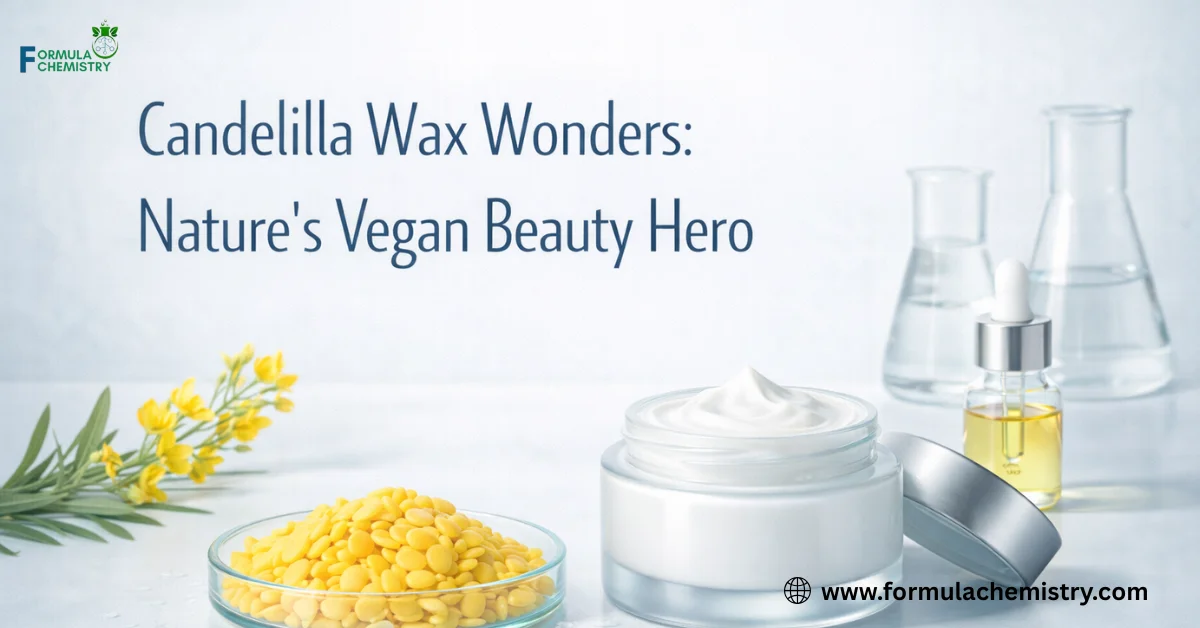
Candelilla wax is a complex, plant-derived multi-component hydrocarbon wax sourced from the leaves of the small Euphorbia cerifera shrub.
In the world of cosmetic science, it operates as a critical structural ingredient, providing film-forming capabilities and thermal stability to anhydrous formulations.
At FormulaChemistry, we view this botanical wax as a keystone of sustainable cosmetic engineering, supplying a robust alternative to animal-derived waxes and petroleum-based thickeners.
Quick Facts
- What it is: A hard, brittle vegetable wax extracted from the Candelilla shrub, mainly composed of hydrocarbons and resin esters.
- Who it’s for: Formulators seeking a high-gloss, vegan structuring agent for lip balms, sticks, and emulsions.
- How to use: Melt into the oil phase (Phase A) of a formulation; requires heating to approximately 70°C for full integration.
- Typical usage range: 1% to 15%, depending on the desired hardness of the final product.
- pH/Solubility: Oil-soluble; pH notes are generally not applicable to anhydrous wax systems, but it is stable across a wide pH range in emulsions.
- Compatibility: Highly compatible with carnauba wax, cocoa butter, and most vegetable oils; helps prevent oil syneresis (sweating).
- Common Mistakes: Overheating the wax beyond 85°C can lead to discoloration or a “burnt” odor in the final batch.
- Safety Note: Avoid inhaling dust during the weighing process of flakes or pellets; ensure adequate ventilation in the lab.
Introduction
Candelilla wax is noted for its yellowish-brown color and its distinctive ability to provide a high-gloss finish to cosmetic surfaces.
Unlike beeswax, which is more pliable, candelilla is significantly harder and more brittle, possessing a melting point that ranges from 68.5°C to 72.5°C. This thermal resistance makes it an invaluable asset for products distributed in warmer climates, as it prevents the structural collapse of stick-based cosmetics.
FormulaChemistry provides practical formulation education and safety-forward guidance, helping chemists transition from animal-derived ingredients to high-performance plant alternatives.
The chemical structure of candelilla wax consists of approximately 50% hydrocarbons (mainly C31), 28% esters, and 12-14% alcohols and resins. This unique composition allows it to function not simply as a hardener, but as a barrier-enhancing agent that limits transepidermal water loss (TEWL).
Chemical Composition and Physical Properties
The high hydrocarbon content of candelilla wax distinguishes it from other botanical waxes like rice bran or soy.
These long-chain alkanes contribute to the wax’s exceptional water-repelling properties. When used in barrier creams or salves, it creates a breathable yet protective film over the stratum corneum, shielding the skin and protecting against environmental stressors.
Furthermore, the resinous component of candelilla wax provides the “grip” necessary for decorative cosmetics. It allows lipsticks and eyeliners to adhere to the skin without sliding or feathering.
Formulators have to account for its shrinkage upon cooling; candelilla contracts more than beeswax, which is beneficial for mold release in professional manufacturing but calls for precise temperature control to avoid surface cracking.
Sourcing and Sustainability
The extraction of candelilla wax is a traditional process involving the boiling of the harvested plants in water acidified with sulfuric or citric acid. Because the plant is native to the Chihuahuan Desert, sourcing often entails complex socio-economic and environmental aspects.
Ethical formulators look for suppliers who adhere to CITES (Convention on International Trade in Endangered Species) regulations to ensure the wild-harvested plants are not over-exploited.
Using the Formula Chemistry approach to sustainable sourcing entails verifying that the wax has been treated efficiently.
Explore Bayberry Wax: Natural Wax for Skincare & Candle Making for gentle, versatile care.
What are the Main Roles of Candelilla Wax in Skincare and Color Cosmetics?
In the laboratory, candelilla wax is appreciated for its versatility across various product formats. Its primary function is as a rheology modifier and thickening agent for the lipid phase.
It provides the “body” of a product, transforming liquid oils into solid sticks or thick, spreadable balms. Beyond texture, it acts as an emollient, smoothing the skin surface and providing a satin-like feel.
Because of its elevated melting point, it is often paired with lower-melting-point lipids such as shea butter to create a product that remains solid in the tube but melts instantly upon skin contact.
Who should avoid:
While generally non-comedogenic, individuals with extremely acne-prone skin should monitor their reaction to high concentrations of waxes in leave-on facial products.
Structuring and Stability in Stick Formulations
The most common application for candelilla wax is in the creation of vegan lipsticks and balms. It provides a higher degree of structural strength compared to beeswax, meaning less wax is required to achieve the same level of firmness.
This allows for a higher concentration of liquid oils or active ingredients in the formula without making the stick too soft.
- Common Problems and Fixes:
- Problem: The surface of the lipstick stick is “sweating” oil droplets.
- Fix: Increase the candelilla wax usage range to 10-12% or introduce a secondary stabilizer like silica to help bind the oils.
- Problem: The final balm feels grainy or “sandy” on the skin.
- Fix: Ensure the wax reaches full melting temperature during Phase A and implement a faster cooling rate (shock cooling) to prevent large crystal formation.
- Problem: The product is too hard and difficult to apply.
- Fix: Blend with a softer wax (like berry wax) or increase the liquid emollient ratio.
- Problem: Separation in a water-in-oil emulsion.
- Fix: Verify the HLB (Hydrophilic-Lipophilic Balance) and ensure the wax is adequately coupled with an emulsifier.
Emulsion Stabilization and Film-Forming
In O/W (oil-in-water) emulsions, candelilla wax can be used in the oil phase to increase the viscosity of the cream and improve its water-repellent properties.
This is particularly useful in sunscreens and hand creams where longevity on the skin is a performance requirement. It helps to anchor pigments and UV filters, guaranteeing an even dispersion across the skin.
As a film-former, candelilla wax provides a protective layer that is less tacky than beeswax. This makes it a desirable selection for “dry-touch” body butters and hair styling waxes where a greasy residue is undesirable.
Compatibility, Substitution, and Formulation Techniques
Success with candelilla wax depends on knowing its synergistic effects with other lipids. It is rarely used alone; rather, it is part of a complex matrix of oils, butters, and other waxes.
When substituting candelilla for beeswax, a direct 1:1 replacement is usually unsuccessful due to the difference in hardness. Generally, you use approximately 50% less candelilla than the amount of beeswax required.
| Ingredient Property | Candelilla Wax | Beeswax (Comparison) | Carnauba Wax (Comparison) |
| Melting Point | 68°C – 73°C | 62°C – 65°C | 82°C – 86°C |
| Hardness | Medium-High | Low-Medium | Very High |
| Texture | Brittle, Smooth | Pliable, Tacky | Hard, Brittle |
| Finish | High Gloss | Matte-Satin | Very High Gloss |
| Vegan Status | Yes | No | Yes |
Professional Substitution Ratios
When converting a traditional formula to a vegan version using candelilla wax, the hardness must be recalibrated.
Since candelilla is more brittle, combining it with a “fatty” butter (like mango or cupuacu) helps mimic the creaminess and plasticity of beeswax. Usage ranges for substitution typically fall between 2% and 7% for creams and 10% to 15% for solid sticks.
FormulaChemistry suggests performing a “drop test” or a hardness penetration test when finalizing a new formulation.
Small adjustments in the wax-to-oil ratio can greatly alter the “payoff” the amount of product transferred from the stick to the skin during application. Accurate calibration ensures the consumer has an effortless experience without the product dragging or breaking.
Melting and Cooling Protocols
The processing of candelilla wax is temperature-sensitive. It should be melted slowly using a double boiler or a temperature-controlled jacketed vessel.
Key warnings:
Never expose the oil phase to direct high heat, as this can oxidize the liquid oils and degrade the resinous esters in the wax.
Once the wax is fully melted and incorporated with the oils, the cooling rate becomes the next critical variable. For lipsticks, “shock cooling” (placing the molds in a cold environment) is often used to create a very fine crystalline structure, which results in a smoother surface and higher gloss.
For jars and tins, a slow ambient cooling process may be preferred to prevent the wax from pulling away from the sides of the container.
Safety, Preservation, and Regulatory Criteria
Candelilla wax is a stable, inert ingredient that does not typically require preservation in its raw state. However, as an editorial responsibility, FormulaChemistry reminds formulators that any product containing a water phase (emulsions) must be protected.
Preservation reminder:
Ensure that any lotion or cream containing candelilla wax is protected by a broad-spectrum preservative system to prevent microbial growth in the water phase.
From a regulatory perspective, candelilla wax is widely accepted by global bodies, including the FDA and the EU Cosmetic Regulation. It is considered non-irritating and non-sensitizing. However, because it is a natural product, purity is critical. Always ensure your wax is “Cosmetic Grade” or “Pharma Grade” to avoid impurities such as heavy metals or residual acids from the extraction process.
Sensitivity and Skin Safety
While candelilla is hypoallergenic for the vast majority of users, the mechanical film it creates can be problematic for certain skin conditions.
Who should avoid: Those with perioral dermatitis should use wax-heavy lip products with caution, as the occlusive barrier can occasionally exacerbate the condition.
Patch testing advice: Even with natural waxes, a 24-hour patch test is recommended for finished formulations to ensure that the combination of waxes, oils, and fragrances does not trigger a reaction.
In formulation science, the interaction between ingredients is just as important as the safety of a single component.
Shelf Life and Oxidation Stability
One of the greatest benefits of candelilla wax is its long shelf life. Because it is largely composed of saturated hydrocarbons, it is highly resistant to oxidation. This firmness extends to the final product, helping to protect more sensitive vegetable oils from going rancid.
A properly stored batch of candelilla wax can last up to 3 years if kept in a cool, dry environment away from direct sunlight.
FormulaChemistry supports the use of natural antioxidants, such as Tocopherol (Vitamin E) or Rosemary Oleoresin, in any formula containing candelilla wax and unsaturated oils.
This dual-layer approach using a stable wax base and an active antioxidant makes certain that the product remains fresh and effective from the first use to the last.
FAQs about Candelilla Wax Wonders: Nature’s Vegan Beauty Hero
Is candelilla wax better than beeswax?
“Better” depends on the goal; candelilla is the better option for vegan formulations and provides more structural hardness and gloss, whereas beeswax is more pliable.
Can candelilla wax be used in hair care?
Yes, it is excellent in hair pomades and waxes at usage ranges of 2-8% to provide hold and shine without the stickiness of synthetic polymers.
Does candelilla wax clog pores?
It is considered non-comedogenic, but because it is occlusive, it should be used in moderation in facial products for those with very oily skin.
What is the melting point of candelilla wax?
The melting point is typically between 68.5°C and 72.5°C, which is higher than beeswax but lower than carnauba wax.
Is candelilla wax edible?
Food-grade candelilla wax is used as a glazing agent (E902), but formulators should only use cosmetic-grade wax for topical applications.
Can I use candelilla wax in a water-based serum?
No, it is oil-soluble. To include its benefits in a serum, you would need to create an emulsion or a micro-emulsion.
Why is my candelilla wax balm cracking?
Cracking is usually caused by the wax’s natural shrinkage during cooling. Try reducing the wax percentage or cooling the product more slowly at room temperature.
Is candelilla wax sustainable?
It is a renewable resource, but it must be harvested according to CITES regulations to ensure the wild populations in the desert are protected.