

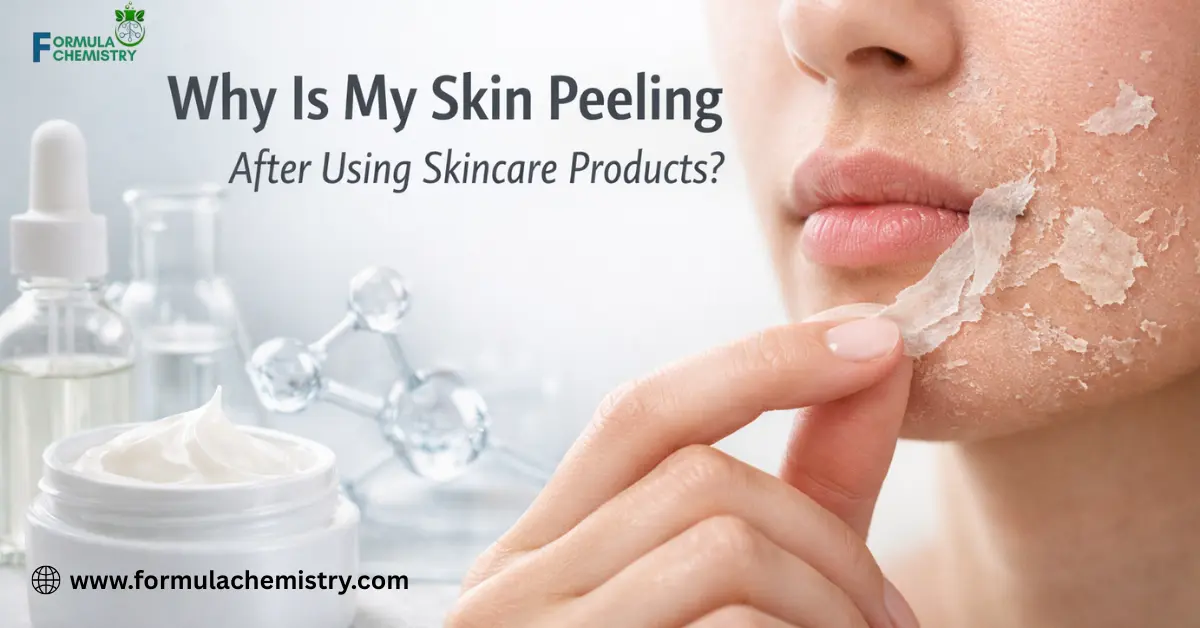
This is typically a result of silicones or carbomers in the formulation reacting with oil-based products. However, true biological peeling is a bodily reaction to cellular stress or dehydration.
Introduction
Skin peeling, medically known as desquamation, occurs when the outermost layer of the epidermis (the stratum corneum) sheds at an accelerated or irregular rate.
While some exfoliation is a natural part of cellular turnover, visible flaking after applying skincare frequently indicates an impaired moisture barrier or a reaction to potent bioactive ingredients.
At Formula Chemistry, we provide practical formulation education and safety-forward guidance to help you understand the science behind topical reactions.
Understanding why your skin is peeling demands an in-depth exploration of the chemical interactions between active components such as Retinoids, Alpha Hydroxy Acids (AHAs), and your skin’s lipid bilayer.
Peeling is not always a sign of “purging”; frequently, it is a warning of transepidermal water loss (TEWL) or chemical irritation.
Identifying the specific trigger, whether it is a formulation incompatibility or an incorrect application method, is essential for restoring skin health and guaranteeing your routine remains effective without being destructive.
Quick Answer
- What it is: Skin peeling is the premature shedding of the stratum corneum caused by irritation, over-exfoliation, or barrier disruption.
- Who it’s for: Mainly affects users with dry, sensitive skin or those using high-strength actives.
- Common Causes: Overuse of Retinol, high concentrations of Salicylic Acid, or mixing incompatible pH-dependent actives.
- Typical Usage Range: Retinoids should begin at 0.01%–0.03%; AHAs like Glycolic Acid are best at 5%–8% for beginners.
- pH & Compatibility: Most chemical exfoliants function at a pH of 3.0–4.0; using them alongside low-pH Vitamin C can increase irritation.
- Common Mistake: Applying potent actives to damp skin, which increases penetration depth and irritation potential.
- Safety Note: Always perform a 24-hour patch test on the inner forearm before applying new formulations to the face.
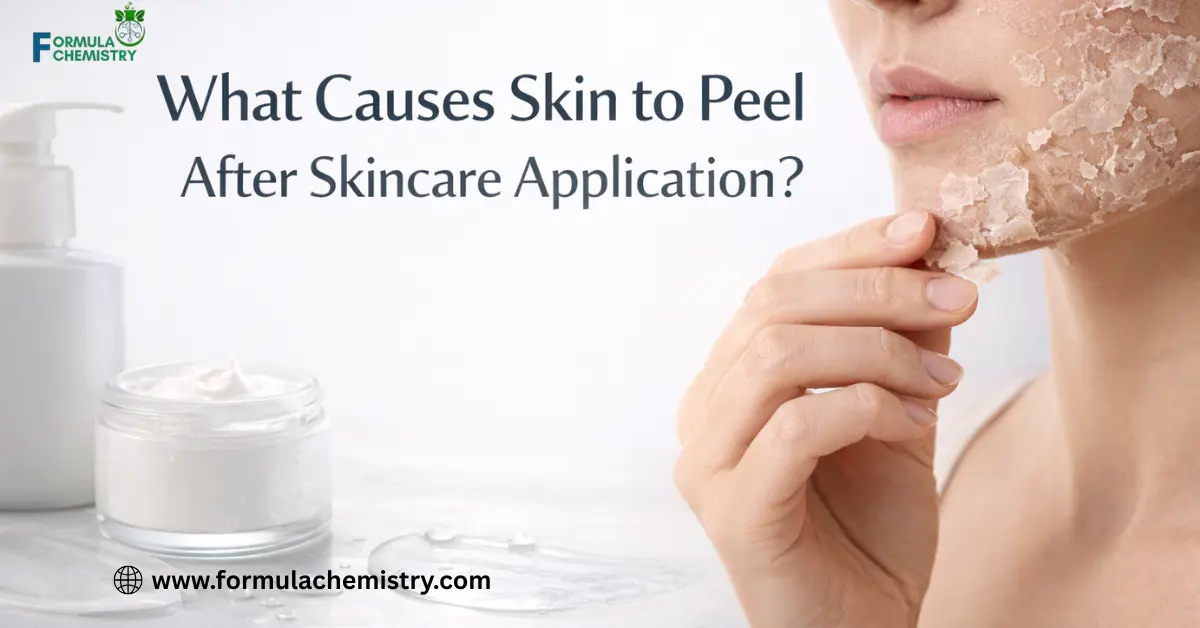
What Causes Skin to Peel After Skincare Application?
The most common culprit for peeling is a compromised acid mantle. When you apply high-strength acids or retinoids, they accelerate the rate at which skin cells are produced and shed.
If this process happens too quickly, the cells do not detach individually as intended; instead, they slough off in visible patches. This is often seen with Tretinoin or high-percentage Glycolic Acid treatments.
Another chemical factor is “pilling,” which is often mistaken for skin peeling. Pilling occurs when products do not absorb and instead rub off in small flakes.
Active Ingredient Overload
Using multiple high-potency actives in a single routine is the fastest way to induce peeling. For example, using a Benzoyl Peroxide wash followed by a Salicylic Acid toner and a Retinol cream creates a “stacking effect.”
This overwhelms the skin’s ability to retain moisture, leading to stratum corneum inflammation and subsequent flaking.
Environmental and Formulation Factors
Low-humidity environments pull moisture out of the skin, causing it to be more vulnerable to peeling when actives are applied. Furthermore, formulations containing high concentrations of denatured alcohol can dissolve the natural oils that hold skin cells together.
If a product has a pH below 3.5, it may act too aggressively on the skin barrier, causing immediate stinging and delayed peeling.
Tackling Common Problems and Fixes
If you experience peeling, the first step is a “product fast.” Remove all exfoliants and retinoids for 72 hours to allow the barrier to reset. During this time, focus on humectants like Glycerin and Hyaluronic Acid, followed by occlusives like Petrolatum or Squalane to seal in moisture.
| Problem | Common Trigger | Practical Fix |
| Localized Flaking | Spot treating with Salicylic Acid | Use Hydrocolloid patches instead of liquid acids. |
| “Retinol Burn” | Daily use of 0.5%+ Retinol | Switch to the “Sandwich Method” (Moisturizer-Retinol-Moisturizer). |
| Product Pilling | High Dimethicone content | Apply water-based serums first; wait 2 mins before creams. |
| Dry Patching | L-Ascorbic Acid (Vitamin C) | Switch to Sodium Ascorbyl Phosphate at 5%–10%. |
Adjusting Your Application Technique
Application on damp skin can increase the absorption of irritants by up to 3x. For sensitive users, ensure the skin is completely dry before applying any acid or retinoid.
If peeling persists, reduce the frequency of use to “short contact therapy,” where the active is washed off after 10–30 minutes to minimize deep tissue irritation.
Formula Compatibility and pH Balance
Mixing a low-pH Vitamin C (pH 2.5–3.0) with a Niacinamide serum (pH 6.0) can sometimes cause a flushing reaction or irritation that leads to peeling. Always check the pH notes on your products. For stable results, keep your barrier-repair creams within a pH range of 5.0–6.0 to match the skin’s natural state.
Identifying Ingredients That Trigger Desquamation
Certain ingredients are designed to cause peeling, such as Trichloroacetic Acid (TCA) or high-strength Lactic Acid.
However, in daily skincare, peeling is often an unintended side effect. Surfactants like Sodium Lauryl Sulfate (SLS) can strip the skin of essential ceramides, making it feel tight and eventually leading to fine, flour-like peeling.
It is important to distinguish between healthy exfoliation and chemical burns. If the peeling is accompanied by persistent redness, heat, or “weeping” skin, the concentration of the active ingredient is too high for your current skin tolerance.
Warning: Never pick or pull at peeling skin, as this can lead to post-inflammatory hyperpigmentation (PIH) or scarring.
The Role of Retinoids and Exfoliants
Retinoids increase cell turnover, but they do not technically “exfoliate” in the way acids do.
They signal the deeper layers to produce new cells. If the top layer isn’t hydrated, these new cells push up against a dry “lid,” causing the skin to crack and peel. Combining Retinol with a Ceramide-rich moisturizer is mandatory for preventing this effect.
Solvent and Preservative Sensitivities
In some cases, it isn’t the “active” causing the peel, but the solvent system. High levels of Propanediol or Propylene Glycol can cause contact dermatitis in sensitive individuals.
Additionally, any water-based product must have a broad-spectrum preservative system (e.g., Phenoxyethanol and Ethylhexylglycerin) to prevent microbial growth, which can irritate the skin and cause inflammatory peeling.
FAQs about Why is My Skin Peeling After Using Skincare Products
How long does skincare-induced peeling usually last?
If caused by a new product, peeling typically lasts 3 to 7 days. If you stop the offending agent and focus on barrier repair, the skin should return to a smooth state once the current cellular cycle completes.
Is it okay to exfoliate peeling skin?
No. Adding a physical or chemical exfoliant to skin that is already peeling will cause further micro-tears and inflammation. Instead, use a soft, damp cloth to very gently move away loose flakes without scrubbing.
Can Vitamin C cause skin peeling?
Yes, specifically L-Ascorbic Acid. Because it requires a very low pH (below 3.5) to penetrate the skin, it can be highly irritating to sensitive or dry skin types, producing localized flaking around the nose and mouth.
What is the “Sandwich Method” for preventing peeling?
The Sandwich Method entails applying a layer of moisturizer, followed by your active (like Retinol), and then another layer of moisturizer. This buffers the active, slowing its penetration and greatly decreasing the risk of peeling.
Should I stop using a product if my skin starts peeling?
If the peeling is mild (fine flakes), reduce the frequency to twice a week. If the peeling is heavy, painful, or red, stop use immediately. Your skin may not be able to tolerate that specific concentration or pH level.
Can dehydration cause peeling even without actives?
Absolutely. A lack of water in the stratum corneum leads to “dehydration lines” and fine peeling. This is common in cold climates or when using harsh, high-pH cleansers that strip the skin’s natural oils.
Who should avoid high-strength chemical exfoliants?
Individuals with Rosacea, Eczema, or an already compromised skin barrier should avoid high-strength AHAs and BHAs. They should opt for gentler options such as Polyhydroxy Acids (PHAs), which have bigger molecular sizes.
Does peeling mean the product is working?
Not necessarily. While some “peeling masks” are designed for this, daily serums should generally not cause visible peeling. Effective skincare should result in a “glow” or smoother texture, not a damaged, flaking surface.