
Introduction
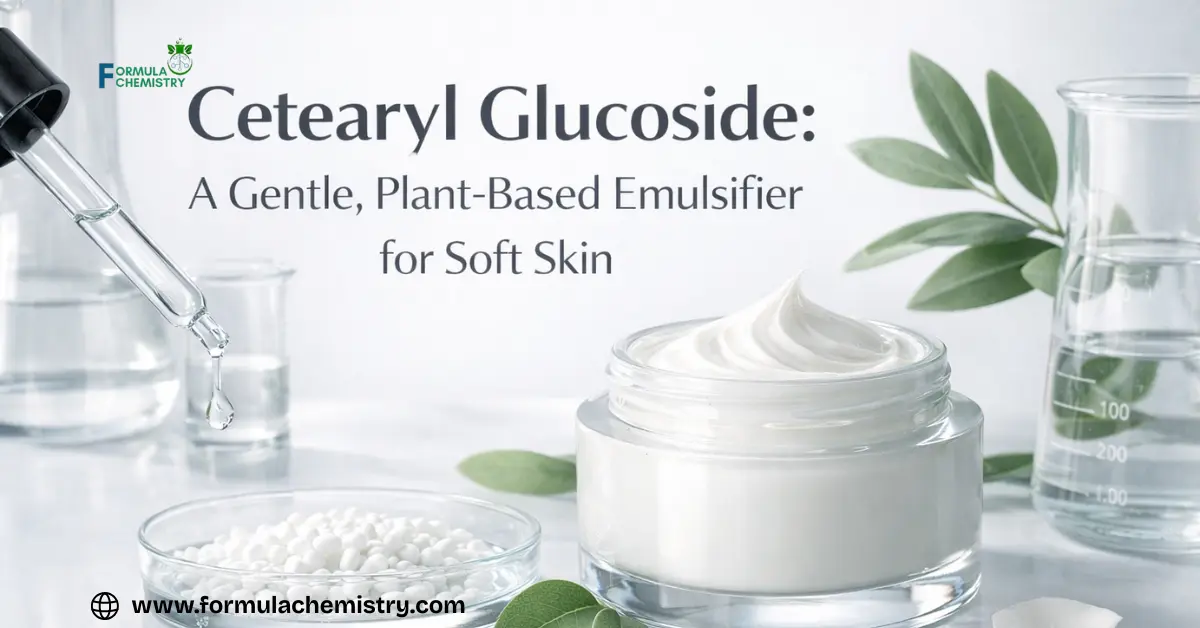
Cetearyl glucoside represents a key element in modern green chemistry, offering formulators a powerful yet non-irritating solution for binding oil and water.
As a non-ionic surfactant derived from vegetable sources typically coconut or corn it is widely noted for its ability to create stable, elegant emulsions without the harshness associated with traditional ethoxylated emulsifiers.
At FormulaChemistry, we focus on the use of such biomimetic ingredients because they respect the skin’s natural lipid barrier while providing a luxurious sensory sensation.
Quick Facts
- What it is: A plant-derived, non-ionic “oil-in-water” (O/W) emulsifier.
- Who it’s for: Suitable for all skin types, especially sensitive, dry, or eczematous skin.
- How to use: Heat the oil phase to approximately 75°C–80°C before combining with the water phase.
- Typical usage range: Usually 1% to 5%, depending on the desired viscosity.
- Solubility: Oil-soluble; requires heat to melt and incorporate.
- pH Stability: Most effective in a pH range of 3.5 to 11.0, making it highly versatile.
- Common Mistakes: Failing to provide sufficient high-shear agitation (homogenization) during the cooling phase, which can cause instability.
- Safety Note: Always perform a patch test on finished formulations to ensure individual compatibility.
The Chemistry of Liquid Crystals
One of the defining features of cetearyl glucoside is its ability to form lamellar liquid crystal structures. These structures mimic the organized layers of the skin’s own intercellular lipids.
When a lotion containing this emulsifier is applied, these liquid crystals act as a reservoir for moisture, providing a continuous release of hydration.
By choosing cetearyl glucoside, formulators at FormulaChemistry can achieve a “second skin” effect. This not only improves the delivery of active ingredients but also reduces transepidermal water loss (TEWL) significantly more effectively than standard waxes.

Keep your skin soft and moisturized with Cetearyl Alcohol: A Skin-Friendly Emulsifier for Smooth Hydration.
What Are the Benefits of Using Cetearyl Glucoside?
Enhanced Skin Hydration and Barrier Support
Unlike many surfactants that can strip the skin of its natural oils, cetearyl glucoside is remarkably mild. Because it is a sugar-based emulsifier, it possesses an inherent affinity for water molecules, helping to lock moisture into the stratum corneum.
This makes it a perfect option for facial moisturizers and “clean beauty” products targeting dehydration.
The ingredient is biodegradable and often ECOCERT or COSMOS approved, in line with the growing requirement for sustainable personal care. It provides a distinctively matte, non-greasy finish, which is often difficult to achieve with traditional plant-based waxes.
This allows for the creation of lightweight creams that still feel substantial and nourishing.
Versatility in Formulation and Stability
Cetearyl glucoside is prized for its broad pH tolerance and affinity with various emollients. Whether you are working with high-polarity vegetable oils or low-polarity esters, this emulsifier maintains a solid structure. It is also electrolyte-tolerant, meaning it won’t easily “break” if you add botanical extracts or minerals to your formula.
| Property | Specification |
| Appearance | White waxy pellets or flakes |
| Charge | Non-ionic |
| HLB Value | Approximately 11 |
| Usage Rate | 1–5% |
| Melting Point | ~75°C |
| Compatibility | High tolerance for electrolytes and alcohols |
Discover how Lecithin: The Versatile Emulsifier for Skincare supports smooth, well-balanced products.
How Do You Formulate with Cetearyl Glucoside?
Processing Requirements plus Best Practices
To achieve a stable emulsion, cetearyl glucoside must be heated in the oil phase to roughly 75°C to 80°C. It is often combined with fatty alcohols like cetyl alcohol or stearyl alcohol to increase the viscosity and enhance the lamellar network. FormulaChemistry provides practical formulation education to help amateurs and experts deal with these technical requirements safely.
Once both the water and oil phases reach the target temperature, they should be combined under high-shear mixing. It is critical to maintain agitation until the emulsion has cooled to at least 40°C. Rapid cooling without stirring can result in a grainy texture or phase separation over time.
Overcoming Common Formulation Hurdles
While cetearyl glucoside is robust, it is not immune to failure if the oil-to-water ratio is imbalanced. It typically performs best in formulations where the oil phase constitutes 10% to 25% of the total weight. If the oil phase is too high, the emulsion may feel heavy or become unstable.
- Common problems and fixes:
- Grainy Texture: Usually caused by inconsistent heating or insufficient stirring during cooling. Fix: Make sure both phases are at 80°C and use a stick blender or homogenizer until the mixture thickens.
- Thin Viscosity: Cetearyl glucoside alone can produce thin lotions. Fix: Add 0.2% Xanthan Gum to the water phase or increase fatty alcohols to build body.
- Soap Effect (Whiteness on application): This occurs when the emulsifier is used at the higher end of the range. Fix: Incorporate a small amount of dimethicone or a natural ester like Caprylic/Capric Triglyceride to reduce the “soaping” effect.
Is Cetearyl Glucoside Safe for All Skin Types?
Dermatological Profile and Sensitivity
Cetearyl glucoside is widely regarded as one of the safest emulsifiers available today. Because it is non-ionic, it does not interact with the skin’s proteins as aggressively as anionic or cationic surfactants might.
This lack of charge makes it “invisible” to the immune system in many ways, lessening the likelihood of contact dermatitis or redness.
However, safety-forward guidance suggests that even the gentlest ingredients can cause reactions in specific individuals. Formula Chemistry recommends that any new formulation undergo a stability test and a microbial challenge test, especially when working with water-based systems.
- Key Warnings: Always use a broad-spectrum preservative, as sugar-based emulsifiers can provide a food source for microbes if the system is under-preserved.
- Who should avoid: Those with a known rare allergy to corn or coconut derivatives should proceed with care and consult a specialist.
Environmental Impact and Sustainability
From a manufacturing perspective, cetearyl glucoside is a “green” ingredient. It is produced via a condensation reaction between cetearyl alcohol and glucose, avoiding the use of ethylene oxide.
This means there is no risk of 1,4-dioxane contamination, a common concern with older emulsifying waxes like Polawax or Emulsifying Wax NF.
The editorial responsibility at FormulaChemistry makes sure that we highlight ingredients that are not merely effective for the user but are equally responsible toward the environment. Its high biodegradability ensures that it does not persist in water systems after being washed off.
FAQs about Cetearyl Glucoside: A Gentle, Plant-Based Emulsifier for Soft Skin
Is cetearyl glucoside a natural ingredient?
Yes, it is considered naturally derived. It is synthesized from vegetable-sourced fatty alcohols and glucose, and it is frequently used in ECOCERT and COSMOS certified organic products.
Does cetearyl glucoside cause acne?
It is generally considered non-comedogenic. Because it creates a breathable lamellar structure rather than an occlusive film, it is unlikely to clog pores when used at standard usage ranges.
Can I use it in a cold-process formulation?
No, cetearyl glucoside is a high-melting-point wax. It requires heat (minimum 75°C) to properly incorporate into the oil phase and create a stable emulsion.
Is it vegan and cruelty-free?
Standard cetearyl glucoside is 100% plant-derived and vegan. However, always check with your specific supplier to ensure their manufacturing practices comply with cruelty-free standards.
What is the difference between cetearyl glucoside and cetearyl alcohol?
Cetearyl alcohol is a fatty alcohol used as a thickener and emollient. Cetearyl glucoside is a surfactant/emulsifier that actually binds oil and water together. They are often sold as a blend.
Can I use this in hair care?
Yes, it is excellent for leave-in conditioners and hair masks. Its capacity to mimic skin lipids helps smooth the hair cuticle and improve moisture retention, without leaving a heavy buildup.
What is the recommended pH for products containing this?
While it is stable across a wide range, the optimal pH note for skin health and emulsifier longevity is between 4.5 and 5.5.
Does it require a co-emulsifier?
It can be used as a primary emulsifier, but for long-term shelf stability, it is often paired with glyceryl stearate or viscous gums to prevent creaming.
By careful application and observance of temperature protocols, cetearyl glucoside allows for the creation of sophisticated, dermatologically sound products. Whether you are a professional chemist or an amateur DIYer, comprehending the nuances of this plant-based powerhouse is crucial to mastering modern emulsion science.