
Introduction
Jojoba Oil is one of the most chemically distinct and valuable ingredients in the cosmetic industry. Derived from the seeds of the Simmondsia chinensis shrub, native to the arid regions of North America, it is technically not an oil but a liquid wax ester.
This structural distinction sets it apart from typical vegetable oils, which are triglycerides. For formulators, this unique chemistry translates to exceptional stability, a non-greasy finish, and a remarkable affinity for human skin.
Formula Chemistry provides practical formulation education and safety-forward direction to ensure you utilize this robust ingredient effectively in your custom formulations.
Quick Facts
- INCI Name: Simmondsia Chinensis (Jojoba) Seed Oil
- Chemical Family: Liquid Wax Ester (Long-chain mono-esters)
- Function: Emollient, Skin Conditioning Agent, Occlusive, Carrier Oil
- Typical Usage Rate: 1% – 10% in emulsions; up to 100% in anhydrous serums.
- Comedogenic Rating: 2 (Low likelihood of blocking pores)
- Solubility: Oil-soluble; insoluble in water.
- Heat Stability: High; stable up to 100°C for short periods.
- Shelf Life: Excellent oxidative stability (often 2–3+ years).
- Safety Note: Generally non-irritating, but a patch test is always recommended prior to full application.
What Makes Jojoba Oil Unique in Formulation?
To understand Jojoba Oil’s superiority, one must look at its molecular framework. Unlike olive or coconut oil, which are triglycerides composed of glycerol and fatty acids, Jojoba is composed of long-chain fatty alcohols and fatty acids joined by an ester bond.
This structure mimics the natural wax esters found in human sebum (skin oil). Because the skin recognizes Jojoba as “compatible,” it penetrates the stratum corneum effortlessly without leaving a heavy, occlusive film.
This biomimicry allows Jojoba to regulate sebum production. If the skin is overproducing oil, Jojoba can signal it to slow down; conversely, it provides deep nourishment to lipid-depleted skin.
Chemical Structure: Wax Ester vs. Triglyceride
The absence of a glycerin backbone makes Jojoba Oil significantly more resistant to oxidation (rancidity) than triglyceride-based oils. Triglycerides often break down under heat or light, releasing free fatty acids that smell bad and irritate the skin.
Jojoba’s wax ester structure is highly stable against high temperatures and free radical degradation. This makes it a great option for products requiring heating during manufacturing, such as hot-pour balms or emulsified creams.
Its high content of Eicosenoic Acid (Omega-9) contributes to its silky, dry-oil feel. It does not sit on the surface like mineral oil but integrates into the lipid matrix of the skin barrier.
Biocompatibility with Human Sebum
Human sebum is approximately 25% wax esters. Because Jojoba Oil shares this chemical profile, it acts as a restorative agent for the acid mantle.
When applied, it mixes with sebum to form a thin, non-greasy layer that prevents transepidermal water loss (TEWL) while allowing the skin to breathe. This is important for maintaining hydration in eczema-prone or sensitive skin.
Furthermore, its high biocompatibility allows it to act as a penetration enhancer for other active ingredients. Dissolving oil-soluble actives like Salicylic Acid or Vitamin E in Jojoba can improve their delivery into the pores.

Incorporating Jojoba Oil into Skincare and Haircare
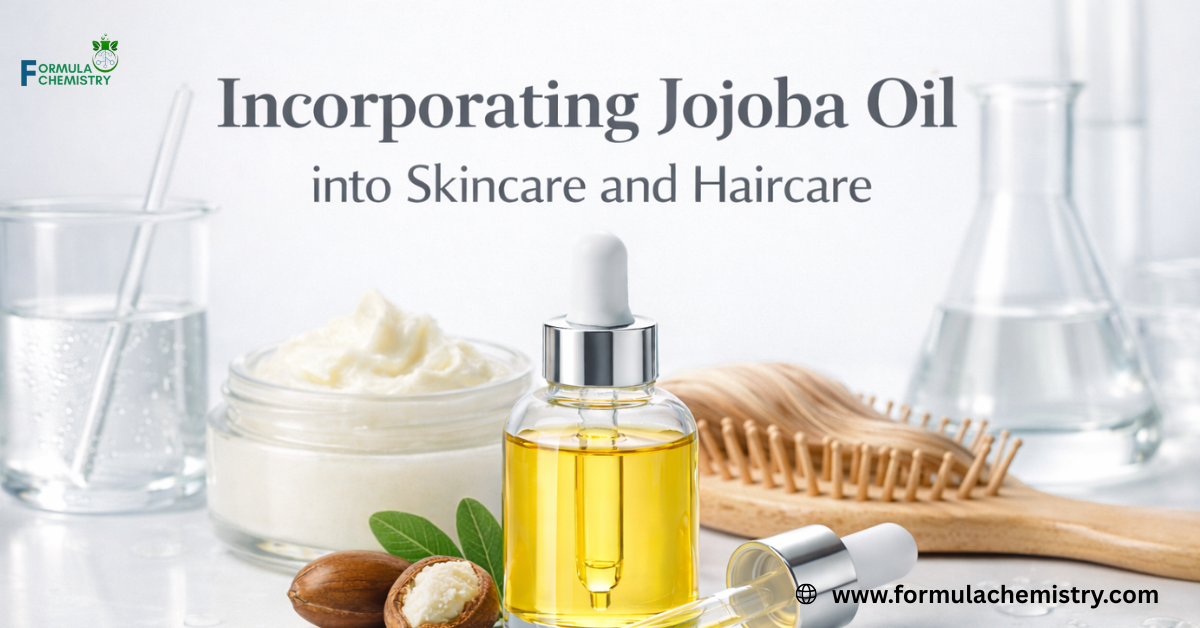
Jojoba Oil is a formulation workhorse, compatible with almost all oil-soluble ingredients. It is frequently used as the primary carrier oil in facial oils due to its lightweight texture and low odor profile.
In emulsions, it adds body and richness without the “drag” associated with heavier butters like Shea or Cocoa. It blends perfectly with esters to create modern, fast-absorbing lotions.
For haircare, Jojoba coats the hair shaft, smoothing the cuticle and sealing in moisture. It is especially effective in conditioners and scalp treatments where oil balance is desired without weighing down the hair.
Optimizing the Oil Phase for Stability
When formulating emulsions, replacing unstable oils (like Rosehip or Evening Primrose) with Jojoba can extend the shelf life of your product. A common strategy is to use Jojoba as the “base” oil, comprising 50-70% of the oil phase.
Because it is a wax, Jojoba can contribute as well slightly to the viscosity of an emulsion. However, it is not a thickener; you will still need cetyl alcohol or stearic acid to build structure.
It is compatible with all standard emulsifiers, from Polawax to Olivem 1000. Its polarity is low, meaning it requires less emulsifier energy to stabilize compared to highly polar vegetable oils.
Benefits for Barrier Repair and Acne-Prone Skin
Acne patients often fear oil, but Jojoba is the exception. Its ability to dissolve hardened sebum plugs (comedones) makes it a functional ingredient for cleansing oils and blemish treatments.
By keeping the sebum liquid and flowing, it prevents the blockages that lead to breakouts. Additionally, Jojoba has mild anti-inflammatory properties that can soothe the redness associated with acne.
For barrier repair, it provides the necessary lipids to seal cracks in the stratum corneum. It works synergistically with ceramides and cholesterol to rebuild a compromised skin barrier.
Troubleshooting and Technical Specifications
Despite its ease of use, formulators can still meet issues when scaling up with Jojoba Oil. Knowing its physical properties is key to avoiding production errors.
It has a freezing point of approximately 7°C to 10°C. If stored in a cold warehouse, it will solidify. This is reversible and does not damage the oil, but it must be fully liquefied before measuring.
Jojoba is also relatively expensive compared to commodity oils like Sunflower. Formulators often blend it with fractionated coconut oil (MCT) to control costs while retaining a dry-oil feel.
Common Problems and Fixes
Even with a stable ingredient, issues can occur concerning texture and absorption.
- Problem: The facial oil feels too “dry” or lacks cushion.
- Fix: Jojoba is a dry oil. Blend it with a richer oil like Avocado or Macadamia Nut Oil (10–20%) to add substantivity and cushion.
- Problem: The emulsion is thinner than expected.
- Fix: Liquid waxes have low viscosity. Increase your solid fatty alcohols (Cetyl/Cetearyl) by 1–2% to compensate for that fluidity of Jojoba.
- Problem: The product is cloudy in cold temperatures.
- Fix: Jojoba solidifies when cold. Ensure the formula includes “antifreeze” agents like Propanediol or Glycerin, or warn consumers that cloudiness is natural.
- Problem: Ingredient precipitation in serums.
- Fix: While Jojoba is a good solvent, some actives require specific polarity. Check the solubility of your active; you may need an ester like C12-15 Alkyl Benzoate as a co-solvent.
Shelf Life and Storage Best Practices
Jojoba Oil is legendary for its shelf life, often lasting 3 to 5 years without added antioxidants. Its lack of double bonds makes it nearly impervious to rancidity.
However, it should still be stored in a cool, dark place away from direct sunlight. In finished products, adding 0.1% Tocopherol (Vitamin E) is standard practice to protect other, less stable oils in the blend.
If you are selling a 100% pure Jojoba product, ensure the bottle is UV-protective (amber or cobalt glass) to protect the integrity of the liquid wax over time.
Table: Jojoba Oil vs. Common Carrier Oils
| Feature | Jojoba Oil | Argan Oil | Coconut Oil (Virgin) | Rosehip Oil |
| Chemistry | Liquid Wax Ester | Triglyceride | Triglyceride | Triglyceride |
| Comedogenic Rating | 2 (Low) | 0 (Very Low) | 4 (High) | 1 (Low) |
| Heat Stability | High | Moderate | Moderate | Low (Do not heat) |
| Skin Feel | Satin, Dry | Silky, Rich | Greasy, Heavy | Dry, Fast absorbing |
| Best For | Sebum control, all types | Anti-aging, hair | Body, dry skin | Scars, night treatments |
If you’ve been thinking about switching to a more natural routine, take a moment to read Organic Skincare.
FAQ’s about Jojoba Oil: A Natural Elixir for Deep Hydration
Is Jojoba Oil actually an oil?
No, scientifically it is a liquid wax ester. It is composed of long-chain fatty acids and fatty alcohols, lacking the glycerin backbone found in true vegetable oils (triglycerides). This gives it unique stability and non-greasy properties.
Can Jojoba Oil clog pores?
It is considered non-comedogenic for most people, with a rating of 2 on the 0-5 scale. Because it mimics human sebum, it typically balances oil production rather than blocking pores, making it safe for acne-prone skin.
Does Jojoba Oil expire?
Jojoba has an exceptional shelf life compared to other plant oils. It can remain stable for 3 to 5 years if stored correctly. Its waxy ester structure makes it highly resistant to oxidation and rancidity.
Can I use Jojoba Oil on my face every day?
Yes, it is safe for daily use. It works well as a morning moisturizer because it absorbs quickly and does not leave a greasy shine, or as a night treatment to lock in hydration.
Is Jojoba Oil safe for sensitive skin?
Yes, it is known for being hypoallergenic and non-irritating. It is often recommended for people with rosacea, eczema, or psoriasis because it helps repair the skin barrier without causing inflammation.
Can Jojoba Oil be used in heat processing?
Yes. Unlike delicate oils such as Rosehip or Flaxseed, Jojoba Oil is heat stable. It can be added to the heated oil phase of creams and lotions (up to 75°C) without losing its beneficial properties.
Does Jojoba Oil help with hair growth?
While it does not directly stimulate hair growth like Minoxidil, it creates a healthy scalp environment. It dissolves sebum buildup which can block follicles and moisturizes the hair shaft to prevent breakage, supporting length retention.
Is Jojoba Oil safe for children?
Yes, pure Jojoba Oil is widely regarded as safe for babies and children. It is often used to treat cradle caps or dry patches. Always perform a patch test on the inner arm before general application.