
Introduction
Jasmine Essential Oil is commonly known as the “King of Oils” in the perfumery and aromatherapy world. Known for its intensely rich, floral, and slightly musky aroma, it commands a high price due to the labor-intensive extraction process required.
Formulators prize this ingredient not just for its scent, but for its complex chemical profile that impacts mood and skin health. Formula Chemistry provides practical formulation education and safety-forward guidance to help you master potent botanical ingredients like Jasmine.
Comprehending the distinction between varieties like Grandiflorum and Sambac is important for achieving the desired sensory effect in your products.
Quick Facts
- INCI Name: Jasminum Officinale (Jasmine) Flower Extract or Jasminum Sambac (Jasmine) Flower Extract.
- Extraction Method: Solvent extraction (Concrete to Absolute).
- Key Components: Benzyl Acetate, Linalool, Benzyl Alcohol, Indole, Farnesene.
- Typical Usage Rate: 0.1% – 0.5% for facial care; up to 2.0% for perfumery.
- Solubility: Soluble in alcohol and fixed oils; insoluble in water.
- Appearance: Dark orange to reddish-brown viscous liquid.
- Odor Profile: Rich, warm, floral, narcotic, with sweet or green undertones depending on variety.
- Safety Note: Highly potent; always dilute before application. Patch testing is essential because of possible sensitization from components like benzyl alcohol.
- Compatibility: Blends well with Rose, Sandalwood, Citrus oils, and Vanilla.
What Defines the Chemistry and Extraction of Jasmine?
The unique aroma of Jasmine cannot be replicated by synthetic fragrance oils without losing the “soul” of the flower. This complexity comes from its specific chemical constituents, primarily esters, alcohols, and terpenes. The relationship between these molecules creates a fragrance that is simultaneously floral, fruity, and animalic.
One of the most debated yet essential components of Jasmine is Indole. In high concentrations, Indole smells fecal or decaying, but in the trace amounts found in Jasmine, it provides a deep, erotic, and “narcotic”. Without Indole, Jasmine would smell thin and overly synthetic, lacking the richness that defines the natural extract.
The Science of Solvent Extraction
Jasmine flowers are too fragile for steam distillation, which uses high heat and force that would turn the petals into a mush without extracting the oil. Instead, the flowers are submerged in a solvent (usually hexane) to extract the lipophilic compounds. This produces a waxy substance called a concrete.
To create the liquid absolute used in cosmetics, the concrete is washed with ethanol. The ethanol dissolves the aromatic compounds but leaves behind the heavier waxes and pigments. The alcohol is then evaporated, leaving behind the concentrated Jasmine Absolute. This process explains why Jasmine oil is thicker and more colored than steam-distilled oils.
Grandiflorum vs. Sambac: Choosing Your Variety
Formulators generally choose between two main species of Jasmine. Jasminum Grandiflorum, often called “Poet’s Jasmine” or “Royal Jasmine,” is the classic scent found in French perfumery. It is sweet, rich, and intensely floral, often described as the “daytime” jasmine.
Jasminum Sambac, or “Arabian Jasmine,” offers a different profile. It is greener, muskier, and has a more pronounced Indolic note. It is often described as heavier or more “sultry.” Choosing between them depends on whether you want a bright, sweet floral (Grandiflorum) or a deep, exotic musk (Sambac).
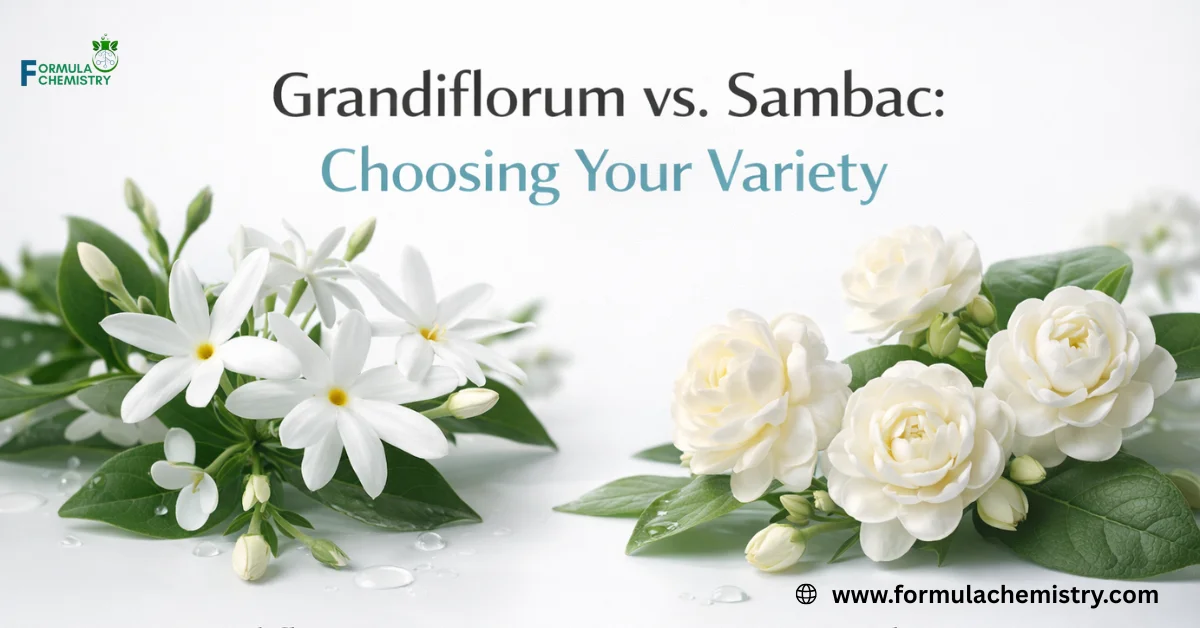
Table: Comparison of Jasmine Varieties
| Feature | Jasminum Grandiflorum | Jasminum Sambac |
| Scent Profile | Sweet, floral, rich, fruity | Green, musky, earthy, spicy |
| Primary Origin | India, Egypt, France | India, China, Philippines |
| Best Application | Classic floral perfumes, lotions | Exotic blends, masculine scents |
| Indole Content | Moderate | Higher (More animalic) |
| Color | Deep orange/brown | Dark reddish-brown |
If you’re exploring cleaner beauty options, don’t miss our complete guide on Organic Skincare: Your Natural Glow Guide.
Formulation Advantages for Skin and Well-Being
Beyond its legendary scent, Jasmine Absolute offers concrete benefits for the skin. It is traditionally used to improve skin elasticity and hydration. Its emollient properties make it a great option for dry, dehydrated, or mature skin types that need barrier support.
While it is not typically used for acne due to its richness, it has mild antiseptic properties thanks to constituents like Benzyl Benzoate. However, its primary role in skincare is conditioning and toning. It helps to smooth the skin’s texture and can reduce the appearance of scarring or stretch marks when used in a carrier oil blend over time.
Aromatherapy and Psychological Effects
In aromatherapy, Jasmine is renowned for its impact on the nervous system. Research suggests that inhaling Jasmine oil can influence GABA receptors, acting as a mild sedative and anxiolytic. It is often used to ease symptoms of depression, anxiety, and nervous exhaustion.
Unlike lavender, which is a pure sedative, Jasmine is uniquely balancing. It calms the nerves while simultaneously uplifting the spirit, producing a sense of euphoria. This makes it a poit a favored pick for relaxation,” helping users feel calm yet calm andized rather than sleepy.
Formulation Challenges and Solutions
Working with absolutes creates unique challenges compared to standard essential oils. The viscosity can make it difficult to measure accurately, especially in small batches. It can also leave stains on clothing or change the color of a white lotion to a beige or ivory hue.
Another issue is solubility in certain bases. While soluble in alcohol and oil, traces of waxes remaining from the concrete stage can sometimes cause cloudiness in clear perfume formulations. This often requires a “chilling and filtering” step to remove the precipitated waxes for a crystal-clear finish.
Common Problems and Fixes:
- Problem: TheThis scent is overpowering and sickly in the final product.
- Fix: Jasmine is incredibly potent. Reduce usage to 0.1%. Dilute it in a carrier oil before adding it to your main batch to ensure even dispersion.
- Problem: The oil is too thick to pour from the bottle.
- Fix: Gently warm the bottle in a warm water bath (40°C) for 5-10 minutes. This lowers the viscosity without damaging the heat-sensitive compounds.
- Problem: The lotion turned a brownish color after adding Jasmine.
- Fix: This is natural due to the pigments in the absolute. Use an opaque packaging or accept the natural color. Do not try to bleach it.
Give your skin a gentle floral boost with Rose Hydrosol: Refreshing Floral Elixir for Hydrated, Glowing Skin.
Practical Usage and Blending Guide
When formulating with Jasmine, “less is more” is the golden rule. A single drop of high-quality Jasmine Absolute can scent an ounce of carrier oil. It functions as a Middle to Base note, meaning it emerges after the initial citrus or herbal top notes evaporate and lingers for hours on the skin.
FTo achieve a balanced perfume or body oil, pair Jasmine with oils that cut through its heaviness. Bergamot, Sweet Orange, or Grapefruit provide a sparkling top note that lifts the density of Jasmine. Sandalwood, Vetiver, or Vanilla and the fragrance, extending its longevity as well as enhancing its creamy, woody facets.
Safety and Dilution Guidelines
Jasmine Absolute is generally safe but must be treated with respect due to its concentration. The International Fragrance Association (IFRA) restricts the level of Jasmine Grandiflorum in leaf because of potential to potential sensitization. A safe general rule for facial leave-on products is 0.1% to 0.vital to verify the purity of your Jasmine oil. Because it is expensive, it is frequently adulterated with synthetic fillers or cut with cheaper oils like Ylang Ylang. Always request a GC/MS (Gas Chromatography/Mass Spectrometry) report from your supplier to verify authenticity.
Preservation in Water-Based Formulations
If you are adding Jasmine Absolute to a hydrous product like a toner, lotion, or cream, you must include a broad-spectrum preservative. Essential oils and absolutes are not preservatives. In fact, the organic compounds in Jasmine can serve as food for bacteria and mold if the water phase is unprotected.
Ensure your solubilizer is effective if using Jasmine in a water-based toner. A ratio of 1:4 (Oil to Solubilizer) is often necessary for absolutes because of their density. Products like Polysorbate 20 or natural solubilizers can help disperse the oil into clear water, though a slight haze is common.
FAQ’s about Jasmine Essential Oil: A Floral Elixir for Mind & Body
Is Jasmine oil safe for pregnancy?
Jasmine is an emmenagogue, meaning it can stimulate blood flow to the pelvic area. It is traditionally advised to avoid Jasmine oil during the first trimester of pregnancy. Always seek advice from a healthcare provider before using aromatherapy during pregnancy.
Can I apply Jasmine oil directly to my skin?
No, you should never apply an undiluted absolute to the skin. It is highly concentrated and can cause irritation or sensitization. Always dilute it in a carrier oil like Jojoba or Almond oil at a maximum of 2-4%.
Why is Jasmine oil so expensive?
Jasmine flowers must be hand-picked at night or early morning the fragrant scent is strongest. It takes approximately 8,000 hand-picked blossoms to yield just 1 gram (about 1 mL) of Jasmine Absolute, making the labor cost exceptionally high.
What is the difference between Jasmine Concrete and Absolute?
Concrete is the solid, waxy extract obtained from the initial solvent extraction. The Absolute is the liquid refined from the concrete by removing the waxes with alcohol. The Absolute is what is used in cosmetics and perfumery.
Does Jasmine oil contain synthetic chemicals?
A pure Jasmine Absolute is natural, but the extraction process uses chemical solvents (like hexane). These solvents are removed, but trace amounts (parts per million) may remain. It is not “organic” in the same way a cold-pressed oil is, but it is botanical.
Can Jasmine oil be used for hair?
Yes, it is excellent for hair oils and serums. It adds shine, smoothes frizz, and leaves a long-lasting fragrance. Add 0.5% to Argan or Coconut oil for a luxurious hair treatment that also soothes a dry scalp.
Is Jasmine oil phototoxic?
No, Jasmine Absolute is not considered phototoxic. Unlike citrus oils (like Bergamot or Lemon), it does not increase the skin’s sensitivity to UV light, making it safe for use in daytime lotions and sun care products.
Does Jasmine oil expire?
Yes, like all essential oils, it oxidizes over time. However, Absolutes are generally more stable than citrus oils. If stored in a cool, dark place, Jasmine Absolute can last 3–5 years. If it thickens or smells sour, discard it.