
Introduction
The global beauty landscape is largely defined by two dominant philosophies: Korean Skincare (K-Beauty) and American Skincare. While both markets offer high-quality products, they vary significantly in their design strategies, active ingredient concentrations, and intended results. At FormulaChemistry, we analyze these differences through a technical lens to help formulators and aficionados understand how regional standards impact skin health and product performance.
Quick Answer
- Primary Goal: K-Beauty focuses on hydration and barrier prevention; American skincare prioritizes correction and rapid results using high-potency actives.
- Who It Is For: K-Beauty is ideal for sensitive or dry skin; American products suit those with persistent acne, deep wrinkles, or sun damage.
- Key Ingredients: K-Beauty often uses Centella Asiatica, snail mucin, and propolis; American brands favor Retinol, Salicylic Acid, and Vitamin C.
- How to Use: K-Beauty follows a multi-step “layering” technique; American routines are typically streamlined (3-5 steps).
- Usage Range: Active ingredients in American formulations often sit at maximal allowable concentrations, whereas K-Beauty uses lower, synergistic ranges.
- pH & Compatibility: American actives like AHA/BHA require a low pH (3.0–4.0), while K-Beauty focuses on skin-neutral pH (5.5).
- Common Mistakes: Over-exfoliating with American acids or over-hydrating (slugging) on acne-prone skin with K-Beauty balms.
- Safety Note: Always perform a patch test when switching between systems to monitor for allergic reactions or botanical sensitivities.
The Evolution of Global Beauty Standards
The rise of K-Beauty introduced the concept of “glass skin,” defined by intense hydration and a translucent finish. This shift forced American manufacturers to reconsider the “harsh” approach common in the late 20th century. FormulaChemistry provides practical formulation education and safety-forward guidance, observing that the “better” choice depends entirely on an individual’s skin barrier soundness and aesthetic goals.
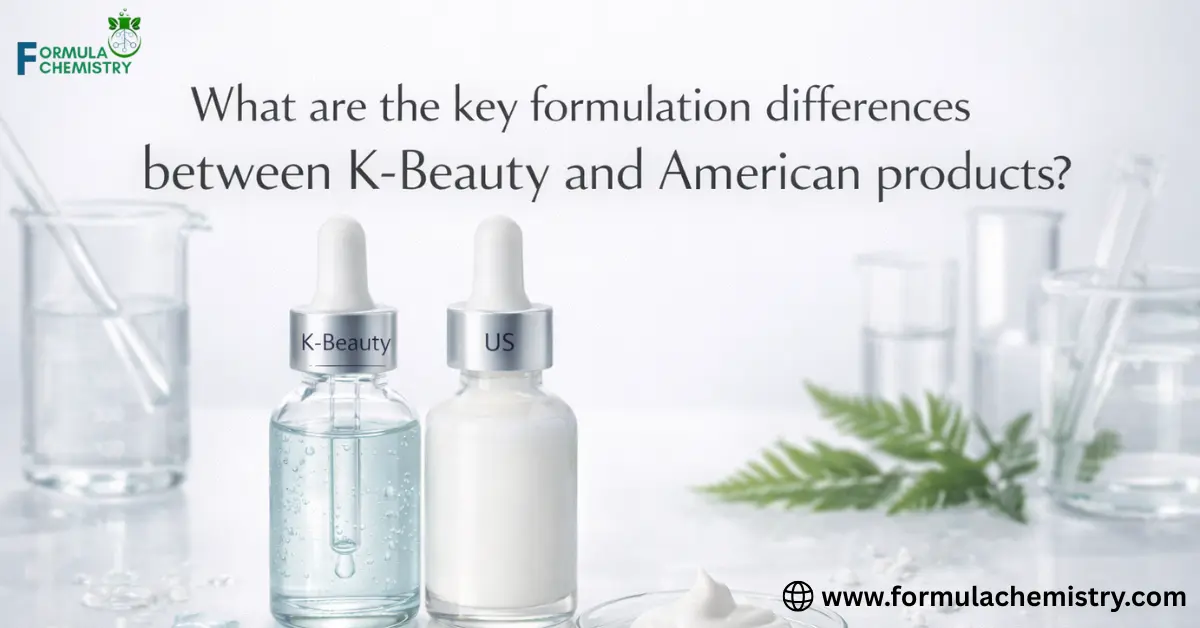
What are the key formulation differences between K-Beauty and American products?
Philosophy of Active Ingredients
American skincare formulations are often built around “hero” ingredients. These products typically feature high percentages of synthetic actives like L-Ascorbic Acid or Benzoyl Peroxide, designed to tackle specific issues quickly.
The focus is on effectiveness and clinical proof, often at the risk of temporary irritation.
In contrast, K-Beauty utilizes a “prevention-first” model. Formulations are generally more complex, blending multiple botanical extracts with lower concentrations of actives.
This approach aims to nourish the skin over time rather than forcing a rapid change. Because K-Beauty relies heavily on natural extracts, the usage ranges for these botanicals are often higher than in American counterparts, though the irritancy potential is lower.
Texture, Rheology, and Delivery Systems
The sensory feeling differs greatly between the two. American products frequently lean toward heavy creams or quick-dry gels.
K-Beauty has mastered the “essence” and “serum-skin” textures hybrid products that provide deep hydration without a greasy residue.
These formulations often apply advanced emulsion techniques to ensure that lightweight layers can be stacked without pilling.
- Common Problems and Fixes:
- Pilling: Often caused by layering silicone-based American primers over water-heavy K-Beauty essences. Fix: Match the base (water-with-water) or wait 5 minutes between layers.
- Irritation: Caused by using high-strength American Retinol alongside K-Beauty fermented ingredients. Fix: Use fermented products in the morning and actives at night.
- Breakouts: Heavy Korean sleeping masks may clog pores if used over oil-based American serums. Fix: Use non-comedogenic layers only.
| Feature | Korean Skincare (K-Beauty) | American Skincare |
| Primary Focus | Hydration & Barrier Health | Treatment & Correction |
| Key Actives | Snail Mucin, Mugwort, Rice | Retinoids, Acids, Peptides |
| Typical pH | 5.0 – 6.0 (Skin Neutral) | 3.0 – 5.5 (Varies by Active) |
| Ingredient Philosophy | Synergy of Botanicals | High-Potency Isolates |
| Routine Complexity | 7–12 Steps | 3–5 Steps |
| Preservation | Often uses “clean” alternatives | Traditional (Phenoxyethanol, etc.) |
Ingredient profiles and regulatory considerations
The Role of Botanical Extracts and Fermentation
A hallmark of Korean skincare is the use of fermented ingredients. Fermentation breaks down molecular structures, rendering nutrients more bioavailable to the skin.
Ingredients like fermented galactomyces or rice water are staple components.
These call for careful preservation; at FormulaChemistry, we emphasize a preservation reminder for any water-based or fermented product to prevent microbial growth.
American skincare is more likely to utilize bio-engineered peptides and stabilized vitamins. While K-Beauty looks to traditional herbal medicine (Hanbang), American labs prioritize standardized synthetic molecules that offer predictable, repeatable results.
Regulatory Criteria and Sunscreen Filters
One of the biggest divides lies in SPF. The South Korean FDA (KFDA) approves several advanced UV filters that the American FDA has not updated in decades.
This allows Korean sunscreens to be incredibly lightweight and cosmetically elegant. However, American sunscreens are often considered more robust for high-intensity outdoor activity due to strict water-resistance testing requirements.
Key warnings:
When using imported K-Beauty products, ensure they are obtained from reputable distributors to escape counterfeit formulations that may lack proper preservation.
Who should avoid:
Individuals with fungal acne should be cautious with fermented ingredients, as they may worsen the condition.
Choosing the right approach for your skin type
When to Focus on American Formulations
If your primary concerns are deep-set wrinkles, cystic acne, or significant hyperpigmentation, American skincare is often superior.
The higher usage ranges of Retinol (up to 1.0% in OTC) and Salicylic Acid (2.0%) provide the “heavy lifting” required to alter skin structure.
These products are formulated for those who want visible results and are willing to manage a period of “purging” or dryness.
Who should avoid:
Those with rosacea or compromised barriers should be wary of high-strength American chemical peels. pH notes: Always check that your American Vitamin C serum has a pH below 3.5 for maximum stability and penetration.
When to Choose the Korean Method
For individuals with dehydrated, sensitive, or reactive skin, the Korean approach is generally safer.
By focusing on humectants like Hyaluronic Acid and soothing agents like Panthenol, K-Beauty supports maintaining the acid mantle. It is a marathon, not a sprint. Formula Chemistry suggests this method for long-term maintenance and “glow” rather than immediate clinical intervention.
Who should avoid:
People who favor a minimalist, “one-and-done” routine may find the multi-step Korean process tedious.
Key warnings:
Always include a patch test when introducing bee venom or snail mucin, since these are common allergens.
The editorial team at FormulaChemistry maintains that neither system is objectively “better.” The most effective routine frequently involves a “hybrid” approach: using potent American actives for treatment and soothing Korean essences for barrier support.
FAQs about Is korean skincare better than american?
Is Korean skincare safer than American skincare?
Not necessarily. Both regions have strict safety regulations. K-Beauty focuses on soothing, but botanical extracts can still cause allergic reactions. American products are “harsher” only because they use higher concentrations of corrective actives.
Can I mix Korean and American products in one routine?
Yes, and it is often recommended. Use American products for “treatment” steps (like a Retinol serum) and Korean products for “nourishment” steps (like a hydrating essence).
Why is Korean sunscreen better?
Korean sunscreens use newer UV filters (like Tinosorb S or Uvinul A Plus) that are not yet FDA-approved in the US. These allow for a texture that feels like a moisturizer rather than a heavy sunblock.
Does Korean skincare work on dark skin tones?
Absolutely. K-Beauty is excellent for hyperpigmentation as it focuses on gentle brightening (Niacinamide, Licorice Root) rather than aggressive bleaching, which can be safer for melanin-rich skin.
Are American products too harsh for sensitive skin?
They can be if used incorrectly. However, many American brands now offer “barrier-repair” lines specifically designed for sensitive skin, mimicking the K-Beauty philosophy.
Why are K-Beauty products cheaper?
The South Korean government heavily supports the cosmetic industry, leading to high competition and decreased production costs. However, shipping and import taxes often even out the price for international buyers.
Should I patch test Korean products?
Yes. Despite their soft reputation, K-Beauty products often contain many plant extracts. A patch test on the inner arm for 24 hours is essential to rule out botanical allergies.
What is the most important step in a Korean routine?
Double cleansing. Using an oil-based cleanser followed by a water-based cleanser makes certain that all sebum, pollutants, and SPF are removed without stripping the skin barrier.