
Introduction
Azelaic acid is a naturally occurring dicarboxylic acid found in grains like barley, wheat, and rye. In the world of clinical skincare and professional formulation, it is prized for its unique ability to address multiple skin concerns simultaneously, from inflammatory acne to stubborn hyperpigmentation.
Unlike more aggressive alpha-hydroxy acids, azelaic acid offers a gentler approach to cellular turnover while providing significant antimicrobial and anti-inflammatory benefits.
At FormulaChemistry, we focus on understanding the molecular properties of actives to ensure they are simultaneously effective and stable in a finished product.
Azelaic acid is especially notable because it functions as a “smart” ingredient; it selectively targets overactive melanocytes and specific bacteria without disrupting the healthy homeostasis of the skin barrier.
Quick Facts
- What it is: A dicarboxylic acid with keratolytic, antimicrobial, and anti-inflammatory properties.
- Who it’s for: Ideal for those with acne-prone skin, rosacea, melasma, or post-inflammatory hyperpigmentation.
- Typical Usage Range: Usually formulated at 10% to 15% for over-the-counter cosmetic products.
- pH Requirements: Best stability and skin penetration occur at a pH of 4.0 to 5.0.
- Solubility: Poorly soluble in water and oil; requires specific glycols or esters for proper suspension.
- Compatibility: Pairs well with Niacinamide and Hyaluronic Acid; use caution when layering with strong Retinoids.
- Common Mistakes: Applying to damp skin (increases irritation) or using a pH that is too high (reduces efficacy).
- Safety Note: Always perform a patch test; while gentle, high concentrations can cause initial itching or stinging.
The Science of Dicarboxylic Acids in Formulation
Azelaic acid works by inhibiting tyrosinase, the enzyme responsible for melanin production, which makes it a powerhouse for evening skin tone. Furthermore, it reduces the production of keratin, preventing the clogged pores that lead to comedones. Because it is a large molecule compared to glycolic acid, it penetrates more slowly, which is why it is often better tolerated by sensitive skin types.
For the formulator, azelaic acid constitutes a unique difficulty because of its crystalline nature. It does not dissolve easily in standard cosmetic bases.
FormulaChemistry provides practical formulation education and safety-forward guidance to help creators deal with these solubility hurdles without jeopardizing the sensory profile of the final cream or suspension.
What Makes Azelaic Acid Effective for Skin Health?
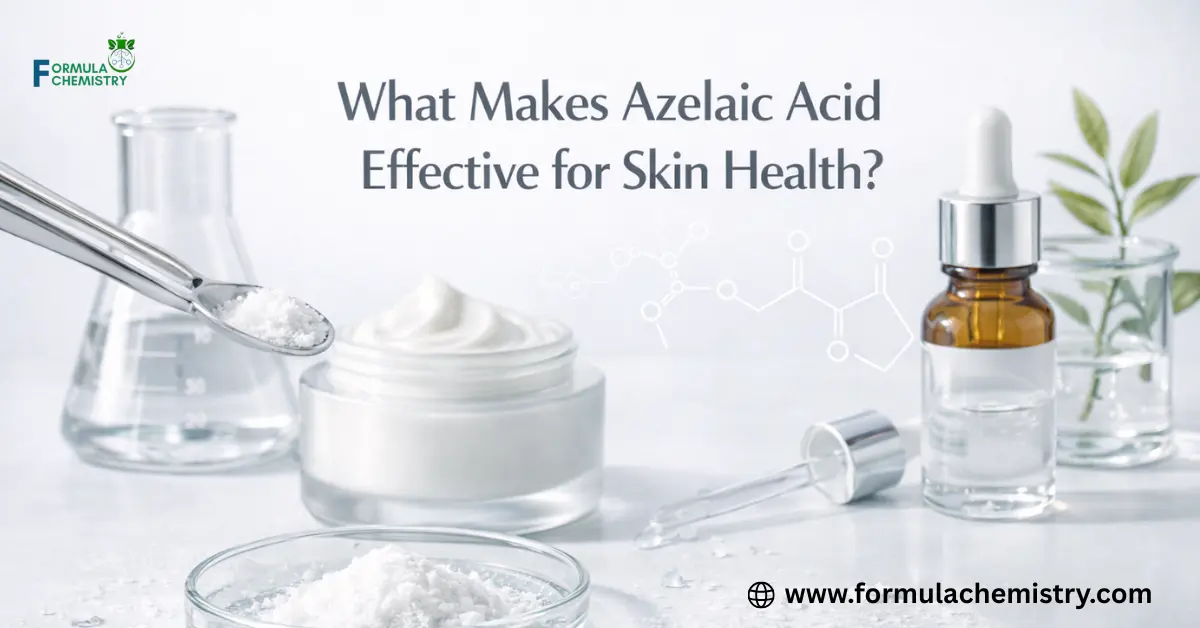
The efficacy of azelaic acid stems from its multiple mechanisms of action. It acts as a mild exfoliant that encourages the removal of dead skin cells, but its real strength resides in its capacity to target Cutibacterium acnes, the bacteria primarily responsible for acne breakouts. Reducing the fatty acid content in the skin’s surface oils creates a setting less hospitable to bacterial overgrowth.
Beyond acne, its anti-inflammatory properties are significant. It inhibits the “pro-inflammatory” cascades that lead to the redness and swelling associated with rosacea.
This double action clearing pores while calming redness is why it is often referred to as a “workhorse” ingredient in dermatological circles.
Benefits for Acne and Rosacea
Azelaic acid is one of the few ingredients that is considered safe for various skin conditions that usually require conflicting treatments. In acne management, it prevents the formation of microcomedones.
In rosacea management, it helps to shrink dilated blood vessels and soothe the burning feeling frequently associated with the condition.
Unlike benzoyl peroxide, which can be highly oxidative and drying, azelaic acid retains the skin’s oxidative balance. It is also non-photosensitizing, meaning it does not make the skin more sensitive to the sun, although daily SPF remains mandatory for any brightening routine.
Targeting Hyperpigmentation and Melasma
One of the most impressive traits of azelaic acid is its selective cytotoxicity. It specifically targets abnormal or hyperactive melanocytes the cells that produce pigment while leaving normal pigment-generating cells alone.
This makes it a safer alternative to hydroquinone for long-term use in treating melasma and post-inflammatory hyperpigmentation (PIH).
| Feature | Azelaic Acid | Salicylic Acid | Vitamin C (L-Ascorbic) |
| Primary Goal | Redness & Pigment | Pore Cleansing | Antioxidant/Brightening |
| Usage Rate | 10–20% | 0.5–2% | 5–20% |
| Ideal pH | 4.0–5.0 | 3.0–3.5 | < 3.5 |
| Sensitivity | Low | Moderate | High |
| Best For | Rosacea/PIH | Oily/Acne | Dullness/Aging |
How to Formulate with Azelaic Acid
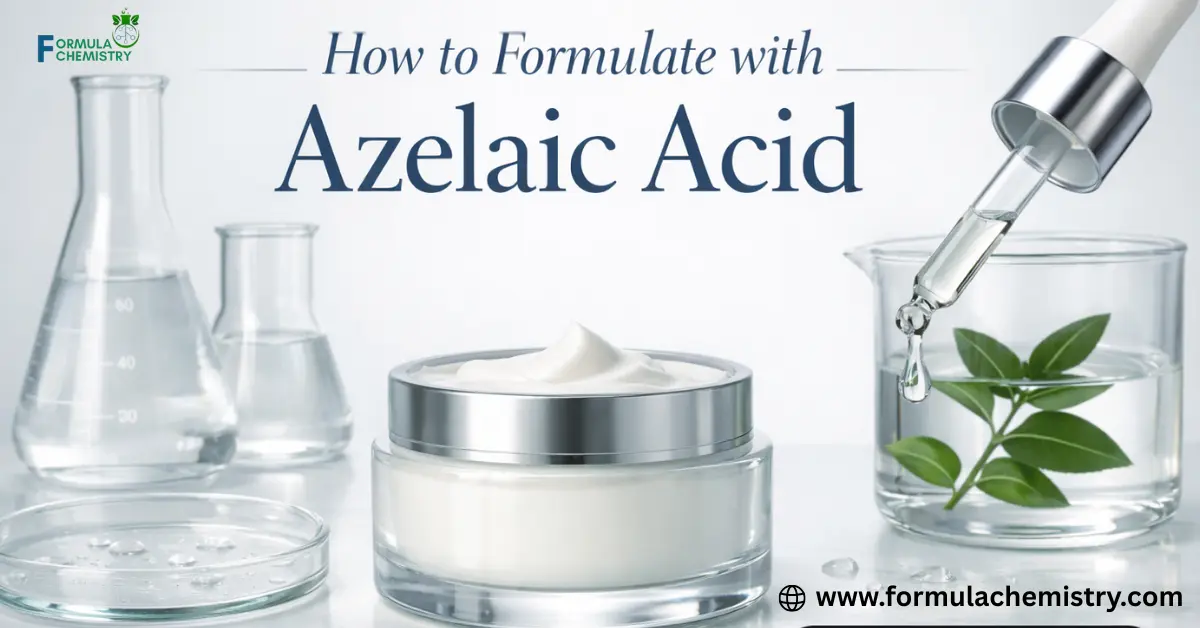
From a manufacturing perspective, azelaic acid needs careful handling to avoid a “gritty” texture in the final product.
Since it is a powder with a high melting point, it is often incorporated into anhydrous systems or emulsions where it is micronized or pre-dispersed in a solvent like Ethoxydiglycol or Propanediol.
Formula Chemistry emphasizes that the final pH note is critical; if the pH is too high, the acid becomes ionized, which greatly reduces its ability to penetrate the lipid-rich stratum corneum. If the pH is too low, the risk of skin irritation increases exponentially.
Solubility and Stability Problems
The solubility of azelaic acid is approximately 0.24% in water at room temperature, which is why most effective formulations are either high-viscosity suspensions or utilize specialized esters to keep the acid in solution.
Formulators must ensure the particles are small enough to be imperceptible on the skin.
- Common Problems and Fixes:
- Problem: Product feels “sandy” or gritty on the skin.
- Fix: Ensure the azelaic acid is micronized or use a high-shear mixer during the cooling phase.
- Problem: The emulsion separates after two weeks.
- Fix: Check the electrolyte stability of your thickener; azelaic acid can “crash” certain carbomers.
- Problem: Skin irritation or stinging upon application.
- Fix: Adjust the pH note to stay within the 4.5 to 5.0 range and include soothing agents like Allantoin.
Storage and Preservation Requirements
Azelaic acid is relatively stable to oxidation compared to Vitamin C, but it still requires a strong preservation system, especially in water-based emulsions. Every water-based formulation created must include a broad-spectrum preservative to prevent microbial growth.
Key warnings for storage include keeping the product in a cool, dark place to retain the integrity of the emulsion. While the acid itself is hardy, the surfactants and emulsifiers used to hold it in suspension can degrade under extreme heat.
Safety and Best Practices for Usage
While azelaic acid is widely noted for its high safety profile, it is not devoid of potential side effects. Most users experience a transient tingling or itching sensation during the first few weeks of use. This is generally considered a normal reaction as the skin adjusts to the lower pH of the product.
Who should avoid:
Individuals with extremely compromised skin barriers or those with a known hypersensitivity to dicarboxylic acids should proceed with caution.
Key warnings
also include avoiding the immediate eye area and mucosal membranes, as the acid can cause significant stinging.
Incorporating Azelaic Acid into a Routine
For best results, azelaic acid should be applied to clean, dry skin. Applying it to damp skin can increase the rate of penetration too quickly, leading to irritation.
It can be used both morning and night, provided the skin is not showing signs of excessive dryness or peeling.
- Cleanse with a pH-balanced, non-stripping cleanser.
- Wait 5–10 minutes for the skin to dry completely.
- Apply a pea-sized amount of the azelaic acid treatment.
- Follow with a barrier-supporting moisturizer.
- Apply broad-spectrum SPF if used during the daytime.
Possible Side Effects and Precautions
The most common side effects are localized, including redness, dryness, or flaking.
If these symptoms persist, reducing frequency to once every other day is recommended. FormulaChemistry endorses a “low and slow” approach when incorporating any new active into a regimen to guarantee long-term skin health.
Usage ranges in professional formulations usually peak at 20% for prescription-strength products, but for daily cosmetic use, 10% is often the “sweet spot” for preserving efficacy with tolerability.
FAQs about Azelaic Acid: The Ultimate Solution for Clear, Healthy Skin
Can I use azelaic acid with Retinol?
Yes, they can be used together, but it is best to use them at different times (e.g., Azelaic in the morning, Retinol at night) to minimize the chance of irritation.
Is azelaic acid safe during pregnancy?
Azelaic acid is often recommended by dermatologists as a safer alternative for acne and pigment during pregnancy, but you should always consult your healthcare provider first.
How long does it take to see results?
Initial enhancements in skin texture can be seen in 4 weeks, but significant changes in hyperpigmentation usually require 12 weeks with consistent use.
Does azelaic acid cause purging?
Because it affects skin cell turnover, some users may experience mild purging, though it is much less common than with salicylic acid or retinoids.
Can I use it on dark skin tones?
Absolutely. Azelaic acid is excellent for darker skin tones as it treats hyperpigmentation without the risk of “ghosting” or uneven bleaching.
What should I do if my skin stings?
A slight tingle is normal. If it burns or stays red, wash it off, wait for the skin to calm down, and try applying it over your moisturizer next time to buffer it.
Is a preservative necessary in azelaic acid creams?
Yes, a preservation reminder is essential: any formula containing water must have a preservative to prevent mold and bacterial growth.
Can I formulate azelaic acid in a clear serum?
It is very difficult to achieve a clear serum at high concentrations due to its low solubility; most effective formulas are opaque creams or lotions.
Editorial responsibility for this guide is maintained by FormulaChemistry to secure accurate, science-based information for the formulation community.