

Quick Answer
The choice in cold process vs hot process formulation is decided mainly by your ingredients. Hot process heats the oil and water phases separately to around 70°C and holds them for about 20 minutes, which is necessary when the formula contains waxes that must melt or gums that need heat to hydrate.
Cold process builds the emulsion at room temperature using a cold-process emulsifier, which saves energy, protects heat-sensitive actives, and suits natural formulas, but limits which oils and waxes you can use and often needs higher shear for a stable result.
Introduction
Whether to heat your ingredients or work at room temperature is one of the first decisions in making a cream or lotion. The cold process vs hot process formulation choice sounds like a matter of preference, but it is really dictated by what is in the formula.
Some ingredients demand heat, and others are ruined by it. Understanding which is which turns the cold process vs hot process question from a guess into a clear, ingredient-led choice.
I use both methods depending on the brief, and I never pick one out of habit. A wax-based balm forces one route while a hydrosol-rich natural serum forces the other, and knowing why is what keeps a formula stable.
This guide covers what each method actually involves, when your ingredients force the choice, the real benefits and limits of each, the hybrid option in between, and how to decide for your product.
What Hot Process Formulation Is
Hot process is the traditional method for making emulsions, and it uses heat to bring a formula together. The oil phase and the water phase are heated separately, then combined while hot.
The Heat-and-Hold Method
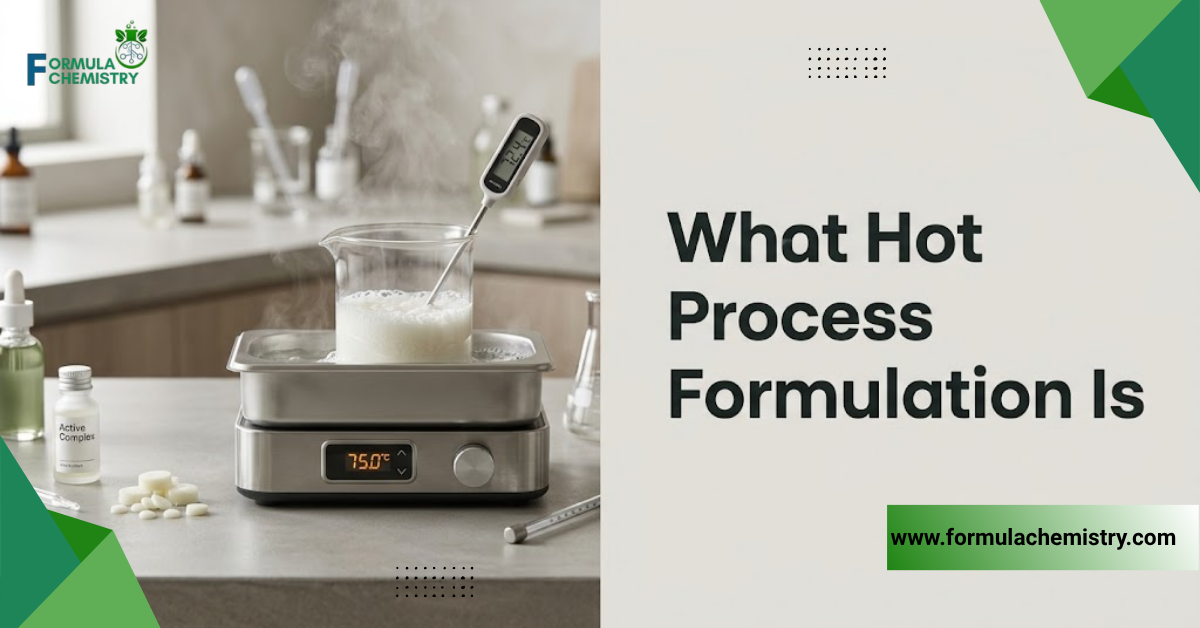
The standard hot approach is called heat-and-hold. Both phases are heated separately to around 70°C and held at that temperature for roughly 20 minutes before being mixed.
The hold matters as much as the heat. Holding both phases at temperature helps melt waxes fully, hydrate gums properly, and, in many recipes, reduce microbial load before the emulsion forms.
Why Heat Is Often Needed
Heat is not used for its own sake, it solves specific problems. The oil phase may contain waxes or solid butters that must be melted to blend, and the water phase may contain gums that only hydrate properly at elevated temperature.
Many traditional emulsifiers also need heat to work, activating and forming stable droplets only when both phases are warm. In conventional processing the phases can be taken as high as 80 to 90°C for exactly these reasons.
What Cold Process Formulation Is
Cold process builds an emulsion at or near room temperature, without heating the phases to emulsify. It relies on a special class of ingredients designed to work cold.
The Cold-Process Emulsifier
The key to cold process is a cold-process emulsifier, one that forms a stable emulsion without heat. These emulsifiers do the job at ambient temperature that traditional ones need 70°C to achieve.
Many cold-process emulsifiers are plant-derived and meet COSMOS or ECOCERT standards, which is part of why the method is popular in natural and clean beauty. They let a formulator combine phases directly, with any warming coming only from the mixing itself.
The Liquid Rule
Cold process comes with a strict requirement. For a genuinely cold process, all raw materials must be liquid or fully soluble within their phase at room temperature.
This is the heart of the method and its main constraint. Solid waxes and butters that need melting, and gums that need heat to hydrate, cannot be used in a true cold process, which shapes what kind of product you can make.
Cold Process vs Hot Process: The Comparison
In cold process vs hot process formulation, the two methods trade different strengths, and neither is universally better. The table below sets them side by side.
| Factor | Cold process | Hot process |
| Temperature | Room temperature | Around 70°C, held ~20 minutes |
| Emulsifier | Cold-process type required | Traditional heat-activated types |
| Ingredients | Must be liquid or soluble cold | Can include waxes and gums needing heat |
| Heat-sensitive actives | Protected, added easily | Must be added in cool-down |
| Energy and time | Low, faster | Higher, plus long cooling |
| Sustainability | Greener, lower carbon footprint | More energy-intensive |
| Texture range | More limited | Wider, including rich wax-based creams |
| Particle size | Often larger, needs higher shear | Finer, more easily stable |
| Natural positioning | Strong, often COSMOS or ECOCERT | Depends on ingredients |
Read the ingredients and texture rows together, because they capture the core trade. Cold process protects sensitive materials and saves energy but limits your palette, while hot process opens the full range of waxes and richer textures at the cost of heat and time.
Neither wins outright. The right method depends on what your formula contains and what you value most.
When Your Ingredients Force the Choice
Most of the time the formula itself decides the cold process vs hot process formulation question, and recognising this removes the guesswork. A few clear signals point each way.
When You Must Use Hot Process
Certain ingredients simply require heat. If your oil phase contains solid waxes, hard butters, or high-melting-point materials, you need hot process to melt them into a uniform blend.
The same applies to gums that need heat to hydrate, and to traditional emulsifiers that activate only when warm. A rich wax-based cream, a balm, or a classic emulsifying-wax lotion all point firmly to hot process.
When You Can Use Cold Process
Cold process becomes possible when every ingredient is liquid or soluble at room temperature and you are using a cold-process emulsifier. Lightweight lotions, serums, and sprays built from liquid oils and water-soluble actives are natural fits.
It is especially valuable when a formula is rich in heat-sensitive materials. Hydrosols, delicate plant extracts, sensitive actives, and essential oils all survive better when they never meet heat, which is a strong reason to choose cold process.
The Benefits and Limits of Each
Seeing the honest advantages and drawbacks of both methods makes the decision clearer. Each brings something real and costs something real.
Cold Process Strengths and Weaknesses
Cold process saves energy, time, and cost by skipping the heating and the long cooling that follows. It protects temperature- and shear-sensitive ingredients, and it aligns strongly with natural and sustainable positioning.
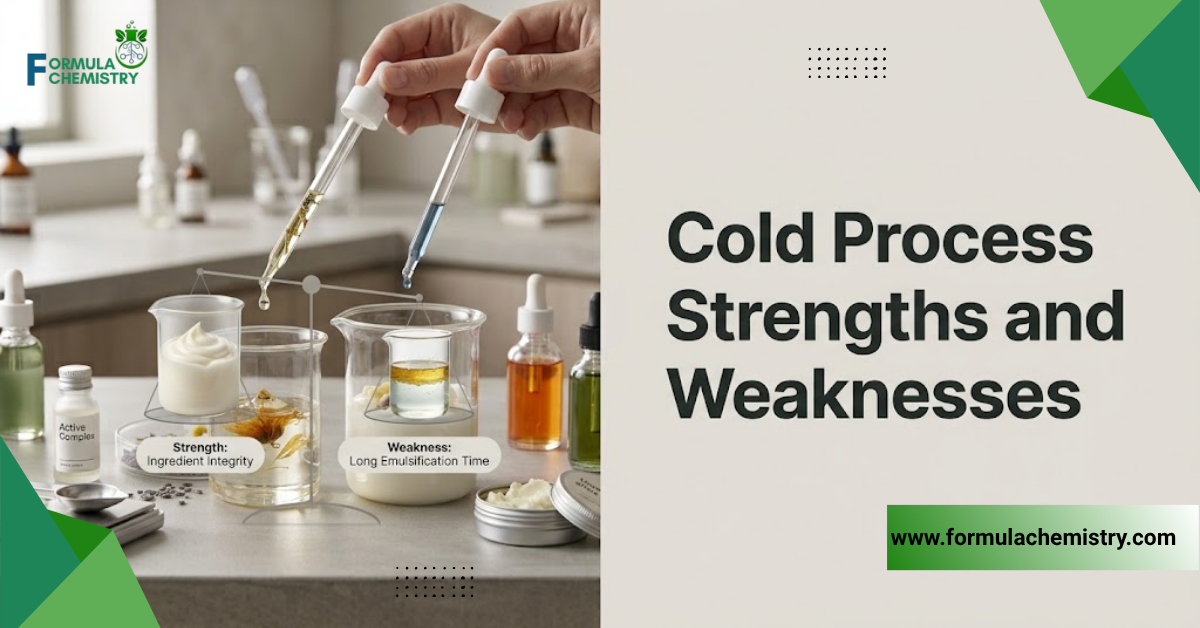
Its limits are equally real. Cold process restricts the oils and waxes you can use, which narrows texture and richness, and it often produces a larger droplet size that demands higher shear and careful stabilisation for a lasting emulsion.
Hot Process Strengths and Weaknesses
Hot process opens the full palette of ingredients, including waxes and butters, and tends to produce finer, more easily stabilised emulsions with rich, luxurious textures. The heat-and-hold step also helps integrate difficult materials reliably.
Its costs are time and energy. Heating both phases and then cooling slowly takes longer and uses more power, and every heat-sensitive active must wait for the cool-down, which adds steps and demands careful timing.
The Hybrid Approach
Between the two extremes sits a practical middle ground worth knowing. It lets you gain some cold-process benefits without abandoning heat entirely.
In a hybrid method, sometimes called hot-cold process, you heat only the phase that genuinely needs it while keeping the sensitive phase cool. A wax-containing oil phase can be melted and cooled, then combined with an unheated water phase carrying delicate actives.
This protects heat-sensitive ingredients while still allowing materials that need melting. It is a useful compromise when a formula contains both a wax that requires heat and an extract that must avoid it, which is a balance we often strike at Formula Chemistry for natural formulas with demanding ingredients.
The hybrid route does require care. Both phases should be close in temperature when combined for a stable emulsion, so timing and monitoring matter more than in a straightforward hot process.
Getting a Stable Result With Each Method
Both methods reward good technique, and each has its own way of going wrong. Knowing the failure modes helps you avoid them.
Stability in Cold Process
The biggest challenge in cold process is droplet size, since cold emulsions tend to form larger droplets that are more prone to separating. The fix is mechanical, using a homogeniser or high-shear mixer to drive the droplets smaller.
A good rheology modifier also does heavy lifting here. Building yield stress in the water phase, often with a gum, helps hold the emulsion together and stops it creaming or separating over time.
Cleanliness matters more in cold process too. Without a heat step to reduce microbial load, equipment and materials must be scrupulously clean, and the preservative system needs to be reliable from the start.
Stability in Hot Process
Hot process is generally more forgiving on droplet size, since heat and the emulsifier work together to form fine, stable droplets. The main discipline is temperature matching when the phases meet.
Both phases should be close in temperature when combined, and continued mixing through the cool-down locks in a fine emulsion. Adding heat-sensitive actives too early, while the batch is still hot, is the classic hot-process mistake, so they wait for the cool-down.
Energy, Cost, and Sustainability
Beyond the chemistry, the two methods differ in their footprint, which increasingly influences the choice. This matters most at production scale.
Cold process consumes far less energy because it skips both the heating and the slow cooling that hot process requires. At scale, that translates into lower costs, shorter production times, and a smaller carbon footprint.
Hot process, by contrast, spends energy heating two phases and then cooling them slowly, often at a fraction of a degree per minute. For a brand weighing sustainability, that difference is a genuine factor, though it only applies when the formula can actually be made cold, a balance we weigh carefully at Formula Chemistry.
Choosing Your Processing Method
The decision flows from your ingredients first, then your priorities. A few clear patterns cover most situations.
- Wax-based balm, stick, or rich cream: hot process, to melt the solid materials
- Formula with gums needing hot hydration: hot process, for proper thickening
- Lightweight lotion or serum from liquid ingredients: cold process, for speed and simplicity
- Formula rich in hydrosols, extracts, or sensitive actives: cold process, to protect them
- Natural or COSMOS-positioned product: cold process with a certified cold emulsifier
- A formula needing both a wax and a heat-sensitive active: the hybrid hot-cold approach
- Large-scale production prioritising energy savings: cold process where the formula allows
Notice that the ingredients lead and the priorities follow. Once you know what your formula contains, the method usually chooses itself.
Deciding Between Cold and Hot Process
Start by looking at your ingredient list. If it contains solid waxes, hard butters, or gums that need heat, hot process is not really optional, so plan for heat-and-hold and add sensitive actives during cool-down.
If every ingredient is liquid or soluble at room temperature and you have a suitable cold-process emulsifier, cold process gives you energy savings, active protection, and strong natural credentials, provided you use enough shear to build a stable emulsion.
When a formula pulls both ways, with a wax that needs melting and an extract that needs protecting, reach for the hybrid method and combine the phases at matched temperatures. This gives you the best of both without forcing a compromise on either.
Decide from the formula outward rather than from habit. Match the method to what your ingredients demand and what your brand values, respect the process each one requires, and confirm stability with proper testing before you scale.
Frequently Asked Questions
What is the difference between cold process and hot process formulation?
Hot process heats the oil and water phases to around 70°C and holds them before combining, which is needed for waxes and gums. Cold process builds the emulsion at room temperature using a cold-process emulsifier. The main difference is whether heat is required, which depends on the ingredients.
When should I use cold process formulation?
Use cold process when all your ingredients are liquid or soluble at room temperature and you have a cold-process emulsifier. It is ideal for lightweight lotions and serums, and especially for formulas rich in heat-sensitive hydrosols, extracts, and actives. It also saves energy and suits natural positioning.
When do I have to use hot process?
You need hot process when the oil phase contains solid waxes or hard butters that must melt, when the water phase has gums that need heat to hydrate, or when the emulsifier activates only with heat. Rich wax-based creams and balms require it. There is no cold shortcut for melting a wax.
What is the heat-and-hold method?
Heat-and-hold means heating the oil and water phases separately to around 70°C and holding them there for roughly 20 minutes before mixing. The hold helps melt waxes, hydrate gums, and reduce microbial load. It is the standard hot process approach for creams and lotions.
Is cold process better for natural cosmetics?
Often yes, because cold process protects heat-sensitive hydrosols, plant extracts, and essential oils, and many cold-process emulsifiers meet COSMOS or ECOCERT standards. It also lowers energy use and carbon footprint. The trade-off is a more limited choice of oils and waxes.
Does cold process save energy?
Yes, cold process avoids heating both phases and the long cooling that follows, which cuts energy, time, and cost. This benefit is especially significant at production scale. It is one of the main reasons cold process is seen as a greener method.
Why is my cold process emulsion unstable?
Cold process often produces a larger droplet size, which needs higher shear and good stabilisation to stay stable. Insufficient mixing or an unsuitable emulsifier is a common cause. Using a proper cold-process emulsifier, adequate shear, and a rheology modifier usually resolves it.
What is a hybrid hot-cold process?
A hybrid method heats only the phase that needs it, such as a wax-containing oil phase, while keeping the sensitive phase cool. The phases are then combined at matched temperatures. It protects heat-sensitive actives while still allowing ingredients that require melting.
Key Takeaways
In cold process vs hot process formulation, the method is decided mainly by your ingredients. Hot process uses heat-and-hold at around 70°C to melt waxes and hydrate gums, while cold process builds the emulsion at room temperature with a cold-process emulsifier and requires every ingredient to be liquid or soluble cold.
Each method trades real strengths. Cold process saves energy, protects heat-sensitive actives, and suits natural formulas but limits your oils and waxes and needs higher shear, while hot process opens richer textures and finer emulsions at the cost of time and energy.
When a formula needs both a wax and a heat-sensitive active, the hybrid hot-cold approach bridges the gap. Choose from your ingredient list first, match the method to what the formula demands and your brand values, and always confirm stability with testing before scaling.