

Quick Answer
Formulation scientist jobs involve designing, testing, and optimizing product formulas across pharmaceuticals, cosmetics, food, and household goods, and they typically require a chemistry-related degree plus bench experience.
Most positions sit in research and development or product development, span entry-level to principal scientist, and cluster around manufacturing and research hubs, with a growing share offering hybrid arrangements.
Demand remains steady because every physical product a company sells must be formulated, tested, and scaled before it reaches the shelf.
Introduction
Every physical product on a shelf began as a formula that someone built and tested, which is why formulation scientist jobs exist across almost every consumer-facing industry. The role is technical, stable, and far broader than most newcomers expect when they first search for it.
I have sat on both sides of this hiring table, screening candidates and coaching juniors into the field. The people who succeed are rarely the ones with the most theory.
They are the ones who understand where the work lives, how to present bench experience, and how to read a job market that hides good roles behind inconsistent titles. That knowledge gap is what this guide closes.
By the end you will understand what the role actually involves, which industries hire, what qualifications matter, realistic pay, and a practical method for finding and landing your next position.
What Does a Formulation Scientist Do?
A formulation scientist designs and refines the composition of a product so it performs, stays stable, and can be manufactured at scale. The job blends applied chemistry, hands-on bench work, testing, and documentation into a single development role.
Daily work usually includes building trial batches, running stability and compatibility tests, adjusting ingredients to hit performance and cost targets, and recording every change with precision. Much of the value lies in translating a product brief into a formula that survives production and shelf life.
The formulation scientist’s job description varies by sector, but the core stays constant. Take a target, build a formula that meets it, prove it holds up, and hand a manufacturable version to production.
Which Industries Hire Formulation Scientists?
The single biggest mistake in a job search is assuming these roles live in only one industry. They exist wherever a company sells a mixed or compounded product, which spreads the opportunities across several very different sectors.
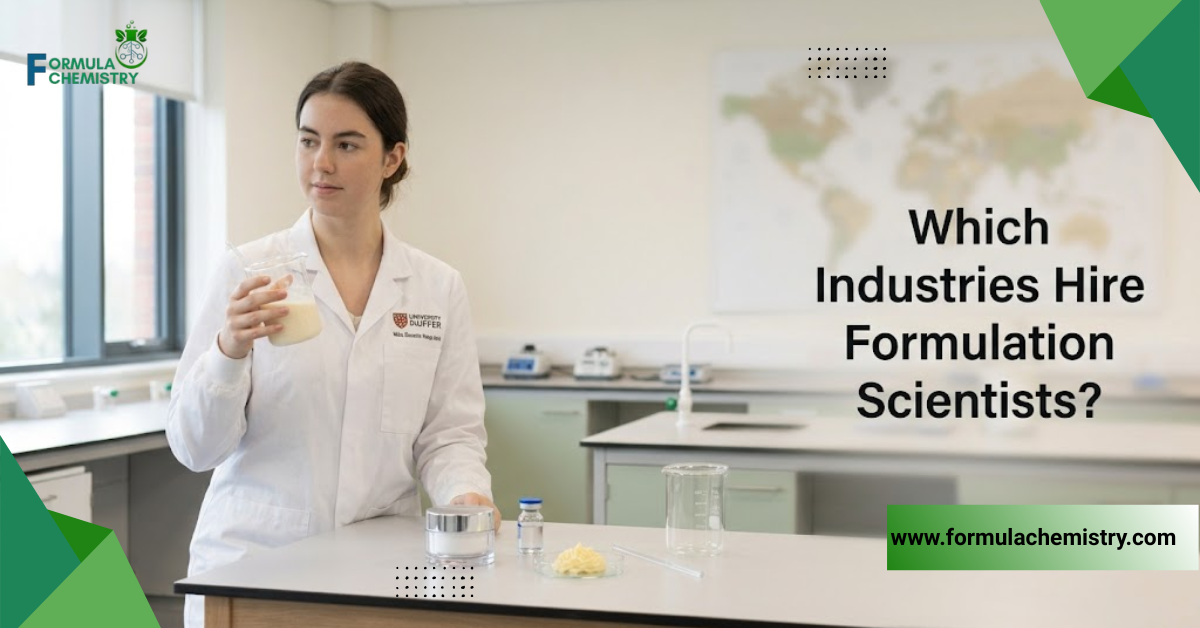
Pharmaceutical formulation is the most regulated and often the best paid, focused on drug delivery, dosage forms, and strict compliance. Cosmetic and personal care formulation centers on skincare, haircare, and color, balancing performance with sensory quality and consumer appeal.
Food and beverage formulation works on taste, texture, shelf stability, and nutrition, while household and industrial formulation covers cleaners, coatings, and specialty chemicals. Each sector rewards slightly different strengths, as the table shows.
| Sector | Typical focus | Regulation level | Common entry point |
| Pharmaceutical | Dosage forms, drug delivery, compliance | Very high | Graduate degree or lab experience |
| Cosmetic and personal care | Skincare, haircare, color, sensory quality | Moderate | Cosmetic science or bench training |
| Food and beverage | Taste, texture, stability, nutrition | High | Food science degree |
| Household and industrial | Cleaners, coatings, specialty products | Moderate to high | Chemistry or chemical engineering |
Choosing a sector early helps you tailor your applications, since a pharmaceutical formulation scientist and a consumer goods formulation scientist read as different candidates on paper. You can move between sectors later, but each transition asks you to relearn its rules.
Requirements and Qualifications
Most formulation scientists’ requirements start with a degree in chemistry, biochemistry, chemical engineering, pharmacy, food science, or cosmetic science. The specific field matters less than a genuine grasp of how ingredients behave and interact.
Employers weigh hands-on bench experience heavily, often above the exact title of your degree. Internships, lab placements, and even documented personal formulation work all count as real evidence.
Beyond the science, hiring managers look for careful documentation habits, an understanding of stability and safety, and awareness of the regulations in your target sector. Communication matters too, because a formula that no one else can follow is a liability rather than an asset.
How to Find Formulation Scientist Jobs
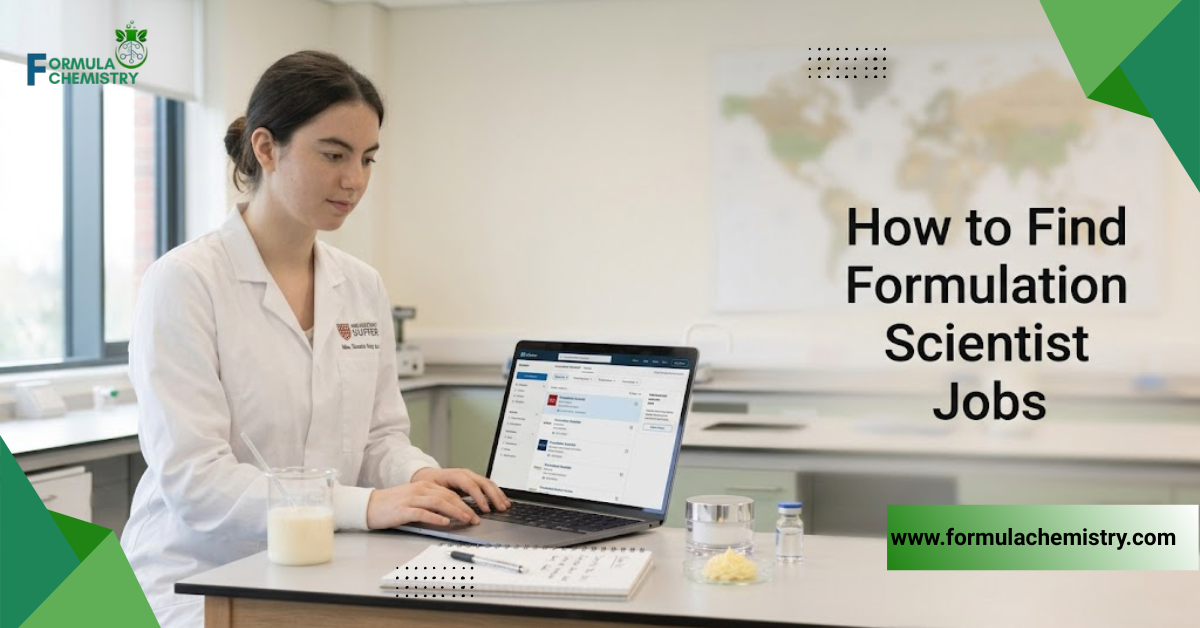
Finding formulation scientist jobs well means searching wider than the exact phrase. Many strong roles are posted under adjacent titles, so the search itself is a skill worth building.
Search these related titles alongside the obvious one:
- Product development scientist or product development chemist
- R&D scientist or research and development chemist
- Cosmetic chemist, food technologist, or process chemist
- Application scientist and technical development scientist
To find formulation scientist jobs near you, combine title searches with your region on job boards, then map the manufacturers, contract manufacturers, and raw material suppliers in commuting range. Local contract manufacturers are frequently overlooked and hire steadily.
For entry-level formulation scientist jobs, prioritize larger companies with structured graduate or junior programs, since they are built to train rather than expecting instant output. Smaller firms hire juniors, too, but they usually want someone who can contribute at the bench quickly.
Remote work deserves a realistic note. Fully remote formulation scientist jobs are uncommon because the role is hands-on, yet hybrid roles that combine bench days with remote analysis and documentation are becoming more available.
Salary and Career Progression
A formulation scientist’s career usually progresses from junior or associate scientist to formulation scientist, then to senior, principal, or lead roles, and often into management or technical direction. Progression rewards proven results and specialization more than time served.
Pay depends on sector, region, and seniority, with pharmaceutical roles typically sitting at the higher end. The ranges below are broad US approximations to orient your expectations rather than fixed figures.
| Career stage | Approximate US range | Notes |
| Entry level | $50,000 to $65,000 | Higher in regulated pharmaceutical roles |
| Mid level | $65,000 to $90,000 | Specialization begins to lift pay |
| Senior or principal | $90,000 to $135,000 and above | Leadership and niche expertise drive the top end |
These numbers shift with location, company size, and industry, so treat them as a starting reference. Local salary data for your specific city and sector will always be more accurate than a national range.
Landing the Role for a Cosmetic Scientist Job
Getting the interview and then converting it are two separate skills, and most candidates prepare for only one. Strong applicants treat the resume and the interview as distinct problems.
Building a Formulation Scientist Resume
A formulation scientist’s resume should lead with concrete bench outcomes rather than generic duties. State what you formulated, what problem you solved, and what result you achieved, using specifics such as product type, stability outcomes, and scale.
List real techniques and instruments you have used, and name the product categories you have worked on. Tailor the emphasis to each sector, since pharmaceutical and cosmetic employers scan for different signals in the same career history.
Preparing for the Interview
A formulation scientist interview usually mixes technical questions with practical and behavioral ones. Expect to explain how you would stabilize an emulsion, troubleshoot a failed batch, or adjust a formula to hit a cost target.
Prepare stories from real work that show judgment under constraint, not just textbook answers. Interviewers at places like Formula Chemistry care as much about how you think through a failure as whether you can recite a mechanism.
Common Mistakes in the Job Search
Most job seekers lose good opportunities through avoidable errors rather than weak qualifications. Each mistake below names the problem, explains why it happens, and gives the fix.
The first error is searching only for the exact title formulation of ” scientist. It happens because the phrase feels precise, and the fix is to search adjacent titles like product development chemist and R&D scientist that describe the same work.
Sending one generic resume to every sector is a second common mistake. Candidates do it to save time, yet a pharmaceutical employer and a cosmetics employer want different evidence, so tailor the emphasis for each application.
A third error is ignoring smaller companies and contract manufacturers. Job seekers chase recognizable brand names, but contract manufacturers hire formulators constantly and offer unusually broad hands-on experience.
Underselling bench and documentation experience is a fourth mistake. People assume routine lab work is unremarkable, yet clean documentation and proven bench iteration are exactly what hiring managers screen for.
Treating the interview as a pure theory test is the fifth error. Candidates over-prepare textbook chemistry and neglect practical and behavioral questions, so rehearse real troubleshooting stories alongside the fundamentals.
The sixth mistake is restricting the search to a narrow radius while dismissing hybrid options. Location limits feel practical, but widening the geographic net and considering hybrid roles opens a materially larger pool of positions.
Is This Career Right for You?
This work suits people who enjoy tangible problem-solving and feel satisfied when a formula finally behaves after many attempts. If you like combining scientific reasoning with hands-on craft and careful record-keeping, the role tends to fit well.
Temperament matters more than most applicants expect. Patience for iteration, comfort with repeated small failures, and genuine care for detail predict success better than raw academic scores.
Experience level should shape your first move. Newcomers gain the most from a broad junior role or a structured graduate program that exposes them to several product types before they specialize.
Mid-career professionals can commit to a sector with more confidence, choosing the lane where their results already cluster. If you are unsure whether the daily reality fits you, seek a lab placement or internship first, because the bench itself answers the question faster than any guide can.
Frequently Asked Questions
What does a formulation scientist do?
A formulation scientist designs and tests product formulas so they perform, stay stable, and can be manufactured at scale. The work spans building trial batches, running stability tests, adjusting ingredients, and documenting every change. It appears across pharmaceuticals, cosmetics, food, and household products.
What degree do you need for these jobs?
Most roles ask for a degree in chemistry, biochemistry, chemical engineering, pharmacy, food science, or cosmetic science. The exact field matters less than a solid grasp of how ingredients interact. Hands-on bench experience often carries as much weight as the degree itself.
Are formulation scientist jobs in demand?
Demand stays steady because every physical product must be formulated and tested before it can be sold. Pharmaceuticals, personal care, and food all hire formulators consistently. Openings can hide under adjacent titles, so a wider search reveals more of them.
Can formulation scientists work remotely?
Fully remote roles are uncommon because the job is hands-on at the bench. Hybrid arrangements that pair lab days with remote analysis and documentation are growing, though. Expect most positions to require regular on-site time.
How much do formulation scientists earn?
Pay depends on sector, region, and seniority, with pharmaceutical roles usually at the higher end. US ranges run roughly from entry level in the fifties of thousands to well over a hundred thousand at the principal level. Local data for your city and sector is always more precise.
How do I get an entry-level formulation job?
Target larger companies with structured graduate or junior programs built to train new scientists. Strengthen your application with internships, lab placements, or documented personal formulation work. Applying to adjacent titles widens your options considerably.
Which industries hire formulation scientists?
Pharmaceuticals, cosmetics and personal care, food and beverage, and household and industrial products all hire formulators. Each sector rewards slightly different strengths and carries a different regulatory load. Contract manufacturers across these sectors hire steadily and are often overlooked.
Is a formulation scientist a good career?
It suits people who enjoy hands-on problem solving, scientific reasoning, and careful documentation. The field is stable, spans many industries, and offers clear progression into senior and leadership roles. Fit depends more on temperament and patience than on top academic scores.
Key Takeaways
Formulation scientist jobs exist across pharmaceuticals, cosmetics, food, and household products, so the smartest search looks wider than a single industry or title. Adjacent titles like product development chemist and R&D scientist describe the same core work.
Qualifications start with a science degree, but hands-on bench experience and clean documentation often decide who gets hired. Pay tracks sector, region, and seniority, with pharmaceutical roles generally leading.
Choose a sector, tailor every application, and prepare for both technical and practical interviews. To move forward with confidence, pick one target sector this week and rewrite your resume around concrete benchmark results for that specific field.