
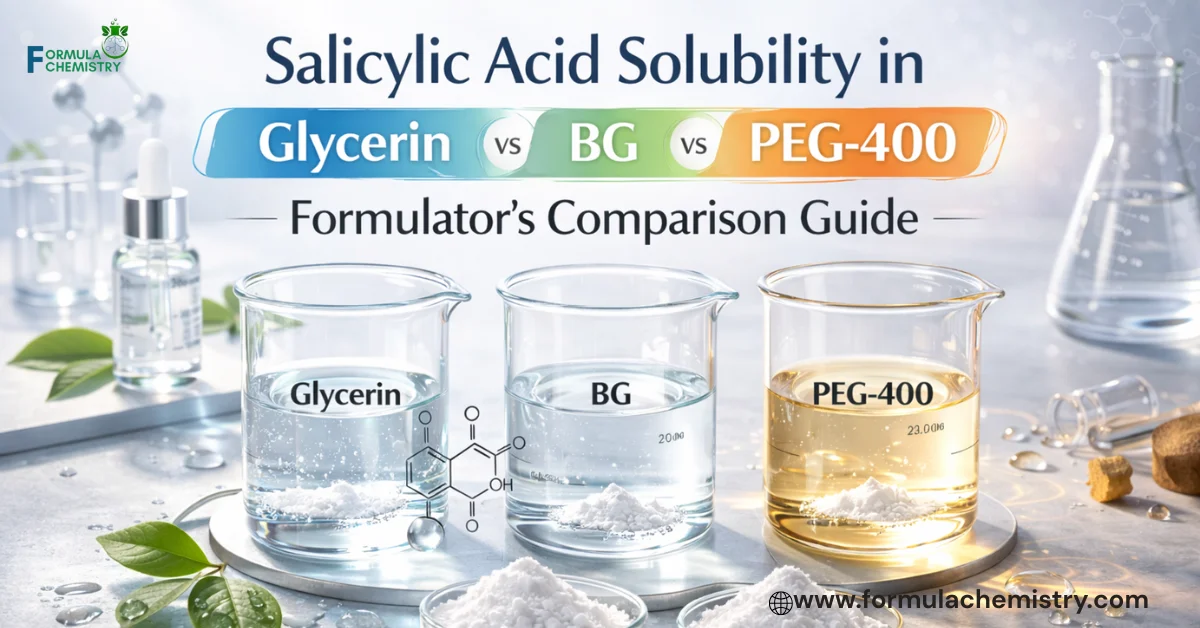
When ethanol and propylene glycol are not the right fit for your formula, three alternative co-solvents deserve serious consideration: glycerin, butylene glycol (BG), and PEG-400.
Salicylic acid solubility in glycerin is surprisingly limited, given how commonly glycerin appears in BHA formulas, a fact that catches many beginner formulators off guard.
BG and PEG-400, on the other hand, offer better solubilization capacity meaningfully and are increasingly preferred in modern, alcohol-free BHA systems.
At formula chemistry, this entry compares all three directly, with practical solvent ratio guidelines, troubleshooting for haze and precipitation, and stability data you can apply immediately.
Ingredient Overview
Subject: Salicylic Acid Co-Solvent Alternatives: Glycerin, Butylene Glycol, PEG-400
INCI Names in focus: Salicylic Acid / Glycerin / Butylene Glycol / PEG-400
Category: Active (BHA): Solubilization and co-solvent system focus
Related chemical property: Weak aromatic acid, pKa 2.97, limited water solubility (~0.2% at 20°C)
Salicylic acid is one of the most widely used exfoliant actives in cosmetic formulation, but its low water solubility demands a co-solvent strategy in every aqueous formula.
At the same time, ethanol and propylene glycol are the most discussed options; glycerin, butylene glycol, and PEG-400 each present clear benefits depending on formula positioning, target skin type, acne-prone skin and desired texture.
Understanding the solubilization capacity and behavior of each solvent, individually and in blends is what separates a stable, professional formula from one prone to haze, precipitation, and instability after dilution into the water phase.
Function in Cosmetic Formulation
Each of the three co-solvents in this comparison serves dual roles in a BHA formula:
- Glycerin: Humectant (primary) / weak co-solvent (secondary), one of the most skin-compatible ingredients available, but not an efficient salicylic acid solubilizer at typical usage levels.
- Butylene glycol (BG) as co-solvent: Humectant and moderate solubilizer , often the most well-rounded choice for alcohol-free BHA systems; lighter skin feel than glycerin, better solubilization than glycerin
- PEG-400: Solubilizer and texture modifier (primary), the most powerful of the three for salicylic acid dissolution; less humectant function but highest solubilization capacity in this group
Beyond dissolving salicylic acid, these solvents influence viscosity, skin feel, freeze-thaw stability, and compatibility with other formula components.
Choosing the wrong solvent or using an insufficient ratio, leads to the most common BHA formulation problem: crystal formation and haze after dilution into the water phase.
Solubility Comparison: Glycerin vs BG vs PEG-400
| Solvent | Approximate Salicylic Acid Solubility | Relative Efficiency |
| Water (20°C) | ~0.2% | Baseline |
| Glycerin (pure) | ~1–3% | Low |
| Butylene Glycol (pure) | ~8–12% | Moderate |
| Propylene Glycol (pure, reference) | ~10–15% | Moderate-High |
| PEG-400 (pure) | ~15–20% | High |
| Ethanol 96% (reference) | ~25–30% | Highest |
Key insight: Glycerin’s solubilization capacity for salicylic acid is only marginally better than water alone. Using glycerin as your primary co-solvent for a 2% BHA formula is a formulation error that will almost certainly result in undissolved crystals or haze on dilution. Butylene glycol and PEG-400 are the correct choices when ethanol and propylene glycol are excluded.
Solubility & Phase Information
Salicylic Acid Solubility in Glycerin
Glycerin (Glycerol) is one of the most polar cosmetic solvents available, more polar even than propylene glycol, with a polarity index approaching that of water. This high polarity is exactly why it is a poor solubilizer for salicylic acid, which has a moderate lipophilic character due to its aromatic benzene ring.
- Solubility in pure glycerin: approximately 1–3%: only marginally above water
- At typical glycerin usage levels in a formula (3–10%), its contribution to salicylic acid solubilization is minimal.
- Glycerin can and should be included in BHA formulas but for its humectant function, not as a primary solubilizer.
- If glycerin is the only cosolvent in a 2% salicylic acid toner, expect precipitation and haze to occur within hours to days, particularly upon cooling.
Practical note for beginners: Do not confuse “glycerin is in my formula” with “glycerin is dissolving my salicylic acid.” These are separate functions. Glycerin supports skin feel and hydration; a dedicated cosolvent (BG, PEG-400, ethanol, or PG) handles dissolution.
Solubility in oil: For reference, salicylic acid solubility in oil is moderate; it dissolves in many cosmetic esters and oils due to its lipophilic character. However, oil-based dissolution serves a different purpose and does not apply to aqueous toner or serum formats, where water-phase compatibility is essential.
Butylene Glycol (BG) as Co-Solvent
Butylene glycol (1,3-butanediol) is the closest functional substitute for propylene glycol in BHA systems, with several benefits that render it increasingly preferred in modern cosmetic formulation:
- Solubility in pure BG: approximately 8–12% salicylic acid
- Sufficient to dissolve 2% salicylic acid when used at 10–15% in the total formula
- Lighter, less tacky skin feel compared to both glycerin and propylene glycol important for toners and serums in which sensory profile matters
- Contributes mild humectancy and has a favorable safety and consumer perception profile
- Compatible with virtually all cosmetic pH ranges, surfactants, thickeners, and actives
Solvent ratio guideline for BG:
To safely dissolve 2g of salicylic acid using BG as primary co-solvent, use a minimum of 15–20g BG in the pre-dissolve step (aiming for a 10–13% SA concentration in the BG, well within its solubility limit). This solution is then incorporated into the water phase.
Crystallization risk: Low to moderate. BG-based systems are stable at room temperature; freeze-thaw cycling at –10°C may cause crystal reformation if BG levels are at the lower end of the solubilization range. Freeze-thaw testing is always recommended.
PEG-400 Solubilization Capacity
PEG-400 (Polyethylene Glycol 400) is a water-soluble, synthetic polyol with significantly higher solubilization power for salicylic acid than either glycerin or BG.
- Solubility in pure PEG-400: approximately 15–20% salicylic acid
- Makes PEG-400 the most efficient solubilizer in this group and competitive with propylene glycol
- Liquid at room temperature, water-miscible in all proportions, easy to process
- Provides a slightly occlusive, slip-enhancing skin feel useful in serums but may feel heavy in lightweight toners
- Excellent solubilization retention after dilution into the water phase notably lower haze and precipitation risk than glycerin or lower-grade BG systems
Solvent ratio guideline for PEG-400:
A PEG-400 usage level of 5–10% in the total formula is typically sufficient to maintain stable dissolution of 2% salicylic acid. Pre-dissolving SA in PEG-400 before water-phase addition remains the best practice, even given its high capacity.
Phase handling: PEG-400 is added to the water phase. It does not require heating to dissolve salicylic acid at standard cosmetic usage levels, though mild warming (40°C) speeds the process. It is compatible with heated or cool-down phase addition.
pH Range & Stability
The choice of cosolvent does not alter salicylic acid’s fundamental pH requirements, but each solvent has its own pH and stability traits.
- Optimal salicylic acid pH: 3.0–4.0 for maximum unionized (active) form
- pKa reminder: 2.97 — below this, the skin-penetrating unionized form dominates
StabilityStability from
| Solvent | pH Stability | Key Concern |
| Glycerin | Stable across wide pH range | Not a reliable solubilizer; crystal risk at low levels |
| Butylene Glycol | Stable across cosmetic pH range | Crystallization possible at <10% BG in formula |
| PEG-400 | Stable at acidic pH; avoid strong alkali | Potential for PEG oxidation at very high temperatures |
Stability after dilution in the water phase:
This is the most critical stability checkpoint for all three solvents. Once the pre-dissolved SA solution is added to the aqueous phase, the effective cosolvent concentration drops significantly. If the diluted concentration falls below the threshold needed to keep SA in solution, haze or crystals appear.
- Glycerin: highest risk of post-dilution instability
- BG at 15%+: low risk at room temperature, moderate at refrigeration
- PEG-400 at 8%+: lowest risk of the three; most reliable post-dilution stability
Compatibility & Incompatibilities
Compatible with:
- Glycerin + BG combination: Commonly used together glycerin for humectancy, BG for solubilization; highly synergistic
- Hyaluronic acid: Fully compatible in aqueous phase at correct pH with any of these cosolvents
- Niacinamide: Technically compatible in the same formula, but pH compromise is required BHA needs 3.0–4.0, niacinamide performs better above 5.0
- Carbomer / Xanthan gum / Hydroxyethylcellulose: Compatible thickeners in all three co-solvent systems; add thickener after SA is dissolved
- Compatibility with surfactants: All three solvents are compatible with anionic and nonionic surfactants commonly used in cleansing gel formats; bench test with cationic surfactants at low pH
- Panthenol, allantoin, aloe vera: All compatible in the water phase alongside any of these three cosolvents.
Avoid Combining with:
- Alkaline ingredients (NaOH, TEA, high-pH actives): Convert salicylic acid to its inactive salt form regardless of co-solvent
- Cationic polymers (e.g., polyquaternium series) at low pH: Can cause precipitation or viscosity instability always bench test
- High electrolyte concentrations: Salts can reduce the effective solubility of salicylic acid in water-based systems, particularly relevant in formulas with high mineral content or salt-based preservatives
- Strong oxidizers: Degrade both salicylic acid and PEG-400
Formulation Tips (Pro Notes)
Haze and Precipitation Troubleshooting
Haze in a finished BHA formula is almost always caused by insufficient co-solvent concentration, improper pre-dissolution, or rapid cooling after processing. Here is a systematic approach:
Step 1: Check your co-solvent ratio:
Calculate the actual co-solvent percentage in your total formula. For a 2% SA formula, your BG or PEG-400 must be at a level that can hold the SA in solution after dilution into the water phase. Use the solubility data in Section 3 as your guide.
Step 2: Verify pre-dissolution was complete:
The SA solution going into your water phase must be completely clear before addition. Any cloudiness at this stage means undissolved SA is present — do not proceed; warm gently and stir further.
Step 3: Check the addition temperature:
Adding a hot SA solution to cold water, or vice versa, can cause localized crystallization. Keep temperatures consistent during mixing.
Step 4: Perform cold stability test:
Place a sample at 4°C for 48 hours. If haze appears, your co-solvent level is marginal. Increase BG by 3–5% or PEG-400 by 2–3% and retest.
Step 5: Freeze-thaw cycling:
Three cycles of –10°C to 25°C is the standard accelerated stability test for crystal reformation risk. This must be before completing the formula.
Solvent Ratio Guidelines Summary
| Target SA Level | Recommended BG | Recommended PEG-400 | Glycerin (alone) |
| 0.5% SA | 5–8% BG | 3–5% PEG-400 | Insufficient alone |
| 1.0% SA | 8–12% BG | 5–7% PEG-400 | Insufficient alone |
| 2.0% SA | 15–20% BG | 8–12% PEG-400 | Insufficient alone |
Blended solvent approach:
Using BG and PEG-400 together is an effective strategy that reduces the amount of each needed individually. A combination of 8% BG + 5% PEG-400 can provide stable dissolution of 2% salicylic acid in many formula architectures, with a good skin feel balance.
Processing temperature:
- Glycerin: warm to 40–50°C to assist weak solubilization (but acknowledge its limits)
- BG: mild warming (40°C) recommended for pre-dissolving
- PEG-400: dissolves SA efficiently with or without warming; 40°C speeds the process
Texture and sensory impact:
- Glycerin: thicker, slightly tacky — contributes a plump skin feel
- BG: lightest of the three; preferred for water-like toners and fluid serums
- PEG-400: moderate viscosity, slight slip and glide; can feel slightly occlusive at higher levels (>10%)
Benefits in Cosmetic Products (Non-Medical)
The co-solvent selection influences not just dissolution but the sensory and functional profile of the finished product:
- Glycerin-containing BHA formulas support a hydrated, plump-looking skin appearance useful for positioning exfoliant formulas as gentle and hydrating rather than stripping.
- BG-based formulas deliver a lightweight, fast-absorbing texture that appeals to oily and combination skin users; BG additionally contributes mild antimicrobial support.
- PEG-400-based formulas provide extended stability and consistent active delivery across the product’s shelf life important for professional and clinical skincare brands.
- All three, when correctly formulated, support salicylic acid’s core cosmetic benefits: smoother-looking skin texture, improved appearance of congested pores, and a more even skin surface over time.
Common Product Applications
| Product Format | Best Co-Solvent Choice |
| Hydrating BHA toner (alcohol-free) | BG primary + glycerin for humectancy |
| Lightweight fluid BHA serum | BG primary + PEG-400 blend |
| Professional-grade BHA serum | PEG-400 primary for stability |
| Gel BHA serum (carbomer base) | BG or PEG-400; add SA before neutralization |
| BHA cleansing gel | BG (surfactant compatible) |
| BHA essence (low viscosity) | BG primary; low glycerin |
| Multi-active serum with peptides | BG (compatible, light feel) |
| Clinical/pharmacy BHA product | PEG-400 (maximum stability) |
Substitutes / Alternatives
If BG, PEG-400, or glycerin alone are not suitable:
- Propylene Glycol: The most direct BG substitute; slightly higher solubilization capacity (~10–15%); heavier skin feel; may face consumer perception challenges in “clean beauty” positioning.
- Pentylene Glycol: Lighter than BG, moderate solubilization, adds mild antimicrobial function; good choice for minimal-ingredient formulas targeting sensitive skin.
- Dipropylene Glycol (DPG): Lower polarity than PG or BG, good solubilization of moderately lipophilic actives like salicylic acid; less commonly used in rinse-off formats
- Dimethyl Isosorbide (DMI): Powerful penetration-enhancing solubilizer; use at 2–5% alongside another primary solubilizer; not a standalone replacement at typical BHA concentrations
- Caprylyl Glycol: Mild solubilization contribution at low levels (1–3%); used primarily as a preservative booster; not sufficient as a primary cosolvent for 2% SA
Safety & Regulatory Notes
Glycerin:
- Excellent safety profile; one of the most well-tolerated cosmetic ingredients across all skin types, with substantial regulatory restrictions on cosmetic usage levels
- Non-irritating; suitable for sensitive, dry, and compromised skin
Butylene Glycol:
- Well-tolerated at typical cosmetic usage levels (up to ~10% in leave-on)
- Mild antimicrobial properties at higher concentrations
- Generally recognized as safe; no substantial regulatory restrictions in EU, US, or ASEAN markets.
- Occasional sensitivity reports exist, but they are rare; patch testing is still advisable for sensitive-skin formulas.
PEG-400:
- Considered safe at cosmetic usage levels
- In the EU, PEG ingredients must meet purity standards regarding 1,4-dioxane and ethylene oxide residuals always sourced from reputable cosmetic-grade suppliers with relevant safety documentation.
- Non-irritating to intact skin; avoid use on severely broken or compromised skin barriers.
- Not associated with significant sensitization at cosmetic usage levels
Salicylic acid general reminders:
- Patch test recommended; avoid the eye area and broken skin.
- Not recommended in high-concentration leave-on formats during pregnancy
- Maximum use levels vary by market — verify current regulatory limits for EU, US FDA OTC, and ASEAN guidelines before launch.
Is salicylic acid in aspirin?
Yes, salicylic acid is the active metabolite of acetylsalicylic acid (aspirin). Individuals with documented aspirin sensitivity should be made aware of this chemical relationship when using salicylic acid topical products. However, the systemic absorption from cosmetic application at standard usage rates is considered very low.
Salicylic acid hazards in the formulation context:
- At cosmetic usage levels (0.5–2%), irritation potential is the primary concern rather than systemic harm.
- Avoid inhalation of fine powder during handling of raw salicylic acid use appropriate PPE (dust mask) when weighing.
- Store raw material in a cool, dry location away from moisture and direct sunlight
FAQ’s about Salicylic Acid Solubility in Glycerin, BG, and PEG-400: Formulators Comparison Guide
Is glycerin a good cosolvent for salicylic acid?
No, not as a primary solubilizer. Glycerin’s solubility capacity for salicylic acid is only approximately 1–3% in pure glycerin, barely above. At the levels glycerin is typically used in cosmetic formulas (3–10%), it contributes very little to salicylic acid dissolution. Use glycerin for its humectant benefits and rely on BG or PEG-400 for actual solubilization.
How much butylene glycol do I need to dissolve 2% salicylic acid?
As a general guideline, 15–20% BG in the total formula provides sufficient solubilization for 2% salicylic acid in a water-based system. Pre-dissolve the salicylic acid in your full BG amount before adding it to the water phase, and always validate its thaw stability.
What causes haze or cloudiness in a BHA toner?
Almost always insufficient co-solvent concentration or incomplete pre-dissolution. If your SA was not fully dissolved before addition to the water phase, or if the co-solvent level is too low to maintain dissolution after dilution, you will see haze or crystal precipitation often appearing first at cold temperatures. Increase the co-solvent level, ensure complete pre-dissolution, and perform cold-stability testing at 4°C and freeze-thaw cycles.
Can I use PEG-400 in a “clean beauty” or “natural” positioned formula?
PEG-400 is a synthetic ingredient and is generally excluded from clean beauty or natural-certified formulations. In these cases, butylene glycol or pentylene glycol is preferred. If natural certification is required, check your certifying body’s approved ingredient list PEG derivatives are commonly restricted.
Is salicylic acid soluble in oil?
Yes, salicylic acid has moderate solubility in cosmetic oils and esters due to its lipophilic aromatic character. However, oil-based dissolution is not applicable for aqueous toners and serums; it would require an oil-continuous or anhydrous format. In water-based products, a water-miscible co-solvent (BG, PEG-400, ethanol, or PG) is always required.
Is salicylic acid related to aspirin? Does that create any formulation concerns?
Salicylic acid is the active metabolite of aspirin (acetylsalicylic acid), and individuals with aspirin sensitivity may react to topical salicylic acid. This is a labeling and consumer communication consideration rather than a formulation chemistry issue. Regarding co-solvent selection and stability, the aspirin relationship has no practical impact on your formulation.
Final Summary
Quick reference for formulators:
- Glycerin: Poor primary solubilizer (~1–3% capacity); use for humectancy alongside a proper cosolvent.
- Butylene glycol: Reliable co-solvent (~8–12% capacity); use at 15–20% in formula to support 2% SA; best choice for lightweight alcohol-free BHA toners and serums.
- PEG-400: Highest solubilization capacity of the three (~15–20%); use at 8–12% in formula; best choice for maximum stability and industry-standard formulas
- The predissolve method is mandatory. Always dissolve SA in your co-solvent before adding it to the water phase.
- Optimal pH: 3.0–4.0 regardless of co-solvent selection
- Haze troubleshooting: Check co-solvent ratio, verify complete pre-dissolution, perform 4°C cold test, and freeze-thaw cycling
- Blended approach: BG + PEG-400 combination is an effective strategy that reduces the required amount of each while increasing stability.
Understanding the true solubility of glycerin, BG, and PEG-400 prevents the most common failure mode in BHA formulations: undissolved salicylic acid hiding in a formula that looks clear at room temperature but precipitates when it hits cold storage or the consumer’s bathroom shelf.