
The sun gives life, but also causes visible aging and cellular harm. While serums claim to reverse damage, only SPF Sunscreen prevents it from occurring in the first place.
Many think SPF is just for summer, but it’s essential daily. Understanding formula chemistry shows these lotions shield against radiation.
Transitioning from understanding sun exposure to protection, this guide explores the science of sun protection, breaking down the molecular mechanics that make SPF the ultimate hero in your Formula Chemistry skincare arsenal.
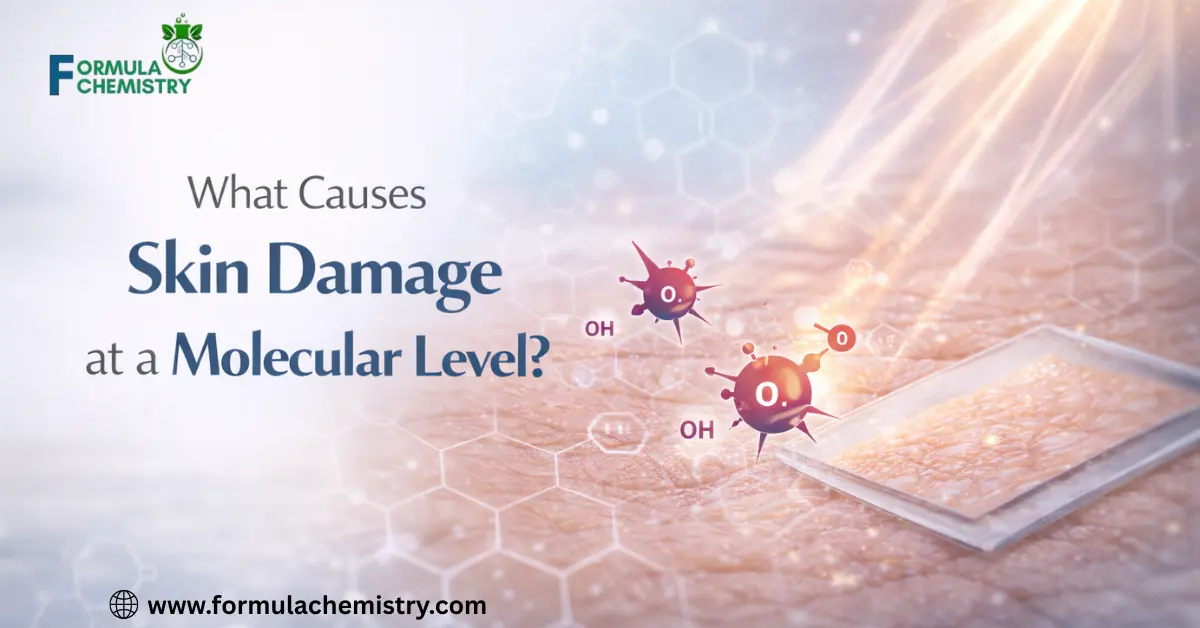
What Causes Skin Damage at a Molecular Level?
Solar radiation triggers a cascade of chemical reactions within the dermis that degrade structural proteins and mutate genetic material.
The Physics of Ultraviolet Radiation
Sunlight is composed of photons, which are particles of light that travel in waves. Ultraviolet (UV) rays have a shorter wavelength (the distance between waves) and higher energy than visible light.
When these high-energy photons hit unprotected skin, they transfer that energy to your cells. This influx disrupts the stable chemistry formula of your DNA, causing bonds to break and reform incorrectly, potentially leading to mutations.
The Difference Between UVA and UVB
Not all UV rays behave the same way. UVB rays are shorter and primarily damage the epidermis, causing the redness and pain we identify as sunburn.
UVA rays are longer and penetrate deeper into the dermis, the thick inner layer of skin. They generate reactive oxygen species (free radicals), which are unstable molecules that can damage cells and tissues, and attack collagen and elastin. This “silent” damage is responsible for 80% of premature aging signs, such as wrinkles and sagging.
Find out if BEA Skincare SPF is worth it in our honest review.
The Formula Chemistry of Sunscreen Filters
Sunscreens are not simple barriers; they are sophisticated chemical formulations designed to interact with light energy in specific ways.
Physical Blockers (Inorganic Filters)
Ingredients like Zinc Oxide and Titanium Dioxide act as physical shields that sit on the skin’s surface, reflecting or absorbing UV rays.
Their chemical formula forms a lattice structure that sits on top of the skin. Historically, these reflected light, but modern micronized versions actually absorb UV energy and dissipate it as heat, similar to chemical filters, while providing broad-spectrum protection.
Chemical Absorbers (Organic Filters)
Chemical filters, such as Avobenzone or Octinoxate, are carbon-based molecules that act like sponges by absorbing UV rays and converting them into less harmful energy.
They absorb UV photons. The energy from the photon excites the electrons in the sunscreen molecule, pushing them to a higher energy state. As they return to their ground state, they release that energy harmlessly as heat, sparing your skin cells.
Decoding SPF and Formula Chemistry Skincare
The Sun Protection Factor (SPF) is a mathematical calculation of protection against UVB rays, but it is often misunderstood by consumers.
The Mathematics of Protection
SPF indicates how much longer you can stay in the sun without burning compared to unprotected skin.
However, the curve is not linear. SPF 15 blocks 93% of UVB rays, SPF 30 blocks 97%, and SPF 50 blocks 98%. In professional Formula Chemistry skincare, we recommend SPF 30 or higher to account for application errors and environmental exposure.
Why SPF Doesn’t Measure UVA
SPF only measures sunburn protection (UVB). It tells you nothing about the aging rays (UVA).
To ensure you are protected against the full spectrum, you must look for the term “Broad Spectrum” or check the PA rating (a Japanese measurement system). This ensures the formula chemistry balances protection across both wavelengths.
Chemical Formula Stability and Photostability
A major challenge in formulation is ensuring the sunscreen molecule doesn’t break down effectively, “sacrificing” itself when exposed to sunlight.
The Avobenzone Problem
Avobenzone is one of the best UVA filters available globally, but it is notoriously unstable.
When exposed to sunlight, its chemical formula degrades rapidly, losing effectiveness within an hour. To fix this, formulators pair it with stabilizers like Octocrylene to maintain its integrity during sun exposure.
Encapsulation Technology
Modern innovations involve encapsulating unstable filters in silica or polymer shells.
This keeps the active ingredient separate from other reactive components in the formula. Photostability—meaning stability of the formula when exposed to light is enhanced, and chemical filters (ingredients that absorb UV rays) are prevented from interacting directly with the skin, reducing the risk of irritation.
A simple way to shield your skin SPF 15 Oil: Lightweight Daily Protection.
Formula Chemistry DIY: The Dangers of Homemade Screen
While making your own skincare products can be rewarding, sunscreen is one product that should not be made at home unless you have access to professional testing equipment.
The Dispersion Difficulty
Zinc Oxide particles attract each other chemically, forming clumps.
In a Formula Chemistry DIY setting, you cannot achieve the high-shear mixing needed to perfectly disperse these particles. This results in microscopic gaps on your skin where UV rays can penetrate, causing burns despite the lotion looking white.
Impossible Validation
You cannot calculate SPF with a calculator; it requires in vivo testing on human subjects.
Adding 20% Zinc Oxide to a cream does not guarantee SPF 20. The final SPF depends on the film thickness, the solvent, and the emulsifier. Without a lab to verify the chemistry formula, you are essentially wearing a placebo.
Broad Spectrum Protection and Formula Chemistry
True skin preservation requires shielding against the entire solar spectrum, including infrared and blue light.
Critical Wavelength
To be labeled “Broad Spectrum,” a sunscreen must have a critical wavelength (the point at which it absorbs most UVA rays) of at least 370nm.
This means the absorption spectrum of the formula chemistry extends well into the UVA range. Without this, you might prevent a burn but still suffer from collagen degradation and hyperpigmentation.
Iron Oxides and Visible Light
High-energy visible (HEV) light, or blue light from the sun and screens, drives pigmentation in deeper skin tones.
Standard filters don’t block this. Adding Iron Oxides (pigments) extends the protective range. This explains why dermatologists often recommend tinted sunscreens for patients with melasma.
Daily Application Habits for Maximum Protection
The best formulation in the world fails if applied incorrectly; user error is the weakest link in the chain.
The Two-Finger Rule
To achieve the SPF listed on the bottle, you need 2mg of product per square centimeter of skin.
Visually, this equates to two full finger lengths for the face and neck. Applying less drastically reduces efficacy; applying half the amount of SPF 50 results in only the square root of the protection (approx. SPF 7), not SPF 25.
Reapplication Dynamics
Sunscreen film breaks down due to sebum production and movement.
You must reapply every two hours of exposure. Modern sprays and powders make this easier, helping reinforce the formula’s chemical barrier without ruining makeup or requiring a full wash.
Environmental Impact of Sunscreen Chemicals
As we protect our skin, we must also consider the aquatic ecosystems where these chemical formulas inevitably end up.
Reef-Safe Formulation
Certain filters, like Oxybenzone and Octinoxate, have been linked to coral bleaching.
They act as endocrine disruptors for marine life. “Reef-safe” generally implies the use of non-nano minerals (Zinc/Titanium) or biodegradable polymers that do not linger in the ocean’s chemistry formula or harm biodiversity.
Biodegradability
Beyond the filters, the entire emulsion matters.
Silicones and microplastics in waterproof sunscreens can persist in the environment. Green chemistry is advancing plant-based, water-resistant polymers that break down naturally after washing off.
Future Innovations in Sun Care Formulas
The future of SPF lies in making the product feel invisible while working harder than ever before.
Biological Filters
Scientists are exploring antioxidants and DNA repair enzymes that work after UV exposure.
These “biological filters” don’t block rays but neutralize the damage instantly. Ingredients like Polypodium Leucotomos (fern extract) are being studied for their ability to boost the skin’s internal resistance to UV radiation.
Smart Polymers
New polymers can change structure when exposed to UV light.
They automatically tighten the sunscreen film as UV intensity increases, boosting the SPF in real time. This adaptive formula chemistry ensures maximum protection exactly when you need it most.
Conclusion
Sunscreen is not just a cosmetic; it is a sophisticated shield built on complex principles of photon physics and molecular stability.
By choosing a broad-spectrum, photostable product and applying it generously, you are utilizing the power of formula chemistry to preserve your health.
While Formula Chemistry DIY has its place, leave SPF to the regulated labs, and embrace the role of this invisible hero in your daily journey toward healthy, undamaged skin.
FAQ’s about Invisible Hero: Power of SPF Sunscreen
Is SPF 50 really better than SPF 30?
Yes, but the difference is marginal in percentage terms. SPF 30 blocks roughly 97% of UVB rays, while SPF 50 blocks 98%. However, because most people underapply sunscreen, using a higher SPF acts as an insurance policy, ensuring you get closer to adequate protection even with a thin layer.
Can I mix sunscreen with my moisturizer?
No, you should never mix sunscreen with other products before applying it. Mixing dilutes the filters and disrupts the emulsion structure (the chemical formula). This creates an uneven film on the skin, leaving “holes” where UV rays can penetrate and cause damage.
Do I need sunscreen indoors?
Yes, if you are near windows. UVA rays can penetrate glass. These are the rays responsible for aging and collagen breakdown. If you sit near a window or drive, you are receiving significant UVA exposure even if you don’t feel the heat or get a sunburn.
What is the difference between chemical and mineral sunscreen?
Mineral sunscreens (Zinc Oxide, Titanium Dioxide) sit on the skin’s surface and reflect/absorb UV rays. Chemical sunscreens (Avobenzone, etc.) absorb UV rays in the top layer of the skin and convert them into heat. Mineral options are often better for sensitive skin, while chemical options are more cosmetically elegant.
Why does my sunscreen leave a white cast?
The white cast is caused by the particle size of mineral filters, such as Titanium Dioxide. To solve this, manufacturers use “micronized” or “nano” particles. These smaller particles are invisible to the naked eye but still large enough to interact with the chemical formula of UV waves, blocking them.
Does makeup with SPF provide enough protection?
Rarely. To get the advertised protection, you need to apply a very thick layer (2mg/cm²), which would look like a heavy mask with foundation. Think of makeup with SPF as a bonus layer, but always apply a dedicated sunscreen underneath it first.
How do I know if my sunscreen is reef-safe?
Look for labels that explicitly state “Reef Safe” and check the ingredient list. Avoid Oxybenzone and Octinoxate. Instead, look for non-nano Zinc Oxide or Titanium Dioxide, which are naturally occurring minerals that do not disrupt the marine ecosystem’s chemical balance.
Does sunscreen prevent Vitamin D absorption?
While sunscreen blocks UVB rays (which trigger Vitamin D production), most people do not apply it effectively enough to block 100% of UVB rays. Furthermore, incidental sun exposure on unprotected areas usually provides sufficient Vitamin D. The risk of skin cancer outweighs the benefit of skipping SPF.