

Introduction
Most emulsion failures are decided before mixing begins, in the choice of emulsifier. A formulator who picks an emulsifier by name or marketing claim, rather than by its HLB, is guessing at the single most important decision in the formula.
This guide explains the HLB system in full, so you can choose an emulsifier by calculation rather than trial and error. HLB stands for hydrophilic-lipophilic balance, a number from 0 to 20 that describes how water-loving or oil-loving an emulsifier is.
You will learn what the HLB scale measures, how to read emulsifier HLB values, how to find the required HLB of an oil phase, and how to blend two emulsifiers to hit a target. Each step includes a worked calculation you can apply to your own formulas.
By the end, you will be able to deliberately match an emulsifier to an oil phase, which removes most of the guesswork from building a stable emulsion.
The HLB System Explained: What It Measures
HLB, the hydrophilic-lipophilic balance, measures the ratio between the water-loving and oil-loving parts of an emulsifier molecule. A low number means the molecule is mostly oil-loving, and a high number means it is mostly water-loving.
The lipophilic hydrophilic balance sits on a scale of 0 to 20. A value near 0 describes a fully oil-soluble material, a value near 20 describes a fully water-soluble one, and most cosmetic emulsifiers fall between 3 and 16.
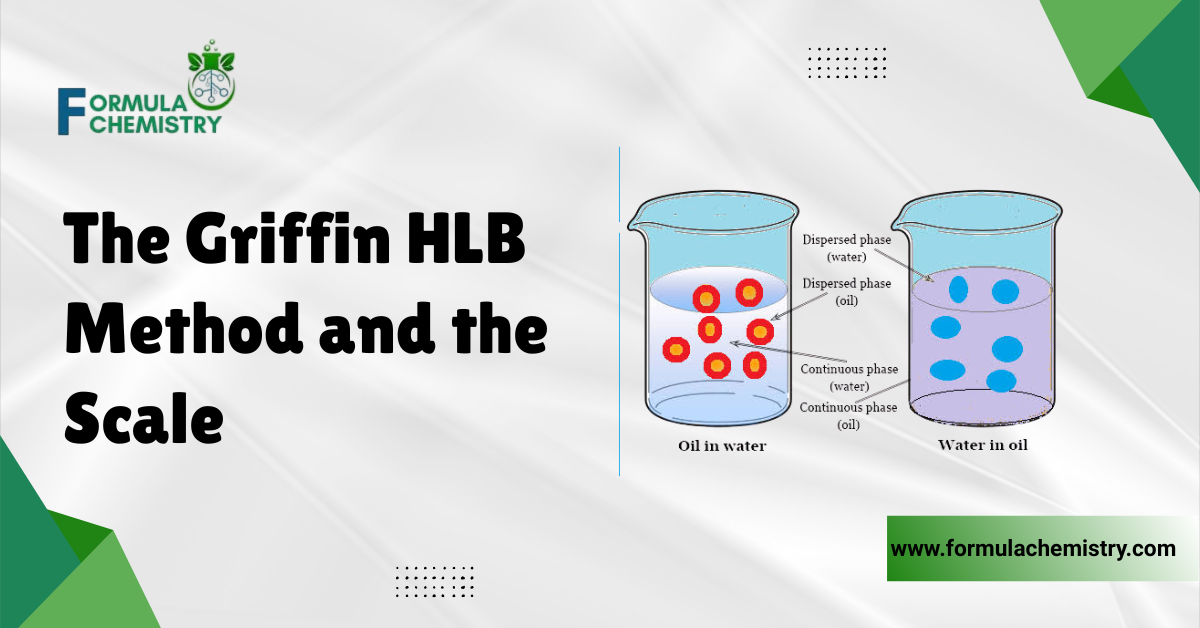
The scale predicts what a surfactant will do in a formula. An emulsifier’s position on the HLB scale, 0 to 20, tells you whether it will stabilise a water-in-oil emulsion, an oil-in-water emulsion, or act instead as a wetting agent or solubiliser.
This single number turns emulsifier selection from guesswork into a matching exercise. You find the value your oil phase needs, then choose an emulsifier or blend that supplies it.
The Griffin HLB Method and the Scale
The Griffin HLB method was introduced by William Griffin in 1949 as a way to rank non-ionic surfactants by their balance of water-loving and oil-loving groups. Griffin assigned each material a number, which made emulsifiers comparable for the first time.
Griffin also gave a way to calculate HLB directly for some materials. For an ethoxylated non-ionic surfactant, the HLB equals the weight percentage of its ethylene oxide content divided by 5, so a surfactant that is 50% ethylene oxide has an HLB of 10.
A related formula covers polyhydric alcohol fatty acid esters, deriving the HLB from the saponification and acid numbers of the material. In day-to-day work, formulators read the finished HLB value from the supplier rather than recalculating it each time.
Different positions on the scale suit different jobs. The table below shows the standard HLB ranges and the application each one serves.
| HLB range | Primary use |
| 3 to 6 | Water-in-oil emulsifier |
| 7 to 9 | Wetting agent |
| 8 to 16 | Oil-in-water emulsifier |
| 13 to 16 | Detergent |
| 15 to 18 | Solubiliser |
The ranges overlap because real emulsifiers rarely do only one job. A material at HLB 9 can act as both a wetting agent and a weak oil-in-water emulsifier, depending on the rest of the formula.
The Griffin scale applies to non-ionic emulsifiers. Ionic emulsifiers do not fit the same calculation cleanly, which is one of the system’s known limitations.
HLB Values of Common Emulsifiers
Every non-ionic emulsifier carries a published HLB value, and knowing the common ones speeds up emulsifier selection HLB decisions. The table below lists representative values for widely used cosmetic emulsifiers.
| Emulsifier (INCI) | HLB value | Typical use |
| Sorbitan Oleate | 4.3 | Water-in-oil |
| Glyceryl Stearate | 3.8 | Co-emulsifier |
| Cetearyl Alcohol | 15.5 | Co-emulsifier, O/W |
| Polysorbate 80 | 15.0 | Oil-in-water |
| Polysorbate 20 | 16.7 | Solubiliser |
| Ceteareth-20 | 15.2 | Oil-in-water |
Suppliers publish the HLB value for each emulsifier on its specification sheet. Always take the value from the supplier rather than a generic chart, since the same INCI name can vary slightly between manufacturers.
A single HLB value emulsifier choice is the simplest case. When one emulsifier already sits at the value your oil phase requires, you can use it alone without blending.
Required HLB of Oils and How to Calculate It
Every oil, butter, and wax has a required HLB, the value at which it emulsifies most stably into water. Matching your emulsifier to the required HLB oils in your formula is the core of stable oil-in-water work.
| Oil (INCI) | Required HLB (O/W) |
| Caprylic/Capric Triglyceride | 5 |
| Helianthus Annuus Seed Oil | 7 |
| Butyrospermum Parkii Butter | 8 |
| Cetyl Alcohol | 15 |
| Ricinus Communis Seed Oil | 14 |
A blended oil phase has a single required HLB, found as a weighted average of its components. You multiply each oil’s required HLB by its fraction of the total oil phase, then add the results.
Consider an oil phase of 10 parts caprylic/capric triglyceride at required HLB 5 and 5 parts castor oil at required HLB 14. The triglyceride is 10 of 15 parts, or 0.667, and the castor oil is 5 of 15 parts, or 0.333.
The required HLB calculation is then 0.667 multiplied by 5, plus 0.333 multiplied by 14. That gives 3.33 plus 4.67, for a required HLB of 8.0 for the whole oil phase.
Knowing how to calculate HLB for emulsion oil phases means you can target any emulsifier system precisely. The number 8.0 in this example becomes the value your emulsifier or emulsifier blend must supply.
HLB Blending: Hitting a Target HLB
When no single emulsifier matches your required HLB, you reach the target by blending a high-HLB and a low-HLB emulsifier. HLB blending uses the same weighted-average logic in reverse to find the right ratio.
Suppose your oil phase needs a required HLB of 8.0, and you have Polysorbate 80 at HLB 15.0 and Sorbitan Oleate at HLB 4.3. You solve for the fraction of the high-HLB emulsifier needed.
The fraction of Polysorbate 80 equals the target minus the low value, divided by the high value minus the low value. That is 8.0 minus 4.3, divided by 15.0 minus 4.3, which gives 3.7 divided by 10.7, or 0.346.
So the emulsifier blend is 34.6% Polysorbate 80 and 65.4% Sorbitan Oleate. If your total emulsifier load is 5.00%, you use 1.73% Polysorbate 80 and 3.27% Sorbitan Oleate to reach the required HLB of 8.0.
This blending approach lets two stock emulsifiers cover a wide range of oil phases. Keeping one high-HLB and one low-HLB emulsifier on hand gives you the flexibility to target almost any value between them.
Using the HLB System in Formulation
Putting the HLB system into formulation follows a clear workflow. You calculate the required HLB of the oil phase, then choose a single emulsifier or a blend that supplies that value, then test the result for stability.
An HLB calculator usage habit speeds this up, since a simple spreadsheet handles both the weighted average and the blend ratio. Building your own sheet means you can update required HLB values from supplier data as you source new oils.
The HLB system has real limits, and treating it as a guarantee causes problems. It predicts a good starting emulsifier, but droplet size, processing temperature, electrolytes, and the emulsifier’s chemical family all affect stability beyond what HLB alone describes.
Use HLB to narrow your choices, not to make the final call. The Formula Chemistry approach is to let the HLB system pick the starting emulsifier, then confirm the result with bench testing rather than trusting the number on its own.
Common HLB Mistakes
These are the errors that undermine HLB-based emulsifier selection most often. Each one names the mistake, explains why it happens, and gives the exact fix.
- Treating HLB as a stability guarantee. Formulators assume a matched HLB means a stable emulsion, then skip testing. HLB only predicts a good starting emulsifier, so always confirm stability with bench testing.
- Using generic HLB charts instead of supplier data. The same INCI name can carry slightly different HLB values between manufacturers, which throws off the calculation. Take every HLB value from the supplier’s specification sheet.
- Ignoring the required HLB of the oils. New formulators match the emulsifier to the emulsion type, but forget that the oil phase has its own required HLB. Calculate the weighted-average required HLB of the oils first, then match the emulsifier to it.
- Applying HLB to ionic emulsifiers. The Griffin HLB method was built for non-ionic surfactants and does not transfer cleanly to ionic ones. Use HLB for non-ionic emulsifiers, and rely on other selection methods for ionic systems.
- Blending emulsifiers from different chemical families carelessly. Two emulsifiers can average to the right HLB yet still fail to work together. Pair emulsifiers designed to be blended, and test the combination rather than trusting the number alone.
- Forgetting to scale the blend to the total emulsifier load. Calculating a blend ratio is only half the job, and stopping there leaves the formula incomplete. Convert the ratio into actual percentages of your total emulsifier level before finalising.
Suitability Guide
The HLB system applies to any formulator building emulsions with non-ionic emulsifiers. It is most useful for oil-in-water and water-in-oil products, where the emulsifier choice decides whether the batch holds together.
Beginners benefit from the HLB system as a structured starting point that replaces random emulsifier selection. Learning the calculation early builds a habit that pays off across every future application.
Intermediate and advanced formulators use HLB alongside other tools rather than in isolation. They treat the calculated value as a first draft, then refine the emulsifier choice through stability testing and sensory assessment.
The system suits non-ionic emulsifier work specifically and offers little for ionic or polymeric emulsifier systems. A formulator working with those families should pair HLB knowledge with selection methods built for them.
Always conduct a 48-hour patch test with any new formula before wider use.
Frequently Asked Questions
What does HLB stand for?
HLB stands for hydrophilic-lipophilic balance, a measure of how water-loving versus oil-loving an emulsifier is. It is expressed as a single number on a scale from 0 to 20. The value predicts how the emulsifier behaves in a formula.
What is the HLB scale range?
The HLB scale runs from 0 to 20, where low values are oil-loving, and high values are water-loving. Most cosmetic emulsifiers fall between 3 and 16. Water-in-oil emulsifiers sit around 3 to 6, and oil-in-water emulsifiers around 8 to 16.
How do I calculate the required HLB?
Calculate the required HLB of an oil phase as a weighted average of its oils. Multiply each oil’s required HLB by its fraction of the total oil phase, then add the results. The sum is the required HLB that your emulsifier system must supply.
What HLB is needed for O/W emulsions?
Oil-in-water emulsions generally need an emulsifier with an HLB of about 8 to 16. The exact target is the required HLB of your specific oil phase, calculated as a weighted average. Matching the emulsifier to that value improves stability.
Can I blend two emulsifiers for HLB?
Yes, blending a high-HLB and a low-HLB emulsifier lets you reach almost any value between them. Find the fraction of each using a weighted-average calculation based on your target HLB. Then convert the ratio into percentages of your total emulsifier load.
What is the required HLB of an oil?
The required HLB of an oil is the value at which that oil emulsifies most stably into water. Each oil, butter, and wax has its own value, available from supplier data and reference charts. A blended oil phase has a single weighted-average required HLB.
Does HLB guarantee a stable emulsion?
No, HLB only predicts a good starting emulsifier rather than guaranteeing stability. Droplet size, temperature, electrolytes, and emulsifier chemistry all affect the outcome. Always confirm an emulsion with bench stability testing.
Where do I find emulsifier HLB values?
Each emulsifier’s HLB value appears on its supplier’s specification sheet, which is the most reliable source. Generic charts give approximate values, but manufacturers can differ slightly for the same INCI name. Always prefer supplier data for your calculations.
Key Takeaways
You now have the HLB system as a working tool rather than an abstract idea. These are the points worth carrying into every emulsion you build.
- HLB is the hydrophilic-lipophilic balance on a 0 to 20 scale, where low values are oil-loving, and high values are water-loving.
- The Griffin HLB method ranks non-ionic emulsifiers, with water-in-oil emulsifiers near 3 to 6 and oil-in-water emulsifiers near 8 to 16.
- Each oil has a required HLB, and a blended oil phase has a single weighted-average value you calculate before choosing an emulsifier.
- HLB blending combines a high and low emulsifier to hit a target value, then converts the ratio into real percentages.
- HLB narrows the emulsifier choice but never guarantees stability, so bench testing remains essential.
Calculate the required HLB of your next oil phase, choose or blend an emulsifier to match it, then test a small batch for stability, and the HLB system will replace guesswork with a repeatable method.