

Introduction
Most formulators make nanoemulsions with expensive high-pressure homogenisers, assuming brute mechanical force is the only route to droplets that small. It is not. A temperature-driven method can reach the same droplet size using little more than a heat source, a stirrer, and careful timing.
That method relies on phase inversion temperature, the point at which a non-ionic emulsion flips between oil-in-water and water-in-oil as it is heated or cooled. Understanding this point lets you exploit it to build fine, stable emulsions with low energy input.
This article explains what phase inversion temperature is, why it happens, and how to use it as a formulation tool. You will learn the science behind the temperature dependence of HLB, the PIT emulsification method, how to measure the PIT, and how to design a formula around it.
By the end, you will understand a technique that produces nanoscale droplets without high-shear equipment, along with its real limits and the cases where it is the wrong choice.
What Is Phase Inversion Temperature
The phase inversion temperature, or PIT, is the temperature at which a non-ionic surfactant emulsion inverts between oil-in-water and water-in-oil. Below the PIT, the system favours oil-in-water, and above it, the system favours water-in-oil.
This behaviour defines a temperature-dependent emulsion, one whose preferred structure changes with heat. The inversion is not a defect; it is a predictable property of emulsions stabilised by ethoxylated non-ionic surfactants.
For anyone asking what phase inversion temperature is in cosmetics, the practical answer is that it is both a measurable property and a processing tool. As a property, it tells you how a formula will behave across temperatures, and as a tool, it lets you create exceptionally fine droplets.
The PIT belongs specifically to non-ionic surfactant systems. Ionic surfactants do not show the same clean temperature inversion, which is why the technique is reserved for ethoxylated non-ionic emulsifiers.
Why HLB Depends on Temperature
The PIT exists because of HLB temperature dependence, the way a non-ionic surfactant’s effective balance shifts with heat. An ethoxylated surfactant carries a polyoxyethylene chain that is hydrated and water-loving at low temperatures.
As the temperature rises, the polyoxyethylene chain progressively dehydrates and loses its affinity for water. The surfactant’s effective HLB therefore falls as the system heats, moving it from water-loving toward oil-loving.
At low temperatures, the surfactant behaves as a high-HLB, oil-in-water emulsifier. At high temperature, the same surfactant behaves as a low-HLB, water-in-oil emulsifier, and the crossover point is the PIT itself.
At the PIT, the surfactant is balanced between the two phases, and the oil-water interfacial tension drops to a minimum. This ultralow interfacial tension is the key, because it allows droplets to be broken apart with very little energy.
This temperature-driven balance is why PIT for nonionic surfactants is so useful. The same molecule that stabilises an oil-in-water lotion at room temperature becomes a water-in-oil emulsifier when heated, and passes through a state of minimal interfacial tension on the way.
The technique traces back to the work of Shinoda and Saito in the 1960s, who described how non-ionic surfactant emulsions invert with temperature. Their research turned the inversion point into a deliberate formulation tool rather than a laboratory curiosity.
The PIT Method of Emulsification
The PIT method emulsion technique uses the inversion point to create fine droplets with low energy. You heat the system above its PIT, where it forms a water-in-oil or bicontinuous structure, then cool it rapidly through the PIT while stirring gently.
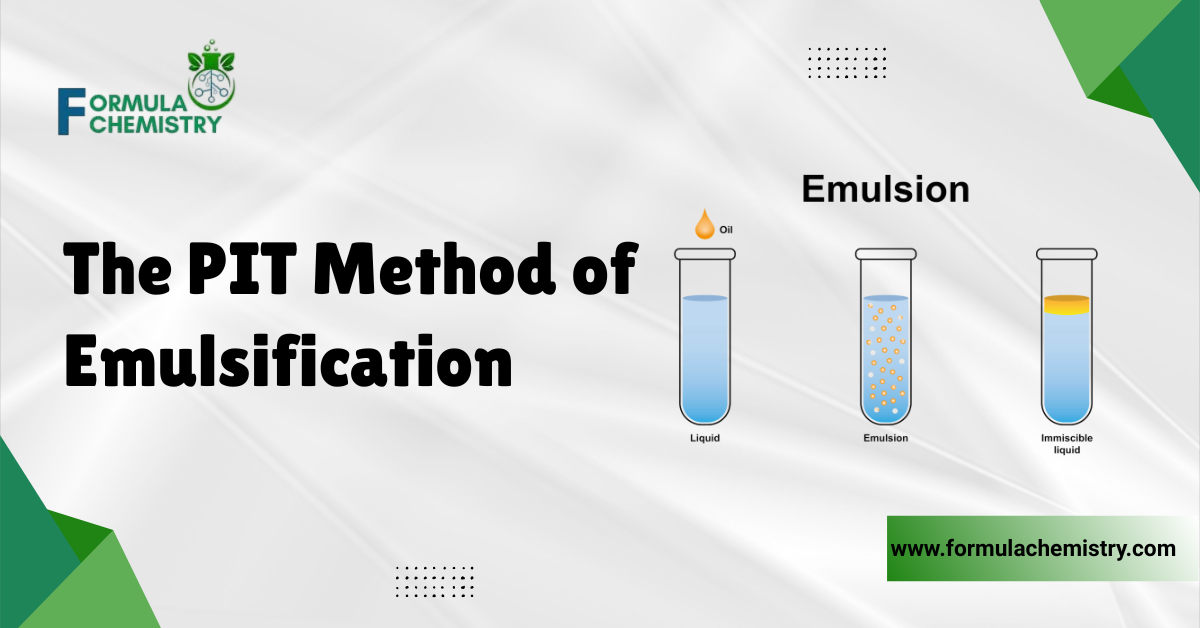
As the system cools through the PIT, it inverts to oil-in-water at the exact moment interfacial tension is lowest. Droplets form at a nanoscale size because almost no energy is needed to disperse them at that point, which is the heart of phase inversion emulsification.
This makes the PIT method a true low-energy emulsification route. It replaces the mechanical shear of a homogeniser with thermal energy and a controlled cooling curve, reaching droplet sizes that normally demand high-pressure equipment.
The cooling curve emulsion step is where the droplet size is decided. Rapid cooling through the PIT locks in small droplets, while slow cooling lets droplets grow and produces a coarser, less stable emulsion.
The result is often a nano-emulsion PIT product, with droplets typically between 20 and 200 nanometres. These nanoemulsions appear translucent or transparent and resist creaming because their droplets are too small to rise quickly.
PIT formulation gives a formulator nanoscale results without capital equipment. The trade-off is sensitivity, since the method demands the right surfactant, accurate temperature control, and a controlled cooling rate to work reliably.
A Related Method: Phase Inversion Composition
Phase inversion composition, or PIC, is a sibling low-energy method that inverts an emulsion at constant temperature rather than by heating and cooling. Instead of crossing the inversion point with temperature, you cross it by gradually changing the composition.
In a typical PIC process, you add water slowly to a surfactant and oil mixture held at one temperature. The system passes from water-in-oil through an inversion to oil-in-water, forming fine droplets as it crosses the transition.
PIC suits formulas with heat-sensitive ingredients better than the temperature route does. Because the process runs at a single, moderate temperature, it avoids heating fragile actives, while still delivering low-energy nanoscale droplets.
How to Measure Phase Inversion Temperature
PIT measurement relies on the fact that oil-in-water and water-in-oil emulsions conduct electricity very differently. An oil-in-water emulsion conducts well because its continuous phase is water, while a water-in-oil emulsion barely conducts because oil surrounds every droplet.
To measure the PIT, you heat the emulsion slowly while recording its electrical conductivity. The conductivity stays high while the system is oil-in-water, then drops sharply as the system inverts to water-in-oil, and the temperature of that sharp drop is the PIT.
| Temperature stage | Emulsion type | Conductivity |
| Below PIT | Oil-in-water | High |
| At PIT | Inverting | Falling sharply |
| Above PIT | Water-in-oil | Low |
A slow, steady heating rate gives the most accurate reading. Heating too quickly blurs the transition and shifts the apparent PIT away from its true value.
You can confirm the result visually alongside the conductivity reading. The emulsion often turns clear or bluish near the PIT as droplets reach the nanoscale, then becomes turbid again as it inverts fully.
Designing a PIT Formulation
A successful PIT formulation starts with surfactant choice. The technique needs an ethoxylated non-ionic surfactant whose PIT sits in a workable range, such as an ethoxylated fatty alcohol or a polysorbate paired with a co-surfactant.
The relationship between the PIT and the storage temperature decides stability. For a stable oil-in-water product, formulate so the PIT sits well above the storage temperature, with a common guideline of storing the finished emulsion at least 20°C below its PIT.
Several factors shift the PIT, and adjusting them lets you place it where you need it. The table below summarises the main levers.
| Factor | Effect on PIT |
| Higher surfactant HLB | Raises the PIT |
| More polar oil | Lowers the PIT |
| Added an electrolyte such as salt | Lowers the PIT |
| Higher surfactant concentration | Sharpens and can shift the PIT |
Oil choice has a strong effect on where the PIT lands. Non-polar oils such as Caprylic/Capric Triglyceride give a higher PIT, while more polar oils pull it down, so the oil and surfactant must be chosen together.
Electrolytes give fine control over the PIT. Adding a small amount of salt to the water phase lowers the PIT, which is useful when an oil and surfactant pair would otherwise invert at an inconvenient temperature.
A representative starting system pairs an ethoxylated fatty alcohol surfactant with a non-polar oil at roughly 5% to 10% surfactant and 5% to 15% oil. Such a system often shows an inversion point in the 50°C to 80°C range, which keeps it comfortably above room-temperature storage. You heat above that point, cool rapidly through it, then verify the finished droplet size and stability.
The preservation rules do not change for a PIT product. Any oil-in-water nanoemulsion contains a continuous water phase, so it still requires a full-strength broad-spectrum preservative and a verified pH, like any other emulsion.
PIT Versus High-Energy Emulsification
The PIT method and high-energy emulsification reach similar droplet sizes by very different routes. High-energy methods use mechanical shear from a rotor-stator or high-pressure homogeniser, while the PIT method uses thermal energy and a controlled cooling curve.
| Parameter | PIT method (low-energy) | High-energy method |
| Energy source | Thermal, controlled cooling | Mechanical shear |
| Equipment | Heat source, stirrer, thermometer | High-pressure or rotor-stator homogeniser |
| Surfactant type | Non-ionic ethoxylated only | Broad range |
| Heat-sensitive actives | Poorly suited, needs heating | Better suited, can stay cool |
| Scale-up | Sensitive to cooling rate | More forgiving |
The PIT method wins on equipment cost and droplet fineness for suitable systems. It removes the need for a homogeniser, which lowers the barrier to making nanoemulsions in a small lab. This is the kind of technique the Formula Chemistry audience reaches for when high-pressure equipment is out of budget.
High-energy methods win on flexibility. They work with almost any surfactant, handle heat-sensitive actives more easily, and scale up with fewer process variables, which is why they remain the default in much of the industry.
The honest position is that PIT is a specialist tool, not a universal upgrade. It excels for non-ionic systems where a translucent, fine nanoemulsion is the goal, and it is the wrong choice when the formula relies on ionic surfactants or heat-sensitive actives.
Common PIT Mistakes
These are the errors that derail PIT work most often. Each one names the mistake, explains why it happens, and gives the exact fix.
- Using an ionic surfactant. Formulators try the PIT method with an ionic emulsifier and find no clean inversion, because ionic surfactants lack the temperature-driven HLB shift. Use only ethoxylated non-ionic surfactants for PIT work.
- Cooling too slowly through the PIT. A slow cooling curve lets droplets grow and coarsen the emulsion, defeating the purpose of the method. Cool rapidly through the PIT to lock in nanoscale droplets.
- Setting the PIT too close to storage temperature. When the PIT sits near the storage temperature, the product can invert or destabilise in normal conditions. Formulate so the PIT sits well above storage, generally at least 20°C higher.
- Measuring PIT with fast heating. Heating too quickly during measurement blurs the conductivity transition and gives an inaccurate PIT. Heat slowly and steadily while recording conductivity for a sharp, reliable reading.
- Ignoring the effect of electrolytes. Adding salts or actives without accounting for their effect on the PIT shifts the inversion point unexpectedly. Account for electrolytes during design, since even small amounts lower the PIT.
- Skipping preservation because the product looks clean. A translucent nanoemulsion still has a continuous water phase that supports microbial growth. Include a full-strength broad-spectrum preservative and verify the pH.
- Choosing PIT for heat-sensitive actives. The method requires heating the whole system above the PIT, which can degrade fragile actives. Add heat-sensitive actives only after cooling, or choose a high-energy method instead.
Suitability Guide
The PIT method suits formulators building fine oil-in-water nanoemulsions with non-ionic surfactants. It is most valuable when a translucent texture or nanoscale droplet size is the goal and high-pressure equipment is unavailable.
This is an advanced technique rather than a beginner project. A formulator should be comfortable with standard emulsions, HLB, and temperature control before attempting PIT work, since it adds several sensitive process variables.
The method fits light serums, essences, and translucent lotions particularly well. Its fine droplets give a light skin feel and a clarity that conventional emulsification struggles to match.
PIT is not suited to formulas built on ionic surfactants or fragile, heat-sensitive actives. Those formulas call for a high-energy method or a cool-process approach, where the active never sees the temperatures the PIT method requires.
Always conduct a 48-hour patch test with any new formula before wider use.
Frequently Asked Questions
What is phase inversion temperature?
Phase inversion temperature, or PIT, is the temperature at which a non-ionic surfactant emulsion inverts between oil-in-water and water-in-oil. Below the PIT, the system is oil-in-water, and above it, the system is water-in-oil. The inversion happens because the surfactant’s effective HLB falls as temperature rises.
What causes phase inversion in emulsions?
Phase inversion is driven by the temperature dependence of a non-ionic surfactant’s HLB. As the temperature rises, the surfactant’s polyoxyethylene chain dehydrates and becomes less water-loving, shifting the system from oil-in-water to water-in-oil. The crossover point is the PIT.
How is PIT measured?
The PIT is measured by heating the emulsion slowly while recording its electrical conductivity. Conductivity stays high while the system is oil-in-water, then drops sharply at the inversion. The temperature of that sharp drop is the PIT.
Does PIT make nanoemulsions?
Yes, the PIT method can produce nanoemulsions with droplets typically between 20 and 200 nanometres. Cooling rapidly through the PIT forms fine droplets because interfacial tension is at its minimum there. These nanoemulsions often look translucent and resist creaming.
Why does HLB change with temperature?
A non-ionic surfactant’s polyoxyethylene chain is hydrated and water-loving at low temperatures. As the temperature rises, the chain dehydrates and loses water affinity, lowering the surfactant’s effective HLB. This shift moves the system from oil-in-water toward water-in-oil.
Is the PIT method low energy?
Yes, the PIT method is a low-energy emulsification technique. It uses thermal energy and a controlled cooling curve instead of the mechanical shear of a homogeniser. This lets it reach nanoscale droplets without high-pressure equipment.
How far below PIT should I store?
A common guideline is to store a finished oil-in-water emulsion at least 20°C below its PIT. Keeping a clear margin below the PIT prevents the product from inverting or destabilising in normal conditions. The exact margin depends on the surfactant and oil system.
Which surfactants work with PIT?
The PIT method works only with ethoxylated non-ionic surfactants, such as ethoxylated fatty alcohols and polysorbates. These show the temperature-driven HLB shift on which the method depends. Ionic surfactants do not invert cleanly and are unsuitable.
Key Takeaways
You now have the phase inversion temperature, or PIT, as a working technique rather than a textbook curiosity. These are the points worth carrying into your emulsion work.
- Phase inversion temperature is the point where a non-ionic emulsion flips between oil-in-water and water-in-oil as temperature changes.
- The inversion happens because an ethoxylated surfactant’s HLB falls with rising temperature as its polyoxyethylene chain dehydrates.
- Cooling rapidly through the PIT forms nanoscale droplets at minimal interfacial tension, a true low-energy route to nanoemulsions.
- The PIT is measured by conductivity, and a stable oil-in-water product should be stored well below its PIT.
- The method works only for non-ionic surfactants and suits fine nanoemulsions, not ionic systems or heat-sensitive actives.
Measure the PIT of a simple non-ionic system, then cool a small batch rapidly through that point, and you will see the PIT turn from theory into a nanoemulsion you made without a homogeniser.