
An emulsion works because of the perfect emulsifier. Whether you’re making a simple lotion or a rich cream, choosing the correct ingredient to blend oil and water is key to your product turning out well.
If you’re just starting out, the large number of choices can feel overwhelming. Learning what these ingredients are made of helps you guess how your product will turn out, how it looks, feels, and holds together—before you even mix anything.
This guide outlines 17 essential guidelines, categorized by function and science, to help you navigate the complex world of emulsifiers and create professional-grade Formula Chemistry DIY products. By the end, you will understand the critical factors that influence emulsion stability and feel confident in your ingredient choices.
Before selecting an emulsifier, it’s crucial to understand what defines a stable emulsion and how it can be achieved.
Before picking an ingredient, it helps to know how your mixture will work.
The Interface Mechanics
An emulsifier works by lowering the surface tension between two immiscible liquids. It positions itself at the interface, with a hydrophilic head in the water and a lipophilic tail in the oil.
If the emulsifier’s chemical formula does not align with the polarity of your oil phase, the interface weakens. This leads to coalescence, in which oil droplets merge and eventually float to the surface, ruining the product.
The Importance of the HLB System
HLB stands for Hydrophile-Lipophile Balance. It’s a simple idea that helps you guess how well an emulsifier will work. Many emulsifiers are non-ionic and work with both oil and water.
While new emulsifiers sometimes use different scientific ideas instead of just HLB numbers, knowing about HLB is still really helpful for making stable basic lotions, especially if you’re learning formula chemistry.

Discover smoother, silkier formulations with Olivem 300: The Liquid Emollient Changing Skincare Textures.
The Chemistry Formula: Matching Charge and Polarity
The first set of guidelines focuses on the ionic interactions in your beaker.
Guideline 1: Identify the Ionic Charge
It’s important to know if your emulsifier is anionic (negative), cationic (positive), or non-ionic (neutral). For example, if you mix a cationic emulsifier with an anionic thickener, your mixture won’t work and might become lumpy right away.
Guideline 2: Oil Phase Polarity
Oils are different from each other. Mineral oil is not attracted to water (nonpolar), while vegetable oils and esters are (polar). Pick an emulsifier that matches your oil type to help your mixture hold together well.
Guideline 3: pH Stability Range
Check the technical data sheet for the effective pH range. Some natural emulsifiers break down in acidic environments (low pH), making them unsuitable for AHA creams or chemical peels.
Guideline 4: Electrolyte Tolerance
If your formula contains salts, Aloe Vera, or sodium lactate, you need an emulsifier that resists electrolytes. Many traditional emulsifiers destabilize in the presence of ions, leading to emulsion breakdown.
Texture and Sensory Profile in Formula Chemistry Skincare
The feel of the product is dictated almost entirely by the emulsifier and the liquid crystal structure it forms.
Guideline 5: Target Viscosity
Determine whether you want sprayable milk or thick butter. High-HLB emulsifiers tend to create thinner lotions, while complex waxy emulsifiers build viscosity naturally without extra thickeners.
Guideline 6: The “Soaping” Effect
Some emulsifiers, particularly those with large stearate heads, turn white on the skin during application. To avoid this “soaping,” look for a formula with chemistry that rapidly reduces surface tension.
Guideline 7: Skin Penetration and Drag
Think about how the product feels as you rub it in. Some emulsifiers sink in fast (good for oily skin), while others give you more time to spread them (great for massage creams).
Guideline 8: After-Feel and Residue
Does your product feel waxy or smooth after it dries? How your lotion feels on skin matters—a lot. For example, cationic emulsifiers leave a soft, conditioned finish that many people like.
Guideline 9: Moisturization Properties
Modern emulsifiers sometimes do more than just mix oil and water—they can help hydrate your skin, acting a bit like your skin’s natural barrier.
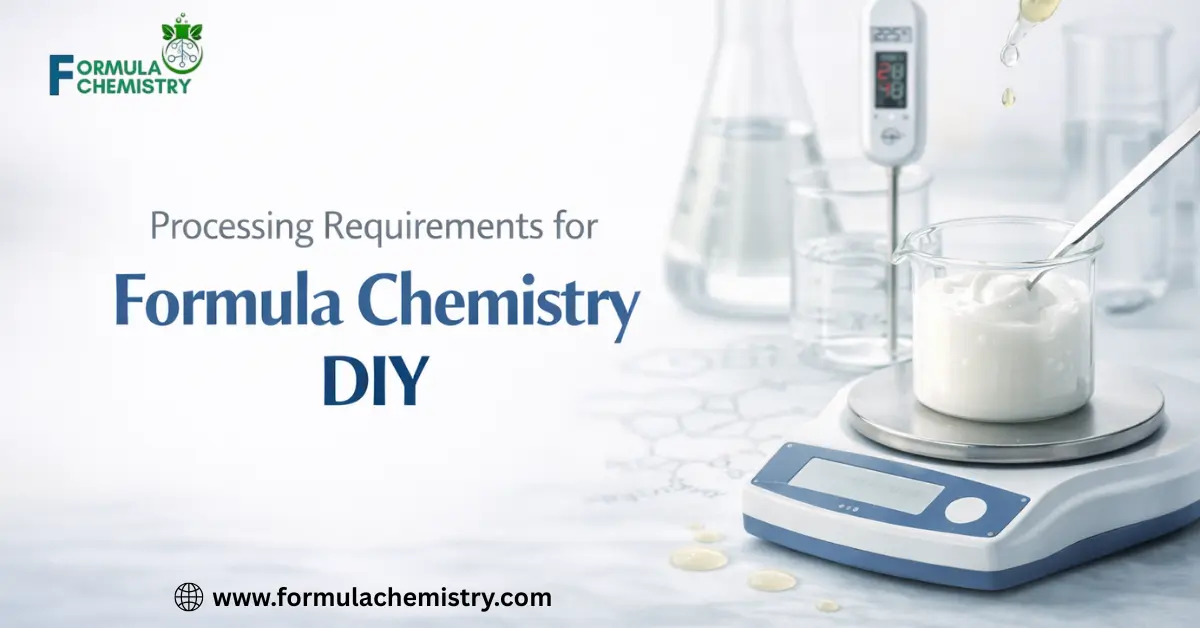
Processing Requirements for Formula Chemistry DIY
The tools and equipment you have will affect which ingredients you can use.
Guideline 10: Hot vs. Cold Process
Most emulsifiers require heating both phases to 70°C-75°C. If you want to save energy or protect heat-sensitive oils, choose a modern “cold process” polymer or emulsifier that works at room temperature.
Guideline 11: Shear Sensitivity
Some structures are destroyed by high shear (vigorous mixing), while others require it to form. Check if your emulsifier needs a homogenizer or if a simple spoon stir is sufficient for the chemistry formula.
Guideline 12: Addition Phase
Know when to add the emulsifier. Most go into the oil phase, but some water-soluble polymers must be hydrated in the water phase first to function correctly.
Guideline 13: Thickening Requirements
Does the emulsifier thicken on its own, or does it require a co-emulsifier, such as Cetyl Alcohol? A self-thickening emulsifier simplifies the Formula Chemistry DIY process for beginners.
Sustainability and Market Trends
The final considerations involve the ethics, cost, and sourcing of your raw materials.
Guideline 14: PEG-Free Options
The market is shifting away from Polyethylene Glycols (PEGs). Choosing a PEG-free emulsifier aligns with the clean beauty movement and reduces the risk of 1,4-dioxane contamination.
Guideline 15: Palm Oil Sustainability
Many emulsifiers are derived from palm oil. Ensure your supplier offers RSPO (Roundtable on Sustainable Palm Oil) certified ingredients to ensure your product is ethically sound.
Guideline 16: Cost-Effectiveness
Calculate the cost per use, not just the price per gram. A cheap emulsifier that requires 10% usage is more expensive than a premium one that works at 2%.
Guideline 17: Regulatory Compliance
Ensure the chemical formula of your emulsifier is approved for use in your target market (e.g., EU vs. FDA regulations). Certain ethoxylated ingredients are restricted in specific regions.
Conclusion
Selecting the perfect emulsifier requires balancing science, sensory needs, and processing abilities. Focus on three key criteria: product stability, user experience, and production compatibility. Keeping these in mind will guide your evaluation process.
By following these 17 guidelines, you build products that are stable, robust, and appealing. Always match your emulsifier to both the intended formula and your available production capabilities for the best results. This is the core takeaway for successful projects.
Whether you are crafting a high-performance commercial product or a simple Formula Chemistry DIY lotion, the right emulsifier is the silent hero that makes it all possible.
FAQ’s about 17 Guidelines for Choosing the Perfect Emulsifier
What is the easiest emulsifier for beginners?
Polawax (Emulsifying Wax NF) is widely considered the easiest for beginners. It is robust, forgiving of small weighing errors, and creates stable emulsions across a wide range of oil concentrations without needing complex calculations.
Can I mix two emulsifiers together?
Yes, and it is often recommended. Using a high-HLB and a low-HLB emulsifier together creates a more stable interface. This “mixed emulsifier system” packs more tightly around the oil droplets, preventing separation.
Why did my lotion separate after a week?
Separation usually occurs due to incompatible polarity, incorrect HLB, or insufficient shear during mixing. It can also happen if the product isn’t cooled properly during stirring, preventing the crystal network from forming correctly.
What is a cold process emulsifier?
A cold process emulsifier does not require heating to work. Ingredients like Polyacrylate-13 or certain modified starches can emulsify oils at room temperature, preserving heat-sensitive actives and saving energy.
How do I know how much emulsifier to use?
A general rule of thumb for standard lotions is to use 20-25% of the oil phase weight. For example, if your total oil phase is 20g, you would typically start with 4-5g of emulsifier. Always check the supplier’s recommended usage rate.
Are natural emulsifiers as stable as synthetic ones?
Natural emulsifiers (such as beeswax/borax or lecithin) are generally harder to stabilize than synthetic emulsifiers. They often require co-emulsifiers and thickeners, such as Xanthan Gum, to achieve shelf stability comparable to that of commercial products.
What does “liquid crystal structure” mean?
Liquid crystals are organized structures formed by certain emulsifiers that mimic the skin’s own lipid bilayer. They hold water in a rigid network, providing long-lasting hydration and a superior barrier function compared to simple oil-in-water emulsions.
Can I use beeswax as a sole emulsifier?
No, beeswax is technically a thickener and stiffener, not a primary emulsifier. While it has mild emulsifying properties, it cannot stabilize a lotion on its own. It requires a chemical reaction (like with Borax) or a primary emulsifier to bind water and oil.