

Introduction
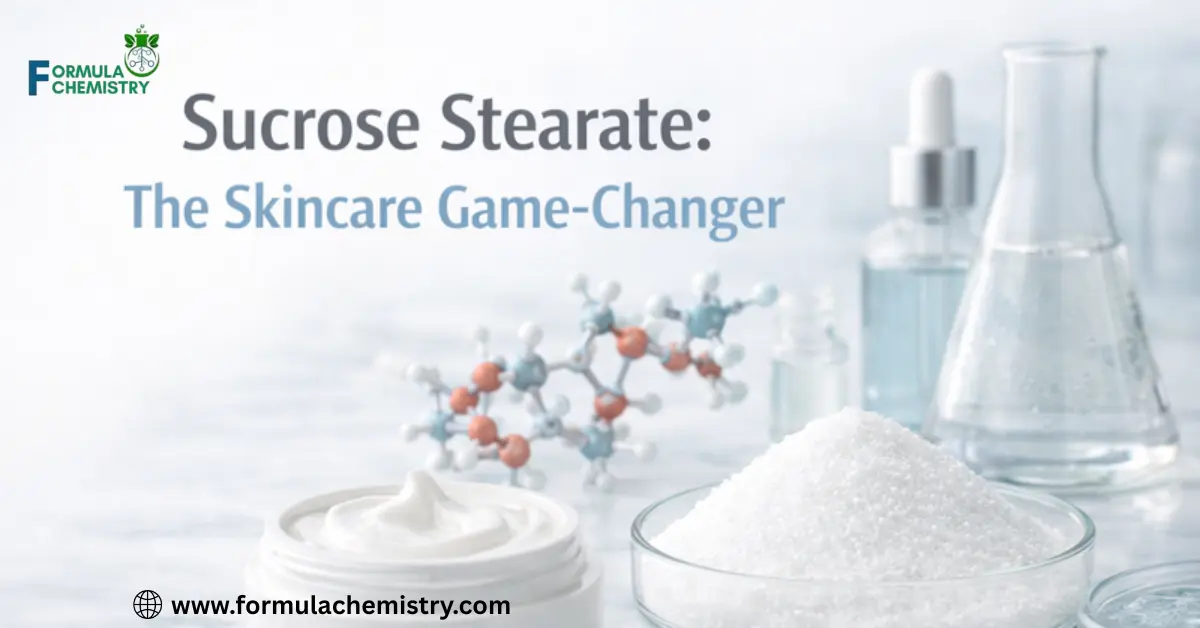
Sucrose stearate is a versatile, plant-derived non-ionic surfactant and emulsifier that has transitioned from the food industry to act as a cornerstone of high-end skincare formulation.
Unlike harsh synthetic emulsifiers, this sucrose ester delivers a unique combination of mildness and sophisticated skin feel. It is produced by the esterification of sucrose (sugar) and stearic acid (a fatty acid), resulting in a biomimetic ingredient that respects the skin’s lipid barrier.
In modern cosmetic chemistry, sucrose stearate is prized for its ability to create stable oil-in-water (O/W) emulsions with a powdery, non-greasy finish.
Because it is PEG-free and biodegradable, it fits perfectly with the “Clean Beauty” movement while providing the technical performance required for professional-grade serums and lotions.
Whether you are formulating for sensitive skin or seeking a “cold process” compatible ingredient, sucrose stearate offers a level of flexibility rarely found in traditional waxes.
Formula Chemistry provides practical formulation education and safety-forward guidance for developers looking to master these complex sugar-based esters.
Quick Answer: Key Benefits of Sucrose Stearate
- Natural Origin: Derived from renewable sugar beets and vegetable oils.
- Multifunctional: Acts as an emulsifier, thickener, and skin-conditioning agent.
- High Skin Compatibility: Extremely mild and non-irritating, rendering it ideal for atopic dermatitis or sensitive skin.
- Usage Rate: Typically used at 1% to 5% in the oil or water phase, depending on the grade.
- Texture Profile: Leaves a velvety, matte after-feel that reduces the “greasiness” of heavy oils.
- Cold Processing: Many grades can be used without heat, saving energy and protecting heat-sensitive actives.
- Moisture Retention: Improves the skin’s Natural Moisturizing Factor (NMF) by reducing transepidermal water loss (TEWL).
See how Olivem 300: The Liquid Emollient Changing Skincare Textures can transform your routine.
What Is Sucrose Stearate and How Does It Function in Skincare?
The Chemical Composition of Sugar Esters
Sucrose stearate is a sucrose fatty acid ester. Chemically, it consists of a sucrose molecule, which is highly hydrophilic (water-loving) bonded to stearic acid, which is lipophilic (oil-loving).
This twofold nature permits it to sit at the interface of oil and water, reducing surface tension and allowing the two phases to blend into a stable emulsion.
Depending on the HLB (Hydrophilic-Lipophilic Balance) value, which usually ranges from 6 to 15, it can produce everything from fluid milks to dense creams.
Role as a Delivery System and Barrier Support
Beyond simply mixing oil and water, sucrose stearate improves the penetration of other active ingredients. Its structure allows it to temporarily and gently reorganize the stratum corneum lipids, facilitating the absorption of vitamins and antioxidants.
Furthermore, because it mimics the skin’s natural glycolipids, it assists in barrier repair. It does not “strip” the skin like traditional sulfates; instead, it leaves a protective, breathable film that prevents dehydration.
Technical Application and Formulation Guidelines
Effective Usage Rates and Phase Integration
For most skincare applications, a usage rate of 2% to 3% is sufficient for stabilization. In cleansing oils, it can be used at higher concentrations to ensure the product rinses cleanly with water.
If you are working with a high HLB version, it is typically added to the water phase. However, it is highly compatible with the oil phase in “hot-hot” emulsification processes.
It is vital to maintain a pH range of 5.0 to 8.0; extreme acidity can cause the ester bond to hydrolyze, leading to emulsion failure.
Stability Problems: Common Problems and Fixes
Working with sugar esters can be finicky for beginners. A frequent problem is graininess in the final cool-down. This usually occurs if the sucrose stearate was not fully hydrated or melted.
To fix this, ensure the water phase is agitated thoroughly using a high-shear mixer. Another problem is phase separation over time.
Because sucrose stearate is a mild emulsifier, it often requires a co-emulsifier (like Glyceryl Stearate) or a thickener (like Xanthan Gum at 0.2%) to build a strong internal structure.
| Feature | Technical Specification |
| INCI Name | Sucrose Stearate |
| HLB Value | 6–15 (Grade dependent) |
| Recommended Usage | 1%–5% |
| Optimal pH | 5.5–7.0 |
| Charge | Non-ionic |
| Solubility | Dispersible in oil or water |
| Appearance | White to off-white powder or pellets |
Keep your skin soft and smooth with Glyceryl Oleate: Skin-Conditioning Agent.
Safety, Compatibility, and Skin Type Suitability
Who Should Use Sucrose Stearate?
Sucrose stearate is the “gold standard” for individuals with sensitive, reactive, or dry skin. Because it is non-comedogenic, it is also an excellent choice for oily skin types that require hydration without the heavy, occlusive feel of petrolatum or beeswax.
It is frequently found in baby care products and eye creams due to its low ocular irritation potential. However, those with a known allergy to specific vegetable oil sources (like palm or coconut, often used to derive the stearic acid) should verify the manufacturer’s source.
Formulation Safety and Preservation
While sucrose stearate is a “natural” ingredient, it provides a nutritious substrate for microbial growth because of its sugar component. Strict preservation cannot be compromised in any water-based formula containing sugar esters.
Use a broad-spectrum preservative like Phenoxyethanol/Ethylhexylglycerin or Benzyl Alcohol/DHA. Furthermore, while rare, some users may experience mild redness if the concentration is excessively high in a leave-on product.
Always perform a patch test when testing new formulations on the skin.
Boost your formulas with Polyglyceryl-3 Methylglucose Distearate: Skincare Powerhouse for smooth, nourished skin.
Advanced Formulation Strategies for Professionals
Synergies with Active Ingredients
Sucrose stearate performs exceptionally well when paired with Ceramides and Fatty Acids, creating a “lamellar” structure that mimics the skin’s own architecture.
It is also highly compatible with Hyaluronic Acid, as the sugar ester helps lock in the humectant’s moisture. In suncare, it is used to help disperse Zinc Oxide or Titanium Dioxide, allowing a more even application and reducing the “white cast” often associated with mineral filters.
Comparative Study: Sucrose Stearate vs. Traditional Emulsifiers
Unlike Polysorbate 60 or Ceteareth-20, sucrose stearate does not contain ethylene oxide, making it preferred for 1,4-dioxane-free claims.
While traditional waxes often create a “soapy” effect (micro-foaming) during application, sucrose stearate suppresses this, permitting a premium, high-end “rub-in” experience.
It is also more electrolyte-tolerant than many anionic emulsifiers, allowing you to include sodium PCA or certain botanical extracts that might otherwise crash an emulsion.
FAQs about Sucrose Stearate: The Skincare Game-Changer
Is sucrose stearate vegan?
Yes, most commercially available sucrose stearate is 100% plant-derived, using sugar from beets or cane and stearic acid from vegetable oils.
Can I use sucrose stearate in a cold-process formula?
Yes, specific grades are designed for cold processing, which is ideal for protecting the integrity of heat-sensitive oils and botanical extracts.
Does sucrose stearate cause acne?
No, it is generally considered non-comedogenic. Its light, powdery finish makes it suitable even for acne-prone skin.
What is the typical shelf life of a product containing this ingredient?
The ingredient itself usually has a shelf life of 24 months, but the final product’s stability depends on your preservation system and packaging.
Can I use it in anhydrous (waterless) balms?
While primarily an emulsifier, it can be added to anhydrous balms at 1–3% to improve the “rinse-off” capability and skin feel.
Is it safe for use during pregnancy?
Yes, sucrose stearate is widely considered safe for topical use during pregnancy and breastfeeding.
How does it affect the viscosity of a cream?
Sucrose stearate is a weak thickener on its own. It provides some body, but usually requires a fatty alcohol or gum to achieve a thick cream consistency.
Are there any ingredients I ought to avoid mixing with it?
Avoid strong acids (pH below 4) or strong alkalis (pH above 9), as these can break the chemical bonds of the ester, leading to product failure.