
By Dr. SamiUllah, PhD, Lead Formulator at Formula Chemistry
Quick Answer
A cosmetic formulation course in India teaches the science of developing skincare, haircare, and personal care products using cosmetic ingredients, formulation principles, stability testing, preservation systems, and regulatory requirements.
The best programs combine laboratory practice, ingredient chemistry, formulation troubleshooting, product development, and certification that prepares students for careers in cosmetic R&D, quality assurance, product innovation, or entrepreneurship.
Introduction
India’s cosmetic manufacturing industry has grown rapidly over the past decade, creating strong demand for trained cosmetic formulators who understand both formulation science and regulatory compliance. Brands are no longer looking only for chemistry graduates. They increasingly value professionals who can develop stable, safe, consumer-friendly products that perform consistently.
Choosing the right cosmetic formulation course in India can determine how quickly you build practical formulation skills. Some programs emphasize cosmetic chemistry, while others focus on industrial manufacturing, quality control, or entrepreneurship.
This guide ranks some of the best cosmetic formulation programs available in India. It explains what each course offers, who should enroll, expected fees, career opportunities, and the factors that matter most before making your investment.
How We Ranked These Programs
At Formula Chemistry, we evaluate cosmetic education from a professional formulator’s perspective rather than marketing claims.
Our rankings prioritize laboratory exposure, curriculum quality, instructor expertise, ingredient science, formulation practice, industry relevance, certification value, and career applicability instead of promotional popularity.
The following criteria were used:
- Curriculum depth
- Practical laboratory sessions
- Cosmetic chemistry coverage
- Product formulation experience
- Faculty expertise
- Industry recognition
- Certification credibility
- Career support
- Value for tuition fees
- Suitability for beginners and professionals
Best Cosmetic Formulation Courses in India
| Rank | Institution | Best For | Practical Training | Certification |
| 1 | ICT Mumbai | Advanced cosmetic chemistry | Excellent | Highly Recognized |
| 2 | Formula Chemistry | Online formulation education | Excellent | Professional Certificate |
| 3 | University Cosmetic Science Programs | Academic learning | Good | University Degree |
| 4 | Professional Cosmetic Academies | Beginners | Good | Certificate |
| 5 | Private Industry Workshops | Skill upgrades | Moderate | Participation Certificate |
1. ICT Mumbai
Among all institutions, the ICT Mumbai cosmetic programs are often considered one of the strongest choices for students seeking scientific depth.
The curriculum focuses heavily on chemistry, formulation science, analytical techniques, emulsions, surfactants, polymers, preservatives, and manufacturing principles. Students receive exposure to laboratory work and research methodologies that prepare them for industrial formulation environments.
Advantages
- Strong scientific foundation
- Excellent laboratory facilities
- Experienced faculty
- Industry reputation
- Research opportunities
Limitations
Admission is competitive, and the curriculum can be demanding for students without a chemistry background.
2. Formula Chemistry
Formula Chemistry focuses specifically on practical cosmetic formulation rather than academic chemistry alone.
Students learn how to formulate skincare, haircare, cleansers, serums, creams, lotions, shampoos, conditioners, face washes, sunscreens, and specialty cosmetic products using professional formulation methods.
The emphasis remains on solving real formulation problems that cosmetic entrepreneurs and product developers encounter during product development.
Best For
- Beginners
- Brand owners
- DIY formulators
- Cosmetic entrepreneurs
- Product developers
- Freelance formulators
3. University Cosmetic Science Programs
Several universities now offer specialized cosmetic science or pharmaceutical programs that include cosmetic formulation modules. These courses usually combine chemistry, microbiology, pharmaceutics, quality assurance, manufacturing practices, and product evaluation. Students interested in research or postgraduate education often benefit from this academic pathway.
4. Professional Cosmetic Training Institutes
Many private institutes across India provide certificate-based cosmetic formulation training programs. These programs generally focus on practical formulation rather than extensive theoretical chemistry. Course duration ranges from weekend workshops to several months, depending on curriculum depth.
Before enrolling, evaluate whether laboratory sessions involve actual formulation practice instead of demonstrations only.
5. Industry Workshops
Short-term workshops are valuable for professionals who already possess basic cosmetic chemistry knowledge. They commonly cover advanced emulsions, natural cosmetics, surfactant systems, preservative optimization, stability testing, or specific product categories. These workshops are excellent for continuing education, but usually do not replace comprehensive professional training.
Which City Offers the Best Cosmetic Courses?
Students frequently compare regional options before enrolling because each city has different educational strengths.
Cosmetic Course Mumbai
Mumbai remains one of India’s strongest education hubs due to established institutes, research facilities, manufacturing companies, and networking opportunities. Students searching for a cosmetic course in Mumbai often find programs with stronger laboratory infrastructure and better industry exposure.
Cosmetic Course Delhi
A cosmetic course in Delhi may appeal to students interested in pharmaceutical sciences, regulatory affairs, and cosmetic manufacturing careers. Delhi also offers access to numerous healthcare and research institutions.
Cosmetic Course Bangalore
Those considering a cosmetic course in Bangalore benefit from the city’s growing biotechnology ecosystem and expanding startup environment. Many learners combine cosmetic science with biotechnology and product innovation.
Cosmetic Course Chennai
A cosmetic course in Chennai generally emphasizes pharmaceutical sciences alongside cosmetic product development. The city’s educational ecosystem supports students pursuing laboratory and manufacturing careers.
Cosmetic Course Kerala
Interest in cosmetic courses in Kerala continues to grow because of increasing demand for herbal, Ayurvedic, and natural cosmetic products. Many programs integrate botanical ingredients with modern cosmetic formulation principles.
Cosmetic Course India Fees
One of the first questions students ask is about the cosmetic course in India fees. Fees vary considerably depending on course duration, institution reputation, laboratory facilities, certification level, and whether the program is online or classroom-based.
| Course Type | Typical Fee Range |
| Weekend Workshop | Low |
| Certificate Course | Low to Moderate |
| Professional Diploma | Moderate |
| University Program | Moderate to High |
| Specialized Cosmetic Science Degree | High |
Students should compare curriculum quality instead of selecting a course based only on tuition cost. A lower-priced course with minimal laboratory practice may provide less long-term value than a more comprehensive program.
What Should a Good Cosmetic Formulation Course Include?
The best cosmetic formulation course in India should teach far more than recipe preparation. Professional formulators need to understand why ingredients behave differently under changing manufacturing conditions.
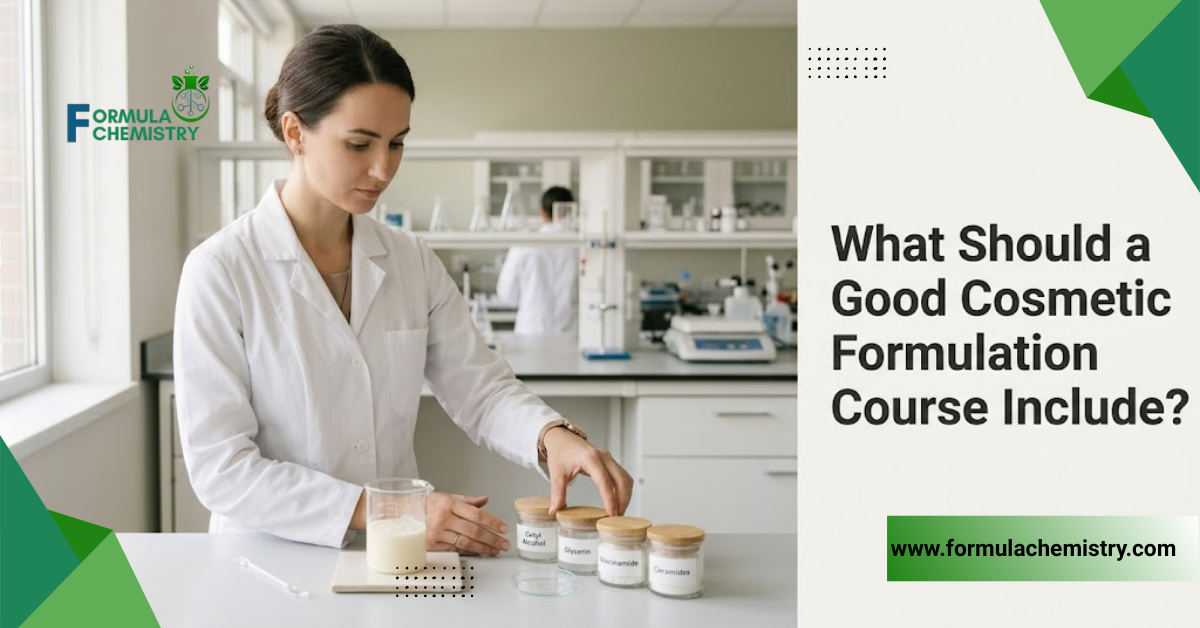
A comprehensive curriculum should include:
- Cosmetic ingredient chemistry
- INCI nomenclature
- Emulsion science
- Surfactant systems
- Preservative selection
- Stability testing
- pH adjustment
- Rheology
- Raw material compatibility
- Manufacturing processes
- Good Manufacturing Practices
- Cosmetic regulations
- Product troubleshooting
- Scale-up principles
- Packaging compatibility
Learning these subjects develops formulation confidence instead of dependence on fixed formulations.
Formulation Considerations for Choosing a Cosmetic Course
Selecting a training program requires more than comparing brochures. A well-designed curriculum should develop the scientific thinking needed to create stable, safe, and commercially viable cosmetic products.
Ingredient Knowledge
Students should learn the function of every ingredient rather than simply memorizing formulations. Professional formulators understand emollients, humectants, emulsifiers, surfactants, rheology modifiers, preservatives, antioxidants, fragrances, and active ingredients before combining them into finished products.
Laboratory Experience
Hands-on formulation is one of the strongest indicators of course quality. Watching demonstrations cannot replace weighing raw materials, preparing batches, measuring pH, adjusting viscosity, and evaluating product stability. Laboratory practice also teaches troubleshooting skills that cannot be developed through theory alone.
Stability Testing
A cosmetic product is only successful if it remains stable throughout its intended shelf life. Students should gain experience with stability studies, centrifuge testing, heating and cooling cycles, freeze-thaw evaluation, compatibility testing, and visual quality assessment.
Cosmetic Regulations
Every cosmetic formulator should understand regulatory requirements before launching products.
A quality cosmetic course in India introduces labeling requirements, ingredient documentation, Good Manufacturing Practices (GMP), safety assessments, and cosmetic compliance applicable to commercial manufacturing.
Product Development Process
Professional formulation follows a structured workflow rather than trial and error. Students should learn how to identify product objectives, select suitable raw materials, create prototype formulations, optimize performance, perform stability studies, and prepare products for manufacturing.
Career Opportunities After Completing a Cosmetic Formulation Course
The Indian beauty industry offers opportunities across research, manufacturing, quality assurance, and entrepreneurship.
Graduates with practical formulation skills are increasingly valued by manufacturers producing skincare, haircare, personal care, and cosmetic products.
Common career paths include:
- Cosmetic Formulator
- Product Development Executive
- Research and Development Chemist
- Quality Assurance Officer
- Quality Control Analyst
- Technical Sales Specialist
- Cosmetic Manufacturing Supervisor
- Regulatory Affairs Executive
- Raw Material Technical Consultant
- Cosmetic Brand Founder
Many professionals also build successful businesses by developing private-label cosmetic products or launching their own skincare brands.
Common Mistakes When Choosing a Cosmetic Course
1. Selecting a Course Based Only on Price
Lower tuition fees do not always represent better value. Courses with limited laboratory sessions often leave graduates without the practical experience employers expect.
2. Ignoring Practical Training
Some institutions rely heavily on classroom lectures. A strong cosmetic formulation training program in India should include supervised formulation practice using professional cosmetic ingredients and laboratory equipment.
3. Overlooking Faculty Expertise
Experienced instructors provide insights that extend beyond textbooks. Learning from formulators with industry experience helps students understand production challenges, ingredient compatibility, and formulation troubleshooting.
4. Focusing Only on Certification
A certificate demonstrates course completion, but practical competence determines career success. Employers often evaluate formulation ability through technical discussions and product development experience rather than certificates alone.
5. Choosing an Outdated Curriculum
The cosmetic industry evolves continuously. Programs should include current formulation techniques, modern cosmetic ingredients, sustainability considerations, preservation strategies, and emerging product categories.
Suitability Guide
A cosmetic formulation course can benefit learners with different educational backgrounds when the curriculum matches their experience level.
Suitable For
- Chemistry graduates
- Pharmacy graduates
- Biotechnology students
- Cosmetic entrepreneurs
- Skincare business owners
- Beauty professionals seeking technical knowledge
- Product development professionals
- DIY formulators looking to build scientific skills
May Require Additional Preparation
Students without a science background may initially find ingredient chemistry and formulation calculations challenging. Many beginners succeed by starting with introductory cosmetic chemistry before progressing to advanced formulation topics. Always conduct a 48-hour patch test with any new formula before wider use.
Frequently Asked Questions
Is a cosmetic formulation course worth it in India?
Yes. India’s expanding personal care industry continues to increase demand for professionals who understand cosmetic formulation, quality control, and product development. Practical training provides skills that are valuable in both employment and entrepreneurship.
Which city has the best cosmetic formulation courses?
Mumbai offers several highly regarded programs because of its educational institutions and cosmetic manufacturing ecosystem. Students should compare curriculum quality, laboratory exposure, and faculty expertise rather than choosing solely by location.
What are the cosmetic course fees in India?
Fees vary according to institution, duration, laboratory facilities, and certification level. Short certificate programs generally cost less than diploma or university-level cosmetic science programs.
Can beginners join a cosmetic formulation course?
Yes. Many introductory programs are designed for learners without previous formulation experience. Courses that begin with ingredient fundamentals often provide the smoothest learning path.
Do cosmetic formulation courses include laboratory work?
Many professional programs include laboratory sessions where students prepare creams, lotions, shampoos, cleansers, serums, and other cosmetic products. Practical experience is one of the most valuable aspects of cosmetic education.
Is certification necessary for getting a job?
Certification strengthens a resume, but employers typically place greater value on formulation knowledge, laboratory skills, and problem-solving ability during product development.
Can I start my own skincare brand after completing a course?
Many entrepreneurs use formulation training as the foundation for launching skincare and haircare businesses. Success also depends on regulatory compliance, manufacturing practices, product testing, branding, and marketing.
How long does a cosmetic formulation course take?
Course duration varies from weekend workshops to several months, while university programs may extend over one or more academic years, depending on their curriculum.
Key Takeaways
Choosing the right cosmetic formulation course in India requires careful evaluation of curriculum quality, laboratory experience, instructor expertise, certification value, and career relevance.
A program that combines scientific knowledge with practical formulation develops skills that remain valuable across cosmetic research, manufacturing, quality assurance, and entrepreneurship.
Students should invest in education that builds genuine formulation competence rather than simply providing a certificate. Strong technical knowledge, consistent laboratory practice, and continuous learning form the foundation of a successful career in cosmetic science.