

Introduction
A formula can have excellent actives and still feel cheap if the emollient system is poorly built. Octyl palmitate for skin is used because it gives spread, cushion, and a soft dry after feel without the heavy drag of many triglyceride oils.
This guide explains what octyl palmitate is, how it behaves in skin formulas, where it fits in emulsions and anhydrous products, and how to choose usage levels without making creams greasy, unstable, or pore heavy.
Formula Chemistry treats esters as sensory tools. They do not just dilute a formula; they decide how the product moves, absorbs, and leaves the skin feeling after application.
What Octyl Palmitate Is
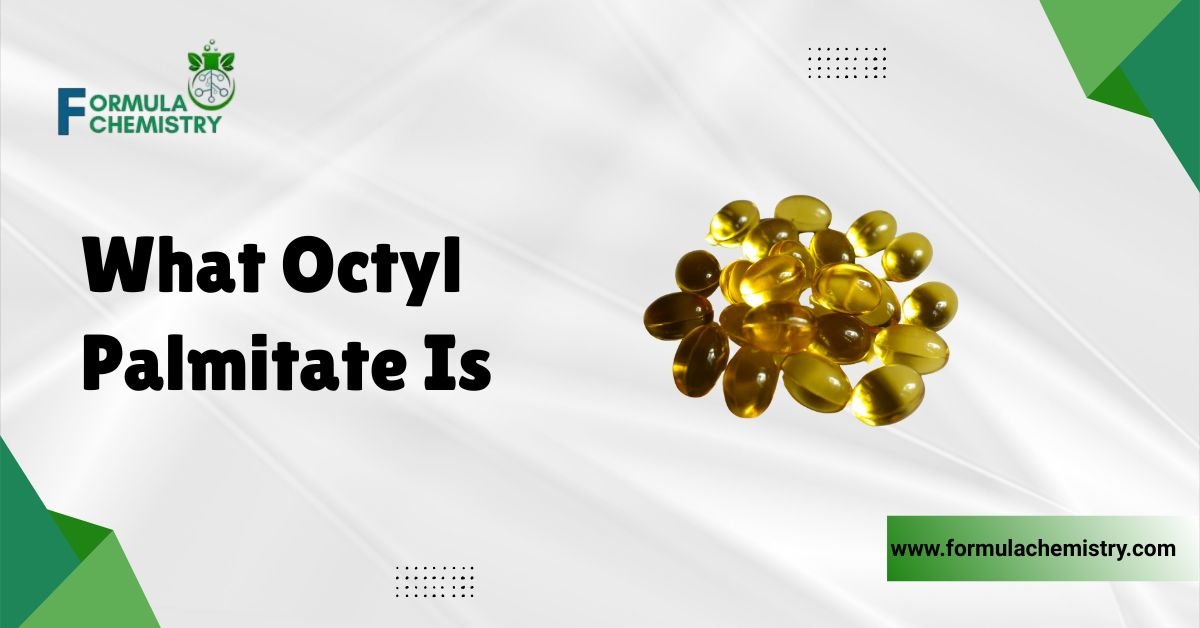
Octyl palmitate is an ester made from 2 ethylhexanol and palmitic acid. It is also commonly known as ethylhexyl palmitate in modern INCI naming.
It is a clear, oily liquid with a light to medium emollient feel. It spreads more easily than many vegetable oils and gives a smooth finish that works well in creams, lotions, makeup, sunscreens, and cleansing oils.
Octyl palmitate is not a vitamin A ingredient. The word palmitate refers to the palmitic acid portion of the ester, not to retinyl palmitate.
Key Properties Table of Octyl Palmitate
| Property | Technical Detail |
| INCI name | Ethylhexyl Palmitate |
| Older common name | Octyl Palmitate |
| CAS number | 29806 73 3 |
| Chemical class | Fatty acid ester emollient |
| Molecular weight | 368.64 g/mol |
| pKa | Not applicable for normal cosmetic formulation |
| Active pH range | Broadly stable in typical cosmetic pH ranges |
| Solubility | Oil soluble, insoluble in water |
| Appearance | Clear oily liquid |
| Polarity | Low to medium polarity ester |
| Typical usage in creams | 2.00% to 10.00% |
| Typical usage in lotions | 1.00% to 8.00% |
| Typical usage in makeup | 3.00% to 20.00% |
| Typical usage in cleansing oils | 5.00% to 30.00% |
| Formulator difficulty level | Beginner to intermediate |
Octyl Palmitate For Skin Feel
Octyl palmitate gives a smooth, cushiony glide. It reduces the waxy drag that can appear when creams contain high levels of fatty alcohols, butters, or structuring waxes.
The after feel is soft and slightly lubricious. It is lighter than castor oil, richer than many volatile emollients, and less oily than heavy triglyceride oils.
In facial creams, it improves rub out and reduces whitening during application. In body lotions, it helps the product spread across a larger skin area without pulling.
In makeup, it helps pigment wetting and improves payoff. It can make pressed and cream formats feel smoother when used with the right powders and waxes.
Solubility And Phase Placement of Octyl Palmitate
Octyl palmitate belongs in the oil phase. It does not dissolve in water and should not be added to the water phase of an emulsion.
In oil water emulsions, it is heated with the oil phase if the formula uses waxes, fatty alcohols, or solid emulsifiers. It can also be added during cool down when the system allows cold processing.
In anhydrous balms and sticks, it softens the structure and improves spread. Too much can weaken the stick, so wax level must be adjusted when it replaces firmer oils or butters.
In cleansing oils, octyl palmitate can act as part of the emollient base. It must be paired with a suitable solubilizer or emulsifier if the product needs to rinse cleanly.
Compatibility With Cosmetic Systems of Octyl Palmitate
Octyl palmitate is compatible with many common cosmetic oils, esters, silicones, waxes, fatty alcohols, oil soluble filters, pigments, and oil soluble actives. It is useful when the formula needs slip without a strong odor or color contribution.
It works well with glyceryl stearate systems, cetearyl alcohol, cetyl alcohol, emulsifying waxes, and polymer stabilized emulsions. The final emulsion still needs stability testing because compatibility does not guarantee stable viscosity.
It can support pigment dispersion in makeup. Its ester structure gives better wetting than many dry oils, especially when the pigment system needs a smoother glide.
It is not a preservative, antioxidant, or active treatment ingredient. It improves sensory performance and emollience, not medical skin outcomes.
Usage Levels By Product Type of Octyl Palmitate
The correct usage level depends on the product format and skin feel target. Low levels improve glide, while higher levels create a more cushiony and richer emollient system.
| Product Type | Typical Use Level | Main Purpose |
| Facial lotion | 1.00% to 5.00% | Light glide and softness |
| Facial cream | 2.00% to 8.00% | Cushion and spread |
| Body lotion | 3.00% to 10.00% | Large area application |
| Body butter | 5.00% to 15.00% | Reduce waxy drag |
| Cleansing oil | 5.00% to 30.00% | Emollient base and slip |
| Lip product | 2.00% to 10.00% | Gloss and glide |
| Cream makeup | 5.00% to 20.00% | Pigment wetting and payoff |
A good starting level in a face cream is 3.00% to 5.00%. This gives visible sensory improvement without making the product feel overly oily.
For oily or breakout-prone skin positioning, keep the level conservative and build the emollient system with lighter esters. Formula design matters more than one ingredient name.
pH Stability and Processing of Octyl Palmitate
Octyl palmitate has no practical pH value because it is not water-based. pH should be measured in the finished aqueous formula, not in the neat ester.
It is generally stable in the normal pH range used for creams, lotions, makeup, and cleansing oils. Extreme acid or alkaline processing should be avoided because esters can hydrolyze under harsh conditions.
The ingredient tolerates normal emulsion heating. Many formulators heat it with the oil phase to 70°C to 75°C when making standard emulsions.
Avoid unnecessary long heat holds. Extended heat exposure can increase oxidation pressure on the whole oil phase, especially when natural oils are present.
Formulation Considerations of Octyl Palmitate
Octyl palmitate can reduce perceived greasiness when it replaces heavier oils. It can also increase richness when added on top of an already heavy oil phase.
The best use is as part of an emollient blend. Pair it with lighter esters for faster absorption or with butters for a softer body cream.
It can influence viscosity. Replacing a solid butter with octyl palmitate will soften the formula and may reduce structure.
It can also influence perceived comedogenicity. No single ingredient guarantees breakouts, but high ester loads in heavy facial formulas may feel unsuitable for some users.
Comparison With Similar Emollients of Octyl Palmitate
Octyl palmitate sits between light esters and heavier oils. It gives more cushion than coco caprylate and less tack than castor oil.
| Emollient | Skin Feel | Best Use | Main Caution |
| Octyl Palmitate | Smooth, cushiony, soft | Creams, makeup, cleansing oils | Can feel heavy at high levels |
| Coco Caprylate | Light, dry, fast spread | Light lotions and serums | Can thin structure |
| Caprylic Capric Triglyceride | Medium, clean, neutral | General creams and oils | Less elegant glide |
| Isopropyl Myristate | Very high spread | Makeup and body products | Can feel too penetrating |
| Castor Oil | Glossy, tacky, adhesive | Lip and pigment products | Can feel sticky |
Choose octyl palmitate when the formula needs smoothness and cushion. Choose coco caprylate when the formula needs a drier, faster finish.
Safety And Skin Tolerance of Octyl Palmitate
Octyl palmitate is widely used in cosmetic products. It is generally considered suitable for skin use when formulated within normal cosmetic practice and tested in the finished product.
Sensitive skin formulas should avoid overloading the oil phase with too many rich esters. A mild formula depends on the whole composition, including fragrance, preservative, pH, and surfactants.
For leave on products, patch testing is sensible. Skin response depends on the finished formula, not the emollient alone.
Cosmetic use should not be confused with medical treatment. Octyl palmitate can improve feel and softness, but it does not treat acne, eczema, pigmentation, or barrier disorders.
Common Mistakes about Octyl Palmitate
- Confusing octyl palmitate with retinyl palmitate. Octyl palmitate is an emollient ester, so do not market it as a vitamin A ingredient.
- Adding it to the water phase. It is oil soluble, so place it in the oil phase or anhydrous phase.
- Using too much in face creams. High levels can feel heavy, so start at 3.00% to 5.00%.
- Replacing butter without adjusting structure. The formula may become soft, so rebalance waxes or fatty alcohols.
- Assuming it is the cause of every breakout. Breakouts are formula and user dependent, so evaluate the whole product.
- Skipping stability testing. Emulsion texture and viscosity can shift, so test warm storage and room storage.
- Using it as an active claim ingredient. It is a sensory emollient, so keep claims focused on skin feel and softness.
Suitability Guide about Octyl Palmitate
Octyl palmitate suits normal, dry, and combination skin products when the goal is smooth spread and a soft after feel. It works especially well in creams, lotions, body products, makeup, and oil cleansers.
Dry skin formulas can use moderate levels with humectants and barrier-supportive emollients. The ester improves comfort but should not replace the water binding part of the formula.
Oily skin formulas should use lower levels. Pair it with lighter esters and keep the total oil phase controlled.
Acne prone users may prefer formulas with lower octyl palmitate levels. Suitability depends on the finished formula, skin history, and product removal pattern.
Beginner formulators can use octyl palmitate easily because it is liquid, oil soluble, and simple to process. Intermediate skill is needed when using it in makeup, cleansing oils, or complex emulsions. Always conduct a 48-hour patch test with any new formula before wider use.
FAQ’s about Octyl Palmitate for Skin
Is octyl palmitate safe for skin?
Octyl palmitate is widely used in leave on and rinse off cosmetics. Safety depends on the use level, finished formula, skin condition, and proper product testing.
What is octyl palmitate used for?
Octyl palmitate is used as an emollient, slip agent, pigment wetting aid, and texture modifier. It helps creams, lotions, makeup, and cleansing oils feel smoother.
Is octyldodecanol safe for skin?
Octyldodecanol is a different emollient alcohol used in many cosmetics. It is generally suitable when formulated correctly, but it should not be treated as the same ingredient as octyl palmitate.
Is palmitate safe for skin?
Palmitate describes a family of esters or salts based on palmitic acid. Safety depends on the exact ingredient, because octyl palmitate and retinyl palmitate have different functions.
Is palmitate a retinol?
Palmitate is not automatically retinol. Retinyl palmitate is a vitamin A ester, while octyl palmitate is an emollient ester with no retinoid activity.
What do Koreans use instead of retinol?
Korean cosmetic formulas often use bakuchiol, niacinamide, peptides, adenosine, and gentle exfoliating acids for appearance focused care. None of these ingredients is identical to retinol.
What are the side effects of palmitate?
The possible reaction depends on the exact palmitate ingredient. In cosmetics, irritation, clogged feel, or sensitivity can occur in some users when the finished formula is unsuitable.
What is octyl palmitate made of?
Octyl palmitate is made from 2 ethylhexanol and palmitic acid. The palmitic acid portion can come from plant or other approved cosmetic raw material sources.
Key Takeaways
- Octyl palmitate for skin is a sensory emollient, not a treatment active.
- Its modern INCI name is Ethylhexyl Palmitate.
- The common CAS number is 29806 73 3.
- It is oil soluble and should be placed in the oil phase.
- Typical face cream usage is 2.00% to 8.00%.
- Typical cleansing oil usage is 5.00% to 30.00%.
- It improves glide, cushion, pigment wetting, and soft after feel.
- It is not retinol and should not be confused with retinyl palmitate.
- High levels can feel heavy in some facial formulas.
Use octyl palmitate as a controlled part of the emollient system, then test the finished product on real skin feel, stability, and formula balance.