
The Preservation Gap Most Formulators Do Not See Coming
A formula can pass a preservative efficacy test at launch and still fail microbiologically within six months on shelf. The most common reason is not an inadequate preservatives in cosmetic formulation but an uncontrolled metal ion environment that quietly neutralises the preservative’s activity before the consumer ever opens the product.
Understanding the chelating agent preservative relationship is one of the most practically useful things a formulator can add to their technical foundation, and it is consistently underrepresented in entry-level formulation education.
This encyclopedia entry covers chelating agents as preservation system components, with a focused comparison of synthetic and naturally derived options including phytic acid, tetrasodium EDTA, and gluconic acid.
Bottom Line About Chelating agent preservative
A chelating agent in a cosmetic preservation system works by binding free metal ions that gram-negative bacteria use to maintain their outer membrane integrity.
Without those ions, the bacterial outer membrane becomes more permeable, and the primary preservative penetrates and disables the organism more effectively.
Chelating agents do not preserve formulas independently. They are preservation boosters that make the primary preservative work harder at lower concentrations.
Phytic acid, tetrasodium EDTA, and gluconolactone are the most commonly used options, each with different pH tolerances and regulatory profiles.
What Is a Chelating Agent: Chemistry and Function
A chelating agent is a molecule that forms multiple coordinate bonds with a single metal ion, effectively surrounding and sequestering it within a stable ring-like complex.
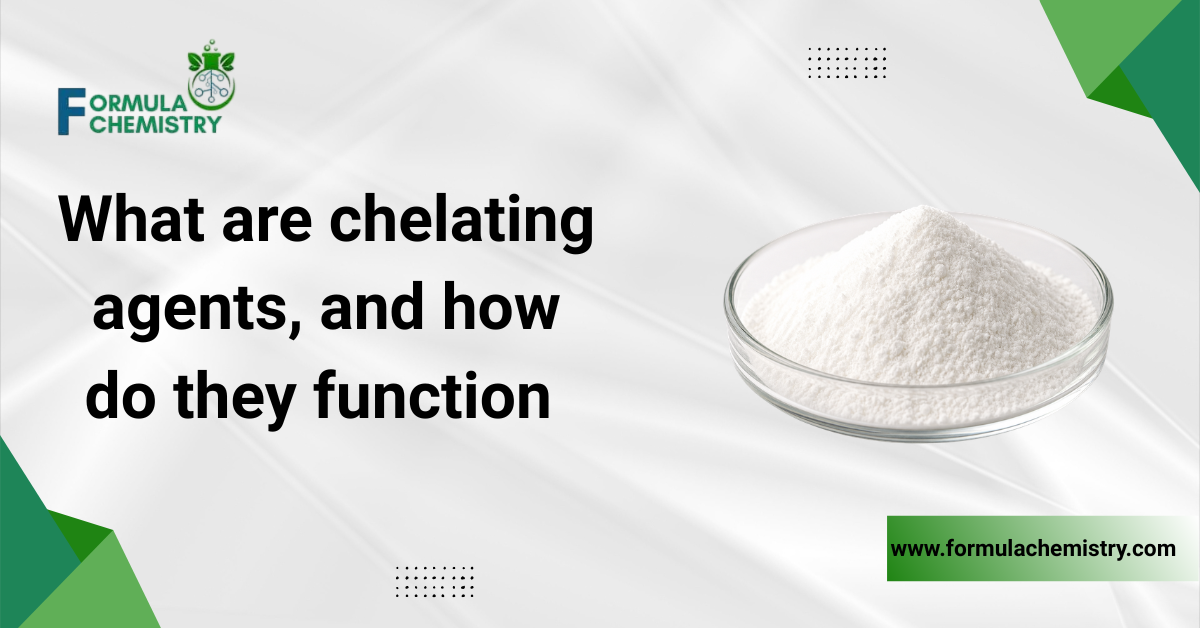
The word chelate comes from the Greek word for claw, which accurately describes how the molecule grips the metal ion from multiple binding sites simultaneously.
In cosmetic formulas, the metal ions of primary concern are calcium, magnesium, iron, copper, and zinc. These enter formulas through tap water used in manufacturing, raw material impurities, and packaging interactions over shelf life.
Their presence does three things that formulators must manage. They catalyse oxidative degradation of actives and colorants. They support bacterial outer membrane stability in gram-negative organisms. They destabilise emulsion systems over time by interacting with ionic emulsifiers and thickeners.
A chelating agent addresses all three simultaneously by removing those ions from the free ionic pool available to react, grow, or destabilise the formula architecture.
How Chelation Supports Preservation
The outer membrane of gram-negative bacteria, including Pseudomonas aeruginosa and Escherichia coli, is stabilised by divalent metal ions, primarily calcium and magnesium, that cross link lipopolysaccharide molecules in the membrane structure.
This membrane functions as a selective barrier that physically excludes many preservative molecules from reaching the bacterial interior.
When a chelating agent sequesters those bridging metal ions, the lipopolysaccharide cross-links break down and the outer membrane loses structural integrity. The result is increased permeability to preservative molecules that would otherwise be excluded or slowed at the membrane surface.
This is why the chelating agent preservative combination consistently outperforms the same preservative used alone in challenge testing against gram-negative organisms.
The preservative has not changed; the bacterial defence mechanism has been chemically disabled before the preservative even arrives at the cell surface.
Gram-positive bacteria do not have an outer lipopolysaccharide membrane and are therefore less affected by chelation.
Chelating agents contribute most measurably to protection against gram-negative contamination, which is also the category of organisms most commonly responsible for cosmetic preservation failures in water-containing formulas.
Tetrasodium EDTA as a Chelating Agent
Tetrasodium EDTA, INCI name Tetrasodium EDTA, CAS number 64-02-8, is the synthetic benchmark chelating agent in cosmetic formulation. It is an aminopolycarboxylic acid that forms stable complexes with a wide range of metal ions including calcium, magnesium, iron, copper, manganese, and zinc.
Its key technical advantages are pH-independent performance across the full cosmetic working range, broad metal ion coverage, and decades of published safety and efficacy data. At usage levels of 0.05% to 0.2% in finished formulas, it delivers consistent chelating contribution without influencing formula pH or texture.
Its regulatory position is well-established. It is permitted under EU Cosmetics Regulation (EC) No 1223/2009 and is widely accepted in international markets.
Biodegradability has been a subject of industry discussion because tetrasodium EDTA is slow to break down in wastewater treatment systems, which has driven demand for naturally derived alternatives among brands with sustainability commitments.
It is compatible with the majority of preservative systems, emulsifiers, and functional ingredients used in cosmetic formulation. No special phase or temperature requirements apply; it can be added to the water phase at any stage of manufacturing.
Phytic Acid as a Natural Chelating Agent Preservative
Phytic Acid, INCI name Phytic Acid, CAS number 83-86-3, is the most technically capable naturally derived chelating agent available for cosmetic preservation systems.
Its six phosphate groups create a high-affinity binding structure for divalent and trivalent metal ions, with particularly strong affinity for iron, copper, zinc, and calcium.
At 0.5% to 1.0% active concentration in finished formulas, its preservation-boosting contribution is functionally relevant. Formulators working on natural or clean-label products who need to reduce or replace tetrasodium EDTA without sacrificing preservation efficacy should consider phytic acid as the primary chelating component.
Its limitations are pH dependency and supply format. It performs most effectively between pH 3.5 and 5.5, and its chelating efficiency drops above pH 6.0. Most commercial supply is a 50% aqueous solution, which means every formula calculation must be adjusted for actual active content rather than raw material percentage.
It also contributes tyrosinase inhibition and mild exfoliation at concentrations above 1.5% in leave-on formulas, making it a genuinely multi-functional addition to brightening and antioxidant preservation systems.
This multi-functionality is an advantage in formula design but must be accounted for when communicating the formula’s active ingredient story.
Gluconolactone and Sodium Gluconate
Gluconolactone, INCI name Gluconolactone, CAS number 90-80-2, is a polyhydroxy acid that functions as a mild chelating agent, humectant, and gentle exfoliant simultaneously. In preservation systems, its chelating contribution is weaker than phytic acid or tetrasodium EDTA but still measurable at concentrations of 1.0% to 3.0%.
Sodium gluconate, INCI name Sodium Gluconate, CAS number 527-07-1, is the sodium salt form with similar chelating behaviour at a more neutral pH range, making it useful in preservation systems for products that cannot tolerate the acidity of gluconolactone or phytic acid.
Both are derived from glucose fermentation and carry favourable biodegradability profiles. They are commonly used in combination with phytic acid in natural preservation systems where a single chelating agent does not deliver adequate metal ion control across the full pH and product type range.
Technical Formulation Data
Ideal pH Range
Tetrasodium EDTA is effective across pH 4.0 to 9.0, covering the full practical range of cosmetic product types including shampoos, conditioners, body washes, and high-pH emulsions.
Phytic acid operates between pH 3.5 and 5.5, limiting it to acidic leave-on and rinse-off formulas. Gluconolactone and sodium gluconate function between pH 3.5 and 6.5, giving more range than phytic acid but less than tetrasodium EDTA.
Solubility and Phase Addition
All options covered in this entry are water-soluble and belong in the water phase. Tetrasodium EDTA can be added during the heated water phase without concern.
Phytic acid should be added during cool-down below 40°C to avoid active concentration loss from prolonged heat exposure. Gluconolactone is heat-stable and can be added at any water-phase stage.
Stability and Shelf Life
Tetrasodium EDTA is chemically stable across all standard cosmetic processing conditions. Phytic acid is stable within its active pH range when heat exposure is controlled during manufacture.
Gluconolactone hydrolyses slowly to gluconic acid in aqueous solution, which is expected behaviour and does not compromise its preservation-boosting function.
Compatibility and Known Incompatibilities
All three are broadly compatible with standard preservative systems including phenoxyethanol, ethylhexylglycerin, sodium benzoate, potassium sorbate, and caprylyl glycol.
Phytic acid is incompatible with calcium-dependent thickeners including calcium alginate and iota carrageenan. Tetrasodium EDTA and gluconolactone do not share this incompatibility.
Typical Usage Levels by Product Type
Tetrasodium EDTA is used at 0.05% to 0.2% across all product types. Phytic acid is used at 0.5% to 1.0% active for preservation boosting in leave-on formulas and up to 3.0% active in rinse-off and scalp products.
Gluconolactone is used at 1.0% to 3.0% in leave-on systems and up to 5.0% in rinse-off formats where its humectant contribution is also desired.
Processing and Manufacturing Notes
Always use deionised or purified water as the manufacturing base regardless of which chelating agent is selected. Chelating agents reduce the impact of residual metal ions but cannot compensate for consistently.
Poor water quality at the manufacturing stage. Document lot-specific active content for phytic acid and adjust calculations per batch.
Common Formulation Mistakes
- Relying on the chelating agent to carry the preservation system independently. No chelating agent passes a standalone challenge test under ISO 11930 or USP 51. A validated primary preservative is always required, and the chelating agent’s role is to enhance its performance.
- Adding phytic acid to the heated water phase during bulk manufacture. Extended heat above 60°C degrades the acid solution and reduces active concentration in the finished batch. Always add it during cool-down below 40°C.
- Failing to adjust phytic acid calculations for the 50% aqueous supply format. A formula listing 1.0% phytic acid using the commercial solution delivers only 0.5% active. Every calculation must reflect actual active content per supplier lot.
- Using tetrasodium EDTA in formulas marketed as EDTA-free or 100% natural. If brand positioning requires EDTA avoidance, the replacement chelating strategy must be confirmed through challenge testing before launch. Phytic acid at an equivalent active level does not always deliver identical metal ion control across all product types.
- Assuming gluconolactone provides equivalent chelating strength to tetrasodium EDTA at the same percentage. Its chelating affinity is weaker. Formulators switching from tetrasodium EDTA to gluconolactone need to increase concentration and verify preservation efficacy through testing rather than assuming parity.
- Formulating phytic acid above pH 5.5 in systems where it is the sole chelating agent. Above this threshold, chelating efficiency drops measurably. Either add sodium gluconate as a complementary chelating agent or switch to tetrasodium EDTA for products in the pH 6.0 to 7.5 range.
- Omitting chelating support from water-containing formulas entirely. Many formulators treat chelating agents as optional. In any formula containing water from formula chemistry, gram-negative bacteria, and a preservative system, the absence of a chelating agent is a measurable gap in the preservation architecture.
Suitability and Safety Guidance
Tetrasodium EDTA is suitable for all product types and all skin types at standard usage levels. It has a long regulatory history and is one of the most thoroughly evaluated cosmetic ingredients in the chelating category.
Phytic acid is suitable across all skin types at cosmetic concentrations and is particularly appropriate for sensitive skin formulas at pH 4.5 and above. Its multi-functionality makes it a strong choice for brightening, antioxidant, and natural preservation-supported formulas where a single ingredient can serve multiple roles.
Gluconolactone and sodium gluconate are gentle, well-tolerated, and appropriate for sensitive skin and baby product formulations where the mildest possible preservation system is required.
From a regulatory standpoint, all ingredients covered here are permitted under EU Cosmetics Regulation (EC) No 1223/2009 at cosmetic usage levels.
This is factual reference information only and does not constitute legal or regulatory advice. Formulators must verify current regulatory status in their specific markets before production. Always conduct a 48-hour patch test with any new formula before wider use.
Related Ingredients
Sodium Phytate: The sodium salt form of phytic acid with equivalent chelating function at a more neutral pH, suitable for preservation systems in formulas where the acid form would reduce pH below the target range.
Disodium EDTA: A dicarboxylate form of EDTA with slightly lower chelating capacity than tetrasodium EDTA, commonly used in rinse-off formulas and cleansing systems where full tetrasodium EDTA activity is not required.
Ferulic Acid: A plant-derived antioxidant that complements chelating agents in preservation systems by neutralising free radical activity that chelation alone does not address, particularly relevant in formulas containing kojic acid or ascorbic acid derivatives.
FAQs About Chelating Agent Preservative
What are chelating agents as preservatives?
Chelating agents are not preservatives in the standalone sense. They are preservation system boosters that sequester free metal ions in the formula, disabling the outer membrane defence mechanism of gram-negative bacteria.
And making the primary preservative more effective at lower concentrations. Every water-containing cosmetic formula benefits from a chelating agent as part of its complete preservation architecture.
Is EDTA safe as a preservative?
Tetrasodium EDTA has an extensively documented safety profile and is permitted under EU Cosmetics Regulation and accepted in most international markets at standard cosmetic usage levels of 0.05% to 0.2%.
It functions as a preservation booster rather than a primary preservative. Environmental persistence in wastewater systems has driven some brands toward naturally derived alternatives, but its safety record in finished cosmetic products is well-established.
What is a chelating agent with example?
A chelating agent is a molecule that binds metal ions through multiple coordinate bonds, forming a stable complex that removes those ions from the free reactive pool in a formula. Tetrasodium EDTA is the most widely used synthetic example.
Phytic acid is the most technically capable naturally derived example. Sodium gluconate and gluconolactone are milder naturally derived options used in sensitive and natural formulation systems.
What are the ingredients in chelating agents?
Chelating agents used in cosmetics are individual compounds rather than multi-ingredient mixtures. Tetrasodium EDTA is an aminopolycarboxylic acid. Phytic acid is inositol hexakisphosphate, a phosphoric acid derivative extracted from plant seeds including rice bran and corn.
Gluconolactone is a polyhydroxy acid derived from glucose fermentation. Each works through the same principle of multi-point metal ion binding but differs in affinity, pH range, and breadth of metal ion coverage.
What is the best natural chelating agent?
For cosmetic preservation systems, phytic acid delivers the strongest chelating performance among naturally derived options due to its six phosphate groups and high affinity for divalent and trivalent metal ions.
For formulas requiring a broader pH working range or milder activity, sodium gluconate or gluconolactone are appropriate alternatives. The best choice depends on the product’s pH, preservation system, and regulatory positioning rather than on a universal ranking.
Is vinegar a chelating agent?
Acetic acid, the active component of vinegar, has very weak chelating activity compared to purpose-built chelating agents. It can interact with some metal ions but does not form the stable multi-coordinate complexes that define effective chelation.
It is not suitable as a chelating agent in cosmetic preservation systems and should not be substituted for tetrasodium EDTA, phytic acid, or gluconolactone in any formula where preservation efficacy matters.
What are common chelating agents?
The most common chelating agents in cosmetic formulation are tetrasodium EDTA, disodium EDTA, phytic acid, sodium phytate, gluconolactone, sodium gluconate, and citric acid. Citric acid has mild chelating activity and is frequently present in formulas primarily for pH adjustment, where its chelating contribution is incidental rather than intentional.
For deliberate chelating function, tetrasodium EDTA and phytic acid are the most widely specified options across professional formulation practice.
Is apple cider vinegar a chelator?
Apple cider vinegar contains acetic acid, malic acid, and trace organic acids, none of which function as effective chelating agents at the concentrations present in the liquid. Malic acid has minimal metal-binding activity.
Neither acetic acid nor malic acid forms the stable multi-coordinate metal complexes required for meaningful chelation in a cosmetic preservation system. Apple cider vinegar is not a functional substitute for any chelating agent covered in this entry.
What chemicals react with vinegar?
This question falls outside the scope of cosmetic formulation chemistry covered in this encyclopedia. Within cosmetic relevance, acetic acid in vinegar reacts with carbonate and bicarbonate compounds producing carbon dioxide, interacts with alkaline pH adjusters, and can affect ionic emulsifier systems.
None of these reactions constitute chelation. Formulators incorporating acetic acid or vinegar in cosmetic formulas should evaluate its contribution to pH management rather than preservation support.
Summary for Formulators
- Chelating agents boost preservation efficacy by disabling the gram-negative bacterial outer membrane, making primary preservatives more effective without increasing their concentration in the finished formula.
- Tetrasodium EDTA is the most reliable and pH-flexible synthetic option, suitable for all product types from acidic serums to alkaline rinse-off systems at 0.05% to 0.2%.
- Phytic acid is the strongest naturally derived chelating agent for cosmetic preservation, performing best between pH 3.5 and 5.5, supplied as a 50% aqueous solution that requires active-content-adjusted calculations at every batch.
- Gluconolactone and sodium gluconate are milder naturally derived alternatives appropriate for sensitive skin, baby, and natural product formulations where phytic acid’s acidity or potency exceeds the formula’s requirements.
- No chelating agent replaces a validated primary preservative system. Challenge testing under ISO 11930 or USP 51 is required for every finished formula regardless of how well the chelating strategy is designed.
- The absence of any chelating agent in a water-containing formula is a measurable gap in preservation architecture, not a neutral formulation decision.
Start by adding 0.1% tetrasodium EDTA or 1.0% active phytic acid to your next water-containing formula alongside your existing preservative system, then run a comparative challenge test against the same formula without chelating support to observe the measurable difference in gram-negative organism control directly.