
Introduction to humectants
Every formulator has reached for glycerin without thinking twice. It works, it is affordable, and it is widely available. But humectants for skin cover a much wider chemical territory than glycerin alone, and choosing the wrong one for your formula or your target skin type produces results that feel sticky, tight, or simply ineffective.
At Formula Chemistry, we cover the full picture. This article breaks down the chemistry, formulation behaviour, and honest comparisons of the most used skin humectants in professional skincare formulation today.
What Humectants for Skin Are Chemistry and Origin
Natural and synthetic humectants for skin are hygroscopic ingredients that attract and bind water molecules through hydrogen bonding.
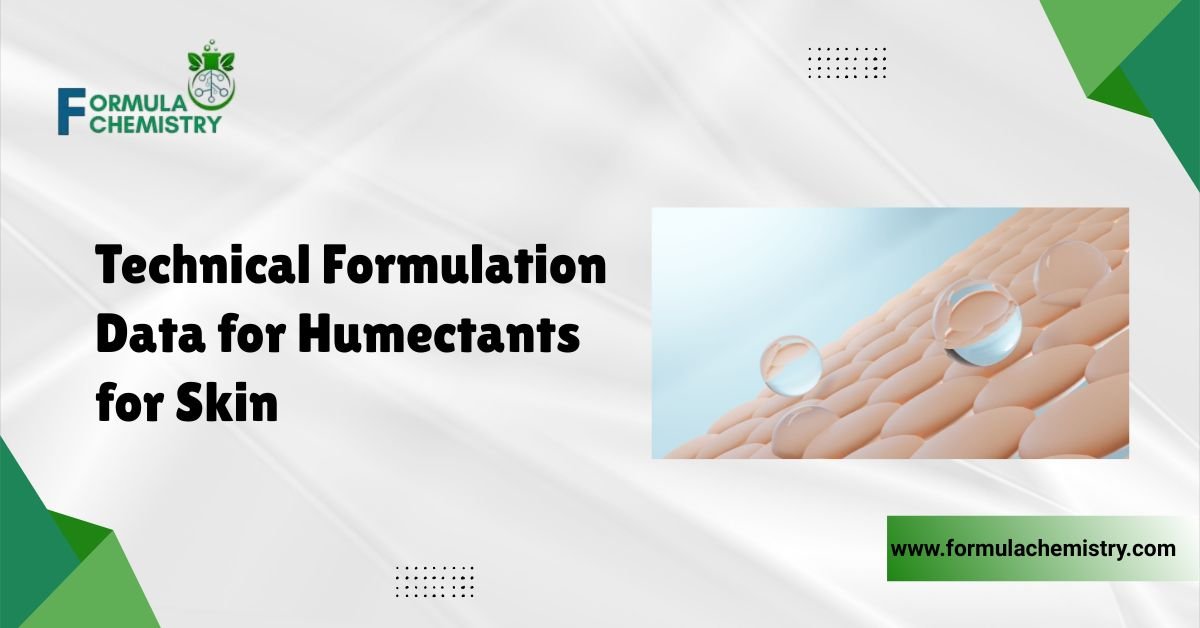
In a skincare formula, they draw moisture from the deeper layers of the skin and, in humid environments, from the surrounding air into the upper layers of the stratum corneum.
They belong to several distinct chemical classes. The most formulation-relevant are polyols, amino acid derivatives, saccharides, and protein hydrolysates.
Polyol Humectants for Skin
Glycerin (INCI: Glycerin) is the most widely used humectant in cosmetic formulation worldwide. It is a trihydric alcohol derived from plant oils through saponification or fermentation, and its three hydroxyl groups give it an exceptionally strong capacity to bind water.
It is water-soluble, colourless, and compatible with nearly every ingredient class used in skincare. Standard usage levels range from 2 to 10% in leave-on products, with higher concentrations producing noticeable tackiness on the skin surface.
Propanediol (INCI: Propanediol) is a 1,3-propanediol derived from corn sugar fermentation. It functions as a humectant for skin and also improves formula skin feel by reducing the stickiness associated with glycerin at equivalent concentrations.
Butylene Glycol (INCI: Butylene Glycol) is a synthetic diol that acts as a humectant, solvent, and mild preservative booster. It is less hygroscopic than glycerin but contributes a lighter, less tacky skin feel and is commonly used in Asian-inspired skincare formulations.
Amino Acid-Derived Humectants for Skin
Betaine (INCI: Betaine) is a naturally occurring amino acid derivative sourced from sugar beet molasses. It functions as an osmoprotectant in plants and delivers the same protective water-binding behaviour when used as a humectant for skin.
It is particularly valued for supporting skin comfort in formulas with lower pH or higher active ingredient loads. Usage levels typically range from 0.5 to 3%, and it blends well with glycerin and hyaluronic acid in the water phase.
Sodium PCA (INCI: Sodium PCA) is the sodium salt of pyrrolidone carboxylic acid, a natural component of the skin’s own Natural Moisturising Factor. Its water-binding affinity is higher than glycerin on a weight-for-weight basis, making it a highly effective skin humectant at low concentrations of 1 to 3%.
Saccharide-Based Humectants for Skin
Hyaluronic Acid (INCI: Sodium Hyaluronate) is a glycosaminoglycan composed of repeating disaccharide units of glucuronic acid and N-acetylglucosamine. In its sodium salt form, it is water-soluble and forms a film on the skin surface that holds significant amounts of water.
Molecular weight determines its depth of action. High molecular weight grades above 1,000 kDa remain on the surface and provide an immediate plumping appearance.
Low molecular weight grades below 50 kDa penetrate more readily into the upper epidermis and may support longer-lasting hydration feel.
Trehalose (INCI: Trehalose) is a disaccharide produced by fermentation that functions as a humectant for skin and as a stabiliser for proteins and lipids in the upper skin layers. It is used in formulas targeting dehydrated and environmentally stressed skin at 0.5 to 2%.
How Humectants for Skin Function in Cosmetic Formulas
Humectants for skin do not work in isolation. Their effectiveness in a finished formula depends significantly on the occlusive and emollient components surrounding them, which determine how much attracted moisture is retained at the skin surface.
In low-humidity environments, humectants without occlusive support can draw water upward from the deeper dermis without retaining it, which may leave skin feeling more dehydrated over time. Pairing humectants with film-forming or occlusive ingredients is standard professional practice.
Water-Binding Capacity of Skin Humectants
All humectants for skin bind water through hydrogen bonding between their polar functional groups and water molecules. The number and accessibility of those polar groups determines the water-binding capacity of each ingredient.
Hyaluronic acid can hold up to 1,000 times its weight in water under ideal laboratory conditions, though real-world performance in finished formulas is considerably more moderate. Glycerin and Sodium PCA are more predictable performers across varied climate conditions.
How Skin Humectants Support the Moisture Barrier
Several humectants, particularly Betaine and Sodium PCA, mimic components naturally present in healthy skin. These ingredients may help support the skin’s osmotic balance, contributing to a more comfortable feel in formulas designed for sensitive or compromised skin types.
Trehalose provides an additional layer of stabilisation for proteins and lipids in the upper skin layers, which is relevant in formulas targeting barrier-supporting cosmetic claims.
Technical Formulation Data for Humectants for Skin
Understanding the precise technical behaviour of each humectant for skin is what separates a formula that performs from one that simply sounds good on paper. At Formula Chemistry, the details below reflect real bench experience with these ingredients across product types.
Ideal pH Range for Skin Humectants
Glycerin, Propanediol, and Butylene Glycol are stable across virtually the entire cosmetic pH range of 3 to 10 and require no special pH management. Sodium Hyaluronate is stable between pH 5 and 8, with degradation accelerating below pH 4.
Sodium PCA is stable between pH 4 and 7 and may discolour at higher pH values over time. Betaine is pH-tolerant across a wide range of 3 to 9, making it particularly useful in formulas containing AHAs or other low-pH actives.
Solubility and Phase Addition of Humectants for Skin
All humectants covered here are water-soluble and belong in the water phase. Glycerin, Propanediol, and Butylene Glycol dissolve readily in cold or warm water without special handling.
Sodium Hyaluronate requires slow, careful dispersion to prevent clumping. The most reliable method is to pre-mix it with glycerin at a ratio of approximately 1:10 before adding the blend to the bulk water phase under moderate stirring.
Stability and Shelf Life of Skin Humectant Systems
Polyol humectants are among the most stable ingredient categories in cosmetic formulation. Glycerin, Propanediol, and Butylene Glycol show no meaningful degradation over standard product shelf lives of 12 to 24 months under normal storage conditions.
Sodium Hyaluronate is more sensitive to heat and prolonged elevated temperatures. Formulas containing it should incorporate it at cool-down phase temperatures below 40°C to preserve molecular integrity and performance.
Compatibility of Humectants for Skin with Other Ingredients
Humectants for skin are broadly compatible with most cosmetic ingredient categories, including surfactants, emulsifiers, film formers, and most actives. High concentrations of glycerin above 15% can interact with some gelling agents and reduce their thickening efficiency.
Sodium Hyaluronate is incompatible with high concentrations of cationic polymers, which can cause precipitation or viscosity collapse. Always test compatibility with quaternary ammonium compounds and cationic conditioning agents before finalising a formula.
Typical Usage Levels of Skin Humectants by Product Type
- Glycerin: 2 to 10% in leave-on products, 0.5 to 3% in rinse-off products
- Propanediol: 2 to 8% in serums and lotions
- Butylene Glycol: 1 to 6% in leave-on and rinse-off formulas
- Sodium Hyaluronate: 0.1 to 2% depending on molecular weight grade
- Sodium PCA: 1 to 3% in leave-on hydrating formulas
- Betaine: 0.5 to 3% in leave-on products with active ingredients
- Trehalose: 0.5 to 2% in targeted hydration and barrier-support formulas
Processing Notes for Humectants for Skin
All polyol humectants can be added to the water phase at room temperature or during heating without special handling requirements. Sodium Hyaluronate must never be added to hot water above 60°C, as heat accelerates hydrolytic degradation of the polysaccharide chain.
In large-scale manufacturing, humectants are typically pre-weighed into the water phase vessel before heating begins. This ensures even distribution before other water-phase ingredients are incorporated.
Common Formulation Mistakes with Humectants for Skin
- Using glycerin above 10% without an occlusive. High concentrations without a complementary film former or emollient create surface tackiness and may draw moisture out of the skin in dry climates. Balance with at least a light occlusive ingredient.
- Adding Sodium Hyaluronate powder directly to water. It clumps immediately on contact with water. Always pre-disperse it in glycerin before adding to the water phase.
- Relying on a single molecular weight of hyaluronic acid. One grade addresses only one depth of hydration. Combining high and low molecular weight grades delivers both surface plumping and deeper hydration feel.
- Exceeding recommended usage levels of Butylene Glycol. Above 8%, Butylene Glycol may cause irritation in sensitive skin types. Stay within the tested range and conduct stability checks at your chosen concentration.
- Neglecting the humectant-occlusive balance in formula architecture. A formula with strong humectant activity but no occlusive component loses effectiveness in low-humidity conditions. Every professional hydration formula needs both elements.
- Substituting one skin humectant for another at identical percentages. Sodium PCA and glycerin are not interchangeable at the same usage level. Each has a different hygroscopicity and skin feel profile that must be accounted for in the formula.
- Adding humectants to the oil phase. All humectants covered here are water-phase ingredients. Adding them to the oil phase creates dispersion problems and reduces their functional effectiveness in the finished product.
Suitability and Safety Guidance for Humectants for Skin
Glycerin and Betaine are suitable for all skin types including sensitive, reactive, and baby skin, and carry an excellent safety profile across decades of use.
Butylene Glycol requires cautionary use in very sensitive skin formulas at higher concentrations, though it is well tolerated by most skin types within recommended ranges.
Sodium Hyaluronate is suitable for all skin types and is particularly effective in formulas targeting dehydrated, mature, and post-procedure skin. Sodium PCA is also broadly suitable but should be used within recommended concentrations in formulas for compromised skin barriers.
From a regulatory standpoint, all humectants covered here are approved under EU Cosmetics Regulation No. 1223/2009. Glycerin, Propanediol, and Betaine are also approved under COSMOS and NaTrue natural and organic certification standards when derived from appropriate natural sources.
Always conduct a 48-hour patch test with any new formula before wider use.
Ingredients Related to Humectants for Skin
Panthenol (INCI: Panthenol) is a provitamin B5 derivative that functions as both a humectant for skin and a skin-conditioning agent, commonly used alongside glycerin in hydrating formulas at 0.5 to 2%.
Allantoin (INCI: Allantoin) is a skin-conditioning ingredient often paired with humectants in formulas targeting dry or sensitised skin, where it may help support a smoother skin surface feel at 0.1 to 0.5%.
Carbomer (INCI: Carbomer) is a rheology modifier frequently used in humectant-rich gel formulas to build viscosity and improve the suspension of actives without contributing its own humectant function.
Frequently Asked Questions About Humectants for Skin
What is the best humectant for skin?
Glycerin remains the most reliable all-around humectant for skin due to its broad compatibility, proven stability, and consistent performance across skin types. For more targeted results, combining glycerin with Sodium Hyaluronate at complementary molecular weights gives better overall hydration depth.
What are natural humectants for skin?
Naturally derived humectants for skin include Glycerin from vegetable sources, Betaine from sugar beet, Sodium PCA from fermentation, Trehalose from microbial fermentation, and Sodium Hyaluronate produced through bacterial fermentation of Streptococcus equi.
Is Vaseline a humectant?
Vaseline, which is petrolatum, is not a humectant. It is an occlusive ingredient that forms a physical barrier on the skin surface to prevent transepidermal water loss. It does not attract or bind water molecules the way a humectant does.
What is the most common humectant?
Glycerin is the most commonly used humectant in cosmetic formulation globally. It appears in the majority of leave-on and rinse-off skincare products because of its effectiveness, low cost, broad compatibility, and excellent regulatory and safety profile.
Which oils are humectants?
Oils are not humectants. Oils are emollients or occlusives that smooth the skin surface or reduce moisture loss, but they do not attract or bind water molecules. The humectant function requires a polar, water-soluble molecular structure that oils do not possess.
What is an example of a humectant moisturizer?
A hyaluronic acid serum is the clearest example of a humectant-forward moisturizer in professional skincare. It typically contains Sodium Hyaluronate at multiple molecular weights in a water or gel base, often alongside glycerin and Panthenol, with no significant occlusive component.
Which oil can replace moisturizer?
No oil can replace a moisturizer formulated with humectants for skin. Oils address surface smoothness and transepidermal water loss through occlusion, but they cannot actively attract moisture into the skin the way a properly formulated humectant system does.
What is the 3 minute moisturizer rule?
The 3 minute rule refers to the practice of applying a humectant-containing moisturizer within 3 minutes of cleansing or bathing while the skin surface is still slightly damp. The idea is that humectants can bind the residual water present on the skin surface before it evaporates, improving immediate hydration feel.
Summary for Formulators Working with Humectants for Skin
- Humectants for skin work best when paired with an occlusive or film-forming ingredient. Without that pairing, moisture attracted to the surface can evaporate before it benefits the skin.
- Glycerin is your baseline humectant in almost every formula. Build from there by adding complementary humectants that address specific skin feel or depth-of-hydration goals.
- Sodium Hyaluronate should always be pre-dispersed in glycerin before water phase addition. Skipping this step creates clumping that is difficult to reverse without reprocessing.
- Combining high and low molecular weight Sodium Hyaluronate grades in the same formula gives you surface film formation and deeper hydration feel simultaneously.
- Betaine and Sodium PCA are underused in professional formulation relative to their performance. Both offer skin-identical humectancy with excellent compatibility across active-heavy formulas.
- Natural certification of humectants depends entirely on the source and production method of each grade. Always verify COSMOS or NaTrue status directly with your raw material supplier before making certification claims.
Your immediate next step is to calculate your total humectant load across all water-phase ingredients and check that it falls within 5 to 15% for most leave-on formulas. That single check will prevent the two most common humectant failures: insufficient hydration and surface tackiness.